2025 Ohio City Population Estimates

2025 Ohio city population estimates

The US Census has released 2025 city population estimates. Let’s look at at how both national and Ohio cities have changed.

Keep in mind, as always, that these are just estimates and are subject to much wider swings and errors compared to decennial census data.

First up, here is Ohio’s data.

Top 30 Largest Ohio Cities on July 1, 2025
1. Columbus: 938,396
2. Cleveland: 363,608
3. Cincinnati: 314,367
4. Toledo: 263,423
5. Akron: 189,691
6. Dayton: 136,688
7. Parma: 78,581
8. Canton: 69,001
9. Lorain: 65,366
10. Hamilton: 64,644
11. Youngstown: 58,832
12. Springfield: 58,281
13. Kettering: 57,396
14. Elyria: 53,634
15. Middletown: 52,146
16. Newark: 51,473
17. Cuyahoga Falls: 50,975
18. Dublin: 49,094
19. Lakewood: 49,027
20. Beavercreek: 48,134
21. Euclid: 47,962
22. Mansfield: 47,381
23. Mentor: 47,010
24. Delaware: 46,636
25. Strongsville: 45,629
26. Grove City: 45,180
27. Fairfield: 44,682
28. Huber Heights: 43,905
29. Cleveland Heights: 43,750
30. Reynoldsburg: 43,350

Top 15 Largest Increases July 1, 2024 to July 1, 2025
1. Columbus: +7,696
2. Grove City: +1,294
3. Delaware: +1,177
4. Powell: +1,083
5. West Jefferson: +925
6. Fairborn: +757
7. Marysville: +720
8. Reynoldsburg: +577
9. Hamilton: +506
10. Sunbury: +495
11. Bowling Green: +482
12. Gahanna: +481
13. Pickerington: +470
14. Dayton: +464
15. Xenia: +420

Top 15 Largest Decreases July 1, 2024 to July 1, 2025
1. Toledo: -962
2. Cincinnati: -488
3. Springfield: -334
4. Bexley: -320
5. Sidney: -297
6. Warren: -245
7. Parma: -220
8. Lakewood: -218
9. Westerville: -206
10. Mansfield: -200
11. Portsmouth: -171
12. Upper Arlington: -166
13. Dublin: -165
14. Sandusky: -165
15. Ada: -158

It is highly unlikely that any of the Columbus suburbs listed as losing population actually did, especially when all of them were seeing decent growth over the previous decade. It would make little sense that Columbus is growing strongly, but it’s inner suburbs, especially ones with high quality of housing and conditions, would be losing population. We’ll have to wait several more years to get a thorough count, though.

Total Change for All Columbus Metro Area Places Census 2020-July 1, 2025
1. Columbus: 938,396 +32,181
2. Newark: 51,473 +1,512
3. Dublin: 49,094 -218
4. Delaware: 46,636 +5,339
5. Grove City: 45,180 +3,924
6. Reynoldsburg: 43,350 +2,276
7. Lancaster: 41,956 +1,413
8. Hilliard: 38,898 +1,738
9. Westerville: 38,165 -1,024
10. Gahanna: 35,986 +259
11. Upper Arlington: 35,893 -886
12. Marysville: 30,190 +4,573
13. Pickerington: 26,333 +3,263
14. Whitehall: 19,805 -323
15. Pataskala: 18,529 +647
16. Powell: 18,269 +4,012
17. Circleville: 14,634 +709
18. Worthington: 14,543 -236
19. Bexley: 12,452 -1,473
20. New Albany: 11,803 +641
21. Heath: 10,859 +408
22. London: 10,813 +546
23. Canal Winchester: 10,058 +936
24. Grandview Heights: 9,112 +1,025
25. Sunbury: 8,857 +2,259
26. Obetz: 7,342 +1,860
27. Logan: 7,164 -138
28. Granville: 6,252 +302
29. West Jefferson: 5,827 +1,684
30. Groveport: 5,818 -190
31. Johnstown: 5,476 +266
32. Ashville: 4,819 +287
33. New Lexington: 4,465 +40
34. Plain City: 4,322 +209
35. South Bloomfield: 4,164 +2,019
36. Commercial Point: 3,271 +183
37. Baltimore: 3,110 +74
38. Lithopolis: 2,969 +818
39. Richwood: 2,640 +421
40. Buckeye Lake: 2,590 +67
41. Hebron: 2,405 +82
42. Crooksville: 2,404 -17
43. Cardington: 2,247 +165
44. Utica: 2,138 +71
45. Mount Sterling: 2,051 +108
46. Minerva Park: 1,950 -62
47. Roseville: 1,751 +3
48. Somerset: 1,482 +1
49. Hanover: 1,397 +129
50. Ashley: 1,343 +143
51. Ostrander: 1,219 +125
52. Thornville: 1,111 +11
53. Williamsport: 1,027 +54
54. Galena: 1,019 +92
55. Millersport: 1,008 +31
56. Urbancrest: 1,003 -32
57. Pleasantville: 964 +22
58. Milford Center: 959 +153
59. Shawnee Hills: 931 +94
60. New Holland: 833 +36
61. Junction City: 722 +1
62. Amanda: 680 +15
63. Marble Cliff: 658 +20
64. New Straitsville: 647 -6
65. Valleyview: 640 -19
66. Thurston: 616 +9
67. Stoutsville: 582 +4
68. Riverlea: 578 -19
69. Buchtel: 508 -8
70. Carroll: 504 +3
71. Shawnee: 504 -1
72. Laurelville: 503 -17
73. Alexandria: 501 +15
74. Kirkersville: 486 +15
75. Corning: 485 -4
76. Edison: 449 +28
77. Hartford: 413 +4
78. Sugar Grove: 413 +4
79. St. Louisville: 359 +15
80. Murray City: 343 -9
81. South Solon: 327 +0
82. Magnetic Springs: 316 +50
83. Harrisburg: 313 -1
84. Rushville: 307 +2
85. Marengo: 285 +5
86. Midway: 270 +0
87. Tarlton: 269 +15
89. Fulton: 254 +7
90. Unionville Center: 235 -13
91. Lockbourne: 228 -9
92. Gratiot: 217 +3
93. Chesterville: 208 +11
94. Darbyville: 189 +4
95. Glenford: 170 -2
96. West Rushville: 165 +0
97. Hemlock: 148 +0
98. Sparta: 127 +2
99. Brice: 110 +16

There used to be 101 places, but 2- Orient and Rendville- have lost incorporated status since 2020.
What is interesting about the estimates is that many very small villages and towns are estimated to have seen relatively strong growth while some major suburbs shows significant declines. Again, that is unlikely, as there would be little logical reason for rural places with few jobs or infrastructure to be seeing steady growth. What is most likely occurring is that the Ohio population change total for the period is being distributed in a way that favors smaller, rural places regardless of their condition or long-term population trends.
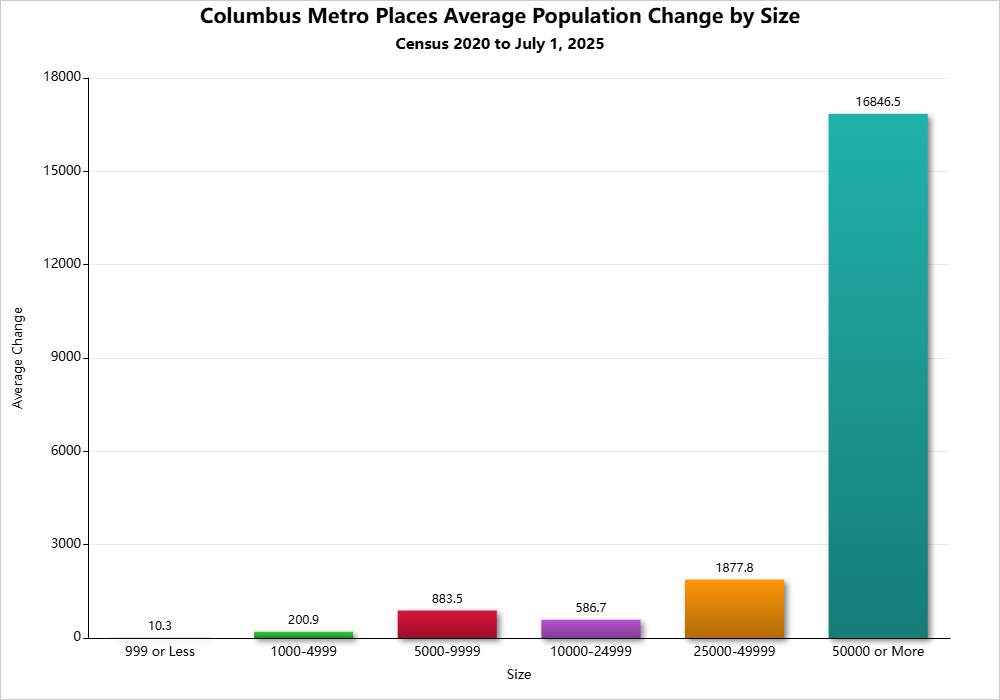
2025 Ohio city population estimates population change by size


2024 County and Metro Population Estimates

Percent Change in County Populations[Source: U.S. Census Bureau]

The US Census has released 2024 county and metro population estimates. The estimates generally show a further continuation of the post-pandemic recovery in the numbers. In fact, older estimates have also been revised upwards. Let’s break down the numbers.

Metro County

2020 Census

2023 Population

2024 Population

Delaware

214,123

232,732

237,966

Fairfield

158,920

165,630

167,762

Franklin

1,323,819

1,338,903

1,356,303

Hocking

28,056

27,567

27,429

Licking

178,517

183,540

184,898

Madison

43,848

44,668

45,531

Morrow

34,944

35,583

35,927

Perry

35,412

35,577

35,682

Pickaway

58,551

61,064

62,158

Union

62,790

69,765

71,721

As you can see, all counties but Hocking grew in both the 2020-2024 and 2023-2024 periods. Most of the estimates were improvements over the 2023 version, as mentioned. For example, Franklin County’s estimates population in 2023 was 1,326,063, but the 2024 version for 2023 was revised to 1,338,903, indicating growth was significantly stronger than originally estimated.

2024 metro population estimates county population

Franklin County continued its very long run of being the top county in the metro for total growth.

2024 metro population estimates county percent change

2024 metro population estimates population change

2024 metro population estimates county population percent change

Here were the top 25 largest Ohio counties in 2024.
1. Franklin: 1,356,303
2. Cuyahoga: 1,240,594
3. Hamilton: 837,859
4. Summit: 538,370
5. Montgomery: 537,443
6. Lucas: 426,291
7. Butler: 399,542
8. Stark: 374,091
9. Lorain: 322,030
10. Warren: 256,059
11. Delaware: 237,966
12. Lake: 232,360
13. Mahoning: 225,786
14. Clermont: 214,123
15. Trumbull: 200,300
16. Licking: 184,898
17. Medina: 184,625
18. Greene: 172,347
19. Fairfield: 167,762
20. Portage: 163,839
21. Clark: 134,985
22. Wood: 133,077
23. Richland: 124,853
24. Wayne: 116,632
25. Miami: 111,950

Metro Area

2020

2024

Change

Akron

702,211

702,209

-2

Canton

401,594

400,551

-1,043

Cincinnati

2,249,812

2,302,815

53,003

Cleveland

2,185,745

2,171,877

-13,868

Columbus

2,138,980

2,225,377

86,397

Dayton

814,040

821,740

7,700

Toledo

606,234

601,396

-4,838

Youngstown

430,675

426,086

-4,589

Franklin County Gentrification Trends 1990-2015


I saw this postthe other day about changing neighborhood demographics in certain cities, particularly when it comes to racial segregation and gentrification. Surprisingly, of all the maps and posts I’ve done on demographics, I hadn’t thought to do one that showed Franklin County gentrification trends. Well, now I have.

Franklin County gentrification trends
A bit of an explanation is needed for the color coding:
-For those categories marked “Steady”, the demographic listed has been the majority throughout the period, with little to no change of other demographics.
-For those mixed categories of one decline and one rise, it means that the majority demographic has declined at least 5 percentage points, while a secondary demographic has risen at least 5 percentage points.
-For the category of recent or steady integration, there are at least 2 demographics at 10% or more of the total population, as well as a 3rd demographic reaching at least 5% of the population.

A few things that stand out to me: The eastern half of the county is in much greater flux than the western half, and integration is respectable county-wide. These neighborhoods of demographic equilibrium are largely the result of increasing Hispanic and Asian populations, particularly on the Northeast and West Sides, as well as the Whitehall area. In the center core, almost all of the High Street corridor has remained Steady White, suggesting that other demographics have, so far, been unable to tap into the building boom along and adjacent to this corridor. One other thing I notice is that there are FAR more tracts with a growing black population than there are with a growing White population, suggesting that perhaps the idea of Whites moving into neighborhoods and displacing residents is not quite as big of an issue as some might believe.

Here are the integrated tracts by year, based the above criteria, and their racial breakdown.

Top 10 Tracts with the Highest White Population
1990

1. 7205: 99.6%
2. 98: 99.1%
3. 7207: 98.9%
4. 120, 9240: 98.8%
5. 7201, 7203, 80: 98.7%
6. 7922, 9440, 9752: 98.6%
7. 9751, 10601: 98.5%
8. 110, 8141, 8821, 9711, 9740: 98.4%
9. 9450, 9800: 98.3%
10. 6230, 7210: 98.2%
2015
1. 65: 98.7%
2. 6810: 97.4%
3. 6822, 9712: 97.0%
4. 98: 96.0%
5. 6721, 6950: 95.9%
6. 220: 95.8%
7. 9497: 95.6%
8. 66: 95.5%
9. 6330: 94.8%
10. 7394: 94.7%

Breakdown of # of Tracts by % of White Population
1990

95% or Higher: 80
90%-94.9%: 73
80%-89.9%: 64
70%-79.9%: 10
60%-69.9%: 11
50%-59.9%: 6
Total Majority White Tracts: 244
40%-49.9%: 7
30%-39.9%: 9
20%-29.9%: 5
10%-19.9%: 9
0.1%-9.9%: 9
0%: 0
Total Minority White Tracts: 39
2015
95% or Higher: 11
90%-94.9%: 35
80%-89.9%: 62
70%-79.9%: 52
60%-69.9%: 30
50%-59.9%: 19
Total Majority White Tracts: 209
40%-49.9%: 11
30%-39.9%: 17
20%-29.9%: 25
10%-19.9%: 15
0.1%-9.9%: 6
0%: 0
Total Minority White Tracts: 74

Top 10 Tracts with the Highest Black Population
1990

1. 730: 94.2%
2. 5420: 93.4%
3. 15, 28: 92.3%
4. 36: 91.8%
5. 5410: 91.4%
6. 7551: 91.1%
7. 7512: 90.9%
8. 23: 89.0%
9. 2520: 87.4%
10. 29: 87.2%
2015
1. 7512: 88.1%
2. 9337: 87.7%
3. 730: 84.9%
4. 7511: 83.6%
5. 23: 82.2%
6. 15: 81.9%
7. 55: 81.4%
8. 5420, 9332: 81.0%
9. 29: 80.9%
10. 8813: 79.1%

Breakdown of # of Tracts by % of Black Population
1990

95% or Higher: 0
90%-94.9%: 7
80%-89.9%: 10
70%-79.9%: 4
60%-69.9%: 8
50%-59.9%: 6
Total Majority Black Tracts: 35
40%-49.9%: 7
30%-39.9%: 10
20%-29.9%: 9
10%-19.9%: 32
0.1%-9.9%: 190
0%: 0
Total Minority Black Tracts: 248
2015
95% or Higher: 0
90%-94.9%: 0
80%-89.9%: 9
70%-79.9%: 8
60%-69.9%: 28
50%-59.9%: 9
Total Majority Black Tracts: 52
40%-49.9%: 20
30%-39.9%: 17
20%-29.9%: 24
10%-19.9%: 44
0.1%-9.9%: 126
0%: 0
Total Minority Black Tracts: 231

Top 10 Tracts with the Highest Asian Population
1990

1. 7820: 23.3%
2. 1122: 11.2%
3. 1110: 10.8%
4. 105: 9.0%
5. 1810: 8.2%
6. 6372: 7.6%
7. 6384: 7.3%
8. 1121: 7.2%
9. 6386: 6.9%
10. 6395: 6.8%
2015
1. 7820: 34.1%
2. 7721: 26.8%
3. 6230: 26.7%
4. 1122: 21.9%
5. 7830: 17.0%
6. 1110: 16.6%
7. 105: 16.2%
8. 6395: 15.5%
9. 6372: 15.3%
10. 6386: 14.9%

Breakdown of # of Tracts by % of Asian Population
1990

95% or Higher: 0
90%-94.9%: 0
80%-89.9%: 0
70%-79.9%: 0
60%-69.9%: 0
50%-59.9%: 0
Total Majority Asian Tracts: 0
40%-49.9%: 0
30%-39.9%: 0
20%-29.9%: 1
10%-19.9%: 2
0.1%-9.9%: 273
0%: 7
Total Minority Asian Tracts: 283
2015
95% or Higher: 0
90%-94.9%: 0
80%-89.9%: 0
70%-79.9%: 0
60%-69.9%: 0
50%-59.9%: 0
Total Majority Asian Tracts: 0
40%-49.9%: 0
30%-39.9%: 1
20%-29.9%: 4
10%-19.9%: 17
0.1%-9.9%: 215
0%: 46
Total Minority Asian Tracts: 283

Top 10 Tracts with the Highest Hispanic Population
1990

1. 7820: 2.9%
2. 1122, 7209: 2.5%
3. 1810, 30: 2.3%
4. 8163, 9323, 9336: 2.1%
5. 6352, 7830: 2.0%
6. 1110, 1121, 2750: 1.9%
7. 10, 32, 40, 42, 7533: 1.8%
8. 12, 17, 1901, 6353, 7041, 7199: 1.7%
9. 6, 1820, 6945, 7531, 7551, 7721, 9326, 99: 1.6%
10. 13, 2710, 6933, 7120, 7532, 8164, 8230, 8730, 103: 1.5%
2015
1. 8230: 39.3%
2. 8164: 28.7%
3. 8163: 26.4%
4. 26: 24.2%
5. 9321: 22.7%
6. 8210: 22.6%
7. 99: 21.4%
8. 9230: 21.0%
9. 7043: 19.8%
10. 6945: 18.9%

Breakdown of # of Tracts by % of Hispanic Population
1990

95% or Higher: 0
90%-94.9%: 0
80%-89.9%: 0
70%-79.9%: 0
60%-69.9%: 0
50%-59.9%: 0
Total Majority Hispanic Tracts: 0
40%-49.9%: 0
30%-39.9%: 0
20%-29.9%: 0
10%-19.9%: 0
0.1%-9.9%: 278
0%: 5
2015
95% or Higher: 0
90%-94.9%: 0
80%-89.9%: 0
70%-79.9%: 0
60%-69.9%: 0
50%-59.9%: 0
Total Majority Hispanic Tracts: 0
40%-49.9%: 0
30%-39.9%: 1
20%-29.9%: 7
10%-19.9%: 33
0.1%-9.9%: 241
0%: 9

Integrated Tracts By Year
1990: 2
2015: 98

Most Integrated Tract by Year
1990
1122: White: 76.6% Black: 9.6% Asian: 11.2% Hispanic: 2.5%
2015
7721: White: 33.9% Black: 31.2% Asian: 26.8% Hispanic: 10.1%

All in all, the data shows that the county is much less racially stratified/segregated now than it was in 1990, and that it doesn’t appear that gentrification is really affecting many areas in terms of forcing out one racial group for another.


Census Tract Income 2010-2015

The US Census recently released demographic information for census tracts for 2015. Here are some quick maps for Franklin County for median household income.

First, median household income for both 2010 and 2015.
Census tract income

And the % change between 2010-2015.

As can be seen, a lot of the greatest improvements over the 5-year period were around Downtown, the Near East Side, North High, South High and around some of the higher-income suburbs like Upper Arlington and the New Albany area.

For more local and national population and demographic data, visit:
Demographics and Population
US Census


2015 Metro Area Population Estimates and Peer Comparison


As promised, here are the 2015 metro area population estimates for Columbus and its regional and national peers.

2015 Metro Population Estimates
Chicago, IL: 9,551,031
Detroit, MI: 4,302,043
Minneapolis, MN: 3,524,583
St. Louis, MO: 2,811,588
Charlotte, NC: 2,426,363
Portland, OR: 2,389,228
Orlando, FL: 2,387,138
San Antonio, TX: 2,384,075
Pittsburgh, PA: 2,353,045
Sacramento, CA: 2,274,194
Cincinnati: 2,157,719
Las Vegas, NV: 2,114,801
Kansas City, MO: 2,087,471
Cleveland: 2,060,810
Columbus: 2,021,632
Austin, TX: 2,000,860
Indianapolis: 1,988,817
San Jose, CA: 1,976,836
Nashville, TN: 1,830,345
Virginia Beach, VA: 1,724,876
Providence, RI: 1,613,070
Milwaukee, WI: 1,575,747
Grand Rapids, MI: 1,038,583
Omaha, NE: 915,312
Dayton: 800,909
Akron: 704,243
Toledo: 605,956
Youngstown: 549,885
2015 metro area population estimates

Components of Metro Area Population Change


As you can see, while Columbus has a middle of the road birth rate for its peers, its relatively low death rate means that it manages to be near the top of the its peer group in natural growth.


It seems that while international migration is competitive with peers in the Columbus metro, domestic migration would need to improve to truly be at the upper peer level. At the very least, it is positive.

For more local and national population and demographic data, visit:
Demographics and Population
US Census