The East Broad Street Boulevard

This collection of photos from the 1920s show the East Broad Street Boulevard. Modeled after European cities like Paris, the boulevard featured tree-lined medians that separated parked vehicles and a slower drive lane from the main traffic lanes. The boulevard, also known as the Broad Street Parkway, was in place for many years until it was ultimately removed beginning in 1932. The decision to remove the medians was to widen Broad to facilitate more car traffic.

East Broad Street Boulevard

East Broad Street Boulevard

East Broad Street Boulevard

East Broad Street Boulevard

2024 Housing Market Update

2024 housing market update Columbus house

The 2024 housing market in Columbus was largely one that continued trends of the past several years- generally increasing prices, a shortage of inventory and a quick sales turnaround.

We’ll start this look back by reviewing how the overall metro area and individual county housing markets performed.
2024 housing market update county home sales
Total 2024 Home Sales in the Metro Area: 24526

2024 housing market update home sales change
2024 Home Sales % Change in the Metro Area: +3.07%

2024 housing market update median sales price
2024 Metro Area Median Sales Price: $335,555

2024 housing market update median sales price change
2024 Metro Area Median Sales Price % Change: +5.34%

Both home sales and median sales prices were up in the overall metro area.

Now let’s look at individual sub-markets within the metro.

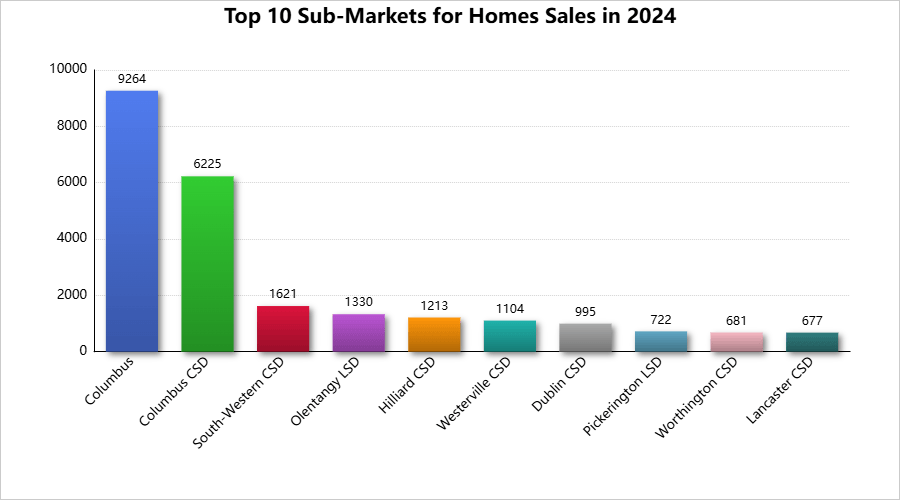
First, overall sales.
2024 housing market update sub-market sales

2024 housing market update sub-market sales change
2024 housing market update worst sub-market sales

Next up, here is the median sales price data.
2024 housing market update most expensive markets
2024 housing market update least expensive markets

2024 housing market update highest sales price change
2024 housing market update lowest sales price change

And finally, here are the charts for the fastest and slowest-selling markets in 2024.
2024 housing market update fastest-selling markets
2024 housing market update slowest-selling markets

If you don’t see data for the market you are looking for, vist the Housing Reports page of the Columbus Realtors site.

Random Columbus Photo 12

For today’s Random Columbus Photo 12, we don’t go back too far in history, but the before and after are definitely one of the more dramatic comparisons featured so far. Larger versions of both photos are available if you click on them.

Before: N. High Street at Hubbard Avenue looking northeast, around 1980.
The Short North by the 1970s was considered a declined neighborhood with significant crime and prostitution problems. Police were called there often, and history tells that it was the police themselves who coined the name of the neighborhood, since it was an area that was just “short of Downtown”.
In the photo, you can see buildings at 790 N. High and beyond. At the time, they were a Trailways bus station and some kind of office building. Trailways was eventually replaced by other businesses and restaurants over the years, the last being the restaurant Haiku until it was all demolished for the current hotel building.
Random Columbus photos 12 High and Hubbard

After: The same view in 2024.
The picture from 2024 shows a drastically transformed neighborhood. After more than 40 years of renovations, revitalization and construction, the Short North has shed it’s drab and shady past. Crime stubbornly persists despite the improvements, but not nearly to the same degree. The taller apartment building in the older photo was torn down in the 1990s.
Hubbard and High

2023 County and Metro Population Estimates


2023 county and metro population estimates

National county map for 2022-2023 population change.

I haven’t done an annual population estimates post since before the 2020 Census. This is because the pandemic- and political actions- screwed up counting quite a bit, and I haven’t felt confident in posting them. The 2023 county and metro population estimates have just been released., and since 3 years have gone by since the census, perhaps some of the kinks have been worked out. That said, the news isn’t all that great for Ohio and Columbus.

2020-2023 County Population Change

Prior to 2020, Franklin County was the fastest-growing county in the state by total growth. Since 2020, it’s fallen to 10th. While that may not seem that bad, only 30 of Ohio’s 88 counties have even seen growth since 2020. On the bright side, Franklin was the only major urban county in the state to see any growth at all. The majority of the 30 counties that saw growth in the state were metro suburban counties, including 8 of the 9 suburban counties within the Columbus Metro Area. Lingering effects of the pandemic are at least partially responsible for this shift, as some people sought to leave highly-populated areas, but wanted to otherwise remain close to core cities.
Another factor is likely the ongoing housing shortage. Housing just isn’t getting built in Franklin County like it was before, which is continuing to cause price increases, making the area less affordable than it used to be.
Additionally, extreme state politics may be driving some people away- or stopping them from moving locally altogether.

Still, the news isn’t all bad. The total Columbus metro population growth is gradually improving. From 2020-2021, the metro change was +7,986, 2021-2022 it was +14,560, and from 2022-2023, it was +18,205. Still a far cry from the pre-pandemic period when annual totals were 25K-30K. Hopefully, the upward trend continues through the rest of the decade.

Now that we know that overall population change, let’s take a closer look at the specific components of change since 2020.

Top 10 Counties by Natural Change 2020-2023
1. Franklin: +18,738
2. Hamilton: +4,233
3. Delaware: +2,072
4. Holmes: +1,309
5. Union: +662
6. Butler: +652
7. Warren: +650
8. Mercer: +543
9. Putnam: +86
10. Shelby: +67
Incidentally, only these 10 counties saw positive net natural change 2020-2023. That’s a terrible statistic for Ohio’s counties. Columbus’ 3 counties in the top 10 provided more natural change than all other 85 counties combined.

Top 10 Counties by Domestic Change 2020-2023
1. Delaware: +13,998
2. Warren: +7,424
3. Union: +6,011
4. Lorain: +5,969
5. Fairfield: +5,932
6. Licking: +4,592
7. Clermont: +3,117
8. Pickaway: +2,783
9. Miami: +2,433
10. Medina: +2,018
Again, Columbus metro counties- aside from Franklin- do relatively well here, with half of the top 10.

Top 10 Counties by International Migration Change 2020-2023
1. Franklin: +20,391
2. Cuyahoga: +8,557
3. Hamilton: +7,037
4. Butler: +3,551
5. Montgomery: +2,885
6. Summit: +2,593
7. Warren: +1,821
8. Delaware: +1,557
9. Lucas: +1,237
10. Greene: +839
Franklin again leads the pack and is generally doing better annually this decade than before the pandemic, the lone bright spot in the numbers.

Finally, here were the overall metro changes, both for 2022-2023 and 2020-2023.

2023 Total Metro Area Population
1. Cincinnati: 2,271,479
2. Columbus: 2,180,271
3. Cleveland: 2,158,932
4. Dayton: 814,363
5. Akron: 698,398
6. Toledo: 600,141
7. Youngstown: 425,969
8. Canton: 399,474
Columbus continues to leave Cleveland behind and close the gap with Cincinnati.

2022-2023 Metro Area Population Change
1. Columbus: +18,205
2. Cincinnati: +12,854
3. Dayton: +1,649
4. Akron: +887
5. Canton: +3
6. Toledo: -378
7. Youngstown: -679
8. Cleveland: -1,769

2020-2023 Metro Area Population Change
1. Columbus: +41,330
2. Cincinnati: +21,698
3. Dayton: +313
4. Canton: -2,106
5. Akron: -3,827
6. Youngstown: -4,707
7. Toledo: -6,100
8. Cleveland: -26,795

CoGo Bike Share Sees Record Ridership in 2023

CoGo bike share

Columbus’ CoGo bike share system has been in operation since July, 2013. After a decade of ups and downs, the system seems to be finally hitting its stride.

CoGo bikeshare total trips by year

As the chart above shows, total CoGo trips were generally up between 2013-2017, and then saw a fairly steep decline 2018-2019. It’s unclear what caused that decline, but everything from system disruptions to weather could have played a role. Regardless, the pandemic, protests and general chaos of 2020 didn’t seem to matter as total trips for the year rebounded strongly. After another down year in 2021, 2022 saw CoGo’s highest ridership since the system opened, and 2023 continued that trend by blowing out 2022’s record. There were an extra 33 trips per day in 2023 vs. 2022, which added up to more than 12,000 more for the year.
Hopefully, the increase in ridership will prompt another expansion of the system into new areas soon. And some actual protected bike lanes would be nice, as Columbus- to date, anyway- has been less than stellar on this issue.