October and November 2013 Jobs Data


November 2013 jobs data

October and November 2013 jobs data comes from the Bureau of Labor Statistics. The data includes up-to-date employment and unemployment figures.

October 2013

Columbus City
Unemployment Rate: 6.2%
Unemployment Rate Change since October 2012: +0.6%
Unemployment Rate Change since January 2013: -0.6%
Civilian Labor Force: 430,800
Civilian Labor Force Change since October 2012: +1,300
Civilian Labor Force Change since January 2013: +4,400
Employment: 404,000
Employment Change since October 2012: -1,600
Employment Change since January 2013: +6,700
Unemployment: 26,800
Unemployment Change since October 2012: +2,900
Unemployment Change since January 2013: -2,300

Franklin County
Unemployment Rate: 6.2%
Unemployment Rate Change since October 2012: +0.6%
Unemployment Rate Change since January 2013: -0.6%
Civilian Labor Force: 630,000
Civilian Labor Force Change since October 2012: +1,700
Civilian Labor Force Change since January 2013: +6,300
Employment: 590,900
Employment Change since October 2012: -2,400
Employment Change since January 2013: +9,900
Unemployment: 39,200
Unemployment Change since October 2012: +4,200
Unemployment Change since January 2013: -3,400

Columbus Metro Area
Unemployment Rate: 6.1%
Unemployment Rate Change since October 2012: +0.6%
Unemployment Rate Change since January 2013: -0.9%
Civilian Labor Force: 975,506
Civilian Labor Force Change since October 2012: +2,253
Civilian Labor Force Change since January 2013: +7,601
Employment: 915,686
Employment Change since October 2012: -3,699
Employment Change since January 2013: +15,230
Unemployment: 59,820
Unemployment Change since October 2012: +5,952
Unemployment Change since January 2013: -7,629

Ohio Overall
Unemployment Rate: 7.5%
Unemployment Rate Change since October 2012: +0.6%
Unemployment Rate Change since January 2013 : +0.5%
Civilian Labor Force: 5,727,346
Civilian Labor Force Change since October 2012: -2,337
Civilian Labor Force Change since January 2013: -12,946
Employment: 5,300,458
Employment Change since October 2012: -33,230
Employment Change since January 2013: -40,394
Unemployment: 426,888
Unemployment Change since October 2012: +30,893
Unemployment Change since January 2013: +27,448

Metro Non-Farm Jobs
Total: 969,600
Change from October 2012: +9,600
Change from January 2013: +26,000

By Industry
Mining/Logging/Construction Total: 31,800
Change from October 2012: +1,200
Change from January 2013: +4,900

Manufacturing Total: 66,200
Change from October 2012: +700
Change from January 2013: +1,200

Trade/Transportation/Utilities Total: 184,500
Change from October 2012: +1,800
Change from January 2013: +1,300

Information Total: 16,100
Change from October 2012: -300
Change from January 2013: -400

Financial Activities Total: 72,400
Change from October 2012: +1,000
Change from January 2013: +700

Professional and Business Services Total: 161,800
Change from October 2012: +700
Change from January 2013: +6,200

Education and Health Services Total: 141,500
Change from October 2012: +3,500
Change from January 2013: +2,000

Leisure and Hospitality Total: 98,300
Change from October 2012: +3,400
Change from January 2013: +9,800

Other Services Total: 35,800
Change from October 2012: -1,500
Change from January 2013: -400

Government Total: 161,200
Change from October 2012: -900
Change from January 2013: +700

November 2013

Columbus City
Unemployment Rate: 6.1%
Unemployment Rate Change since November 2012: +0.7%
Unemployment Rate Change since January 2013: -0.7%
Civilian Labor Force: 433,700
Civilian Labor Force Change since November 2012: +4,500
Civilian Labor Force Change since January 2013: +7,300
Employment: 407,100
Employment Change since November 2012: +1,000
Employment Change since January 2013: +9,800
Unemployment: 26,600
Unemployment Change since November 2012: +3,500
Unemployment Change since January 2013: -2,500

Franklin County
Unemployment Rate: 6.1%
Unemployment Rate Change since November 2012: +0.7%
Unemployment Rate Change since January 2013: -0.7%
Civilian Labor Force: 634,400
Civilian Labor Force Change since November 2012: +6,800
Civilian Labor Force Change since January 2013: +10,700
Employment: 595,400
Employment Change since November 2012: +1,400
Employment Change since January 2013: +14,400
Unemployment: 39,000
Unemployment Change since November 2012: +5,400
Unemployment Change since January 2013: -3,600

Columbus Metro Area
Unemployment Rate: 6.1%
Unemployment Rate Change since November 2012: +0.8%
Unemployment Rate Change since January 2013: -0.9%
Civilian Labor Force: 981,927
Civilian Labor Force Change since November 2012: +9,454
Civilian Labor Force Change since January 2013: +14,022
Employment: 921,937
Employment Change since November 2012: +1,470
Employment Change since January 2013: +21,481
Unemployment: 59,990
Unemployment Change since November 2012: +7,984
Unemployment Change since January 2013: -7,459

Ohio Overall
Unemployment Rate: 7.4%
Unemployment Rate Change since November 2012: +0.6%
Unemployment Rate Change since January 2013 : +0.4%
Civilian Labor Force: 5,734,909
Civilian Labor Force Change since November 2012: +6,424
Civilian Labor Force Change since January 2013: -5,383
Employment: 5,307,912
Employment Change since November 2012: -30,979
Employment Change since January 2013: -32,940
Unemployment: 426,997
Unemployment Change since November 2012: +37,403
Unemployment Change since January 2013: +27,557

Metro Non-Farm Jobs
Total: 975,000
Change from November 2012: +9,000
Change from January 2013: +31,400

By Industry
Mining/Logging/Construction Total: 32,300
Change from November 2012: +1,900
Change from January 2013: +5,400

Manufacturing Total: 66,000
Change from November 2012: +300
Change from January 2013: +1,000

Trade/Transportation/Utilities Total: 189,200
Change from November 2012: -700
Change from January 2013: +6,000

Information Total: 16,200
Change from November 2012: -300
Change from January 2013: -300

Financial Activities Total: 72,100
Change from November 2012: -500
Change from January 2013: +400

Professional and Business Services Total: 161,800
Change from October 2012: +700
Change from January 2013: +6,200

Education and Health Services Total: 143,700
Change from November 2012: +4,700
Change from January 2013: +4,200

Leisure and Hospitality Total: 95,600
Change from November 2012: +2,700
Change from January 2013: +7,100

Other Services Total: 35,800
Change from November 2012: -800
Change from January 2013: -400

Government Total: 162,600
Change from November 2012: -900
Change from January 2013: +2,100


How I Would Complete the Arena District


In the 2nd in this series of posts, I made maps for how I imagine the Arena District could be finished and made whole.

Here’s the link to the map. There are 2 pages, so be sure to check them both.
http://goo.gl/maps/t0Xw1

What I envision for this area is as follows:

-5 new parking garages, all at least 5 stories and 500 spaces. They would also be mixed-use with ground floor retail/restaurant space and potential residential above. 1 additional garage already built would be expanded.
-7 groups of historic buildings would be preserved. These could be converted to mixed-use spaces.
-10 existing buildings would be torn down and replaced with mixed-use development.
-11 new parks/green spaces would be created. The largest would be go in the large wooded lot south of Vine Street and north of the railroad tracks.
-A transit hub for light rail would be built at the railroad tracks just north of Nationwide Boulevard west of the Buggyworks complex. The location could serve trains going in any direction.
-New pedestrian/bike trails would be built from the Scioto River connecting to the new transit hub, as well as to a new parking garage behind the LC Pavilion and to the large central park south of Vine Street. The trail would then run parallel to the park, cross under 670 and connect with the Olentangy Trail.
-The old casino site would become the new home of a new/relocated stadium for the Columbus Crew.
-Broadbelt Lane would be extended past the new stadium site and then connect to W. Nationwide Boulevard. This would allow several new mixed-use buildings to go up around the stadium.
-A large public plaza would go in north of the stadium. It would potentially include a playground, skate park, public art pieces, barbeque areas and perhaps an outdoor skating rink.
-At least 22 surface lots would be replaced with mixed-use development, all at least 5 stories in height. Those closest to the Scioto would be minimum of 10 stories.
-Bike lanes would go on all major streets, and new sidewalks would be constructed where they either don’t exist or where they need to be connected.

So, what do you think of this plan?

Housing Market Update November 2013


housing market update November 2013 Columbus, Ohio

November home sales were down in Central Ohio for the 2nd straight month according to the Housing Market Update November 2013 data from Columbus Realtors. One main reason seems to be the culprit: There just aren’t enough houses to go around. Hot urban markets simply have a limited stock of homes with very few going up for sale at any one time, and builders still have not been building very much since the recession. Combined, the total number of homes for sale has declined to levels not seen since the early 2000s. This explains why most markets are still seeing gains in home prices while overall sales have fallen from the year before.

The bottom line is that demand is outpacing supply, and that situation doesn’t look to change anytime soon, especially in the urban core.

Here are the stats for the 21 major areas of Franklin County that I look at housing stats for.

Top 10 November 2013 Sales Totals
1. Columbus: 701
2. Dublin: 52
3. Clintonville: 49
4. Gahanna: 38
5. Upper Arlington: 38
6. Hilliard: 36
7. Reynoldsburg: 36
8. Grove City: 35
9. Westerville: 31
10. Canal Winchester: 20

Top 10 November 2013 Sales Increases over November 2012
1. Downtown: +50.0%
2. Grandview Heights: +14.3%
3. Clintonville: +6.5%
4. Hilliard: +5.9%
5. Minerva Park: +0.0%
6. New Albany: +0.0%
7. Obetz: +0.0%
8. Gahanna: -2.6%
9. Reynoldsburg: -5.3%
10. Grove City: -5.4%

Top 10 Year-to-Date Sales Through November 2013
1. Columbus: 9,561
2. Dublin: 747
3. Upper Arlington: 678
4. Clintonville: 656
5. Westerville: 580
6. Grove City: 568
7. Hilliard: 533
8. Gahanna: 494
9. Reynoldsburg: 466
10. Pickerington: 291

Top 10 Year-to-Date Increases Through November 2013 Over 2012
1. Minerva Park: +46.2%
2. Pataskala: +31.3%
3. Gahanna: +30.3%
4. Reynoldsburg: +28.0%
5. Whitehall: +27.3%
6. Hilliard: +27.2%
7. Clintonville: +24.2%
8. Grove City: +23.7%
9. Westerville: +23.4%
10. Bexley: +22.5%
10. Downtown: +22.5%

Average Sales November 2013
Urban: 79
Suburban: 28.7
Urban without Columbus: 16.8

Average % Change November 2013 vs. November 2012
Urban: -7.1%
Suburban: -11.6%
Urban without Columbus: -6.5%

Average YTD Sales Through November 2013
Urban: 1,097.7
Suburban: 435.9
Urban without Columbus: 251.4

Average YTD % Change YTD Through November 2013
Urban: +14.9%
Suburban: +19.9%
Urban without Columbus: +14.4%

Top 10 Average Sales Price November 2013
1. New Albany: $614,687
2. Bexley: $456,365
3. Dublin: $344,341
4. Upper Arlington: $326,913
5. Downtown: $302,464
6. Worthington: $296,328
7. German Village: $271,656
8. Grandview Heights: $257,001
9. Pataskala: $196,158
10. Hilliard: $193,756

Top 10 Average Sales Price % Change November 2013 Over November 2012
1. Worthington: +59.6%
2. Pataskala: +38.0%
3. Downtown: +36.7%
4. Bexley: +32.5%
5. Obetz: +30.8%
6. New Albany: +28.6%
7. Dublin: +21.6%
8. Whitehall: +10.1%
9. Minerva Park: +10.0%
10. Pickerington: +10.0%

Top 10 Average Sales Prices YTD Through November 2013
1. New Albany: $541,931
2. Upper Arlington: $364,369
3. Bexley: $351,282
4. Dublin: $335,164
5. German Village: $297,832
6. Downtown: $286,470
7. Worthington: $249,979
8. Grandview Heights: $226,458
9. Hilliard: $215,966
10. Gahanna: $198,612

Top 10 Average YTD Sales Price % Change Through November 2013 vs. 2012
1. Whitehall: +17.2%
2. Minerva Park: +17.1%
3. Downtown: +15.5%
4. Upper Arlington: +13.0%
5. Obetz: +12.3%
6. Gahanna: +11.6%
7. Reynoldsburg: +8.5%
8. New Albany: +8.3%
9. Worthington: +8.1%
10. Bexley: +4.9%

Average Sales Price November 2013
Urban: $227,811
Suburban: $229,942
Urban without Columbus: $238,166

Average Sales Price Change November 2012 vs. November 2012
Urban: +12.5%
Suburban: +6.0%
Urban without Columbus: +13.7%

Average Sales Price YTD
Urban: $217,072
Suburban: $223,394
Urban without Columbus: $226,041

Average Sales Price % Change YTD
Urban: +6.3%
Suburban: +4.9%
Urban without Columbus: +6.6%

Top 10 Fastest Selling Markets November 2013 (Based on Average # of Days for Listings to Sell)
1. Grandview Heights: 15
2. Westerville: 38
3. Clintonville: 40
4. Upper Arlington: 44
5. Hilliard: 47
6. Bexley: 49
7. Worthington: 57
8. Whitehall: 61
9. Dublin: 62
10. Minerva Park: 65
10. Obetz: 65

Top 10 Fastest Selling Markets YTD
1. Worthington: 40
2. Grandview Heights: 44
3. Upper Arlington: 45
4. Clintonville: 50
5. Westerville: 52
6. Hilliard: 54
7. Bexley: 58
8. Gahanna: 59
9. Dublin: 62
10. Grove City: 64

Average # of Days Before Sale, November 2013
Urban: 57.4
Suburban: 89.4
Urban without Columbus: 56.3

Average # of Days Before Sale YTD
Urban: 60.6
Suburban: 62.7
Urban without Columbus: 60.2

Top 10 Lowest Market Housing Supplies (Based on # of Months to Sell all Listings)
1. Worthington: 1.6
2. Upper Arlington: 2.1
3. Hilliard: 2.2
4. Minerva Park: 2.2
5. Bexley: 2.3
6. Clintonville: 2.4
7. Westerville: 2.4
8. Gahanna: 2.6
9. German Village: 2.6
10. Grandview Heights: 2.6

A healthy housing supply is considered to be around 5 months. Anything less than 3 months is considered very low. All of the 21 areas I looked at were below 5 months, indicating a county-wide shortage.

Average # of Months to Sell All Listings, November 2013
Urban: 2.8
Suburban: 3.6
Urban without Columbus: 2.7

Average % Change of Single-Family Home Sales November 2013 vs. November 2012
Urban: -1.7%
Suburban: -12.6%
Urban without Columbus: -0.5%

Average % Change of Single-Family Home Sales YTD vs. YTD 2012
Urban: +9.3%
Suburban: +19.4%
Urban without Columbus: +8.2%

Average % Change of Condo Sales November 2013 vs. November 2012
Urban: +23.3%
Suburban: +52.8%
Urban without Columbus: +26.6%

Average % Change of Condo Sales YTD vs. YTD 2012
Urban: +27.6%
Suburban: +26.4%
Urban without Columbus: +28.3%


How I Would Develop Southeast Downtown


Southeast Downtown will be getting a relative boost in the next few years, thanks to the Mound Street Connector, currently under construction. As part of the I-70/I-71 rebuild, a new ramp will run from westbound I-70 into Downtown via Mound Street, which currently is a dead end at the Split. It has been that way since the highway was constructed in the early 1960s. The city of Columbus recently came out with development guidelines for the Mound Street Corridor concerning preferred type of development, preferred heights, etc. I wanted to make my own map of how I would redevelop this long-neglected part of Downtown if I had the ability.

This is the map I came up with:
http://goo.gl/maps/gg0Mx

The area I looked at is bounded by Main Street to the north, 71 to the east, 70 to the south and 3rd Street to the west.

Some of the details include:
-The creation of 2 gateways into Downtown, one on Mound and the other on Main Street. The gateways could include some kind of large public art sculpture, signature signage and landscaping, or really anything that provides a welcoming entrance into the heart of the city.
-20-25 historic buildings that currently exist in this part of the city would be preserved. Any historic commercial buildings would remain as such or converted to mixed used with residential above and ground-floor retail. Historic homes would be restored (if needed) and kept as residential buildings or perhaps used for small businesses.
-4 new CoGo stations would be built.
-Currently, several streets have incomplete or non-existent sidewalks. These would be completed along with landscaping.
-Mound Street’s original street grid would be restored. That means connecting the sections between Grant and S. 5th Street.
-Noble Street’s original street grid would be restored, also between Grant and S. 5th Streets. Both new sections of Mound and Noble would have sidewalks and landscaping.
-17 major street intersections would be rebuilt with brick. Pedestrian priority walks and signaling would be installed.
-4th Street would be converted to 2-ways with a landscaped central median.
-All major streets would have designated bike lanes.
-3 pedestrian/bike greenways would be created. The first would run along Waldo Alley from Fulton Street to the south to Walnut Street to the north. The 2nd would run from Fulton Street to the south to Rich Street to the north. Finally, the 3rd would run along Lazelle Street from Fulton Street to the south to Town Street to the north. The paths would be landscaped and would have bike and pedestrian lanes. Cafes and other small eateries could line certain sections, and they could also potentially be the site of markets and other events. Adjacent residential/mixed-use buildings would have direct access to these paths.
-31 buildings would be torn down. These would be non-historic, low-rise buildings with non-adaptable uses and suburban layouts.
-These 31 along with 21 other surface lots would be replaced with mixed-use development for a total of 52 new buildings. The minimum height being 5-10 stories depending on the location. Mixed-uses would include residential over retail/offices.
-Over 60 surface lots in all would be replaced with some kind of development.
-6 new parking garages would be strategically built to serve new development needs with a minimum of 3,000 spaces. Ground-floor retail would be included, and the garages would be built with the potential to add residential/offices on top.
-13 new parks or green spaces would be created.

What do you think? It’s just a wish list I want to see and a fun little exercise more than anything. Obviously, private/public developers would have to step forward. Not to mention that the 31 tear downs just might object to losing their buildings. Oh well… we can all dream, can’t we?


The 1901 Mega Cold Front


1901 mega cold front

The 1901 mega cold front was a massive wake-up call after a relatively tranquil, if not cool, fall. Temperatures through November and early December 1901 had been persistently below normal. 24 days in November had been below normal, and but for a few days very early in December, this pattern continued. However, beginning on December 11th, temperatures began to rise ahead of an approaching weather system. By the 13th, temperatures reached record highs in Columbus when they spiked at 65 degrees. The following day started equally warm with a record high of 65. However, a change was coming.

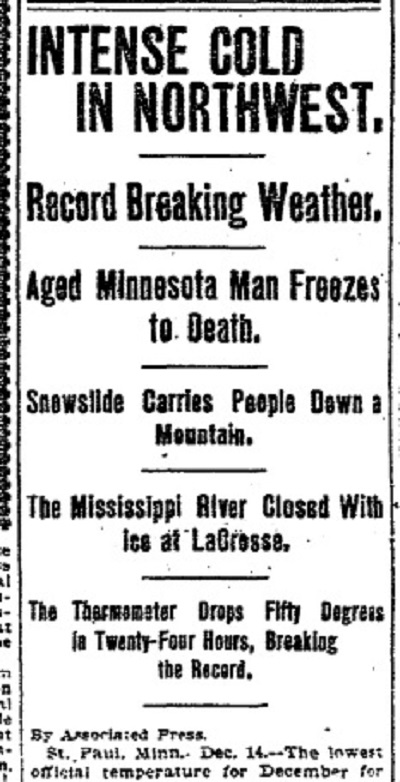
To the northwest of Ohio, temperatures were plunging rapidly as a deep, cold high pressure system was being pulled south. Dispatch headlines warned of the record-breaking cold.
1901 mega cold front

A powerful cold front would move through late on the 14th, and temperatures began to plummet. By midnight, the temperature had dropped all the way down to just 14 degrees, a single day drop of 51 degrees! A driving rain accompanied the frontal passage, but quickly changed over to heavy snow that accumulated 3″-5″ across the area.

On the 15th, the temperature continued to fall, albeit more slowly, and by midnight the reading was -4. This mega-cold front had produced a 69-degree total drop in Columbus, which made it one of the strongest cold fronts ever to move through the Ohio region.

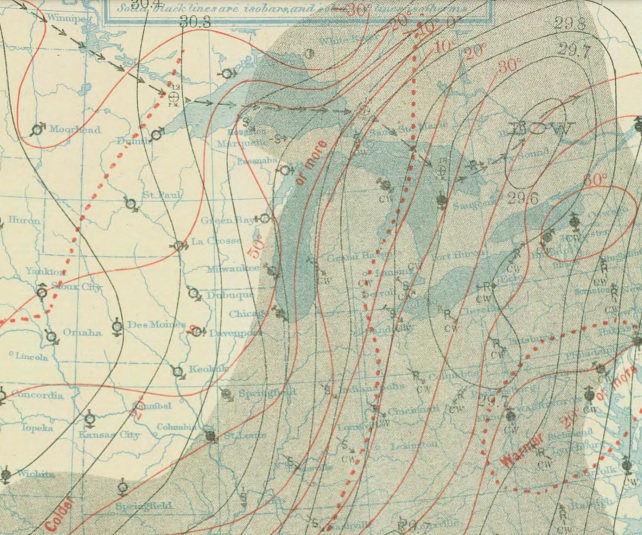
The weather map on December 14, 1901, as the front began pushing through Ohio.

The front would bring a major pattern change. Every day from the 15th-21st featured highs in the teens, which set many daily low maximum records, some of which still stand more than 100 years later.

The winter of 1901-02 was generally cold and snowy in the Ohio Valley, but no future front that winter would come close to December 14-15th of 1901.

To view more local and current weather, visit: Wilmington National Weather Service
And for more historic December records, check out: December Weather Records