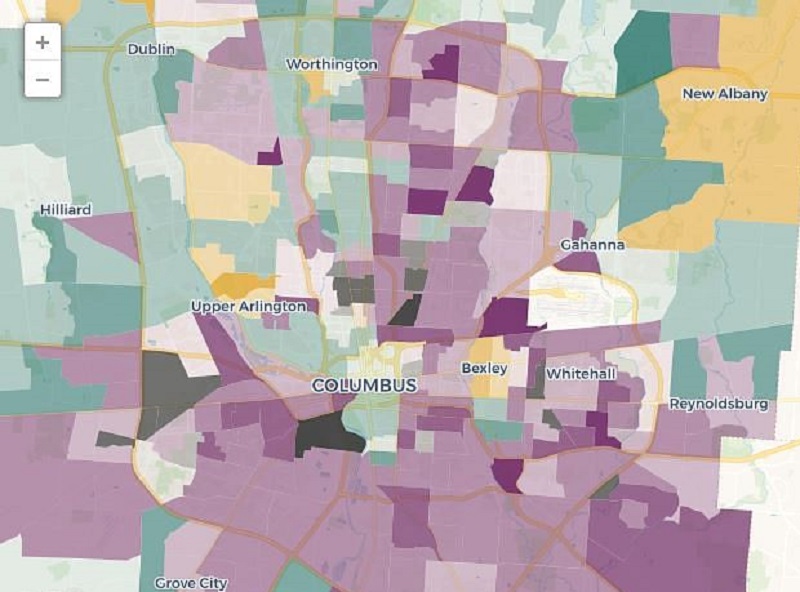
While I wouldn’t normally make a post on the 2011 census tract estimates- or any other estimates for them- because I really don’t know what their reliability is, I thought it might be an interesting exercise.
I only looked at those tracts that made up the original 1950 boundaries as well as some of the adjacent areas. I won’t go into too much detail, but…
In 2010, only 20 of the 78 tracts I looked at were growing. Well, specifically, only 20 grew during the 2000-2010 period, not just in 2010 alone. So several more could’ve been starting to recover in 2010, but since it measured the whole decade, it might still show up as a loss. In any case, the 2011 estimates are interesting just because they show a much different picture.
If I use the exact estimate used, 34 of the 78 tracts were growing in 2011, a significant improvement. However, some of the estimates were hard to understand where they came from. For example, they had Downtown tracts, which have had rapid growth the last decade, as declining in population for 2011, even while more and more residential units are built and more people move into the area. Also, they showed some tracts gaining population when the long-term trend is for significant loss and no reason to see that reversing.
So using the margin of error as a guide, I went back over them and did my own estimates. Of the 78 tracts, I only did my own for 14, as they were the only ones I felt didn’t match the reality on the ground or the long-term trends. With those changes, 38 of the 78 were growing, a slight increase of the official 34.
If we use the official estimates, the total population for the 78 tracts was 232,297, a loss of 2,285 since 2010. If we use my estimates, the population would be 237,806, or an increase of 3,224. So what’s the real story? Well, new 2012 tract estimates will be coming out soon. When they do, I will compare and see what, if any, updates should be made. The only real way to know, however, is to wait until 2020 with the next census. Still, until that time, it’s fun to look at the numbers- or maps– and see if the urban core is recovering in the same way that cities and towns are in and around Franklin County.
I posted the 2012 city estimates from the US Census yesterday. Within them may be an interesting trend that has long-term implications for Columbus and other cities, so today we’re going to go over 2012 urban population trends, and see how they compare.
A lot of the talk in the news in recent years has been how urban core cities are seeing a comeback of sorts. I’ve made mention of it several times, myself, with hard data located on the Demographics and Population part of this site. However, there is some disagreement between urban proponents and suburban proponents about what’s really going on, and that disagreement seems to focus mostly around if the city is growing faster than the suburbs, and if so, if that trend can be sustained.
Looking over the estimates, I noticed something that may support the urban back-to-the-city argument, at least in Columbus. What I noticed was that those villages/towns/cities that were growing tended to be clustered closer to the urban core of the metro than those that were losing population.
I first gathered the data on the Columbus metro area’s 99 incorporated places, ranging in population from 36 on up to Columbus’ 809,798. I then measured the distance between Columbus’ Downtown center and the center of all 99 places. I then broke them up into increments of about 5 miles each. Here is some of what I found.
Average Total Population Growth by Place 2010-2012 by Distance from Columbus’ Center 0-4.9 Miles: 3,962.8 5-9.9 Miles: 438.4 10-14.9 Miles: 342.8 15-19.9 Miles: 26.5 20-24.9 Miles: 148.9 25+ Miles: 10.5
What this says, is that for the most part, the closer a place is to the center, the more total average growth it’s had since 2010. While the 0-4.9 mile distance is somewhat skewed because it includes Columbus’ growth, there is also a significant drop-off beyond 15 miles from the center.
Next, I looked at all the places that saw either 0 population change or a loss during the 2010-2012 period. Again, it was separated by the distance from Columbus’ center.
0-4.9 Miles: 0 of 6, or 0.0% 5-9.9 Miles: 0 of 12, or 0.0% 10-14.9 Miles: 1 of 12, or 8.3% 15-19.9 Miles: 2 of 8, or 25.0% 20-24.9 Miles: 2 of 10, or 20.0% 25+ Miles: 21 of 51, or 41.2%
What this shows is that the further the distance away from the center, in general, the more places there were that were stagnant or lost population since 2010.
Finally, I looked at the top 15 total population increases of all places from 2010-2012, as well as their distance from Columbus’ center. 1. Columbus (obviously): +22,765- 0 Miles 2. Hilliard: +2,129- 9.9 Miles 3. Grove City: +1,257- 7.4 Miles 4. Delaware: +1,172- 23.6 Miles 5. Dublin: +1,155- 11.3 Miles 6. Westerville: +953- 12.0 Miles 7. New Albany: +783- 13.0 Miles 8. Gahanna: +580- 7.5 Miles 9. Powell: +460- 14.2 Miles 10. Reynoldsburg: +454- 9.9 Miles 11. Upper Arlington: +432- 4.1 Miles 12. Pickerington: +401- 14.1 Miles 13. Grandview Heights: +374- 2.6 Miles 14. Whitehall: +341- 6.0 Miles 15. Canal Winchester: +292- 12.7 Miles
12 of the 15 are within Franklin County. Another 2 (Pickerington and Powell) are near the Franklin County border. Only Delaware is beyond 15 miles from Columbus’ center.
So do these numbers show a real trend? Maybe. Some of the questions are: Do 2 years of data support a real trend or just a blip? Is this really an urban movement or a rural decline… or both? Is this a new/recent trend or have the numbers been changing? Those questions and others need to be answered before making a definitive statement, but if nothing else, they are a positive indication that Columbus and it’s immediate surroundings remain the metro’s (and Ohio’s) strongest population draw.
For those counting, there are 99 places in that list. 79 of them, or 79.8%, show growth over the period. Every place within Franklin County saw growth- maybe not down to the neighborhood level- but in all of the towns and cities.
Columbus passed 800,000 for the first time, and its actual growth rate increased from about 1.1% annually to 1.6% annually.
The Columbus Board of Realtors released home sales data for April and YTD recently. Their area covers an area a bit larger than the Columbus metro, so I tried to stick with just those areas within it. I also tried to avoid capturing essentially the same area (school district vs city boundary). There are a few exceptions where I wanted to highlight specific areas or neighborhoods of Columbus.
LSD=Local school district CSD=City school district
Top 10 Home Sales % Change since April 2012 1. Bexley city: +137.5% 2. Sunbury city: +125.0% 3. Delaware LSD: +82.4% 4. Lancaster CSD: +74.2% 5. Hilliard city: +66.7% 6. Marysville CSD: +64.3% 7. Pataskala city: +57.1% 8. London CSD: +50.0% 9. Upper Arlington CSD: +48.9% 10. South-Western CSD: +47.8%
Top 10 Home Sales % Change 2013 Year to Date 1. Sunbury city: +78.6% 2. Lithopolis city: +66.7% 3. Bexley city: +50.0% 4. Gahanna city: +46.1% 5. Hilliard city: +45.5% 6. Delaware CSD: +44.3% 7. Westerville city: +40.3% 8. Whitehall city: +37.5% 9. Marysville CSD: +36.7% 10. Lancaster CSD: +36.0%
Bottom 10 Home Sales % Change since April 2012 1. Powell city: -55.6% 2. Minerva Park city: -50.0% 3. Whitehall city: -42.9% 4. German Village: -36.4% 5. Downtown: -29.6% 6. Obetz city: -20.0% 7. New Albany city: -14.3% 8. Worthington city: -12.5% 9. Grandview Heights city: -11.1% 10. Circleville CSD: -11.1%
So it looks like, so far… in the urban core, Bexley, Upper Arlington and Whitehall are all having a good sales year, while Worthington and Grandview Heights are not. Downtown had a bad April, but is doing well for the year. Same with German Village. Suburbs performing well include Delaware, Hilliard and Sunbury. Those performing badly include New Albany and Powell.
Top 10 Turnover (Average # of Days on the Market before Sold) in April 2013 1. Valleyview city: 0 Days 2. Plain City CSD: 25 Days 3. Sunbury city: 27 Days 4. German Village: 29 Days 4. Obetz city: 29 Days 4. Worthington city: 29 Days 5. Powell city: 43 Days 6. Upper Arlington CSD: 47 Days 7. Beechwold/Clintonville: 49 Days 8. Gahanna city: 52 Days 8. Pataskala city: 52 Days 9. Lithopolis city: 54 Days 10. Grandview Heights city: 56 Days
Bottom 10 Turnover for April 2013 1. Circleville CSD: 164 Days 2. London CSD: 131 Days 3. Newark CSD: 123 Days 4. Minerva Park city: 116 Days 5. Downtown: 105 Days 6. Marysville CSD: 102 Days 7. Lancaster CSD: 98 Days 8. Delaware CSD: 92 Days 9. Blacklick: 88 Days 10. Bexley city: 80 Days
Top 10 Turnover 2013 Year to Date 1. Worthington city: 42 Days 2. Plain City CSD: 46 Days 3. Obetz city: 48 Days 4. Upper Arlington CSD: 60 Days 5. Pickerington city: 65 Days 6. Pataskala city: 67 Days 6. Whitehall city: 67 Days 7. Beechwold/Clintonville: 68 Days 7. Grandview Heights city: 68 Days 7. Minerva Park city: 68 Days 8. Groveport LSD: 69 Days 8. Reynoldsburg LSD: 69 Days 8. South Western CSD: 69 Days 9. German Village: 70 Days 9. Powell city: 70 Days 9. Westerville city: 70 Days 9. Worthington city: 70 Days 10. Columbus city: 72 Days
Bottom 10 Turnover 2013 Year to Date 1. Valleyview city: 151 Days 2. Circleville CSD: 148 Days 3. Newark CSD: 117 Days 4. London CSD: 115 Days 5. Bexley city: 97 Days 6. Lancaster CSD: 96 Days 7. Delaware CSD: 90 Days 7. Hilliard city: 90 Days 7. New Albany city: 90 Days 8. Johnstown LSD: 89 Days 9. Downtown: 87 Days 9. Lithopolis city: 87 Days 9. Marysville CSD: 87 Days 10. West Jefferson LSD: 86 Days
# of Months Total On-Market Housing Supply Would Last if No Other Homes Became Available, April 2013- Top 10 1. Valleyview city: 1.6 Months 2. Worthington city: 1.8 Months 3. Grandview Heights city: 2.0 Months 4. Upper Arlington CSD: 2.3 Months 5. Sunbury city: 2.5 Months 6. Hilliard city: 2.7 Months 7. Beechwold/Clintonville: 2.8 Months 8. Powell city: 2.9 Months 8. Westerville city: 2.9 Months 9. Gahanna city: 3.1 Months 10. Johnstown LSD: 3.2 Months
And Bottom 10 1. Granville CSD: 9.2 Months 2. London CSD: 8.7 Months 3. Circleville CSD: 8.6 Months 4. Newark CSD: 7.4 Months 5. Pataskala city: 5.9 Months 6. Lancaster CSD: 5.8 Months 7. Obetz city: 5.0 Months 8. South Western CSD: 4.8 Months 9. Canal Winchester CSD, Marysville CSD, New Albany city, Reynoldsburg CSD: 4.6 Months 10. Columbus city, Grove City city: 4.5 Months
With the supply numbers, generally anything around 5 months is considered a healthy supply. Well over and the market is saturated, well under it’s undersupplied. For the record, Downtown’s supply is 4.1 months.
Top 10 Average Sales Price % Change Year to Date 1. Valleyview city: +52.3% 2. Circleville CSD: +29.8% 3. Johnstown LSD: +26.7% 4. Minerva Park city: +23.7% 5. Gahanna city: +22.6% 6. Marysville CSD: +22.3% 7. Downtown: +19.9% 8. Lancaster CSD: +17.6% 9. Reynoldsburg CSD: +14.0% 10. Bexley city: +11.3%
Okay, maybe not the coolest link, but still… The Mortgage Interest Deduction is basically a government subsidy that specifically targets single-family home ownership. What this means is that it’s basically money to build more sprawl. Today’s link shows several interactive maps on this topic, and you can search all the way down to the zip code. For Columbus, those who take advantage of this deduction live far more in the suburbs than in the inner core, not surprisingly.