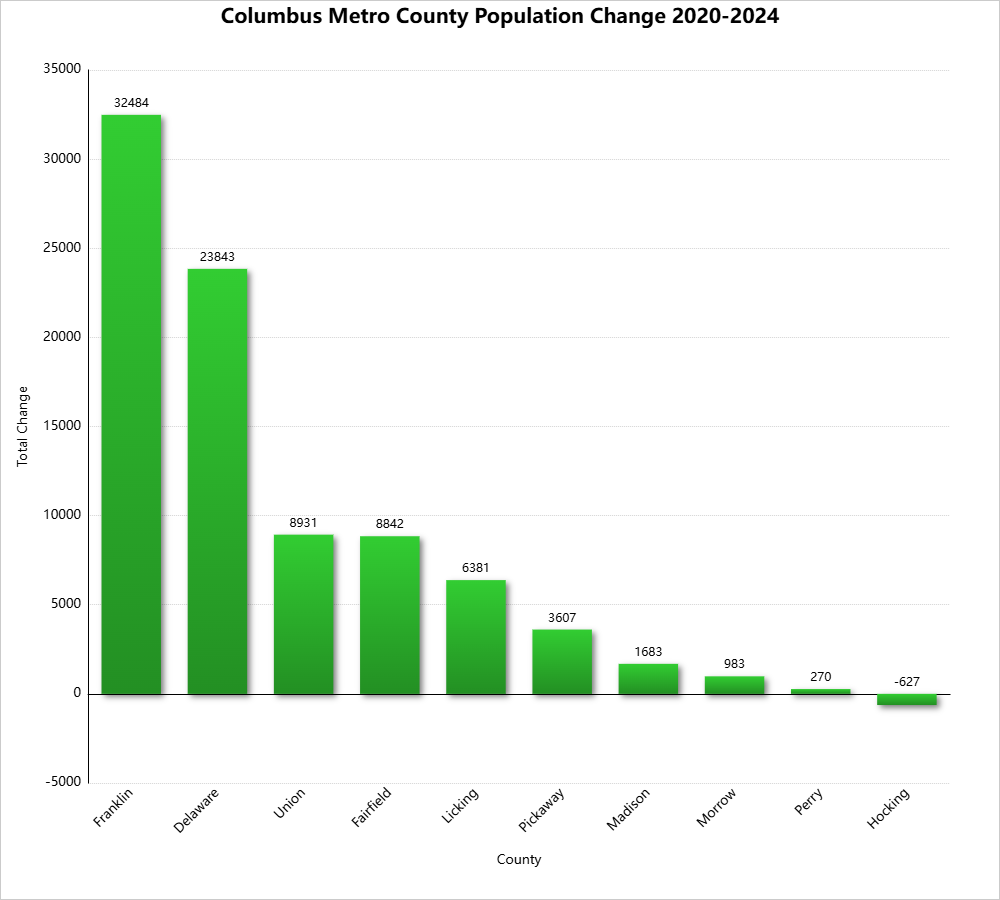
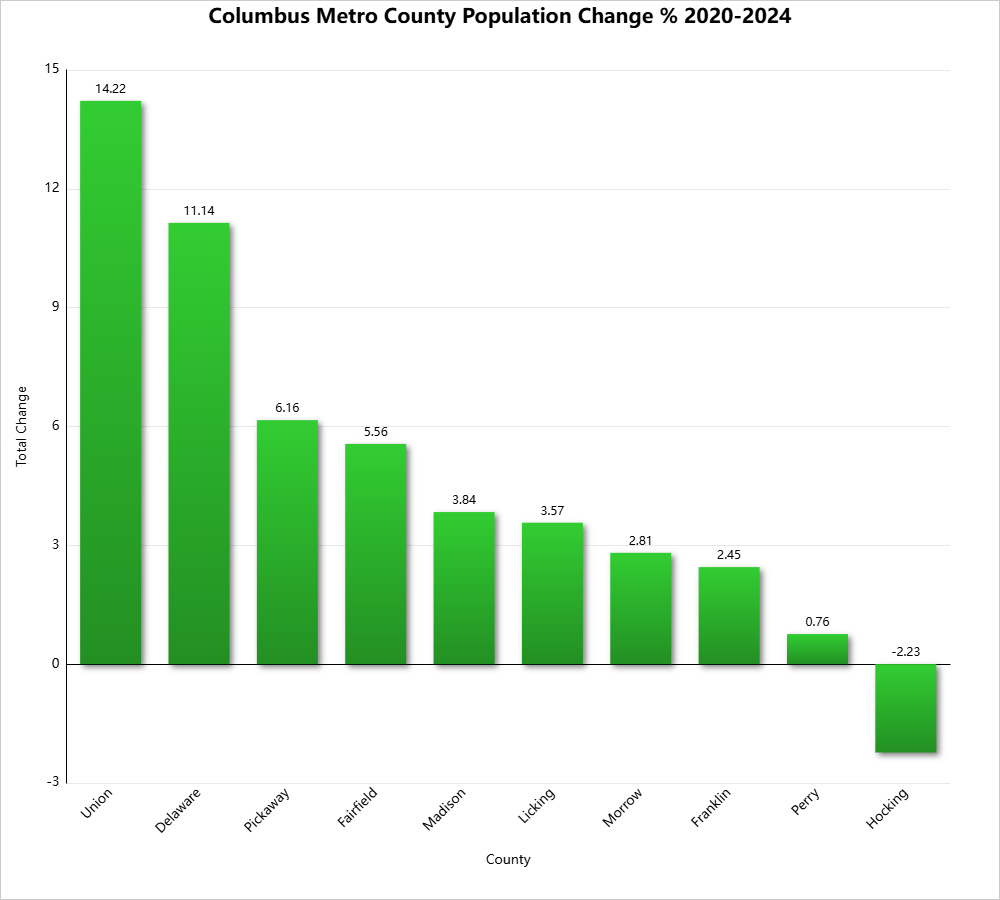
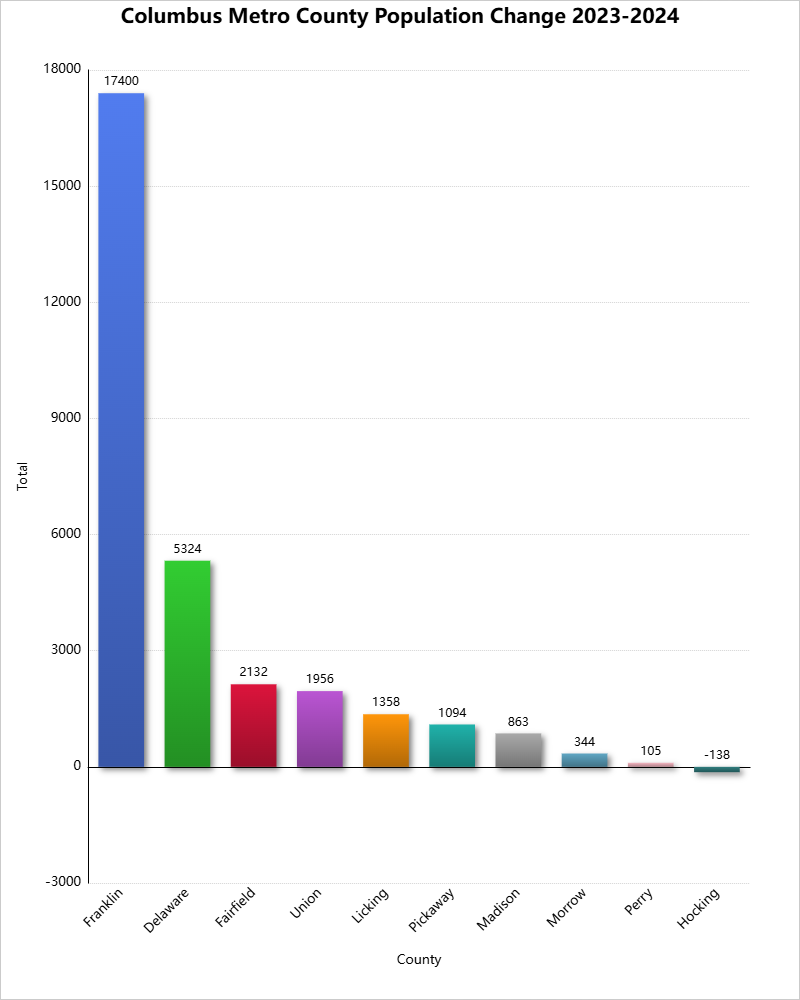
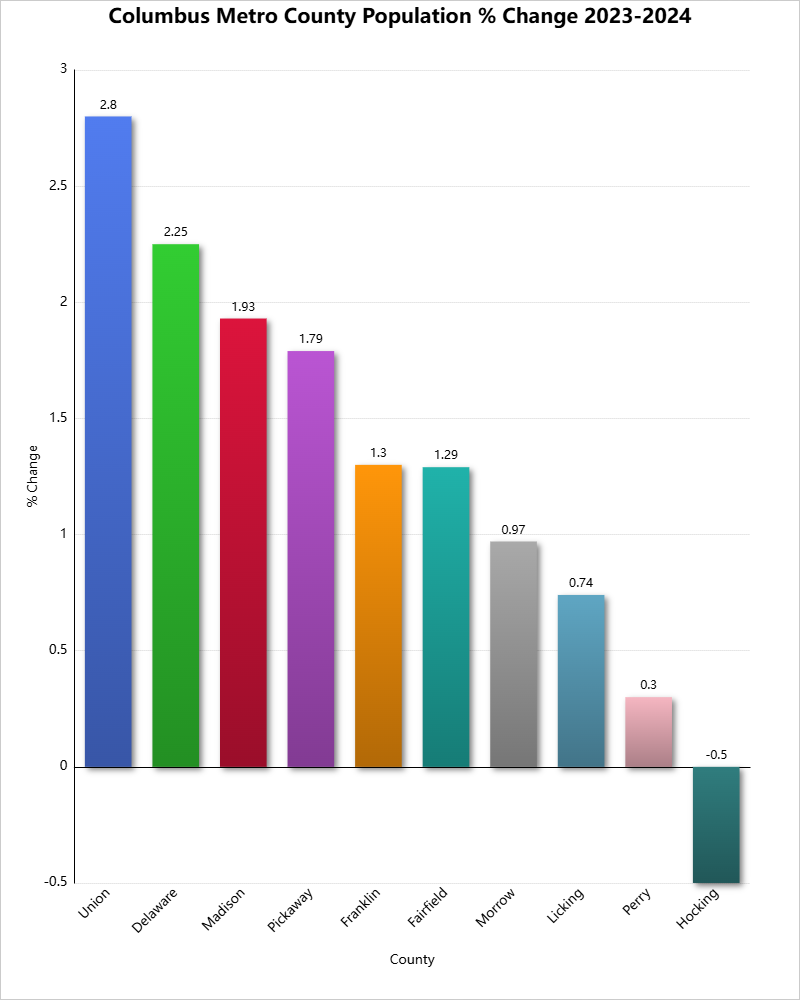
The US Census has released 2024 county and metro population estimates. The estimates generally show a further continuation of the post-pandemic recovery in the numbers. In fact, older estimates have also been revised upwards. Let’s break down the numbers.
Metro County
2020 Census
2023 Population
2024 Population
Delaware
214,123
232,732
237,966
Fairfield
158,920
165,630
167,762
Franklin
1,323,819
1,338,903
1,356,303
Hocking
28,056
27,567
27,429
Licking
178,517
183,540
184,898
Madison
43,848
44,668
45,531
Morrow
34,944
35,583
35,927
Perry
35,412
35,577
35,682
Pickaway
58,551
61,064
62,158
Union
62,790
69,765
71,721
As you can see, all counties but Hocking grew in both the 2020-2024 and 2023-2024 periods. Most of the estimates were improvements over the 2023 version, as mentioned. For example, Franklin County’s estimates population in 2023 was 1,326,063, but the 2024 version for 2023 was revised to 1,338,903, indicating growth was significantly stronger than originally estimated.
Franklin County continued its very long run of being the top county in the metro for total growth.
The US Census has begun releasing 2019 population data, which will be the final data before we get the official, decennial census statistics for 2020. With Covid-19 ravaging the world and United States at the moment, it remains to be seen what effects it might have on the census counts, or if the official census may even end up delayed. While we wait for those issues to resolve, here are the 2019 Ohio county population estimates.
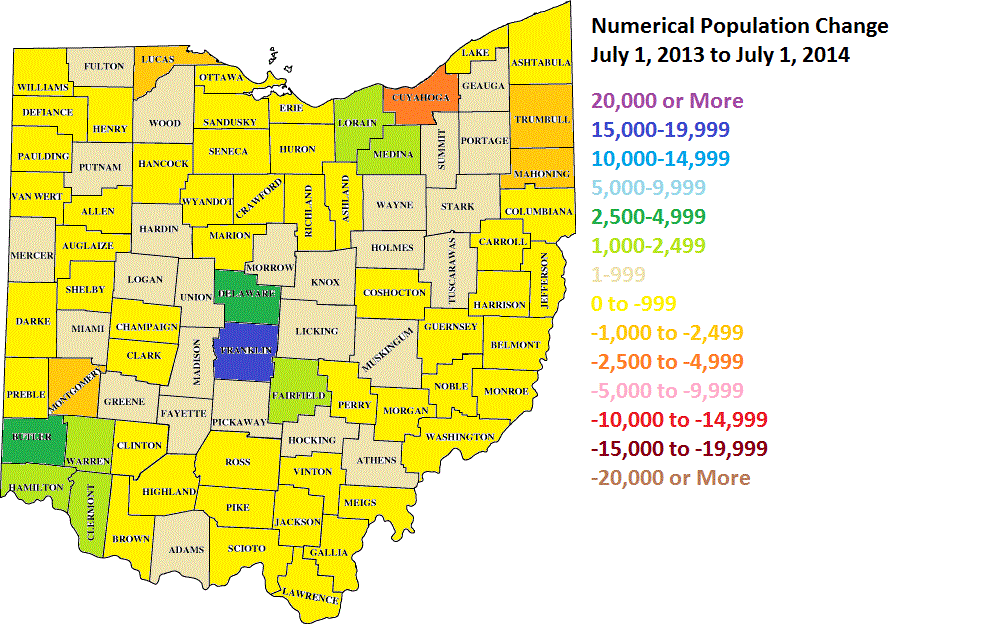
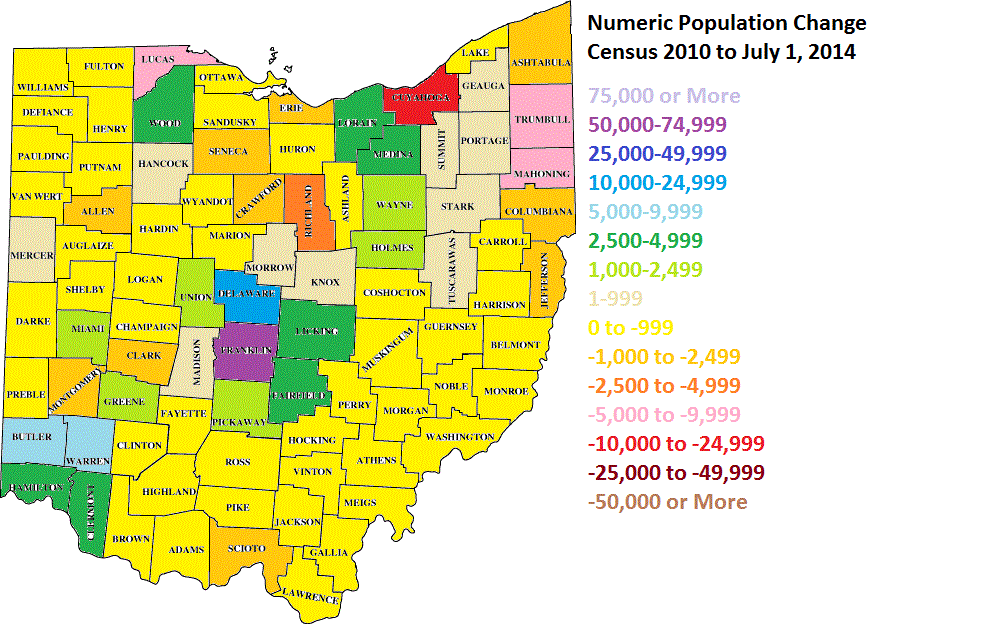
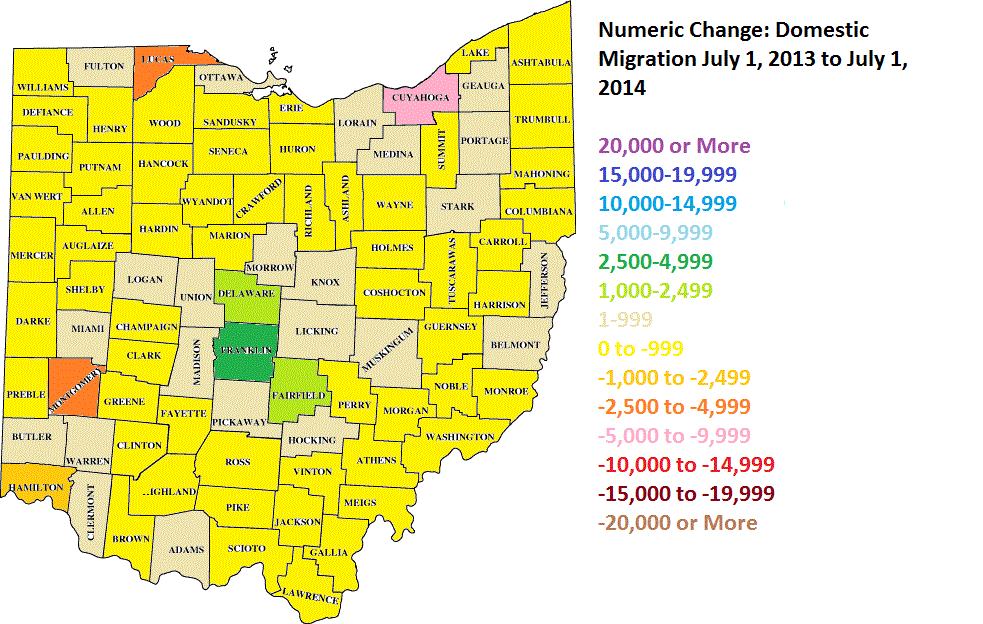
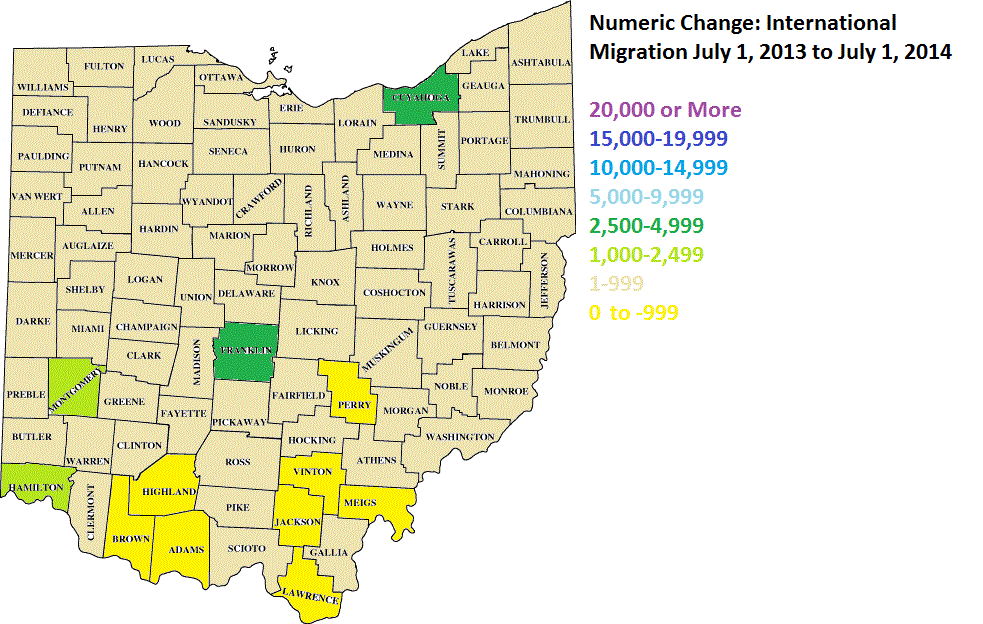
New 2014 county population estimates were released Thursday by the Census. Franklin County had its 2nd highest growth year since 1970 and within a few years of passing Cuyahoga County to become the most populated in Ohio.
New 2012 metro and county population estimates have been released by the US Census, so we’ll break down the numbers and see if any trends pop out.
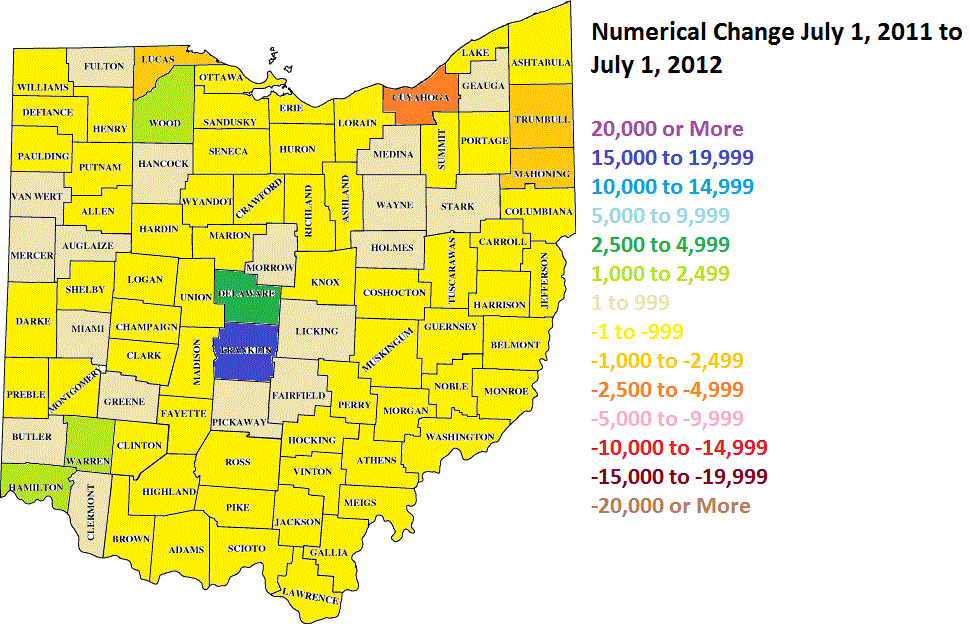
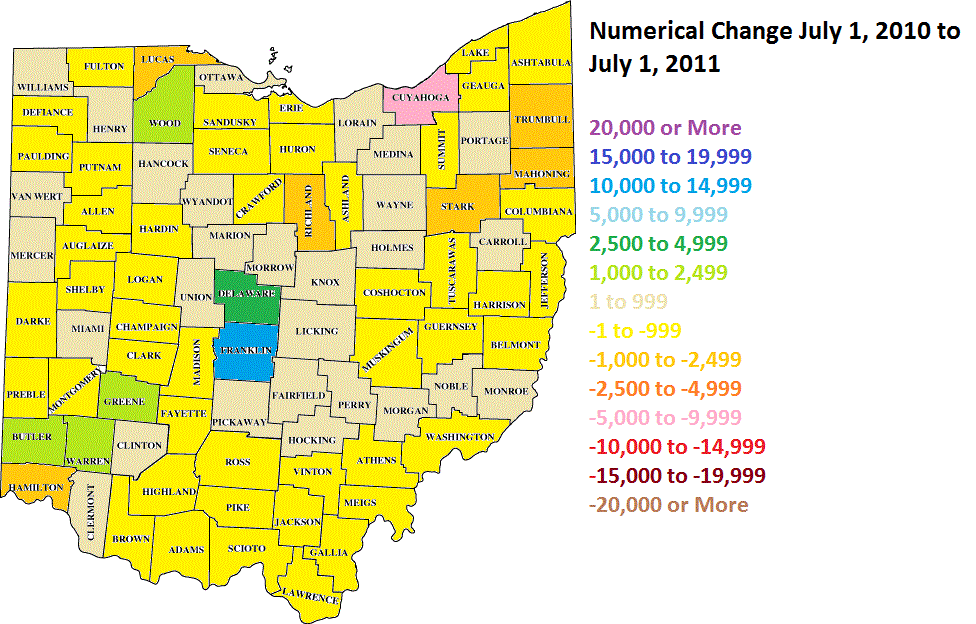
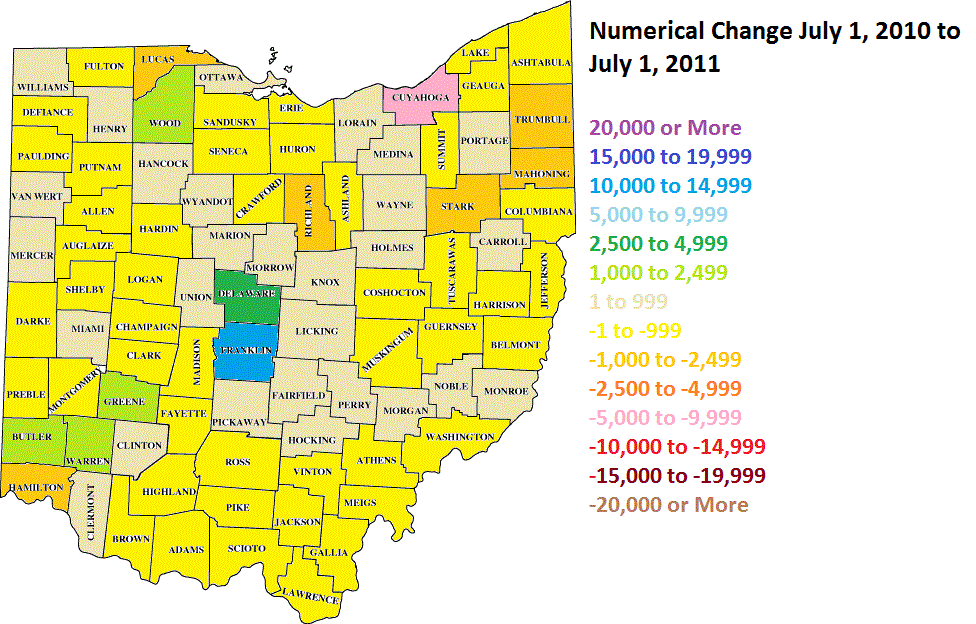
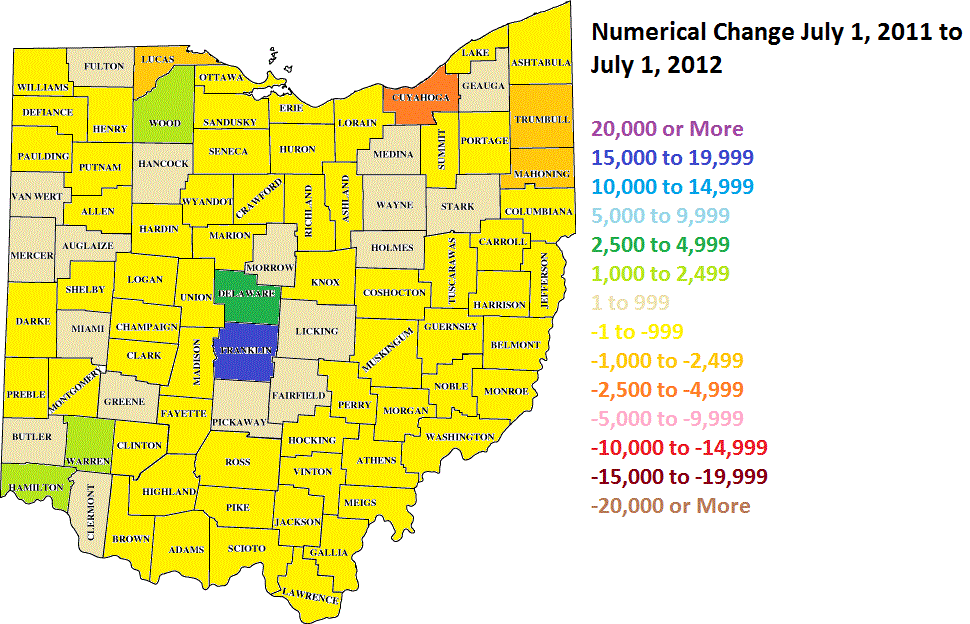
First the statewide county maps for numerical change for 2010-2011 and 2011-2012. Some good and bad with these. The bad is that fewer counties were estimated to be growing from 2011-2012 than were in 2010-2011. The good news it that central core counties improved their growth or slowed their losses, such as Franklin, Cuyahoga and Hamilton. This may mean that population is consolidating around urban cores rather than being spread out… or it may just mean that more counties are losing population.
If we take every county estimate, Ohio grew by 10,502, which is a slight improvement from 2011′s 8,447, which itself was faster than 2010′s 7,608. Still very slow, but seemingly getting a bit better each year.
As far as the metropolitan areas, their boundaries were changed last week as new definitions for what constitutes a metro area were introduced. This produced some rather drastic changes to metro areas and their populations.
Old and New Metro Boundaries and their Old and New Populations Akron: Did not change boundaries and still consists of Summit and Portage counties. 2011: 702,854 2012: 702,262
Canton: Did not change and is still Stark and Carroll counties. 2011: 403,164 2012: 403,455
Cincinnati: Added Union County, Indiana, but dropped Franklin County, Indiana. 2011: 2,122,330 2012: 2,128,603
Cleveland: Did not change and is still Cuyahoga, Lake, Lorain, Geauga and Medina counties. 2011: 2,068,397 2012: 2,063,535
Columbus: Added Perry and Hocking Counties. 2011: 1,925,137 2012: 1,944,002
Youngstown: Did not change, still Mahoning, Trumbull and Mercer County, PA. 2011: 561,697 2012: 558,206
As you can see, 5 of the 8 are losing population, though most had slower losses in 2012 than they did in 2011. This may also be a sign of population moving toward the urban centers, or again, could just be a blip.
One of the interesting pieces of data about the metro areas is the section on components of population change, meaning where did the growth or loss come from.
Total Metro Births July 1, 2011 to July 1, 2012 and Rank 1. Cincinnati: +27,374 2. Columbus: +25,910 3. Cleveland: +22,484 4. Dayton: +9,414 5. Akron: +7,418 6. Toledo: +7,285 7. Youngstown: +5,446
Total Metro Deaths July 1, 2011 to July 1, 2012 and Rank 1. Cleveland: -20,290 2. Cincinnati: -18,204 3. Columbus: -14,457 4. Dayton: -7,930 5. Youngstown: -6,811 6. Akron: -6,756 7. Toledo: -5,678
Natural Change (Births vs Deaths) July 1,2011 to July 1, 2012 and Rank 1. Columbus: +11,453 2. Cincinnati: +9,170 3. Cleveland: +2,194 4. Toledo: +1,607 5. Dayton: +1,484 6. Akron: +662 7. Youngstown: -1,365
Domestic Migration July 1, 2011 to July 1, 2012 and Rank 1. Columbus: +2,688 2. Akron: -2,248 3. Youngstown: -2,341 4. Dayton: -2,717 5. Toledo: -2,931 6. Cincinnati: -6,036 7. Cleveland: -10,579
Columbus is the only metro seeing positive domestic migration in Ohio.
International Migration July 1, 2011 to July 1, 2012 and Rank 1. Columbus: +4,729 2. Cleveland: +3,555 3. Cincinnati: +3,217 4. Dayton: +1,175 5. Akron: +1,009 6. Youngstown: +778 7. Toledo: +676
Total In-Migration July 1, 2011 to July 1, 2012 and Rank 1. Columbus: +7,417 2. Youngstown: -974 3. Akron: -1,239 4. Dayton: -1,542 5. Toledo: -2,255 6. Cincinnati: -2,819 7. Cleveland: -7,024
Canton is the only other Ohio metro that saw a net postive in-migration for the time period besides Columbus.

 [Source: U.S. Census Bureau]