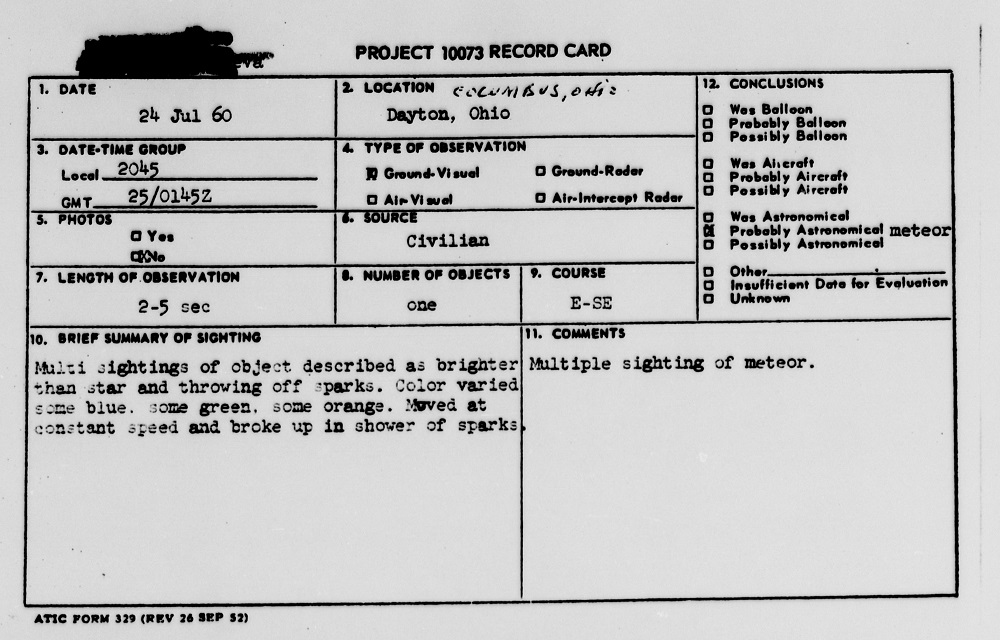
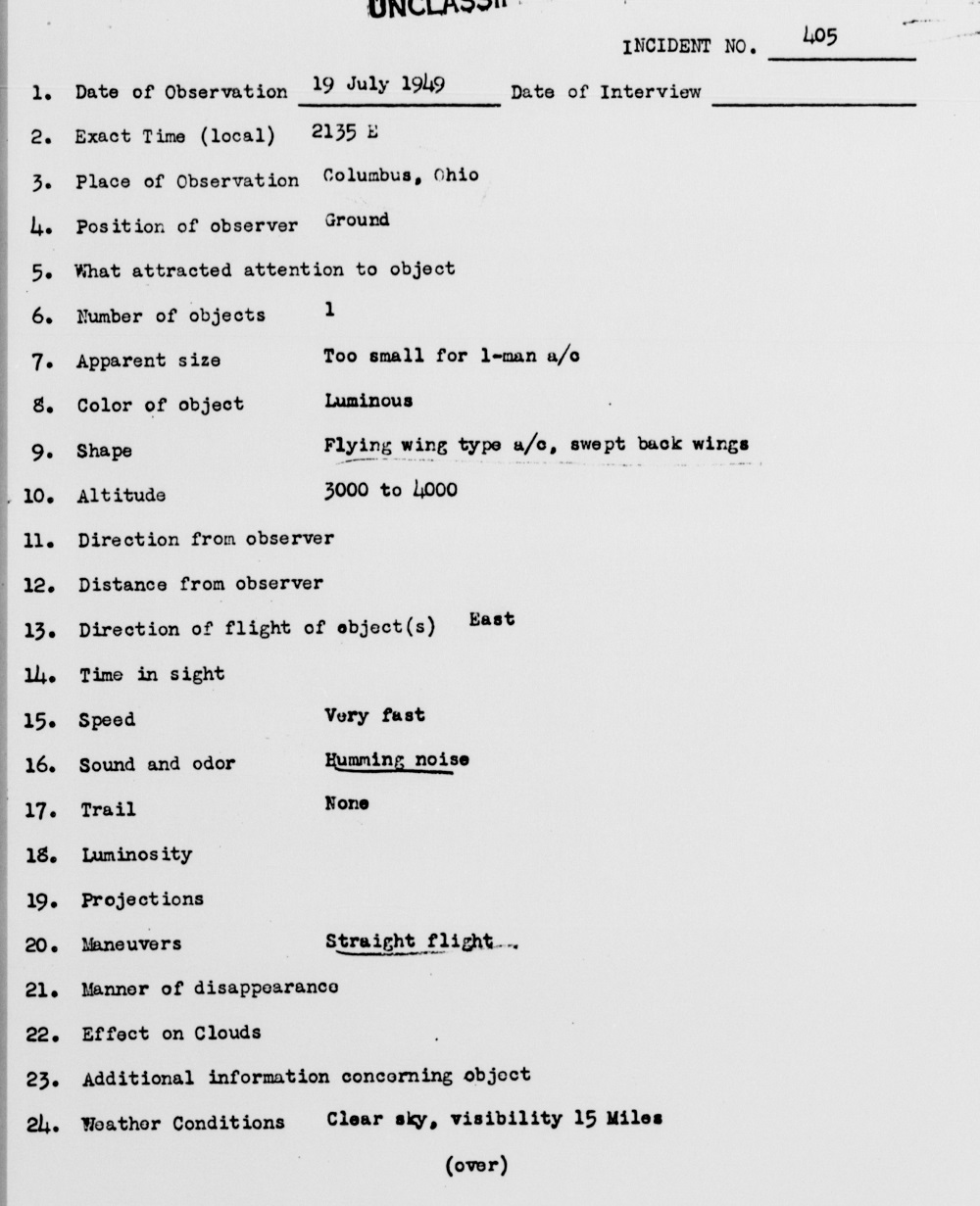
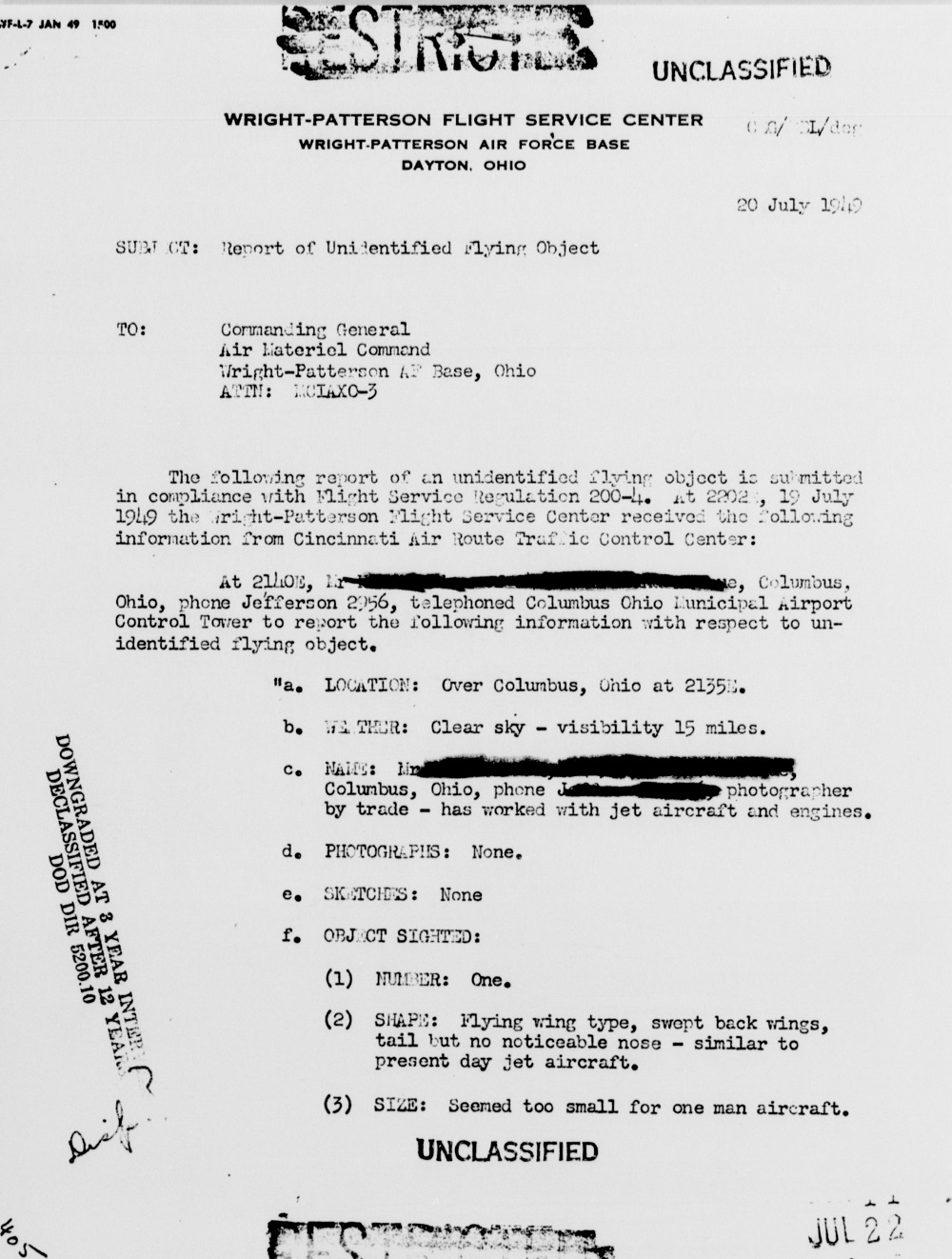
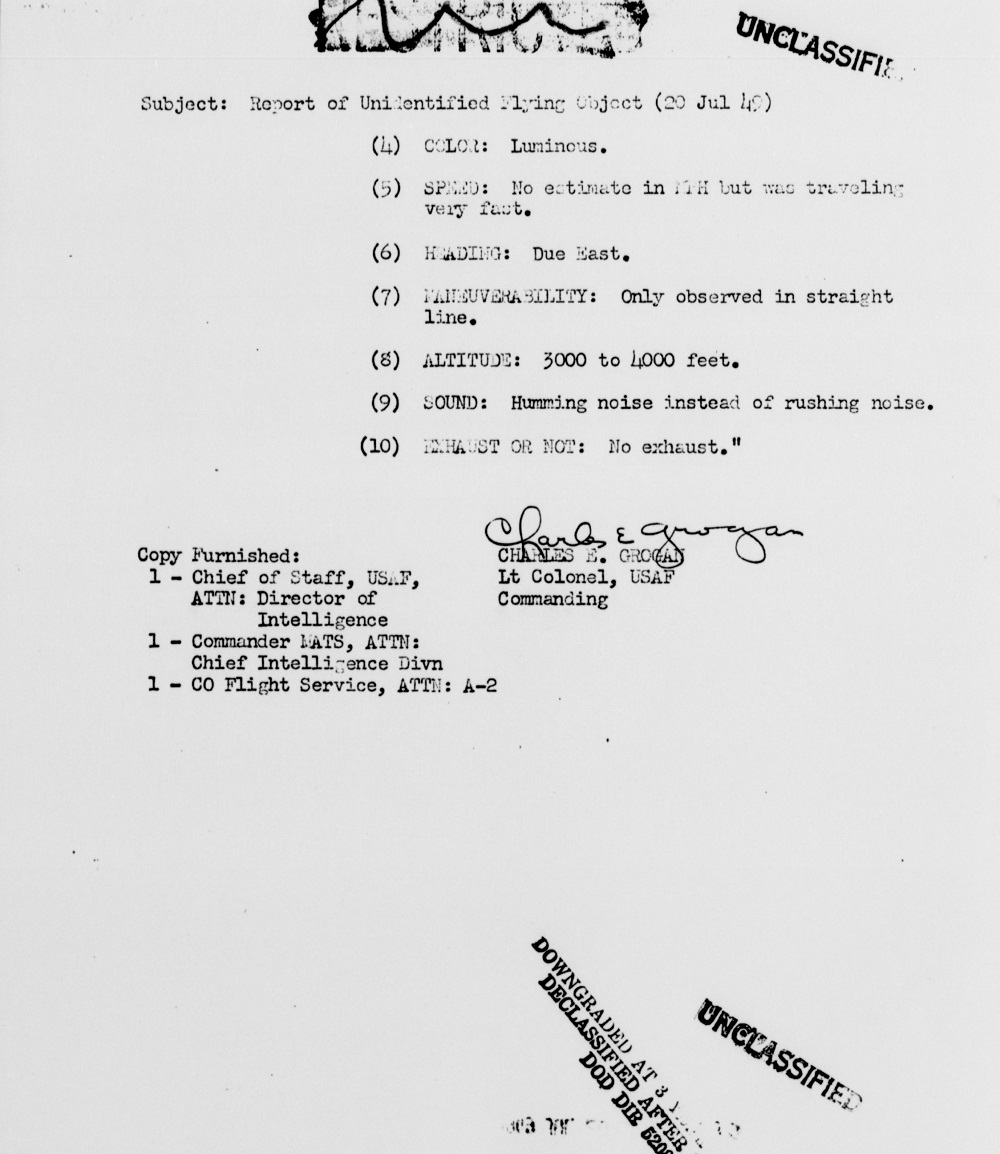
The July 24, 1960 meteor occurred during the early morning hours, and at first was reported to Lockbourne AFB as a possible UFO. The case was actually investigated as a Project Blue Book case, but the description and multiple eyewitness reports across the region supported that this was a meteor.
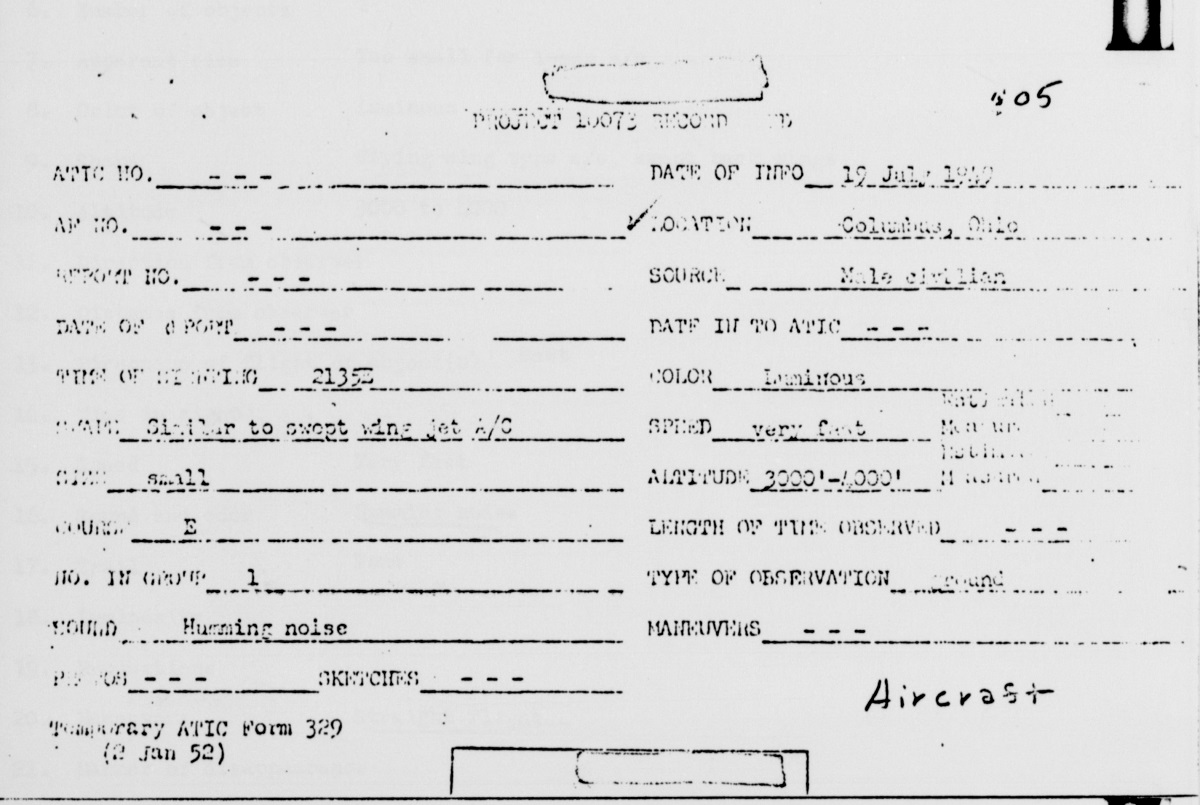
Unfortunately, much of the original report notes beyond the introductory page have faded to the point where it is difficult or impossible to read them. Still, the forms are provided below in a PDF. Perhaps someone is able to make out more than I could. Full Report
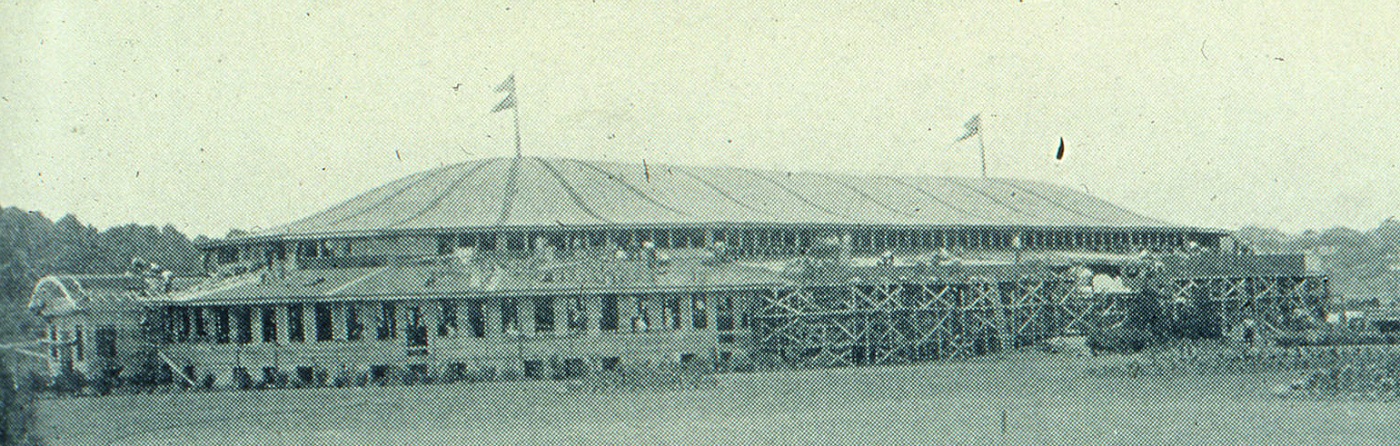
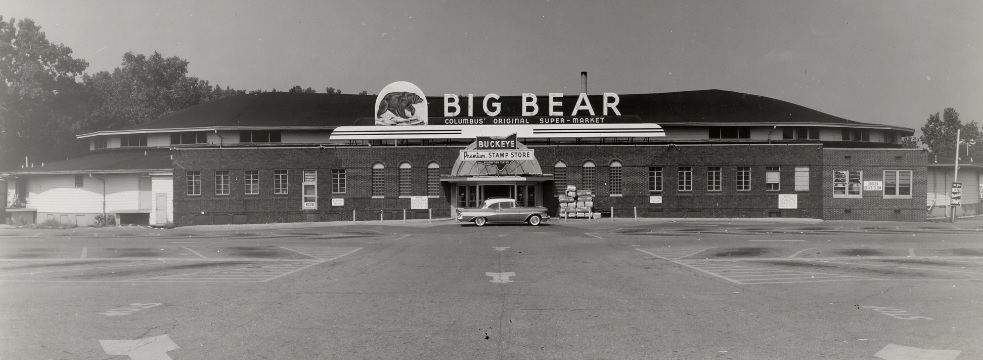
This edition of Before and After Big Bear’s First Store, we look at the chain’s original location. Big Bear grocery stores were founded in November, 1933 in Columbus. The first store in what would eventually become a significant regional chain, was located at 386 W. Lane Avenue. The building was originally built as the “Crystal Slipper” ballroom, which opened in June, 1926. The ballroom was designed to hold 7,000 people and was called “America’s Most Beautiful Ballroom” by the developer, the Stadium Ovals Company. The ballroom itself was open less than a year, and the building was later used for various purposes into the early 1930s.
The Crystal Slipper finishing construction in 1926.
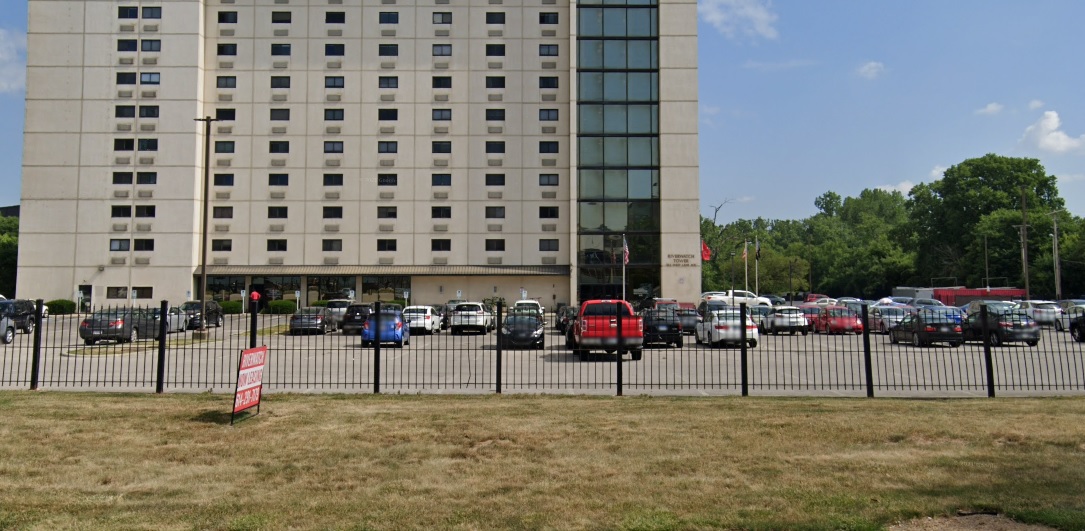
Big Bear would purchase the building and renovate it into a grocery store over the winter of 1933-1934. The location subsequently opened on February 15, 1934. The 47,000 square foot store was said to have attracted 200,000 people on opening day, the success of which allowed the company to open a second store less than a year later. Before: The first Big Bear store sometime in the late 1950s-early 1960s. Big Bear was quite innovative for its time. It was the first self-serve supermarket in the Midwest and the first to use grocery conveyor belts for cashiers, for example. The company eventually grew to include about 100 locations. Ironically, a company that started as innovative ultimately failed because of a lack of innovation and maintenance of quality and service. In 1989, the company was purchased by Penn Traffic, a company that already owned several other chains in the Midwest. Unfortunately, it didn’t exactly have the cash to be buying the chain, and loaded Big Bear with debt. In 1993, newly-appointed CEO Philip Hawkins began cost-cutting measures. These measures included reducing staff and staff hours, and lowering product quality. Store conditions deteriorated and customers began choosing other supermarket chains. By 2003, the company was being run into the ground. Customer volume had dropped to where the company could no longer pay vendors, so shelves were regularly empty of many products. This was the final death spiral. In 2004, Penn Traffic filed for bankruptcy and all remaining Big Bear stores were closed. After: This 2021 image shows the site today. This particular location closed long before the company did- it closed in 1985 and the original building was demolished. Several years later, the current Riverwatch Tower was constructed on site.
Next month, AllColumbusData.com will have its 10-year anniversary. Hard to believe! Here are some stats on just some of what the site now contains: -338 published posts. 10 additional are already complete and scheduled over the next few months. -105 specific content pages. -Well over 2,000 individual and before and after series historic photos. -143+ years of weather data for both Columbus and its suburbs. -200+ years of demographic and population data for Columbus and its suburbs. -Information and photos for hundreds of current and past development projects. -100+ videos.
What has been the most visited page, the most popular post over the years? Unfortunately, visitor data was lost prior to 2015 for various reasons. However, here have been the top 10 most popular posts and pages since 2015.
Top 10 Posts and the Year Published 1. Before and After How Columbus Changed in 10 Years 2021 This 2-part series was extremely popular last year, and easily became the most visited in the past 7 years. 2. Questions Answered- Columbus Zip Codes 2014 This post was very popular into 2018, but is now defunct. The information on this post ended up becoming bits and parts of other posts and pages. 3. Columbus Retail History- Shopping Centers 2013 One of the oldest posts on the site, it still gets consistent traffic almost a decade later. 4. Columbus Historic Church Demolition 2021 This one detailed plans to demolish an old church on the South Side. 5. Columbus Area Murders by Zip Code 2008-2015 2016 Pretty explanatory. This post provided crude maps of murders by zip code. 6. Columbus’ Greatest Snowstorm 2021 This post gave an account of the March 7-8, 2008 blizzard. 7. Columbus Area Zip Codes and Their Economies 2013 Still a consistent hit after a decade, this post gave details on economic information by local zip code. 8. Winter 2020-2021 Review 2021 Review the 2020-2021 winter with stats and rankings, something that has been done for all winters since 2014. 9. Franklin County Gentrification Trends 1990-2015 2017 This post looked at how income and race changes were driving neighborhood gentrification around Columbus. 10. How We Should Develop Around Intel 2022 The most recent on this list, this post deals with how the area around the Intel project should have a development plan, and detailed a hypothetical map of what that development could look like.
Top 10 Pages 1. Columbus Tornado History The most popular by far, this page covers historic tornadic events throughout the entire Columbus Metro Area. 2. Olde Towne East Historic Buildings This has been the most popular of all the Historic Building Database pages to date. 3. Proposed Development This regularly-updated development page highlights the region’s many proposed projects. 4. Other Residential Historic Buildings This page was one of the very first to be included in what would eventually become the Historic Building Database. It is defunct now, as its photos were eventually divided into a much greater expansion of featured neighborhoods. 5. Development Under Construction All the projects currently under construction at any given time. 6. Census Tract Maps Demographics, population and other data at the census tract level are provided in interactive maps going back to 1930. 7. Winter Storms This page chronicles significant winter weather events from the past. 8. Columbus Flood History As above, but dealing with flooding events. 9. Columbus Crime Statistics Violent and property crime data, maps and demographic data related to Columbus crime are provided going back about 40 years. 10. Completed Development Buildings and projects that were completed at some point in the past are highlighted on this page going back to the 19th Century.
Any surprises in what has been the most popular? Any posts or pages you’d like to see more of? Let me know here or on the Facebook page if you are enjoying the content or would like to see something different!
This link is a great repository of historic photographs of the Ohio State Campus area, including High Street and neighboring Weinland Park. There is also a lot of historical information on events, restaurants, buildings and a lot more.