A Glimpse at 1960s Preservation Efforts


In my research into finding photos and information on historic buildings in Columbus, I have come across some interesting documents related to why some buildings were demolished and how 1960s preservation efforts were often failtures. Take the Alfred E. Kelley House, which once stood at 282 E. Broad Street. Built over the course of about a year between 1837-1838, the house was a classic Greek Revival. Over the many years of its existence, the house functioned in multiple capacities, including as a school. During those other uses, the architecture was drastically altered, and by 1960, the year the house was proposed to be demolished to build the Christopher Inn, the historic nature had been “severely damaged”. Still, the house had survived 122 years by then, and a history-minded group of people got together to try and save it with the intent of restoration and operating a period museum.

1960s preservation efforts Alfred Kelley house

Photo taken in 1898.

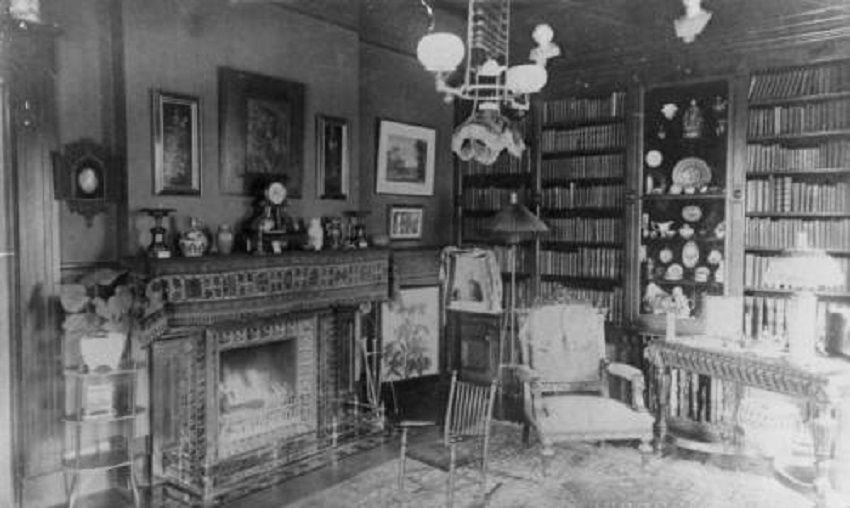
The library in the Kelley House, circa 1900.
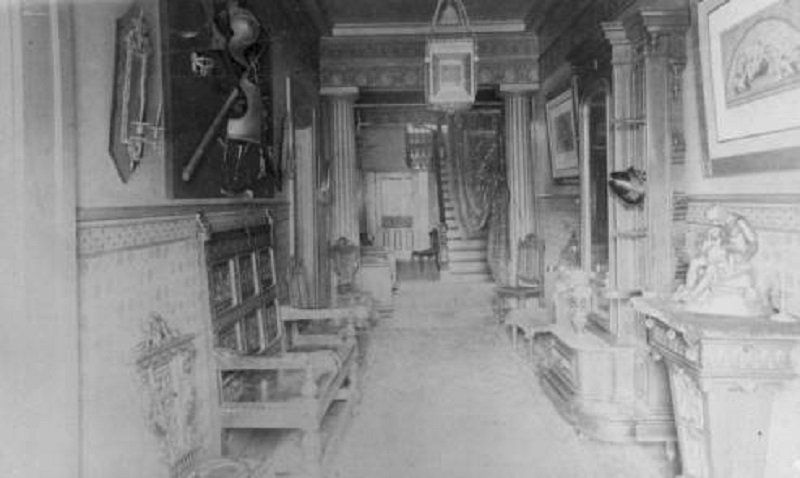
An elaborately decorated hallway in the Kelley House circa 1900.
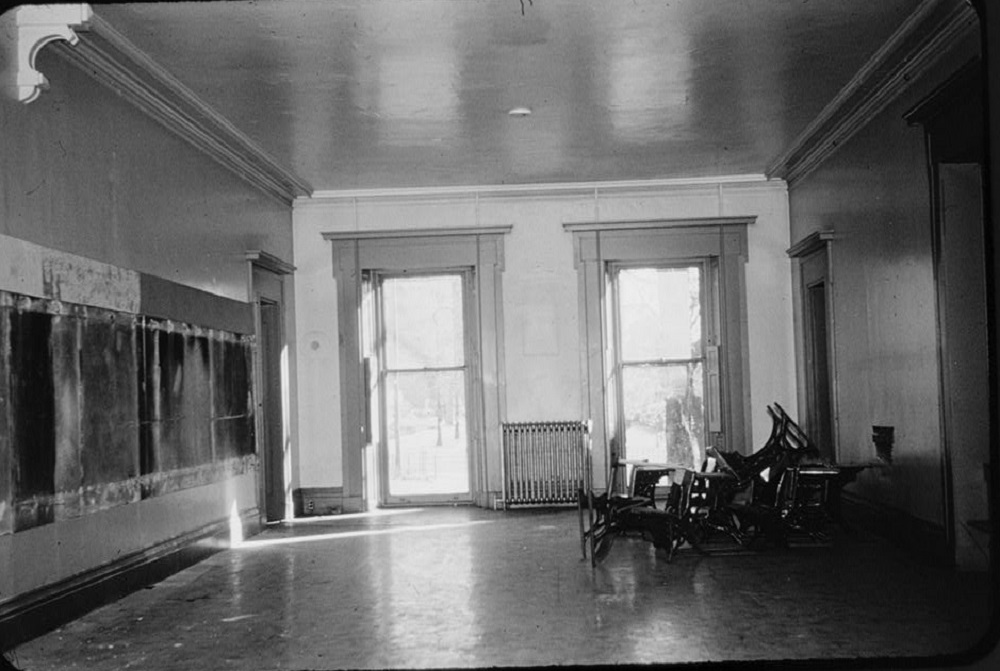
The gutted house in 1958.

In early January 1962, the efforts to save the house during the previous year were detailed by one Dixie Sayre Miller, chairman of the Kelley House Committee, which had been formed on March 24th, 1961. The goal of the committee was as follows:

“Considering the time element and the importance of Kelley to the State**, the committee decided to ask the legislature for money for which to move the house intact. We, later, would seek private money with which to restore it.”

The Committee had some powerful allies at the time. State Rep. Chris McNamara and John Vorys, former delegate to the UN, were both in leadership roles. Given this, even during a time when preservation efforts took a clear backseat to development, the Committee did meet with some initial success. The Kelley House legislative subcommittee was able to pass an appropriations bill in July 1961 for the amount of $95,000. The governor vetoed the bill, calling the appropriation “frivolous”. In August, a member of the Committee, Lee Skilken, had the idea to solicit local contractors to volunteer in taking down the house in order for it to be moved. When the idea was presented to the property owners on September 5th, it was rejected because it could not be guaranteed that the property would be clear in time for construction to begin. Instead, the owners wanted a paid contractor to do the work so that the timeline could be met. The land had to be cleared by October 15th, 1961, and the Committee had to have the money to pay the contractor by September 15th.

Here is where the story becomes a bit shady and political. On September 6th, members of the committee went to the Governor for advice on how to proceed. He recommended that they go to the Emergency Board, which would be able to issue a grant towards the project. The Governor promised he would “not object, would not fight it and would not make a political issue of it”.
On September 15th, the money deadline, the Committee had raised only $11,000 towards the $35,000 cost of the paid contractor. However, the following day, they caught a break. Another contractor came forward offering to take down the house for just $20,000 and would begin immediately. Further, even though the Committee did not have the full $20,000, the contractor trusted that the Committee would have raised the amount by the time the work was completed. I’m not sure if such deals would ever occur in today’s environment, but they still happened 53 years ago.
Only 2 days after the contractor began to take down the house, the Emergency Board awarded a $20,000 grant to the Committee and the house was fully dismantled before the deadline of October 15th. Stonework and foundations of the house were moved to a holding site at Franklin Park, while interior detailing was stored “in a city building”, all waiting for funding to be assembled and restored at a new site. This new site was listed as being in Wolfe Park on “East Broad at Nelson Road”.


So, why isn’t the Alfred E. Kelley house at Wolfe Park today? Two things happened after October 15th. First, the Governor lied. On the very day that the Committee was supposed to pay the contractor, they received a call stating that the Governor had deemed the Emergency Board grant unconstitutional and was withholding the money, despite being his recommendation that the Committee seek the grant from it in the first place. This also after a promise that he would not interfere or stand in the way. The Committee considered legal action, but decided a costly court process was not “advisable”.

Without the $20,000, the Committee was only able to pay the contractor $6,000, who then threatened legal action for the full amount. Since the Committee had neglected to be incorporated, each member was personally responsible for a share of what was owed. By December 1961, the Committee had become incorporated and had managed to pay an additional $2,000, but still owed the majority of the contract.

That concluded the events through January 1962. After that time, there are mysteries that remain unknown (at least as far as I can tell). First, what happened to the Committee? Did it end up raising the amount to pay off the contractor or did they end up in court? Why had the Governor decided to prevent the Committee from getting the grant? Did he have a political axe to grind with members of the Committee? Finally, and far more importantly, what happened to the Kelley House? The materials were in storage in early 1962, but the house was never rebuilt. Were they destroyed? Did the contractor take possession of them if the Committee was unable to pay? Are they still sitting in some warehouse somewhere covered in half a century’s worth of dust? We may never know, though I suspect that someone out there has the answers.
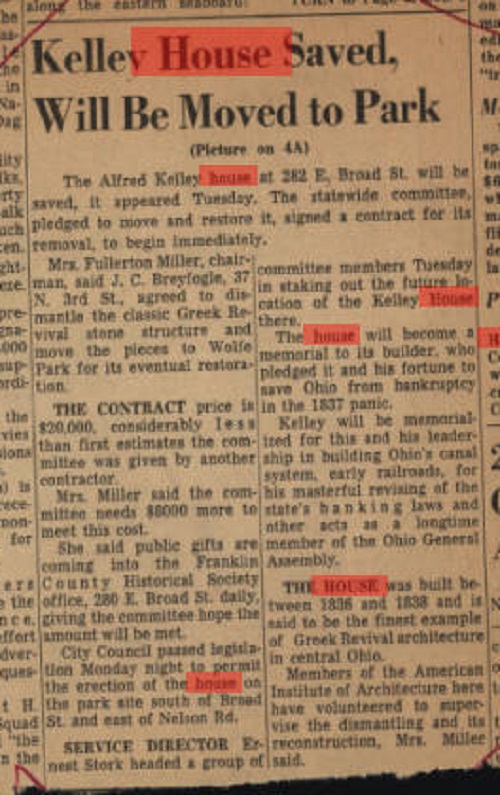
An ironic article in 1961.

**Kelley helped save the state from bankruptcy during the Panic of 1837 by offering up his house, possessions and business interests as collateral.

Edit 7/18/2014:
I guess research pays off, and now, at least some of the mystery is solved, as contacts through readers led me to part of the answer. As mentioned above, part of the house’s remains, particularly the stone and brick portions, were stored at Franklin Park after the demolition in 1961. Five years later in 1966, these were moved to the Ohio Exposition Center at the Ohio State Fairgrounds. By then, the plans no longer called for putting the house back together and restoring it. Instead, the stone materials were planned to be incorporated into a new Ohio Historical Center in the late 1960s, presumably the one that now sits adjacent to the fairgrounds today. But that plan also fell through for unknown reasons. The stone materials were eventually gifted to the Western Reserve Historic Society in Cleveland. Some of the stone was used in the restoration of the Hale Farm, but much of it now sits tossed around outside in the elements, slowly being worn away. This still leaves many questions unanswered, such as where the interior portions of the house ended up and why none of the material was ever reused in Columbus despite preservation interests eventually securing the funds to do so.
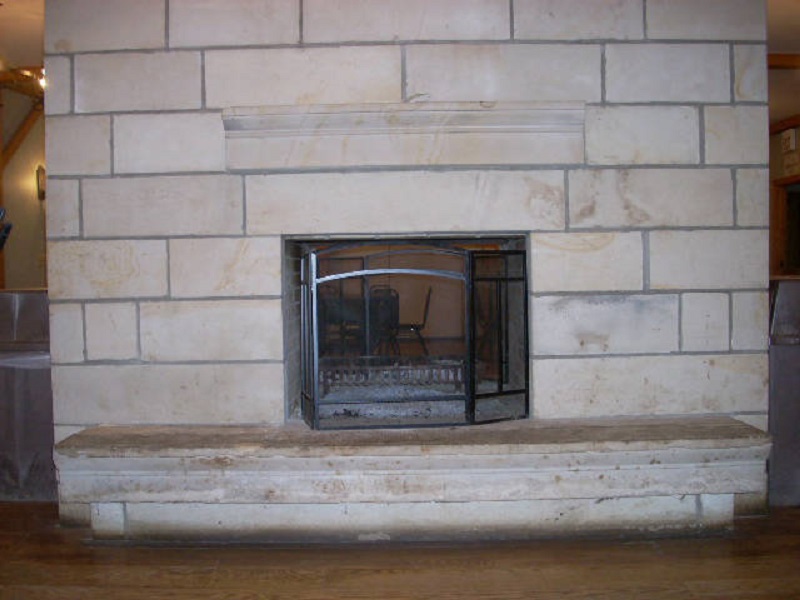
A fireplace at the Hale Farm rebuilt with Kelley House stones.
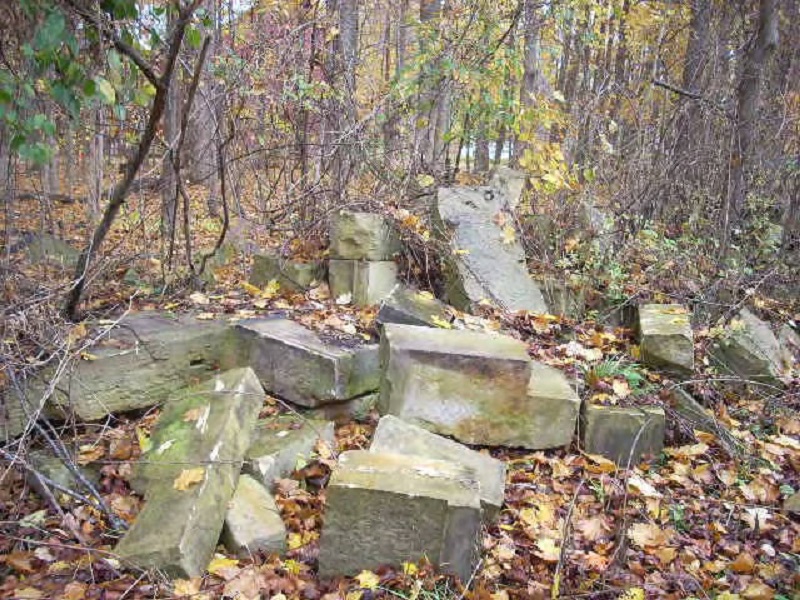
Kelley House stones in the elements at Hale Farm near Cleveland.


Disastrous Decision for the Columbus Convention Center


I’m not a complainer… or at the very least, I don’t prefer to be. That said, there are simply times where negativity makes perfectly logical sense, and where it can serve a real purpose for true positive change. That is arguably the case now, with the a very poor decision about the Columbus Convention Center. I’ve not posted too much on my personal views regarding development, but recent events have prompted me to give some of them on this particular project.

Back in March, it was revealed that the Greater Columbus Convention Center leadership had asked the local development community to come up with ideas for a potential expansion project for the convention center itself. The building was designed by famed 1980s and early 1990s architect Peter Eisenman (who also did the Wexner Center for the Arts), and began construction in 1989 and completed in 1990. Originally, the building included 1.4 million square feet of space, with a large parking lot occupying the southeast corner of the Goodale/N. High Street intersection.
Columbus convention center

In 1999, an expansion pushed the structure north nearly to Goodale, but left enough space for a small plaza there.

So even after the initial construction of the original building, there were obvious problems with the design, not least of which was the pastel color scheme better suited for Miami Beach. The building simply didn’t have any street-level presence. Beyond a few entrances, the convention center’s design essentially created a block-long wall along High Street. There was no ground floor retail, no restaurants and no pedestrian interaction whatsoever. Back in 1989, this was just fine and dandy, because no one really cared about that and hadn’t since the days before WWII. Cities had become showplaces and for big buildings and massive surface parking lots that didn’t actually bring anyone to live there. There was no reason to walk on the streets of the city, and architects certainly didn’t think it was necessary to build for that purpose. The suburbs were the real future, blah blah blah. Everyone knows that story.

Since 1999, the neighborhood around the convention center has been rocketing upward in popularity. The nearby Arena District continued to grow and add development, and the Short North continued to rapidly revitalize and is now the city’s hottest neighborhood. For the past few years, there has been a push to attract more business to Columbus via the center and to highlight all the nearby amenities. To that end, the 12-story, 500+ room Hilton was completed across the street in 2012. The $140 million structure was built with public dollars, as a private developer did not step forward when the idea was put forth. The project was somewhat speculative, as the demand for hotel space in the city was not particularly high enough to warrant the construction (a good reason why private development hadn’t shown up), but because the city understood that hotel space was part of the key to attract bigger and better convention events, the hotel went up and Hilton came in to run the space.

The gamble seemed to be paying off, and in January, the Columbus Dispatch came out with an article about the hotel’s success. In the article, there was even the mention of adding even more hotel space, possibly up to 1,000 additional rooms, at some point in the near future.

So when the convention center authority announced it was searching for ideas for a new expansion project, that reality seemed to be taking place. In late March, there was this bit of news. Four separate proposals had been submitted by private developers on ideas to develop the north end of the convention center, along with the surface parking lot north of Goodale behind the 670 retail cap. The most prominent idea came from Wagenbrenner, with a pair of 15-story, mixed-use towers that would’ve included more than 100 residential units, hotel and event space, and ground-floor retail along High Street, an element the original building severely lacked.

Columbus convention center Wagenbrenner proposal

Wagenbrenner Development’s proposal.

Columbus convention center Wagenbrenner proposal rendering 2

Wagenbrenner Development’s proposal, looking southeast from High and Goodale.

Another proposal from Kaufman was far more modern, but still retained mixed-use elements.

Columbus convention center Kaufman proposal

The Kaufman proposal, looking east on Goodale.

In Wagenbrenner’s case, a hotel chain had already stepped forward interested in running the hotel aspect of the project, and there seemed little doubt that one of the proposals would move forward, based on quotes from the convention center authority and their stated goal for a “big idea” sort of project moving forward. The selection of the design would be announced in a few month’s time.

So what was the result of all that? On June 12th, 2014, an article in the Dispatch came out detailing a renovation and expansion project for the convention center.
The problem was that the article did not mention any mixed-use project whatsoever. Instead, it called for a general total-building renovation and a small 30,000 sf expansion and entranceway into the plaza space at the southeast corner of High and Goodale. Additionally, an 800-space parking garage would be built in the surface lot behind the 670 cap.

Wait, what?? When the article initially came out, there was confusion by many in the development-following community on just what was going on. Part of the confusion stemmed from the fact that the convention center authority had already announced a renovation project just 2 weeks prior to the release of the information on the mixed-use expansion project. That announcement had mentioned only a $30 million renovation, not the much larger one announced on June 12th. There had also been mention previously of the garage project, back in late 2013. In that discussion, the garage was being looked at to get ground-floor retail, especially closer to High, to take advantage of the neighborhood’s high walkability and retail success.

So at first, it was assumed that the garage and renovation project was a separate issue from the larger proposed expansion, but the article on June 12th specifically mentioned the very same land that the proposed mixed-use towers would’ve used. The following day, on June 13th, the Dispatch came out with a second article about the $125 million renovation/expansion project, and in it near the bottom, was this damning paragraph:

Jennison said the expansion of the convention center rules out earlier ideas of adding shops and residences to the north end of the facility, including the possibility of more hotel space. The authority’s board sought proposals for such a project earlier this year before ultimately ruling them out.

Suddenly, the 2-tower project had been swept under the rug and abandoned. Worse, it had been abandoned in favor of new carpets/fresh paint, a glorified 2-story entrance on Goodale, and a 1970s parking garage with no retail at all.

Columbus convention center parking garage

The parking garage proposal on Goodale behind the 670 retail cap, part of the convention authority’s new plan.

To say that there was some disbelief that such a decision had been made is putting it mildly. Across development forums, and even on the Dispatch articles themselves, the negative reaction was swift and universal. How and why had such a promising proposal for the convention center turned into the height of mediocrity? And why had potential fully private or a private/public funded project turned into a 100% publicly funded fiasco? The answer, it seems, is likely staring us in the face: The Hilton Hotel. Though it hasn’t been confirmed either way, there is an element of suspicion against the Hilton for obvious reasons. The Hilton is publicly financed and was publicly built. To have a private company build a competing hotel may have taken away business, and the convention authority was not interested in allowing competition for a public enterprise. There are precious few other logical reasons why the convention authority would actively seek private investment only to toss those proposals out a few months later in favor of a project that had no competing elements to it.

Worse still, the convention authority knows it’s a terrible plan in comparison. On June 15th, yet another article on the project appeared in the Columbus Dispatch.

In it, the idea is pushed forth that the renovation plan will be transformative, and will keep Columbus competitive for convention business. The problem is that it’s neither transformative nor competitive. Granted, the convention center is in need of renovations, as much of the interior is dated. But to spend $125 million on that renovation, combined with a laughably bad expansion/garage rather than actually going with, at the very least, a partially privately-funded project that would’ve actually improved Columbus’ competitiveness along with adding much needed pedestrian access and excitement to the intersection in question… well, it’s insanity. And the 3rd article only suggests that the convention authority is well aware of the overwhelmingly negative reaction to their plan and are attempting to justify it as much as possible. Only there can be no real justification. Bad decisions remain bad decisions. Whether this one was made to prevent competition or is simply an example of being out of touch with a stated goal, the convention center authority has made one of the worst decisions in Columbus development history… and that was after the city allowed Union Station to be demolished. Shame on them.


Residential Construction Trends of Columbus in One Graph


We’ve been hearing a lot the last few years about how residential construction has largely turned toward the rental variety, and no more so than in the urban areas. I have tried to document the level of activity in the city in my development page, but it doesn’t quite show what’s going on in the city overall. I did a little research and found some surprising realities that fully support the rental boom. The residential construction trends of Columbus have changed significantly in recent years.

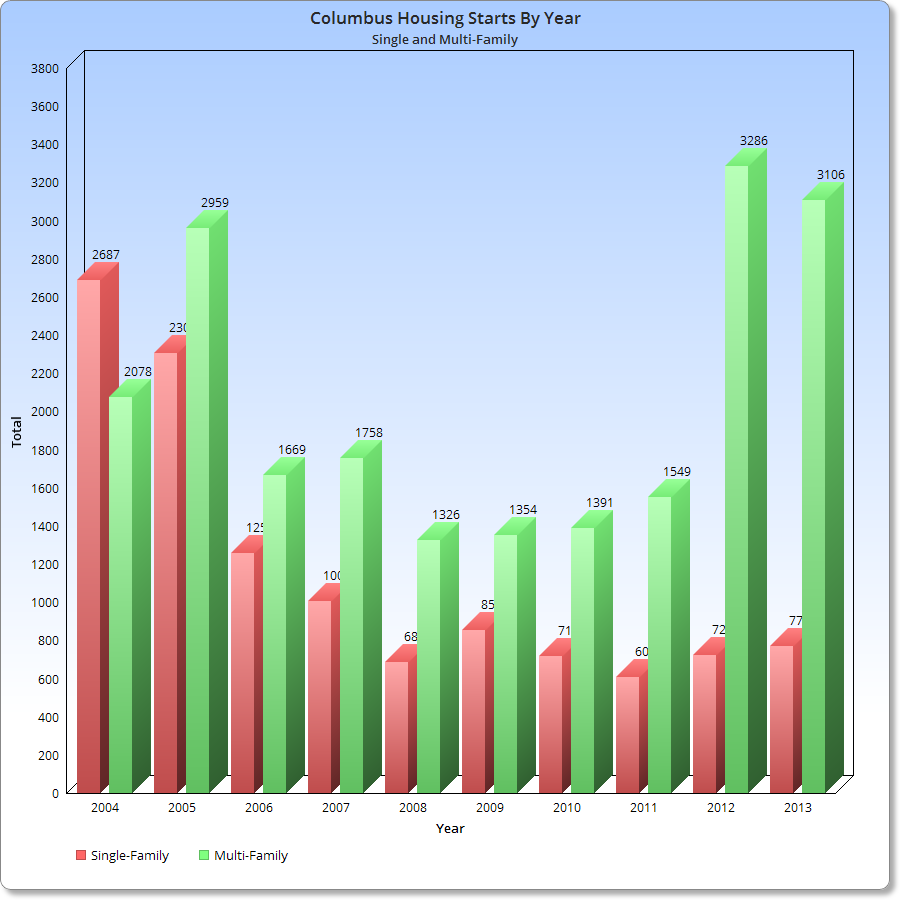
Here is a graph of annual housing construction permits from 2004-2013 broken down by multi-family and single-family types.

The chart above is based on the # of units, not the number of overall projects.

So what do the numbers say? Well, it raises some interesting questions. First, was the amount of single-family home construction on the decline before 2004 given the downward trend from that year through 2005? And was multi-family construction on the rise during the same period? Did the recession merely interrupt a trend that began more than a decade ago and resurfaced strongly in recent years? It’s hard to say for sure as I don’t have information before 2004, but regardless, it is clear that multi-family construction is the preferred residential preference right now by builders. Single-family home construction, however, has remained steady and well below its previous peak of the last decade.

This continued low level of single-family construction has likely contributed to the fact that area sales in that market have been down for several months now due to a lack of inventory. Prices, however, have risen.


2013 Residential Projects and the Year Ahead


2013 residential projects

2013 was a pretty significant year for Columbus, if only because it saw its busiest residential developmentyear in and around the urban core in many years. Here are the highlights of some of the biggest 2013 residential projects.

1. The South Campus High Rise and Addition Project
# of New Units: 360
Project Cost: $171.6 Million
Project Height: 7-8 Stories in Multiple Buildings
Some might suggest that this isn’t strictly a residential project because it was student housing. However, I disagree with that. The projects added significant additions to already existing Park, Stradley, Steeb and Smith Halls by connecting the pairs together with what essentially amounted to a brand new building stuck in-between. It also involved significant renovations to other residential buildings in South Campus. This was the first part of a major renovation and expansion project for housing on OSU’s campus.

Some links to this project complete with site maps and construction photos:
http://fod.osu.edu/projects/s_res/2010_7-26.htm
http://www.columbusunderground.com/forums/topic/south-campus-high-rise-additionrenovation

2. HighPoint at Columbus Commons
# of New Units: 302
Project Cost: $50 Million
Project Height: 6 Stories in 2 Buildings
HighPoint was a rather unexpected surprise for Downtown. When Columbus Commons was being constructed, the plan called for residential buildings running along High Street on the west side of the park. Unfortunately, that plan was not supposed to happen for perhaps a decade or more, depending on development interests. Within a year of the completion of the park, however, HighPoint was being proposed. While not exactly the most inspired design or preferred height for such a prominent location Downtown, the projects potential 450+ residents will greatly help the neighborhood’s goal of increased vitality and 24-hour activity. In fact, it may not be too much to assume that this project has encouraged others, such as the 12-story 250 High Project and LC’s double 8-story tower project, both of which will begin construction soon just across the street from HighPoint and the park. Collectively, they will add, at minimum, over 650 new residents.

Links for the project:
http://www.highpointcolumbus.com/columbus/highpoint-on-columbus-commons/photos/

3. Liberty Place, Phase II
Address: 250 Liberty Street
# of New Units: 207
Project Cost: $25-$30 Million
Project Height: 4 Stories
Liberty Place, in the Brewery District, was completed in 2006, the last of a slew of development projects in the Brewery District beginning in the 1990s and came in the middle of a relative quiet period that began when the Arena District stole some of the neighborhoods momentum. That momentum has returned in recent years as urban living has gained significant traction in public opinion. Phase II of Liberty Place was supposed to have been built years ago, but the recession and the uncertainty regarding the exact layout of the rebuilt I-70/I-71 split which runs past the site put the project on hold. All told, Liberty Place now has 342 units.

Links for the project:
http://www.columbusunderground.com/forums/topic/phase-2-of-liberty-place-apartments
http://thelibertyplaceapartments.com/

4. Tribeca
Address: 700 West Third Avenue
# of New Units: 205
Project Cost: Unknown
Project Height: 4 Stories
Tribeca, from Edwards Communities, was built along Third Avenue in the 5thxNW neighborhood. While adding significant density to the area, the project is mostly known for its strange layout. Dubbed the “Fortress” or the “prison”, the project has a long, blank wall along Third Avenue with tower-like structures along it, resembling the fortifications of a prison. The ugly design and lack of interaction with Third because of this layout caused the project to receive a lot of criticism.

A link to the project, the criticism and photos:
http://www.columbusunderground.com/forums/topic/gowdy-field-development

5. Lennox Flats
Address: Kinnear Road, Lennox Town Center
# of New Units: 194
Project Cost: Unknown
Project Height: 3 Stories
Lennox Flats was built over two phases, the first with 92 units and the second with 102. Built in a mostly vacant lot just to the west of Lennox Town Center (across the railroad tracks), these were built in modern-styles and were targeted at students from OSU.

Link with photos:
http://www.columbusunderground.com/phase-two-of-lennox-flats-wrapping-up-this-summer-bw1

6. 600 Goodale
Address: 600 West Goodale Street
# of New Units: 174
Project Cost: Unknown
Project Height: 5 Stories
600 Goodale is likely the most strangely located new project of 2013. It was built on a small strip of land located north of Goodale Street across from White Castle’s HQ building. The location is strange because the land is bordered by the Olentangy River on the west and a highway exit ramp to the north and east sides. In fact, the site sits on a section of land between 315, 670 and major ramps for both to the north. The land is not directly connected to any major neighborhood. Despite the strange location, the modern building was, at last count, 96% leased.

Photos of the project:
http://www.columbusunderground.com/construction-to-wrap-soon-on-600-goodale-bw1

So those were the top 6 largest projects from 2013. More than 2,200 total units were completed in the urban areas of Columbus.

But what’s coming for 2014? Here are the top 5.

1. Jeffrey Park Phase 1
Address: E. 1st Avenue and N. 4th Street, Italian Village
# of New Units: 334
Project Cost: $180 Million+ For all phases.
Project Height: 4 Stories
The Jeffrey Manufacturing site has long been planned for redevelopment. It is, by far, the largest undeveloped site in Italian Village or anywhere in the Short North. Previous plans from the early-mid 2000s fell through, but were revived by a new developer in recent years. The first phase calls for the completion of a mix of townhomes and apartments in a mix of styles. A community center is also planned with a gym and pool. Although this project was supposed to start in the fall of 2013, calls are now for it to begin before winter is over. This may delay the finish for this project into 2015, but for now, it’s still the biggest project for 2014. The entire Jeffrey site will eventually have more than 1,300 new units.

Photos and project information:
http://www.columbusunderground.com/jeffrey-park-will-add-over-1300-new-residences-to-italian-village

2. Taylor House
Address: 5005 Olentangy River Road
# of New Units: 329
Project Cost: Unknown
Project Height: 4 Stories
This project along Bethel Road will go into the site of a former K-Mart. Construction began over the fall and should wrap up toward the end of the year.

Renderings and more information:
http://www.bizjournals.com/columbus/news/2013/09/24/former-kmart-site-at-olentangy-and.html

3. View on 5th
Address: 965 West 5th Avenue
# of New Units: 285
Project Cost: $50 Million
Project Height: 6 Stories
The View on 5th, in 5thxNW, is a 2-building complex along 5th and Holly Avenues. The 6-story building along 5th will contain 153 apartments with ground-floor retail, while the Holly Avenue building would be 3-stories and contain 132 units. The project is scheduled for completion this coming summer.

Link with info and renderings:
http://www.bizjournals.com/columbus/print-edition/2013/06/28/top-end-housing-for-w-5th.html

4. Berkeley House
Address: Bethel Road and Riverside Drive
# of New Units: 256
Project Cost: Unknown
Project Height: 4-5 Stories
Berkeley House is being built by the same company as Taylor House, only on opposite ends of Bethel Road. This will be a mixed-use complex featuring apartments and offices. There was some controversy surrounding this project as it sought to demolish a small stone house from around 1808. Unfortunately, no one seemed to realize the historical significance or age of the structure until the project was set to begin construction. The lack of time made it impossible to raise the money to move the house, so it was demolished. The Upper Arlington Historical Society saved the stone from the house and plans to build some type of marker with it.

Unfortunately, I have not seen any renderings for this project yet, but it has begun construction.

5. Neighborhood Launch
Address: East Long Street, Downtown
# of New Units: 130
Project Cost: Unknown
Project Height: 5 Stories
Neighborhood Launch is an ongoing project Downtown. About 200 units have already been completed along and near the Gay Street Corridor. The project is continuing with the first of 2 buildings, each containing 130 units, along Long Street. The first of these 2 should be complete later this year, with the 2nd beginning construction over the summer.

Renderings can be found here:
http://www.columbusunderground.com/neighborhood-launch-to-build-260-new-downtown-apartment-units

So there you have it. 2013′s and 2014′s largest projects. These, of course, represent just a small sample of what’s being built.


How I Would Complete the Arena District


In the 2nd in this series of posts, I made maps for how I imagine the Arena District could be finished and made whole.

Here’s the link to the map. There are 2 pages, so be sure to check them both.
http://goo.gl/maps/t0Xw1

What I envision for this area is as follows:

-5 new parking garages, all at least 5 stories and 500 spaces. They would also be mixed-use with ground floor retail/restaurant space and potential residential above. 1 additional garage already built would be expanded.
-7 groups of historic buildings would be preserved. These could be converted to mixed-use spaces.
-10 existing buildings would be torn down and replaced with mixed-use development.
-11 new parks/green spaces would be created. The largest would be go in the large wooded lot south of Vine Street and north of the railroad tracks.
-A transit hub for light rail would be built at the railroad tracks just north of Nationwide Boulevard west of the Buggyworks complex. The location could serve trains going in any direction.
-New pedestrian/bike trails would be built from the Scioto River connecting to the new transit hub, as well as to a new parking garage behind the LC Pavilion and to the large central park south of Vine Street. The trail would then run parallel to the park, cross under 670 and connect with the Olentangy Trail.
-The old casino site would become the new home of a new/relocated stadium for the Columbus Crew.
-Broadbelt Lane would be extended past the new stadium site and then connect to W. Nationwide Boulevard. This would allow several new mixed-use buildings to go up around the stadium.
-A large public plaza would go in north of the stadium. It would potentially include a playground, skate park, public art pieces, barbeque areas and perhaps an outdoor skating rink.
-At least 22 surface lots would be replaced with mixed-use development, all at least 5 stories in height. Those closest to the Scioto would be minimum of 10 stories.
-Bike lanes would go on all major streets, and new sidewalks would be constructed where they either don’t exist or where they need to be connected.

So, what do you think of this plan?