2023 County and Metro Population Estimates


2023 county and metro population estimates

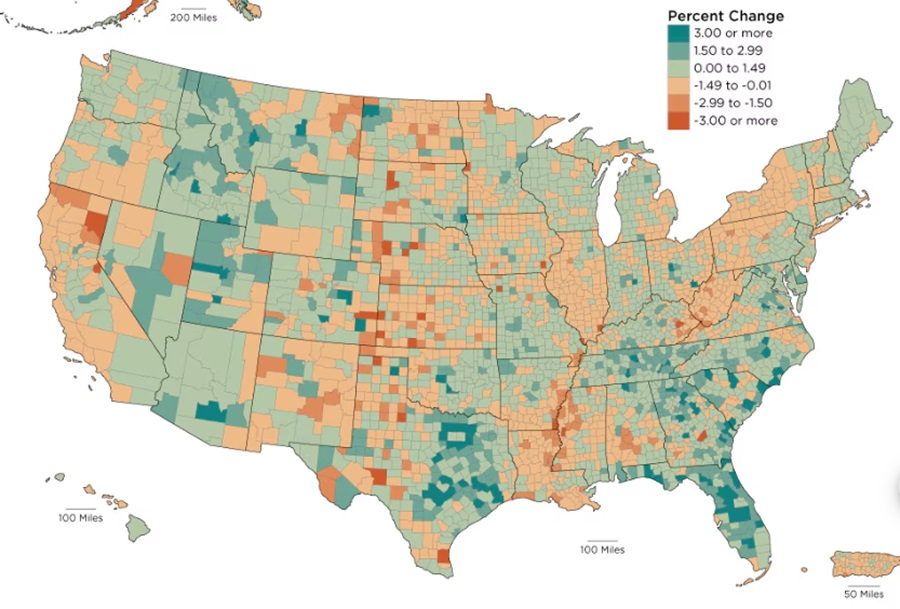
National county map for 2022-2023 population change.

I haven’t done an annual population estimates post since before the 2020 Census. This is because the pandemic- and political actions- screwed up counting quite a bit, and I haven’t felt confident in posting them. The 2023 county and metro population estimates have just been released., and since 3 years have gone by since the census, perhaps some of the kinks have been worked out. That said, the news isn’t all that great for Ohio and Columbus.

2020-2023 County Population Change

Prior to 2020, Franklin County was the fastest-growing county in the state by total growth. Since 2020, it’s fallen to 10th. While that may not seem that bad, only 30 of Ohio’s 88 counties have even seen growth since 2020. On the bright side, Franklin was the only major urban county in the state to see any growth at all. The majority of the 30 counties that saw growth in the state were metro suburban counties, including 8 of the 9 suburban counties within the Columbus Metro Area. Lingering effects of the pandemic are at least partially responsible for this shift, as some people sought to leave highly-populated areas, but wanted to otherwise remain close to core cities.
Another factor is likely the ongoing housing shortage. Housing just isn’t getting built in Franklin County like it was before, which is continuing to cause price increases, making the area less affordable than it used to be.
Additionally, extreme state politics may be driving some people away- or stopping them from moving locally altogether.

Still, the news isn’t all bad. The total Columbus metro population growth is gradually improving. From 2020-2021, the metro change was +7,986, 2021-2022 it was +14,560, and from 2022-2023, it was +18,205. Still a far cry from the pre-pandemic period when annual totals were 25K-30K. Hopefully, the upward trend continues through the rest of the decade.

Now that we know that overall population change, let’s take a closer look at the specific components of change since 2020.

Top 10 Counties by Natural Change 2020-2023
1. Franklin: +18,738
2. Hamilton: +4,233
3. Delaware: +2,072
4. Holmes: +1,309
5. Union: +662
6. Butler: +652
7. Warren: +650
8. Mercer: +543
9. Putnam: +86
10. Shelby: +67
Incidentally, only these 10 counties saw positive net natural change 2020-2023. That’s a terrible statistic for Ohio’s counties. Columbus’ 3 counties in the top 10 provided more natural change than all other 85 counties combined.

Top 10 Counties by Domestic Change 2020-2023
1. Delaware: +13,998
2. Warren: +7,424
3. Union: +6,011
4. Lorain: +5,969
5. Fairfield: +5,932
6. Licking: +4,592
7. Clermont: +3,117
8. Pickaway: +2,783
9. Miami: +2,433
10. Medina: +2,018
Again, Columbus metro counties- aside from Franklin- do relatively well here, with half of the top 10.

Top 10 Counties by International Migration Change 2020-2023
1. Franklin: +20,391
2. Cuyahoga: +8,557
3. Hamilton: +7,037
4. Butler: +3,551
5. Montgomery: +2,885
6. Summit: +2,593
7. Warren: +1,821
8. Delaware: +1,557
9. Lucas: +1,237
10. Greene: +839
Franklin again leads the pack and is generally doing better annually this decade than before the pandemic, the lone bright spot in the numbers.

Finally, here were the overall metro changes, both for 2022-2023 and 2020-2023.

2023 Total Metro Area Population
1. Cincinnati: 2,271,479
2. Columbus: 2,180,271
3. Cleveland: 2,158,932
4. Dayton: 814,363
5. Akron: 698,398
6. Toledo: 600,141
7. Youngstown: 425,969
8. Canton: 399,474
Columbus continues to leave Cleveland behind and close the gap with Cincinnati.

2022-2023 Metro Area Population Change
1. Columbus: +18,205
2. Cincinnati: +12,854
3. Dayton: +1,649
4. Akron: +887
5. Canton: +3
6. Toledo: -378
7. Youngstown: -679
8. Cleveland: -1,769

2020-2023 Metro Area Population Change
1. Columbus: +41,330
2. Cincinnati: +21,698
3. Dayton: +313
4. Canton: -2,106
5. Akron: -3,827
6. Youngstown: -4,707
7. Toledo: -6,100
8. Cleveland: -26,795

CoGo Bike Share Sees Record Ridership in 2023

CoGo bike share

Columbus’ CoGo bike share system has been in operation since July, 2013. After a decade of ups and downs, the system seems to be finally hitting its stride.

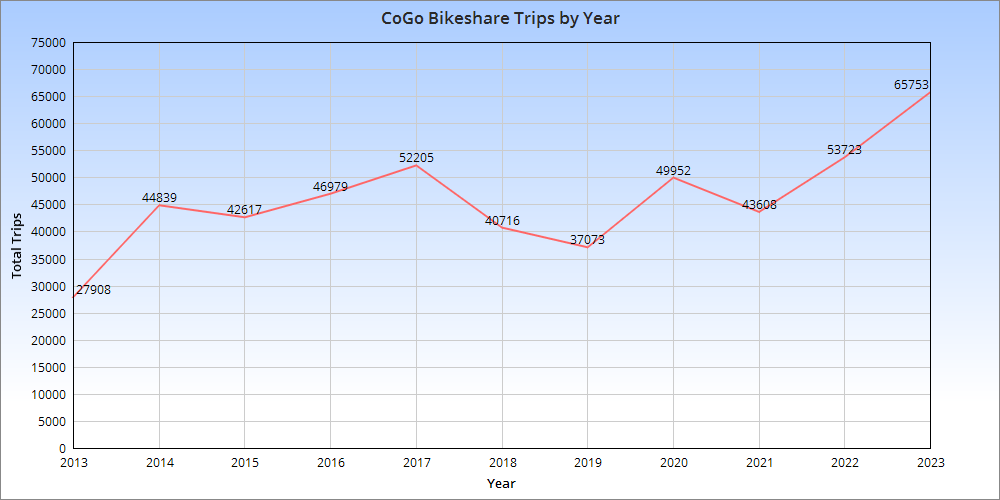
CoGo bikeshare total trips by year

As the chart above shows, total CoGo trips were generally up between 2013-2017, and then saw a fairly steep decline 2018-2019. It’s unclear what caused that decline, but everything from system disruptions to weather could have played a role. Regardless, the pandemic, protests and general chaos of 2020 didn’t seem to matter as total trips for the year rebounded strongly. After another down year in 2021, 2022 saw CoGo’s highest ridership since the system opened, and 2023 continued that trend by blowing out 2022’s record. There were an extra 33 trips per day in 2023 vs. 2022, which added up to more than 12,000 more for the year.
Hopefully, the increase in ridership will prompt another expansion of the system into new areas soon. And some actual protected bike lanes would be nice, as Columbus- to date, anyway- has been less than stellar on this issue.


Failed Project- Ohio’s Atom Collider


Ohio's atom collider

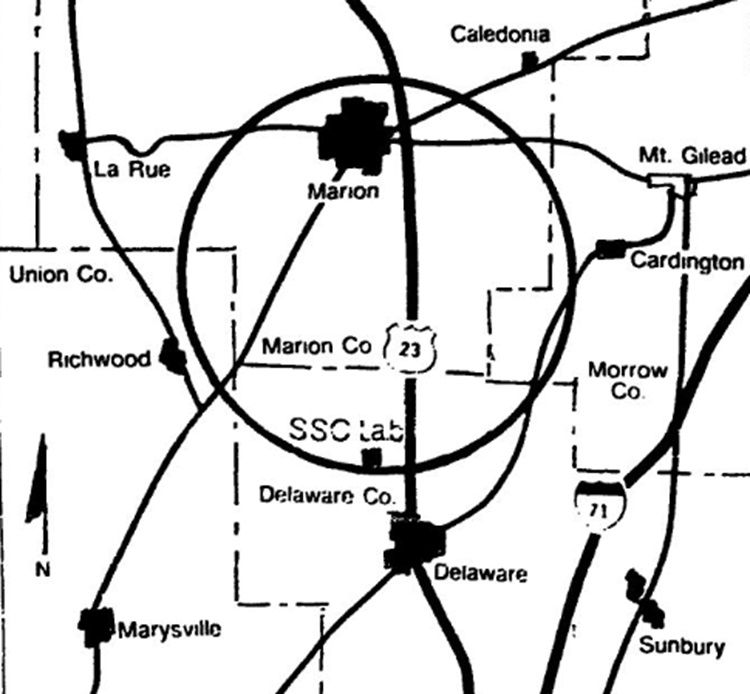
The approximate location of the proposed atom collider tunnel.

Today’s failed project is a short, but interesting one- Ohio’s atom collider.

On August 9, 1985, the Columbus Dispatch ran an article about an “atom tunnel” to be located underneath parts of Delaware, Marion, Morrow and Union counties. This 60-100 mile long tunnel was to be one of the first of its kind, an early version of the Hadron Collider in Europe. The $3 billion dollar tunnel was to be buried 200 feet down and be about 10 feet in diameter. Ohio was not the only state vying for the project, but Ohio was considered to be near the top of the list. Ohio would’ve had to spend $66 million to get the site ready, anchored by a 5,000 acre project laboratory in Delaware County. The project, expected to bring 3,000 construction jobs and 6,000 permanent jobs, was expected to put the state at the forefront of scientific research.

This project largely failed for one reason: The Reagan Administration. Though the Department of Energy and the science community wanted this and other science advancements funded, it never went through, so the funding never became available. Instead, the European Organization for Nuclear Research (CERN) took the lead and built the now famous Large Hadron Collider, between 1998 and 2008. While Ohio’s “atom tunnel” would by now be far outdated, who knows what kind of research and technological advancement, even to this day, would’ve taken place under the Columbus metro’s northern counties.

El Niño and Columbus Winter History


Columbus winter history El Niño

A small snow event should affect the Columbus area today into tomorrow morning, with forecasts calling for up to 2″ of snow when all’s said and done. While by no means a significant event, it could end up being one of the largest snowfalls of the entire 2023-2024 winter season. The reason- El Niño.

El Niño winters in Ohio tend to be much warmer than normal with much below normal snowfall. This is especially true when the El Niño is moderate to strong, as it is now. Let’s take a look back at how different ENSO states (or El Nino Southern Oscillation) produced different results in Columbus winter history.

ENSO conditions come in 3 different forms- El Niño, which is when the Equatorial Pacific is warmer than normal, Neutral, when the waters are neither cold nor warm, and La Niña, which features colder than normal Equatorial Pacific waters.
Since the 1950-1951 season, there have been 24 Neutral seasons, 25 La Niña seasons and 25 El Niño seasons, so the breakdown has been very even. Because there is a lag because Pacific water temperatures and atmospheric response, the conditions that affect winter weather can typically be traced back to Fall water temperatures rather than winter. To see how 2023-2024 might shape up, we have to look at the September-October-November Pacific water temperature anomalies. During that time, the anomaly was +1.8. Which seasons had an anomaly of +1.5 to +2 during September-October-November? As it turns out, not very many- only 1965, 1972, 1982 and 1987.

How were those 4 subsequent winters in terms of temperature and snowfall?
Mean Temperature
1965-1966: 29.4
1972-1973: 32.8
1982-1983: 34.7
1987-1988: 30.5
Avg: 31.9
Temperatures overall were somewhat split, with 2 winters being slightly below normal and 2 winters with well-above normal temperatures, with the average of the 4 being slightly above.
Snowfall
1965-1966: 17.5″
1972-1973: 24.5″
1982-1983: 11.5″
1987-1988: 23.9″
Avg: 19.4″
Snowfall was well below normal in all 4 seasons, with an average of about 8″ below normal.
The snowfall that did fall typically came in 1-2 moderate events with very little otherwise.
1965-1966
5.9″ 1/22/66
3.7″ 2/1/66
1.2″ 1/29/66
1965-1966 had a few moderate events, but the 3 days here were the only 3 days during the entire winter that featured an inch or more of daily snowfall. This winter also occurred during a generally snowier, colder decade.
1972-1973
6.3″ 4/12/1973
4.0″ 11/30/1972
2.1″ 3/17/1973
1972-1973 again featured a few moderate events as well that contained the bulk of the season’s snow. The interesting thing about this winter is that those events occurred outside of the main December-January-February heart of winter.
1982-1983
1.9″ 2/6/1983, 3/11/1983
1.1″ 1/15/1983
1.0″ 12/10/1982
1982-1983 ended up being what’s called a Super ENSO event, with a very strong El Niño. Temperatures were very warm the entire winter, and snowfall was less than 50% of normal.
1987-1988
4.7″ 1/25/1988
1.8″ 12/3/1987
1.6″ 2/11/1988
1987-1988 only had a single moderate event, with most other snowfalls during the season amounting to a few tenths.

Bottom line: Don’t expect major snowfalls this winter.

Now, these are just 4 seasons. Other slightly stronger or weaker El Niño seasons produced very different results. Furthermore, the orientation of where the warmest water is in the Pacific can have very different outcomes. For example, if the warmer water is hugging the coast of South America, winters tend to be warmer and snowless, but if that warmer water is centered further west in the Pacific, winters can be very cold and snowy. For example, both the winters of 2002-2003 and 2009-2010 were west-based El Niño seasons, and they were historically snowy and cold winters. 2023-2024 is decidedly an east-based Niño, however, so it’s unlikely we will see anything but a rather boring winter with warmer than normal temperatures and below average snowfall. Obviously, depending on your viewpoint, that could be a very good thing.

Columbus Casino Most Successful in State


After 4 previous tries, Ohio voters approved a constitutional amendment to allow casinos to operate in the state’s 4 largest cities. Three years after that 2009 vote, casinos began operations in Cleveland, Columbus and Toledo, with Cincinnati’s casino opening the following year in 2013.
The Columbus casino was originally supposed to be built Downtown in the Arena District. Specifically, it was supposed to be built where the Crew’s new stadium now sits. There was quite a bit of opposition to this plan given that casinos provide little to no external business traffic, and the thinking was that it would’ve caused more problems for the neighborhood than what it was worth.
So, the following year, a second statewide vote allowed for the Columbus casino to change locations to the West Side. The site that was chosen was the former Delphi plant, which had been closed since 2007. A bit of hypocrisy and irony was not lot in the demand to move the site, though. The West Side and Westland area were already in late state decline at that point, and proponents of the move claimed that the casino would help the area improve. This claim was made despite the fact that the move was initiated with the idea that it would’ve hurt the Arena District.
Still, the West Side seemed to be all for the move, as a new business- even a casino- was still better than a closed and deteriorating industrial plant.
Columbus’ Hollywood Casino opened on October 8, 2012 after about 2 years of site clearing and construction. While visions of the West Side raking in the benefits never really materialized in reality, the casino itself has gone on to great success in terms of revenue.

Initially, Cleveland- whose own Jack Casino was located in the heart of its downtown- was the highest earner by revenue in the state, Columbus passed it by 2016 and has been the state’s leader ever since.

Columbus casino Cincinnati vs Columbus

Columbus casino Cleveland vs Columbus

Columbus casino Toledo versus Columbus

All the casinos saw a 2020 drop as they were closed for 2 months and had hour restrictions into early 2021 due to the pandemic. Curiously, though, all of the casinos saw a huge increase in revenue over where they were in 2019. I’m not sure if that’s a good thing.