Does Fall Weather Correlate to Winter Severity?


winter severity

Republished with data through the 2019-2020 winter.

As we go into the winter season, it’s time to talk about how this one might end up. There’s a belief that fall weather is a good sign of how cold or warm winter will be. Let’s see if that holds true.

First, let’s just look at October temperatures.
The October normal mean temperature for Columbus is 55 degrees.

Between 1878 and 2019, there have been 47 Octobers that featured a mean temperature of 53.9 degrees or lower, what we’re considering a Cold October for the purposes of this comparison.
Of those 47 Octobers, 27 of the 47 had following winters that were colder than normal, or 57.4%, 13 had average temperature winters, or 27.7%, and the remaining 7 were warmer than normal, or 14.9%.
Interestingly, this category contains both the warmest winter on record- 1889-1890 and the coldest on record- 1976-1977- as shown by the chart below.

Next, we look at Normal Octobers, which are +/- 1 degree of the 1981-2010 Average of 55 degrees.
Between 1878 and 2019, there were 45 normal Octobers. Of those, 21 had colder than normal following winters, or 46.7%. 11 were followed by normal winters, or 24.4%, and 13 had warmer than normal winters, or 28.9%.

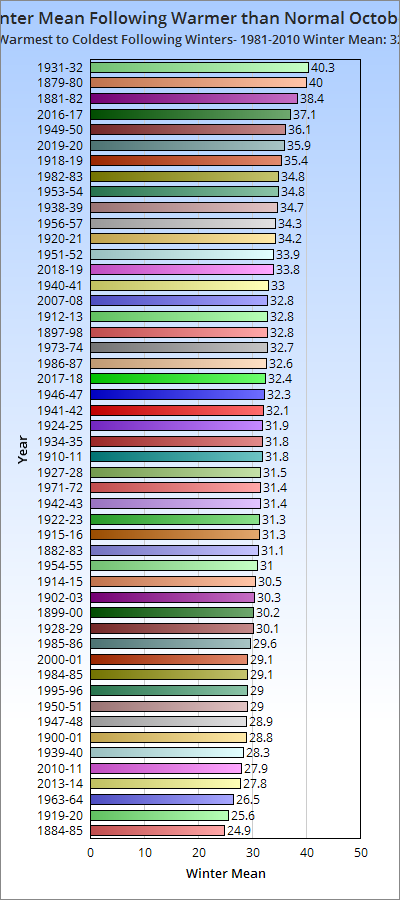
Finally, let’s look at warm Octobers, which are those with means of 56.1 degrees or higher. There were 49 Octobers with warmer than normal means since 1878. Of those, 18 featured following winters that were colder than normal, or 36.7%. Another 19, or 38.8%, were followed by average winters. The final 12 winters, or 24.5%, were warmer than normal. Here’s the graph.

So just based on the October mean temperature, Octobers that are colder than normal are almost twice as likely as normal Octobers and almost 4x as likely as warm Octobers to be followed by a cold winter. But what about Novembers? It is closer to winter itself, so does its weather matter even more?

Colder than normal Novembers- 43.3 degrees or lower- included 80 Novembers since 1878. Of those, 38 or 47.5% had colder than normal winters. 22 (27.5%) had normal winters and 19, or 23.8%, had warmer than normal winters.

With the 39 normal Novembers, 43.4 to 45.4 degrees, there were 18 that had colder than normal winters, or 46.2%, with 12 normal winters (30.8%) and 9 warmer than normal winters (23.1%).

Finally, there were 24 warmer than normal Novembers since 1878- 45.5 degrees or higher. Only 6, or 25%, were followed by cold winters. An additional 9 (37.5%) were normal, while the last 9 (37.5%) were warmer than normal.

To reiterate, here are the ranked percentages of cold winters by the preceding October or November.
1. Cold Octobers: 57.4%
2. Cold Novembers: 47.5%
3. Normal Octobers: 46.7%
4. Normal Novembers: 46.2%
5. Warm Octobers: 36.7%
6. Warm Novembers: 25.0%

It should be no surprise that cold Octobers and Novembers have a stronger correlation to the following winters also being colder, with colder winters becoming increasingly unlikely as those months warm. What is surprising is that October weather, across the board, was more predictive of cold winters than Novembers were.

Going further, though, what about bi-monthly combinations?

Rank of Bi-Monthly Combinations and the percentage of colder than normal following winters, along with total years in sample:
Normal October/Normal November: 87.5% 8 Years
Cold October/Warm November: 57.1% 7 Years
Cold October/Cold November: 53.8% 26 Years
Normal October/Cold November: 48.1% 27 Years
Warm October/Cold November: 40.7% 27 Years
Cold October/Normal November: 38.5% 13 Years
Warm October/Warm November: 28.6% 7 Years
Warm October/Normal November: 25.0% 16 Years
Normal October/Warm November: 0.0% 8 Years

So a normal fall is clearly the best, but the sample size is not particularly high. Normal to Warm is unanimously warm, but again, it has a small sample size.

So does fall weather ultimately have a correlation to winter severity? To some degree yes, as patterns established in the fall tend to appear in the winter as well, but October, rather than November, has a clear higher correlation. But as with everything, there are many other factors involved.

October 2020 looks to at least begin with below normal temperatures, but it remains to be seen how it ends up.

To see records for Columbus falls and winters going back to 1878, visit the following links.
Autumn Weather Records
Winter Season Records

And to see current local weather and forecasts, visit: Wilmington National Weather Service


Ohio Census 2020 Response Rates


Ohio census 2020 response rates

The 2020 US Census is currently winding down, perhaps somewhat earlier than planned, but wrapping up nonetheless.
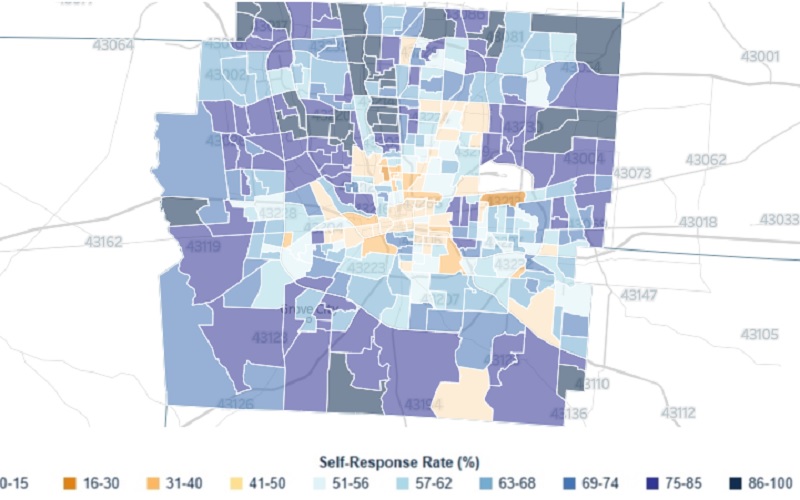
The accuracy of the Census relies heavily on enough people responding to the surveys. Because of the pandemic this year, the internet has played a bigger role in the response rates than normal, but there were still plenty of door to door workers doing surveys. How did Columbus, Central Ohio and other parts of the state do? Here are the Ohio census 2020 response rates.

First, let’s look at Ohio counties. These numbers are through September 2nd.

Top 10 counties for Census Response
1. Medina County: 81.9%
2. Delaware County: 79.7%
3. Geauga County, Warren County: 78.7%
4. Union County: 78.0%
5. Lake County: 77.4%
6. Auglaize County: 76.9%
7. Wayne County: 76.8%
8. Greene County: 76.0%
9. Miami County: 75.9%
10. Fulton County: 75.2%

Bottom 10 Counties for Census Response
1. Harrison County: 55.5%
2. Morgan County: 57.7%
3. Vinton County: 57.9%
4. Pike County: 58.5%
5. Monroe County: 58.8%
6. Lawrence County: 59.3%
7. Scioto County: 59.4%
8. Meigs County: 59.6%
9. Adams County: 59.9%
10. Ashtabula County, Athens County: 60.8%

Most of the high-reporting counties were large metro counties, while most of the low ones were Appalachia. This may be related to access to the internet, which again, played a crucial role this year.

Here are the counties that anchor Ohio’s largest metros
Lucas County: 64.6%
Cuyahoga County: 65.5%
Franklin County: 66.7%
Hamilton County: 66.7%
Mahoning County: 67.4%
Montgomery County: 68.0%
Stark County: 74.3%

Columbus’ Franklin County was tied for 3rd worst.

Now let’s look at Central Ohio cities and towns.
Minerva Park: 88.6%
Worthington: 86.8%
Upper Arlington: 85.7%
Westerville: 83.2%
Dublin: 82.7%
Canal Winchester: 81.8%
Grandview Heights: 81.8%
Gahanna: 81.1%
New Albany: 81.1%
Bexley: 79.5%
Grove City: 78.9%
Groveport: 78.9%
Pataskala: 77.4%
Hilliard: 77.0%
Valleyview: 76.5%
Reynoldsburg: 75.3%
Obetz: 72.7%
Pickerington: 71.6%
Columbus: 62.1%
Whitehall: 58.5%

Generally, the more urban commmunities tended to do worse than the outer suburbs. This has implications on urban areas possibly being undercounted, though the response rates are generally similar to what they were in 2010, so that concern is probably overblown to some extent.

If your’e interested in taking a further look at Ohio’s and other states numbers, visit the following link, in which response rates are tracked all the way down to the Census Tract level: https://2020census.gov/en/response-rates/self-response.html


Cool Link: Columbus Urban Forestry Plan

Only about 22% of Columbus’ land is made up by tree cover, which is lower than many of its national peers. Because of this, the city has come up with the Columbus Urban Forestry Plan, which in part seeks to plant millions of trees in the coming years, potentially beginning next year. You can view the plan, timeline, tree canopy statistics and neighborhood maps all the way down to a block by block level at the following link: Forestry Plan


The Best and Worst Columbus Summers on Record


Best and worst Columbus summers

Let’s be honest, Summer 2020 is hardly shaping up to be one of swimming pools and BBQs and beach vacations. With the virus continuing to rage nationally, it’s going to be the kind of summer many people watch from their porches or couches. So in that sense, 2020 certainly ranks up there as one of the worst summers ever. On the other hand, there’s probably going to be a bit less concern as to how the weather is. Still, here’s a look back on the best and worst Columbus summers when it comes to weather.

I used a basic ranking system, much like I did with my Worst Winters of All Time post a few years back, to determine the severity of each summer’s weather. Here was the point system I used.

On temperature, I added one point for each of the following:
-# of 86 or Above Highs
-# of 70 or Above Lows
-# of 70 or Below Highs
-# of 50 or Below Lows
Each earned the summer a point for each day that featured these conditions, as either extreme heat or low temperatures during summer are generally considered a negative.

With precipitation, I added one point for each of the following:
-# of days with measurable precipitation.
-# of days with at least 1″+ of precipitation.

The more points a summer got, the worse the weather was overall.

Top 10 Worst Summers
1. 1935: 110
2. 1988: 108
3. 1949: 99
4. 1936, 1944, 1955: 97
5. 2012: 96
6. 1881, 1947, 1980, 1999, 2005: 94
7. 1901, 1916, 1931: 93
8. 1934, 1940, 2018: 91
9. 1941, 1977: 90
10. 1943, 1987: 88

If you like either very hot, very wet or summers with a combination of both conditions, these ones were for you.  It’s no surprise the 1930s and 1940s show up often.  Every summer between 1930 and 1944 had hotter than normal conditions.  No other similar period has matched it.

Top 10 Best Summers
1. 1904: 43
2. 1967, 1971: 44
3. 1922, 1960, 1984: 47
4. 2000: 49
5. 1962: 50
6. 1950, 1981: 51
7. 1884, 1886, 1985: 52
8. 1889, 2009: 53
9. 1929: 56
10. 1905, 1976: 57

If your preference is instead summers with little extreme heat and drier conditions, these were the best.

Now, you might wonder which decade had the best average and worst average summers.

Average Annual Points By Decade
1960s: 64.0
1900s: 66.2
1970s: 67.2
1920s: 67.8
1980s: 70.2
1880s: 70.9
1950s, 2000s: 71.2
1990s: 73.6
1890s: 75.1
1910s: 76.0
2010s: 78.7
1870s: 80.0
1930s: 81.9
1940s: 85.9

The 1960s had the best average score, with the 1940s easily claiming the top prize for worst.  Perhaps unsurprisingly, the 2010s featured more crappy ones than not.

To see a lot more summer and other weather records, check out:
Summer Season Records
Wilmington National Weather Service


Cool Link Ohio Ghost Towns and Abandoned Places

Ohio ghost towns and abandoned places

While the West is better known for its many ghost towns, they exist in the Midwest as well. If you’re interested in learning about Ohio’s many long-lost small towns and villages, this is a great link. You can search through information for every county, read town histories, view photos and more. There are also links to old maps and indexes, as well as historic research resources.
Not all of the places still have remaining evidence, but enogh exist to easily justify a cool road trip around the state.

Ohio Ghost Town Exploration Co.