Now that the Summer of 2016 is but a memory, let’s take a quick look back at where it stands in the weather record books.
Temperature
Summer 2016 Means June-August Mean High: 85.5 June-August Mean Rank since 1878: 26th Warmest While the average high for Summer 2016 was certainly warm, it fell just outside of the top 25. By comparison to recent years, 2010 (85.6), 2011 (85.7) and 2012 (87.7) all had warmer average highs.
June-August Mean Low: 66.1 June-August Mean Low Rank since 1878: 4th Warmest The average low for the summer is what made 2016 much more exceptional. No recent years (last decade) were warmer, although 2010 did tie.
June-August Mean: 75.8 June-August Mean Rank since 1878: 10th So if you thought this summer was hot, well you were right. Only 2010 (75.9) and 2012 (76.4) were warmer of any recent years.
Monthly Means June Mean: 73.2 June Mean Rank since 1878: 17th Warmest July Mean: 76.6 July Mean Rank since 1878: 20th Warmest August Mean: 77.6 August Mean Rank since 1878: 6th Warmest The summer gradually became hotter as it went on.
Summer 2016 Misc. Temperature Stats # of 90+ Days: 18 90+ Days Rank: 22nd Warmest High: 95 Warmest Low: 77 Coldest High: 72 Coldest Low: 48
Daily Temperature Records June 11th: Record Warm Maximum Tie: 95: Tied with 1914 and 1933. August 10th: Record Warm Minimum Tie: 75: Tied with 2001. August 11th: Record Warm Minimum Tie: 76: Tied with 1918. August 12th: Record Warm Minimum: 76: Beat record from 1947. August 13th: Record Warm Minimum Tie: 75: Tied with 1995.
Precipitation June-July Precipitation Total: 13.53″ June-July Precipitation Rank since 1878: 29th Wettest Besides being warm, Summer 2016 was also fairly wet.
Monthly Precipitation Stats June Precipitation: 5.22″ June Precipitation Rank since 1878: 29th July Precipitation: 2.49″ July Precipitation Rank since 1878: 27th Driest August Precipitation: 5.82″ August Precipitation Rank since 1878: 13th Wettest So the summer was bookended by wet months with July being fairly dry.
Summer 2016 Misc. Precipitation Stats Total Precipitation Days (including Trace): 45 Total Measurable Precipitation Days: 30 Measurable Precipitation Days Rank since 1878: 16th Highest Days with 0.25″ or Higher: 16 Days with 0.50″ or Higher: 10 Days with 1.00″ or Higher: 4
Daily Precipitation Records June 23rd: 2.75″: Beat the old record in 1901.
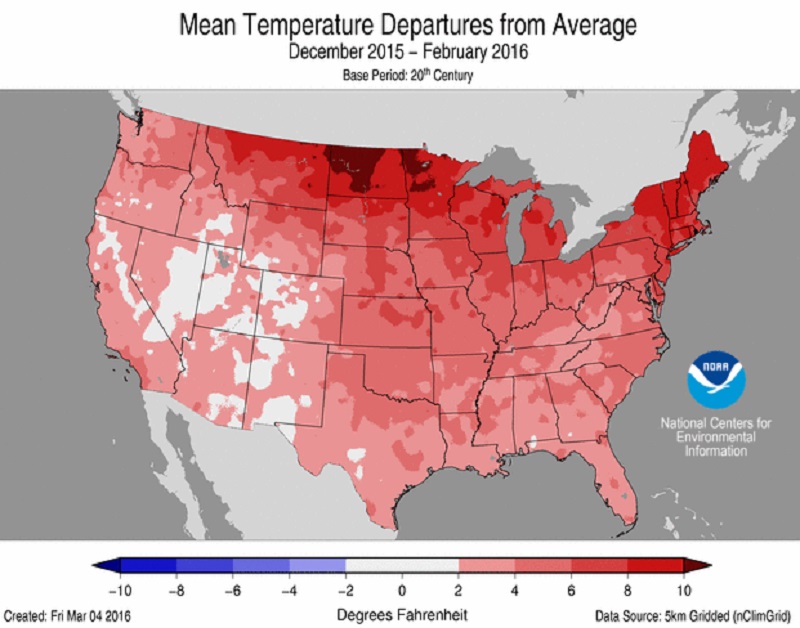
The winter of 2015-2016 featured warmer than normal temperatures across the country.
After the double cold and snowy winters between 2013-2015, the winter of 2015-2016 was drastically different. It featured general warm temperatures- including the warmest December ever- and little snowfall overall.
Temperature and snowfall ranking data goes back to the winter of 1878-1879. Snow depth ranking data goes back to 1940.
December-February Only Average High: 44.0 8th Warmest Average Low: 27.5 14th Warmest Mean: 35.8 12th Warmest Precipitation: 9.29″ 37th Wettest Snowfall: 14.5″ 44th Least Snowy Average Daily Snow Depth: 0.3″ 4th Lowest Largest Snowstorm: 2.4″ on January 12th 32 or Below Highs: 21 15th Fewest 32 or Below Lows: 61 9th Fewest Measurable Precipitation Days: 34 10th Fewest Measurable Snowfall Days: 14 10th Fewest Deepest Snow Depth: 3″ on February 16th Days with 1″+ Snow Depth: 14 11th Fewest
Entire Cold Season: October-April Average High: 53.7 3rd Warmest Average Low: 35.3 10th Warmest Mean: 44.5 5th Warmest Precipitation: 20.92″ 48th Wettest Snowfall: 17.1″ 36th Least Snowy Average Snow Depth: 0.1″ 2nd Lowest Largest Snowstorm: 2.4″ on January 12th 32 or Below Highs: 21 11th Fewest 32 or Below Lows: 87 7th Fewest Measurable Precipitation Days: 82 17th Fewest Measurable Snowfall Days: 17 8th Fewest Deepest Snow Depth: 3″ on February 16th Days with 1″+ Snow Depth: 15 8th Fewest
Average High By Month October 2015: 65.4 45th Warmest November 2015: 57.7 7th Warmest December 2015: 52.5 1st Warmest January 2016: 36.7 56th Warmest February 2016: 42.9 26th Warmest March 2016: 57.8 8th Warmest April 2016: 62.5 41st Warmest
Average Low By Month October 2015: 45.7 34th Warmest November 2015: 39.5 6th Warmest December 2015: 36.9 1st Warmest January 2016: 20.1 44th Coldest February 2016: 25.4 39th Warmest March 2016: 39.1 7th Warmest April 2016: 40.4 28th Coldest
Mean By Month October 2015: 55.5 37th Warmest November 2015: 48.6 5th Warmest December 2015: 44.7 1st Warmest January 2016: 28.4 45th Coldest February 2016: 34.2 34th Warmest March 2016: 48.5 7th Warmest April 2016: 51.4 42nd Coldest
Precipitation By Month October 2015: 2.68″ 44th Wettest November 2015: 2.37″ 57th Driest December 2015: 4.88″ 8th Wettest January 2016: 1.12″ 9th Driest February 2016: 3.29″ 31st Wettest March 2016: 4.27″ 36th Wettest April 2016: 2.31″ 35th Driest
Snowfall By Month October 2015: 0″ 1st Least Snowy November 2015: Trace 2nd Least Snowy December 2015: Trace 2nd Least Snowy January 2016: 5.4″ 39th Least Snowy February 2016: 9.1″ 29th Snowiest March 2016: 2.3″ 22nd Least Snowy April 2016: 0.3″ 5th Least Snowy
Average Snow Depth By Month October 2015: 0″ November 2015: 0″ December 2015: 0″ January 2016: 0.2″ February 2016: 0.8″ March 2016: 0.1″ April 2016: 0″
Maximum High By Month October 2015: 79 on the 6th and 8th November 2015: 75 on the 3rd and 5th December 2015: 68 on the 12th January 2016: 60 on the 31st February 2016: 68 on the 20th March 2016: 75 on the 27th April 2016: 81 on the 18th
Maximum High Records -The 68 on December 12th was a record for the date, beating the old record of 65 set in 1949. -The 65 on December 14th tied the record for the date set in 1901 and 1995. -The 65 on December 23rd was a record for the date, beating the old record of 62 set in 1933. -The 68 on February 20th tied the record for the date set in 1891. -The 65 on February 28th tied the record for the date set in 1896, 1939 and 1955.
Minimum High By Month October 2015: 49 on the 17th and 30th November 2015: 37 on the 22nd December 2015: 33 on the 19th January 2016: 13 on the 18th February 2016: 16 on the 13th March 2016: 33 on the 2nd April 2016: 36 on the 9th
Maximum Low By Month October 2015: 57 on the 24th November 2015: 59 on the 5th December 2015: 56 on the 12th January 2016: 49 on the 31st February 2016: 44 on the 20th March 2016: 56 on the 14th April 2016: 59 on the 21st
Maximum Low Records -The 57 on November 18th was a record for the date, beating the old record of 56 set in 1921. -The 47 on December 22nd was a record for the date, beating the old record of 46 set in 1931. -The 51 on December 23rd tied the record for the date set in 1941. -The 49 on December 31st tied the record for the date set in 1988.
Minimum Low By Month October 2015: 28 on the 18th November 2015: 21 on the 23rd December 2015: 21 on the 20th January 2016: 2 on the 13th February 2016: 2 on the 14th March 2016: 22 on the 2nd and 3rd April 2016: 23 on the 5th
Highest Daily Precipitation By Month October 2015: 1.25″ on the 28th November 2015: 0.55″ on the 28th December 2015: 1.19″ on the 27th January 2016: 0.47″ on the 10th February 2016: 1.22″ on the 24th March 2016: 0.98″ on the 10th April 2016: 1.05″ on the 11th
Precipitation Records -The 1.25″ on October 28th was a record for the date, beating the old record of 1.10″ set in 1883. -The 1.19″ on December 27th was a record for the date, beating the old record of 0.90″ set in 1968.
Highest Daily Snowfall By Month October 2015: 0.0″ November 2015: Trace on the 22nd December 2015: Trace on the 3rd, 18th and 31st January 2016: 2.4″ on the 12th February 2016: 1.9″ on the 16th March 2016: 1.5″ on the 4th April 2016: 0.3″ on the 9th
Deepest Snow Depth By Month October 2015: 0″ November 2015: 0″ December 2015: 0″ January 2016: 2″ on the 13th and 14th February 2016: 3″ on the 16th March 2016: 2″ on the 4th April 2016: 0″
With temperatures predicted to fall to near freezing for the first time this week for the fall season, I thought it might be interesting to take a look at the incidence of early season cold, and the average on when it tends to arrive.
Here are the earliest dates on record for the following:
Average Date of First Under-40 Temp By Decade (1878-2014) 2010s: October 11th 2000s: October 8th 1990s: October 2nd 1980s: September 30th 1970s: October 1st 1960s: September 25th 1950s: September 25th 1940s: September 30th 1930s: October 11th 1920s: October 2nd 1910s: October 9th 1900s: October 5th 1890s: October 1st 1880s: October 2nd 1870s: October 1st
Average Date of First 32 or Below High By Decade 2010s: December 4th 2000s: December 2nd 1990s: December 7th 1980s: November 28th 1970s: November 29th 1960s: November 23rd 1950s: November 26th 1940s: December 2nd 1930s: November 27th 1920s: November 28th 1910s: November 22nd 1900s: November 30th 1890s: November 25th 1880s: November 30th 1870s: December 4th
Average Date of First 32 or Below Low By Decade 2010s: October 24th 2000s: October 26th 1990s: October 22nd 1980s: October 17th 1970s: October 17th 1960s: October 8th 1950s: October 22nd 1940s: November 3rd 1930s: October 24th 1920s: October 28th 1910s: October 31st 1900s: October 24th 1890s: October 20th 1880s: October 20th 1870s: October 26th
As summer slowly approaches its inevitable end, thoughts of winter have started to creep into our minds. The last two winters seemed particularly harsh, and questions were often asked as to their historic status as well as whether another bad winter was on the way. Ask any older person in Ohio, and the winters between 1976 and 1979 will often come up. But do they really deserve their reputations? To find out, I came up with a ranking system for meteorological winter only- December through February0- to rank the worst winters of all time. Here was the criteria:
Temperature: # of 32 or Below Highs, # of 32 or Below Lows, # of 0 or Below Highs, # of 0 or Below Lows: Each earned the winter a point for each day that featured these conditions. # of 60 or Above Highs and # of 50 or Above Lows meant a point was removed for each occurrence.
Precipitation: # of Days with Measurable Snowfall, # of 1″+ Snow Days, # of 2.5″+ Snow Days, # of 5″+ Snow Days, # of 10″+ Snow Days as well as # of Measurable Precipitation Days all counted as 1 point for each occurrence.
I then added the temperature and precipitation points together to come up with a ranking for how miserable each winter really was.
Do any of these surprise you? Both 2013-2014 and 2014-2015 are in the top 30 worst, but only 2013-2014 is in the top 10. In fact, other recent winters like 2000-2001, 2002-2003, 2009-2010 and 2010-2011 are all ranked worse than last winter. There have been a surprising number of recent winters in the top 30, however. There have been 8 total since 2000. No other similar time frame has produced as many.
Look how many of the warmest/least snowy occur between 1920 and 1945. Historically, this period had the fewest number of cold and/or snowy winters on record of any such 25-year period.
And what about winter 2015-2016? Well, that remains to be seen. However, the developing strong El Nino suggests a warmer than average winter. However, factors such as its position (west or east-based) as well as the PDO could throw some wrenches into that standard El Nino forecast. Either way, it will likely not be a top 30 worst.