German Village dates back to the early 19th Century, when it was sometimes called called Germantown. Unsurprisingly, by the middle of the 20th Century, the neighborhood had declined significantly, yet still retained the vast majority of its historic buildings. The city of Columbus had it in mind to bulldoze a large part of the neighborhood in the 1950s for public housing, but activists organized against those plans. Instead, in what was one of the first major success stories of Columbus preservation, German Village was saved. The entire area was eventually added onto the National Register of Historic Places in 1975, and today it is still the largest historic district on the registry anywhere in the United States. Here are just a few before and after photos around the neighborhood.
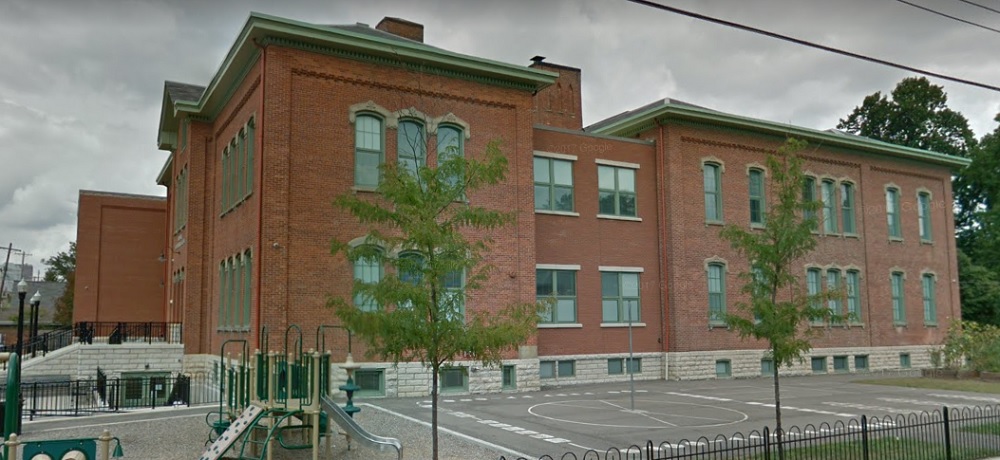
Before: Stewart Avenue Elementary School, looking northeast, in 1920. After: 2017 The school was constructed in 1873 and remains in use today, one of the oldest continuous schools remaining in the city.
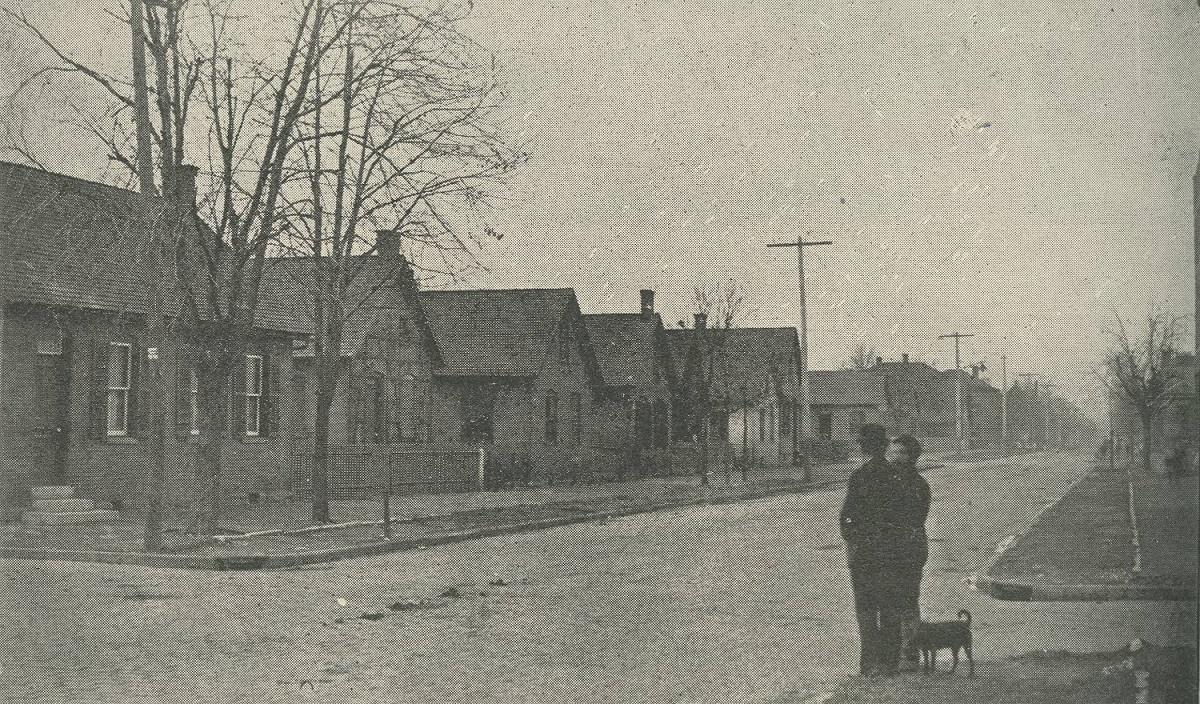
Before: City Park Avenue at Lansing Street, looking south, in 1898. After: 2016
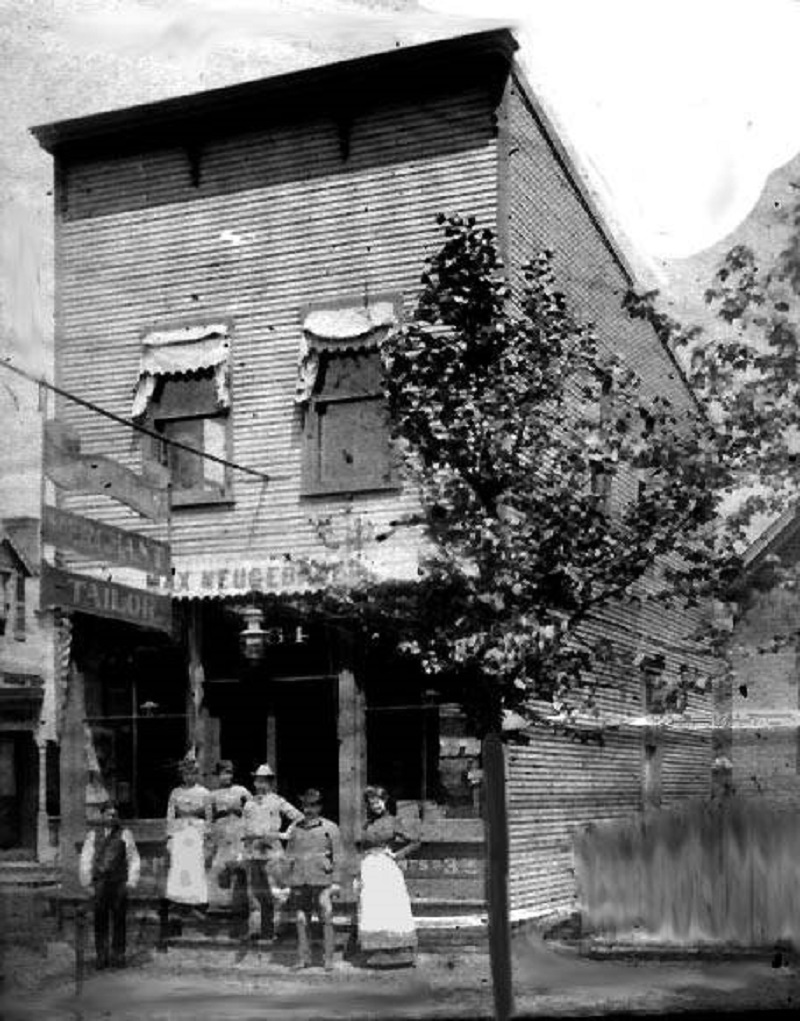
Before: The Max Neugebauer Tailor Shop at 764 Mohawk Street in 1897. After: 2016 Neugebauer arrived in Columbus in 1887, but it’s unclear when he opened this business.
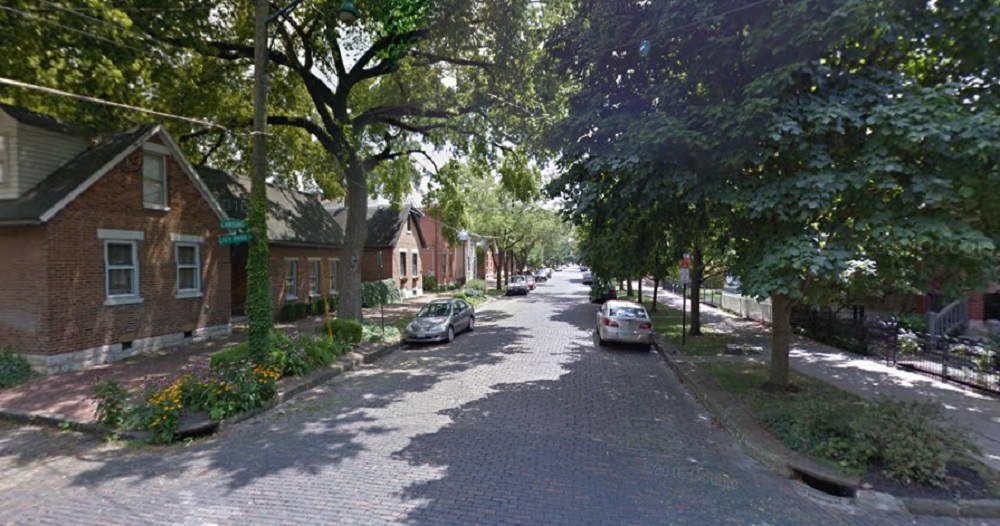
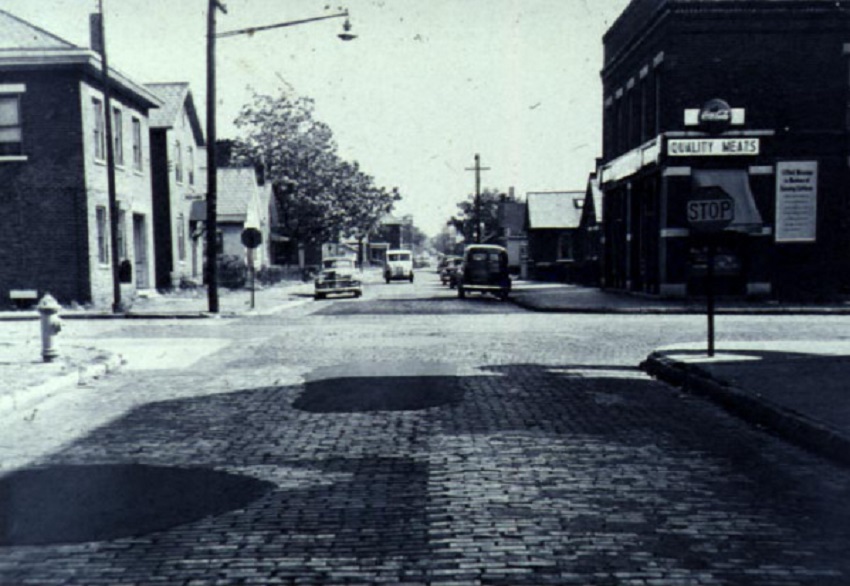
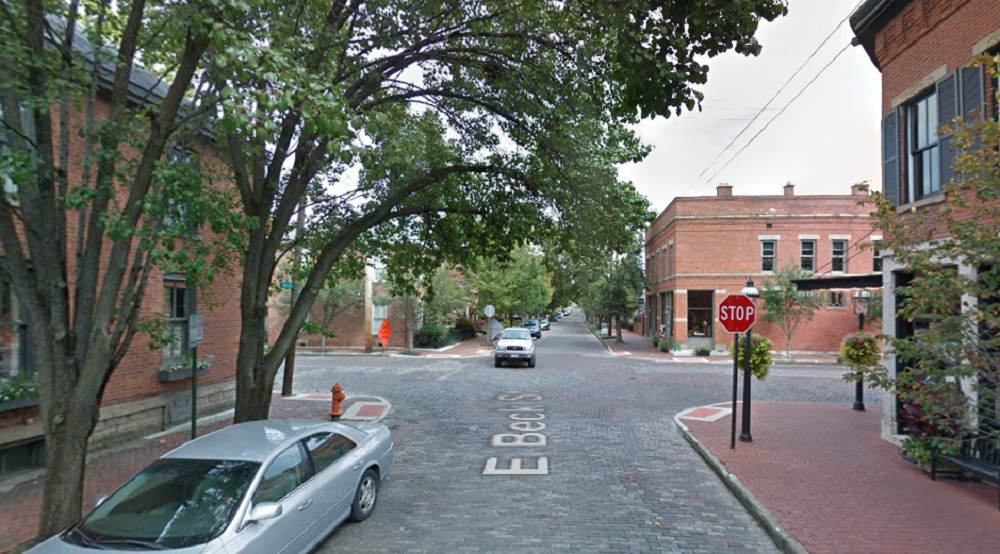
Before: Beck Street and Mohawk, looking east, in 1950. After: 2017 German Village was considered a “slum” by 1950, so the before photo would’ve been around the time of the neighborhood’s low point.
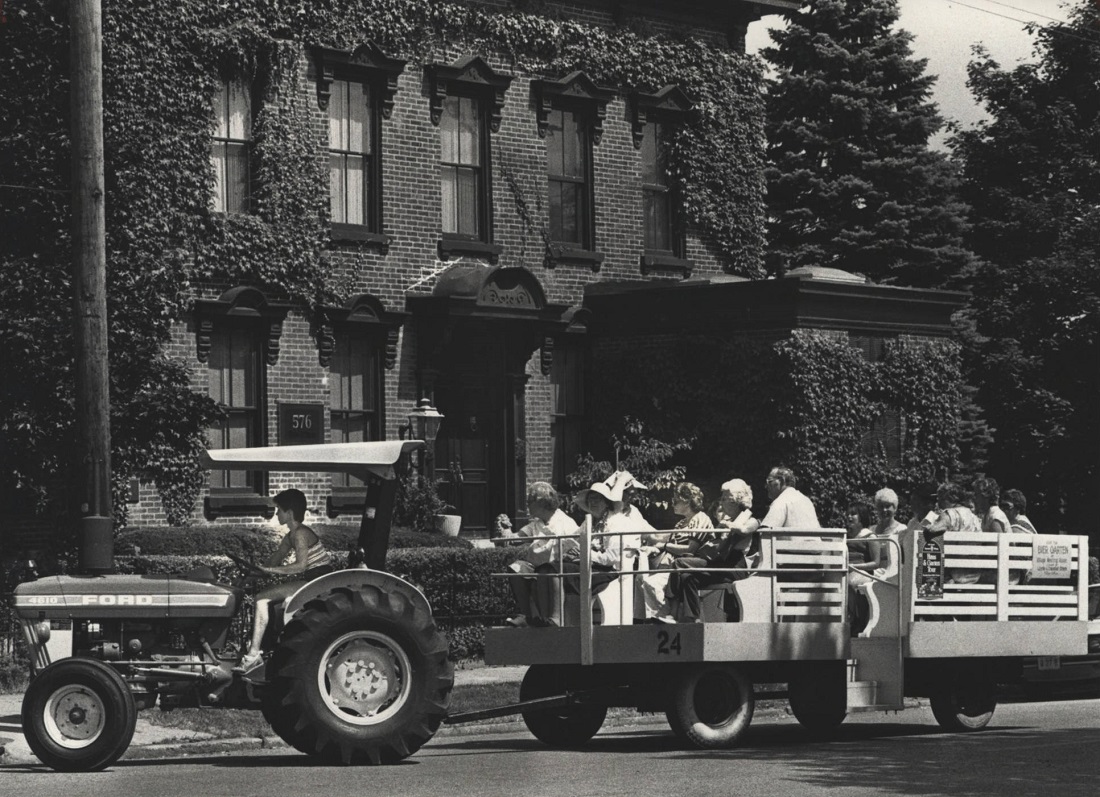
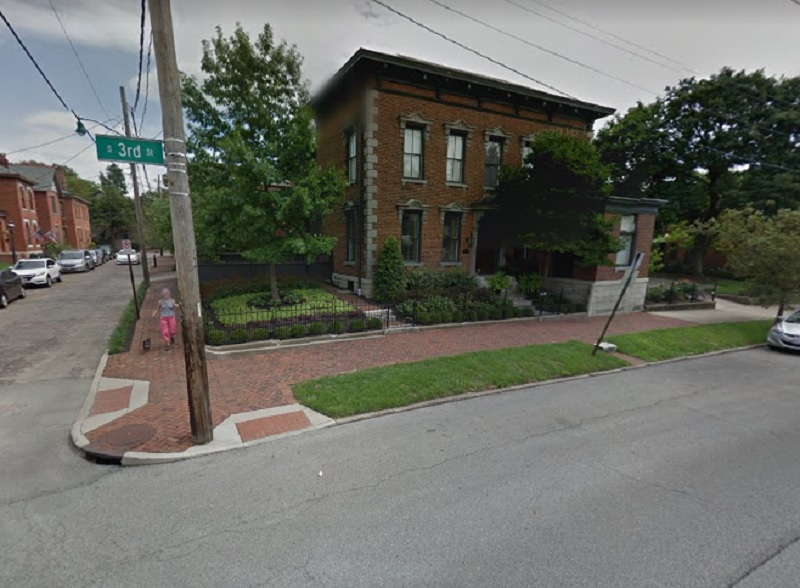
Before: Third Street and Beck, looking east, in 1981. After: 2016 The photo shows a German Village “Haus and Garten Tour” through the neighborhood.
I haven’t done a Before and After installment for a while. This time around, I chose to not focus on any single neighborhood.
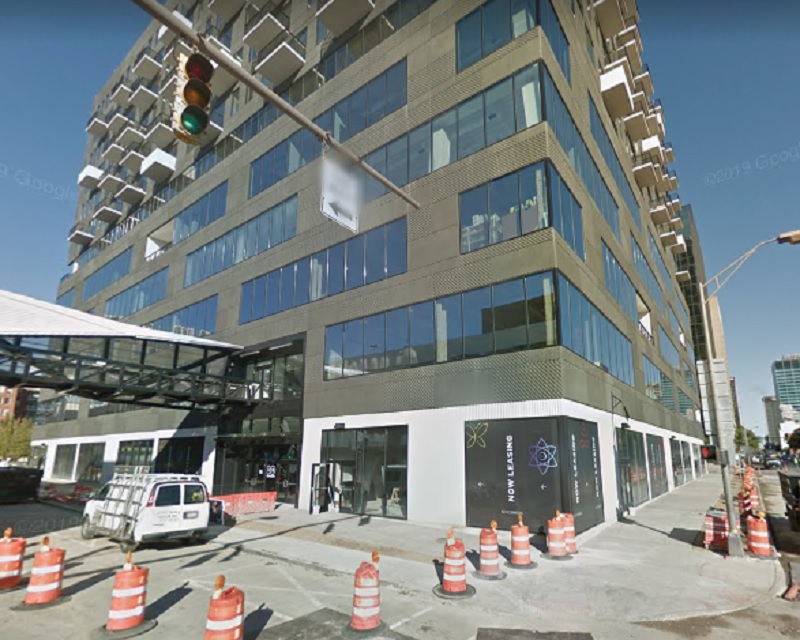
First up is a photo of the construction of the Columbus Interurban Terminal, looking northwest from 3rd. The photo was taken on October 5, 1911, about 3 months before the building opened. The interurban system was relatively short-lived in the city, and the terminal closed after only 26 years in 1938. The building survived as a grocery store through the mid-1960s before the building was demolished in 1967 as part of the construction of the Greyhound Bus Terminal across the street. The actual location of the building was not on the Greyhound site, but was used as an overflow parking lot. It remained a parking lot until the mid-1980s, when it became part of the City Centre Mall site. Today, plans are for the site to become the location for the 12-story, 80 on the Commons mixed-use project.
October, 1911.
Here is the same place in October, 2018.
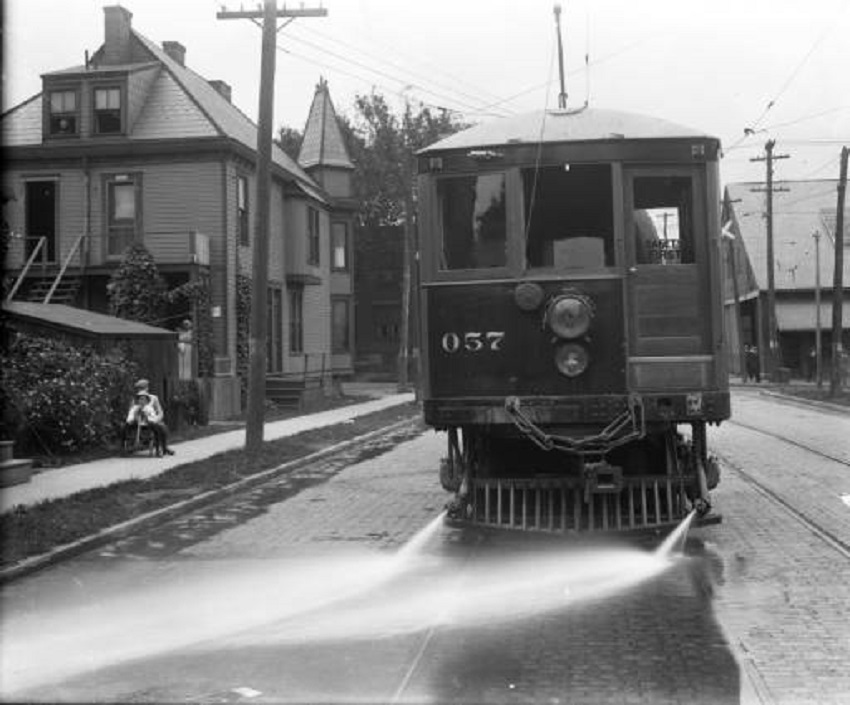
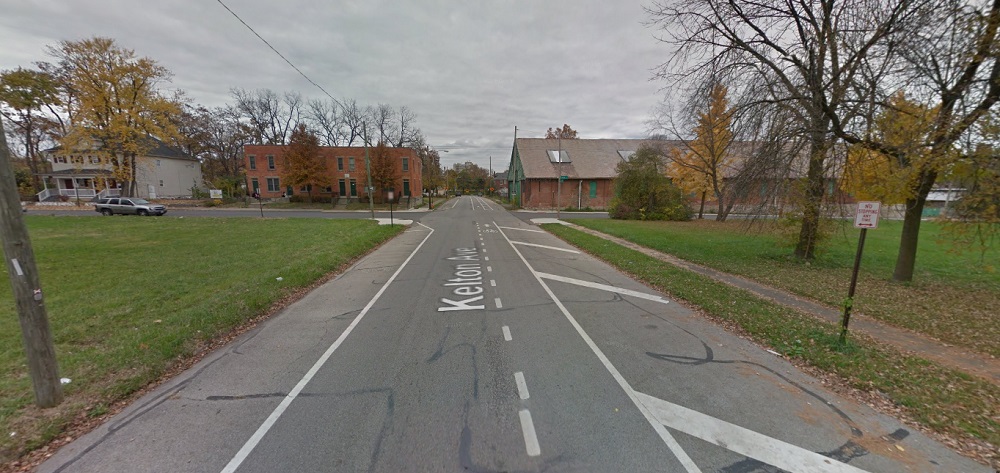
The second historic photo is of the #57 streetcar on Kelton Avenue just south of the Oak Street intersection. The photo, which looks north, was taken on June 30, 1915 and includes 3 separate visible buildings as well. The house on the left actually survived until 1977, when it and the rest of the east half of the block was demolished. The building visible on the right is the surviving streetcar barn. Today, it is in bad shape, and while many would like to see it renovated and saved, time seems to be running out. The other surviving building, barely visible in the 1915 photo, is the tenement building on the northwest corner of Oak and Kelton. And in 2015:
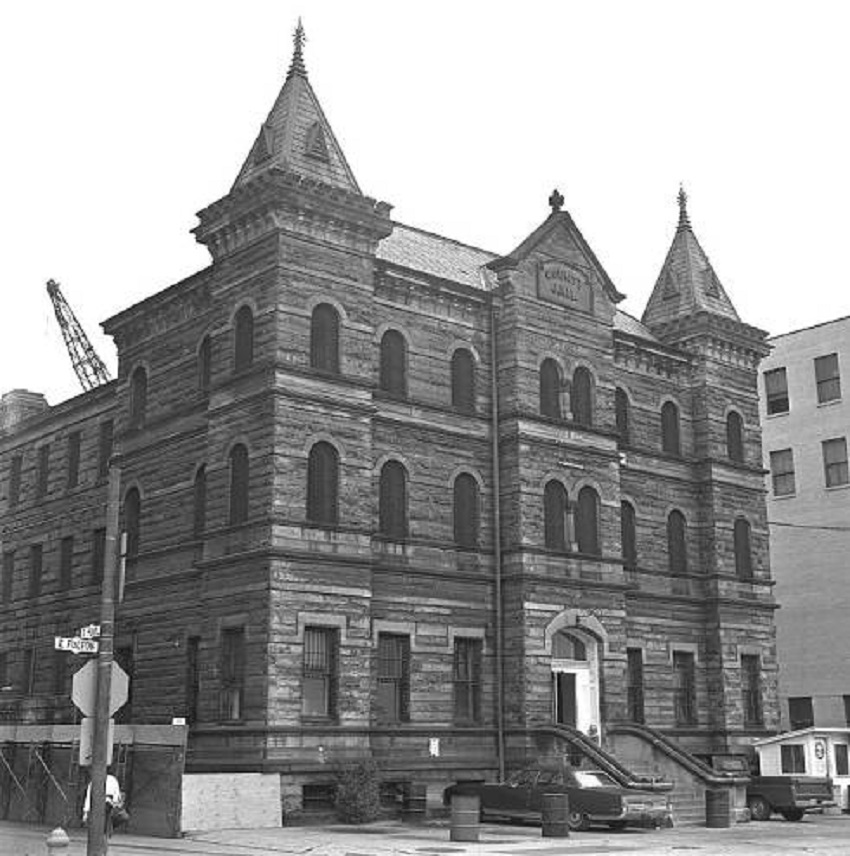
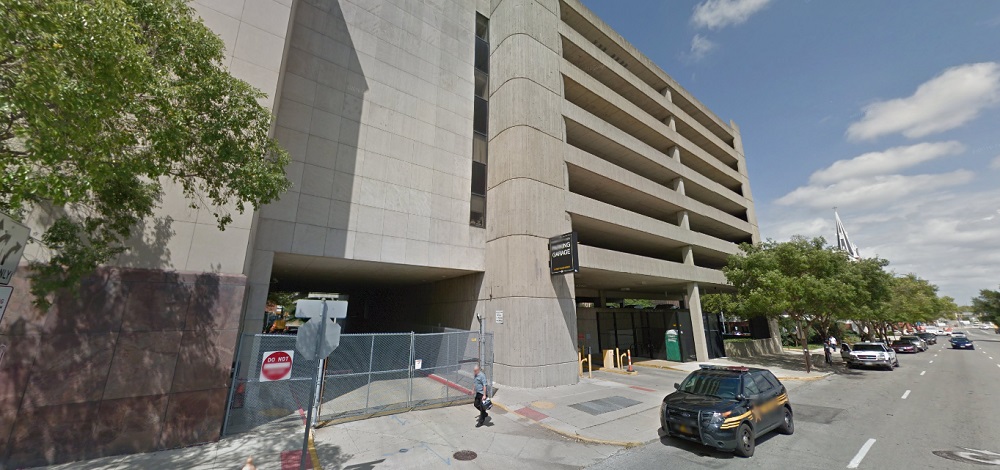
Third in this list is a photo of the demolition of the old Franklin County Jail, once located at 36 E. Fulton Street in Downtown. Built in 1889, the structure survived until the fall of 1971, when the building, which by then had become outdated for its intended purpose, was torn down to make way for- what else- a parking garage. The parking garage remains to the present day. Columbus leaders at the time should’ve been flogged for such short-sighted thinking, something that was repeated over and over and over again during that era. Today, such a very cool, unique building would’ve made an excellent candidate for mixed-use conversion. And in August, 2016:
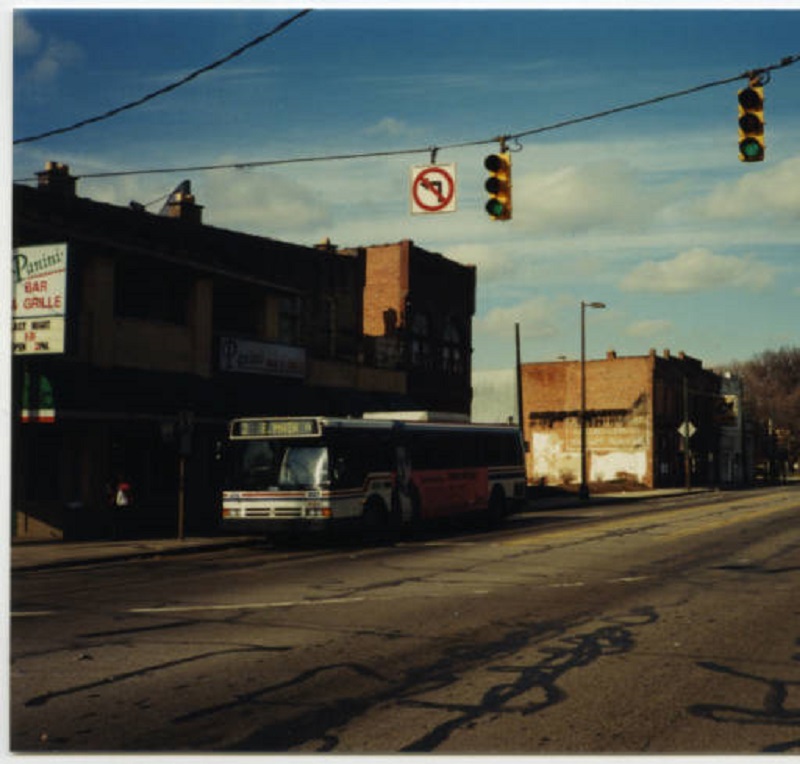
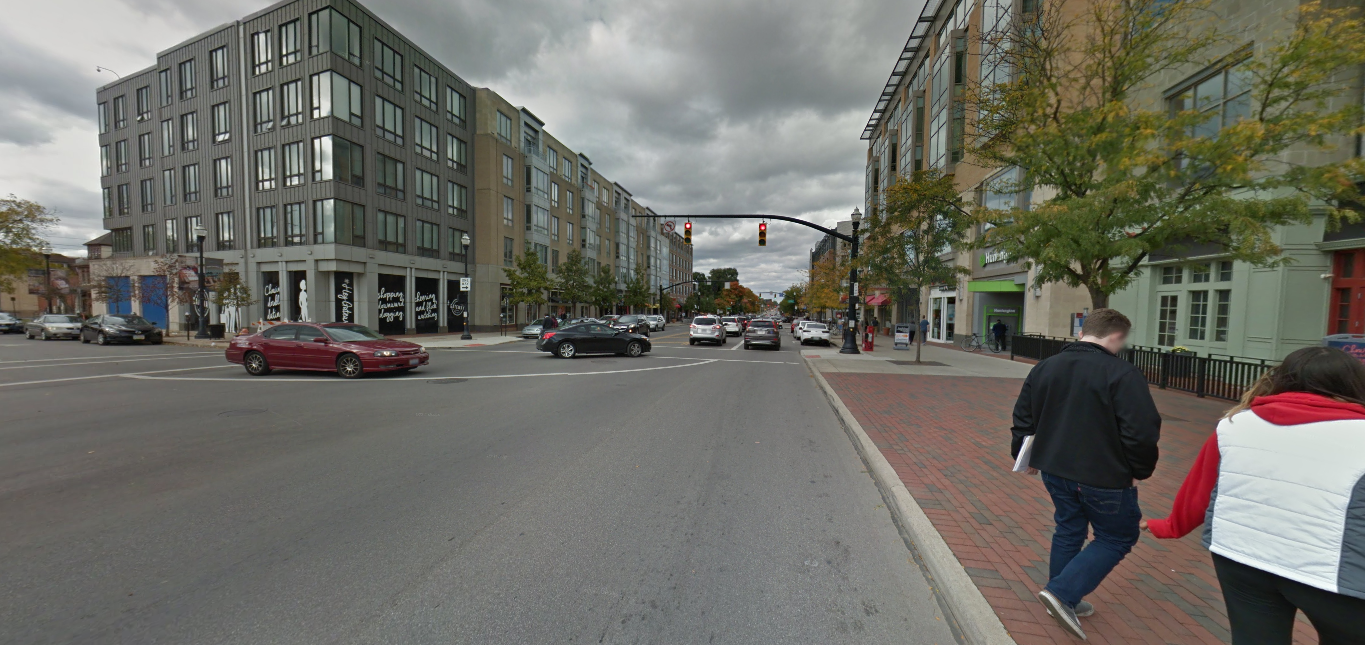
Finally, this next photo isn’t really historic. It was taken a mere 15 years ago in February, 2002, looking northwest from the corner of N. High Street and 10th Avenue. At the time, this area had been made up of low-rise historic buildings that had long held bars for OSU students. All these buildings in the photo, and many more, were demolished not long after the photo was taken in order to make room for the South Campus Gateway, now more or less just called the Gateway. Similar large-scale demolitions are taking place to the north and south as the entirety of the High Street corridor around Campus is transformed. Whether that is good or bad depends on who you ask. What can be agreed upon, however, is that the corridor will be almost unrecognizable in the end. And in October, 2016:
This Random Columbus Photos 3 edition looks at a Downtown icon, the Columbus Athletic Club..
Photo Date: November 1, 1914 Location: 136 E. Broad Street
The photo shows the ongoing excavation of the Columbus Athletic Club. It was conceived a few years prior as a social club by a group of wealthy Columbus businessmen in 1912. The organization was originally housed in the Atlas Building at Gay and High, but the club wanted their own building. Construction began in early 1914, and the 6-story building was dedicated in 1915. The 100-year-old institution, now on the National Register of Historic Places, looks pretty much the same as it did when it was first built, and it remains a private club to this day. Over the years, the club has had many prominent members, including politicians and even a president, Warren G. Harding.
Random Columbus photos 1 is the first edition in a new, very occasional series highlighting historic views in and around the city.
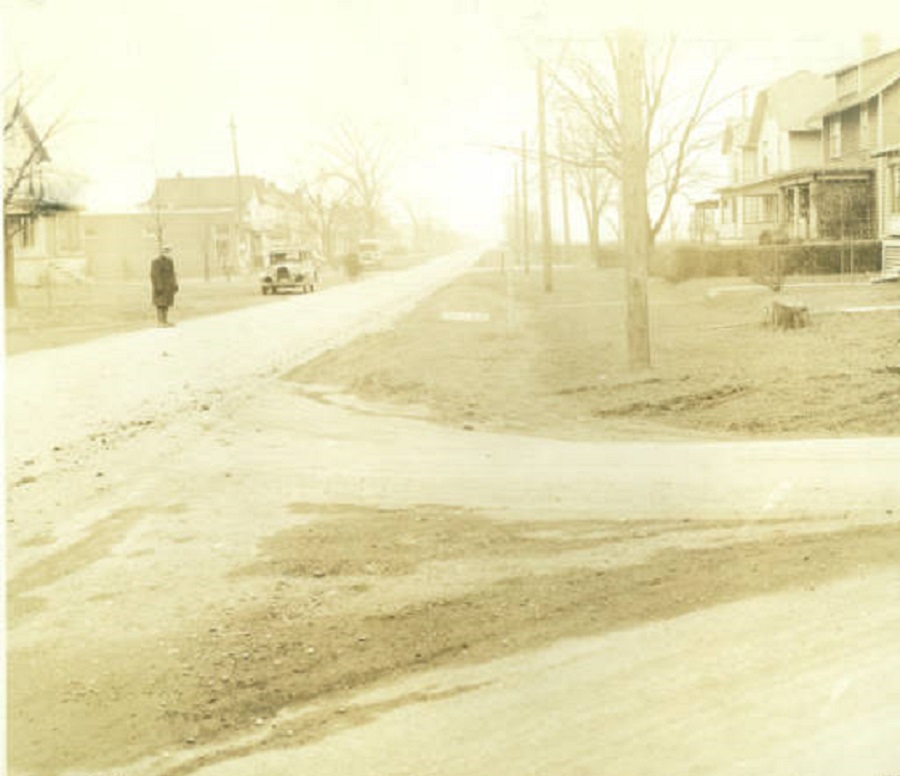
Photo Date: January 15, 1936 Location: Parkwood Avenue, East Linden
This random street scene photo was taken during the frigid winter of 1935-36. I couldn’t pinpoint exactly where the photo was taken, only that the style of homes indicates that it was taken looking north between Earl and Denune Avenues. Little has changed on Parkwood in the last 79 years. The area still looks and feels a little rural, and there are still no sidewalks. The one change, however, is that the roads are no longer dirt.
The day of the photo was fairly mild, with highs in the mid-40s. The next day, however, a snowstorm struck that dropped about 5″ of snow, and just a week later, temperatures hit 16 degrees below zero.
In my research into finding photos and information on historic buildings in Columbus, I have come across some interesting documents related to why some buildings were demolished and how 1960s preservation efforts were often failtures. Take the Alfred E. Kelley House, which once stood at 282 E. Broad Street. Built over the course of about a year between 1837-1838, the house was a classic Greek Revival. Over the many years of its existence, the house functioned in multiple capacities, including as a school. During those other uses, the architecture was drastically altered, and by 1960, the year the house was proposed to be demolished to build the Christopher Inn, the historic nature had been “severely damaged”. Still, the house had survived 122 years by then, and a history-minded group of people got together to try and save it with the intent of restoration and operating a period museum.
Photo taken in 1898.
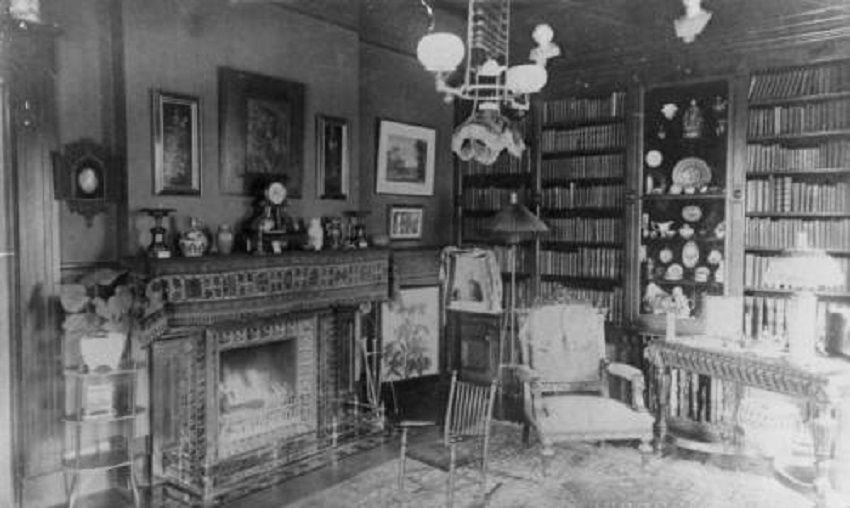
The library in the Kelley House, circa 1900.
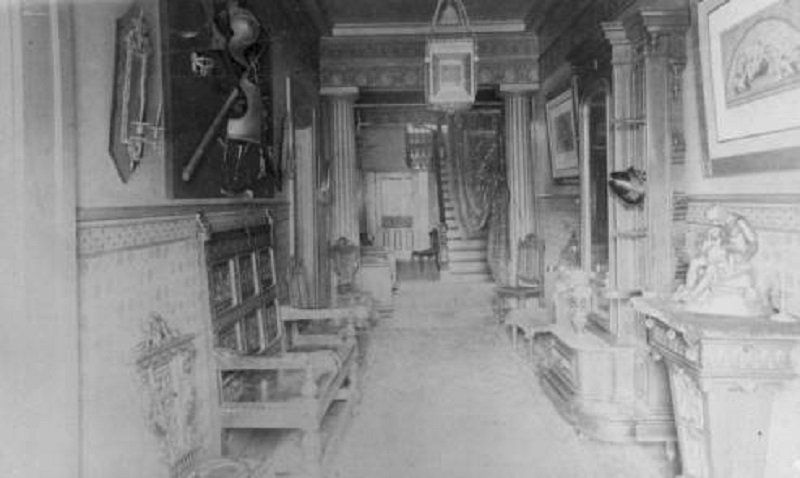
An elaborately decorated hallway in the Kelley House circa 1900.
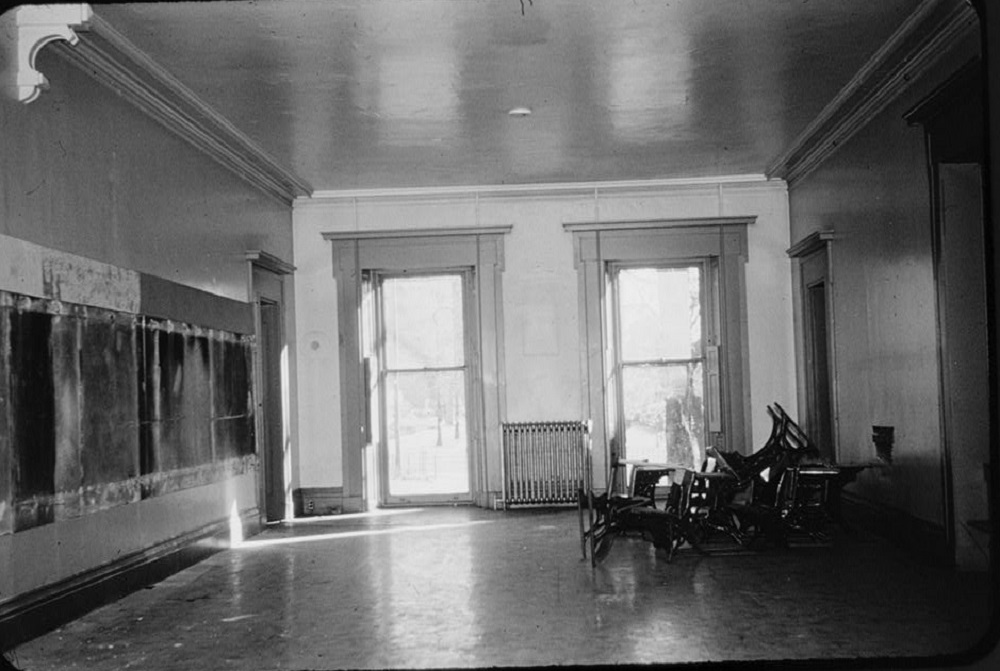
The gutted house in 1958.
In early January 1962, the efforts to save the house during the previous year were detailed by one Dixie Sayre Miller, chairman of the Kelley House Committee, which had been formed on March 24th, 1961. The goal of the committee was as follows:
“Considering the time element and the importance of Kelley to the State**, the committee decided to ask the legislature for money for which to move the house intact. We, later, would seek private money with which to restore it.”
The Committee had some powerful allies at the time. State Rep. Chris McNamara and John Vorys, former delegate to the UN, were both in leadership roles. Given this, even during a time when preservation efforts took a clear backseat to development, the Committee did meet with some initial success. The Kelley House legislative subcommittee was able to pass an appropriations bill in July 1961 for the amount of $95,000. The governor vetoed the bill, calling the appropriation “frivolous”. In August, a member of the Committee, Lee Skilken, had the idea to solicit local contractors to volunteer in taking down the house in order for it to be moved. When the idea was presented to the property owners on September 5th, it was rejected because it could not be guaranteed that the property would be clear in time for construction to begin. Instead, the owners wanted a paid contractor to do the work so that the timeline could be met. The land had to be cleared by October 15th, 1961, and the Committee had to have the money to pay the contractor by September 15th.
Here is where the story becomes a bit shady and political. On September 6th, members of the committee went to the Governor for advice on how to proceed. He recommended that they go to the Emergency Board, which would be able to issue a grant towards the project. The Governor promised he would “not object, would not fight it and would not make a political issue of it”. On September 15th, the money deadline, the Committee had raised only $11,000 towards the $35,000 cost of the paid contractor. However, the following day, they caught a break. Another contractor came forward offering to take down the house for just $20,000 and would begin immediately. Further, even though the Committee did not have the full $20,000, the contractor trusted that the Committee would have raised the amount by the time the work was completed. I’m not sure if such deals would ever occur in today’s environment, but they still happened 53 years ago. Only 2 days after the contractor began to take down the house, the Emergency Board awarded a $20,000 grant to the Committee and the house was fully dismantled before the deadline of October 15th. Stonework and foundations of the house were moved to a holding site at Franklin Park, while interior detailing was stored “in a city building”, all waiting for funding to be assembled and restored at a new site. This new site was listed as being in Wolfe Park on “East Broad at Nelson Road”.
So, why isn’t the Alfred E. Kelley house at Wolfe Park today? Two things happened after October 15th. First, the Governor lied. On the very day that the Committee was supposed to pay the contractor, they received a call stating that the Governor had deemed the Emergency Board grant unconstitutional and was withholding the money, despite being his recommendation that the Committee seek the grant from it in the first place. This also after a promise that he would not interfere or stand in the way. The Committee considered legal action, but decided a costly court process was not “advisable”.
Without the $20,000, the Committee was only able to pay the contractor $6,000, who then threatened legal action for the full amount. Since the Committee had neglected to be incorporated, each member was personally responsible for a share of what was owed. By December 1961, the Committee had become incorporated and had managed to pay an additional $2,000, but still owed the majority of the contract.
That concluded the events through January 1962. After that time, there are mysteries that remain unknown (at least as far as I can tell). First, what happened to the Committee? Did it end up raising the amount to pay off the contractor or did they end up in court? Why had the Governor decided to prevent the Committee from getting the grant? Did he have a political axe to grind with members of the Committee? Finally, and far more importantly, what happened to the Kelley House? The materials were in storage in early 1962, but the house was never rebuilt. Were they destroyed? Did the contractor take possession of them if the Committee was unable to pay? Are they still sitting in some warehouse somewhere covered in half a century’s worth of dust? We may never know, though I suspect that someone out there has the answers.
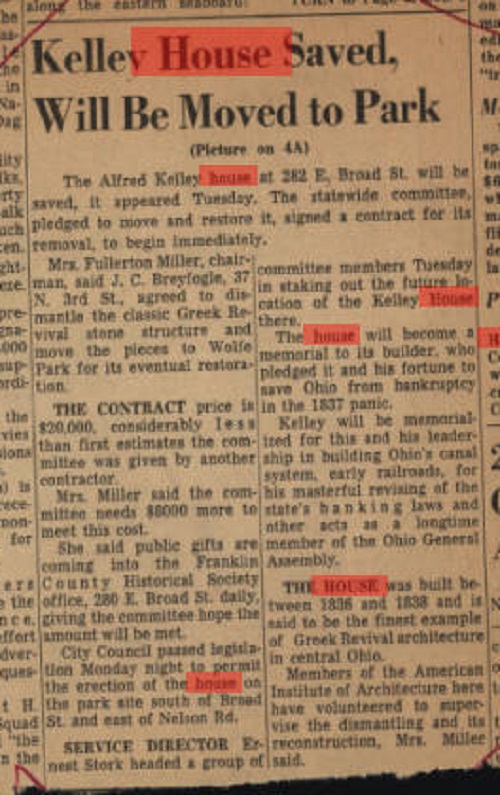
An ironic article in 1961.
**Kelley helped save the state from bankruptcy during the Panic of 1837 by offering up his house, possessions and business interests as collateral.
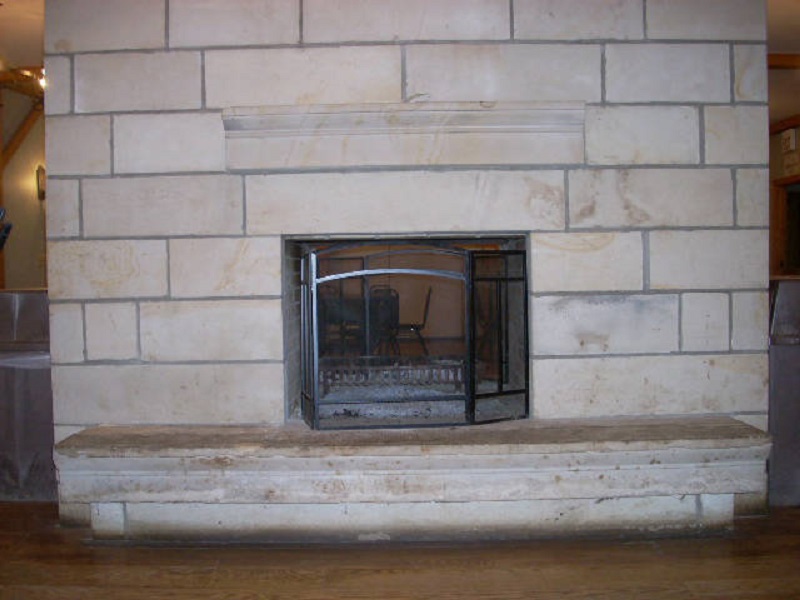
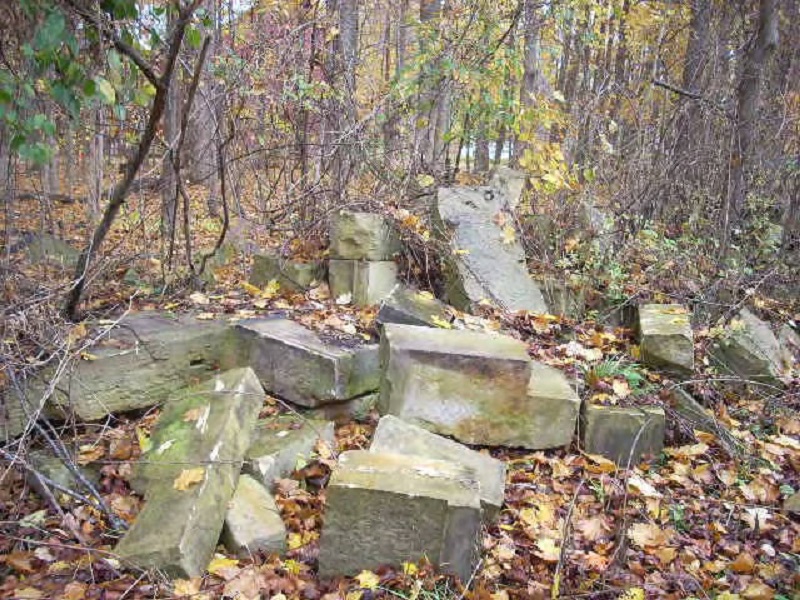
Edit 7/18/2014: I guess research pays off, and now, at least some of the mystery is solved, as contacts through readers led me to part of the answer. As mentioned above, part of the house’s remains, particularly the stone and brick portions, were stored at Franklin Park after the demolition in 1961. Five years later in 1966, these were moved to the Ohio Exposition Center at the Ohio State Fairgrounds. By then, the plans no longer called for putting the house back together and restoring it. Instead, the stone materials were planned to be incorporated into a new Ohio Historical Center in the late 1960s, presumably the one that now sits adjacent to the fairgrounds today. But that plan also fell through for unknown reasons. The stone materials were eventually gifted to the Western Reserve Historic Society in Cleveland. Some of the stone was used in the restoration of the Hale Farm, but much of it now sits tossed around outside in the elements, slowly being worn away. This still leaves many questions unanswered, such as where the interior portions of the house ended up and why none of the material was ever reused in Columbus despite preservation interests eventually securing the funds to do so.
A fireplace at the Hale Farm rebuilt with Kelley House stones.
Kelley House stones in the elements at Hale Farm near Cleveland.