In the Spring of 2021, I wrote about Amtrak’s proposal to bring passenger rail back to Columbus as part of its ConnectUS plan. That original plan included Columbus in just one route- the long-sought-after Cleveland-Columbus-Dayton-Cincinnati route, otherwise known as the 3-C Corridor. In my article, my view was that this plan was far too limiting for Columbus. That its growth and location suited the city for much better local and regional connections. Now, Amtrak is calling for Columbus to be a rail hub, complete with multiple routes and connections that rival those found in Chicago.
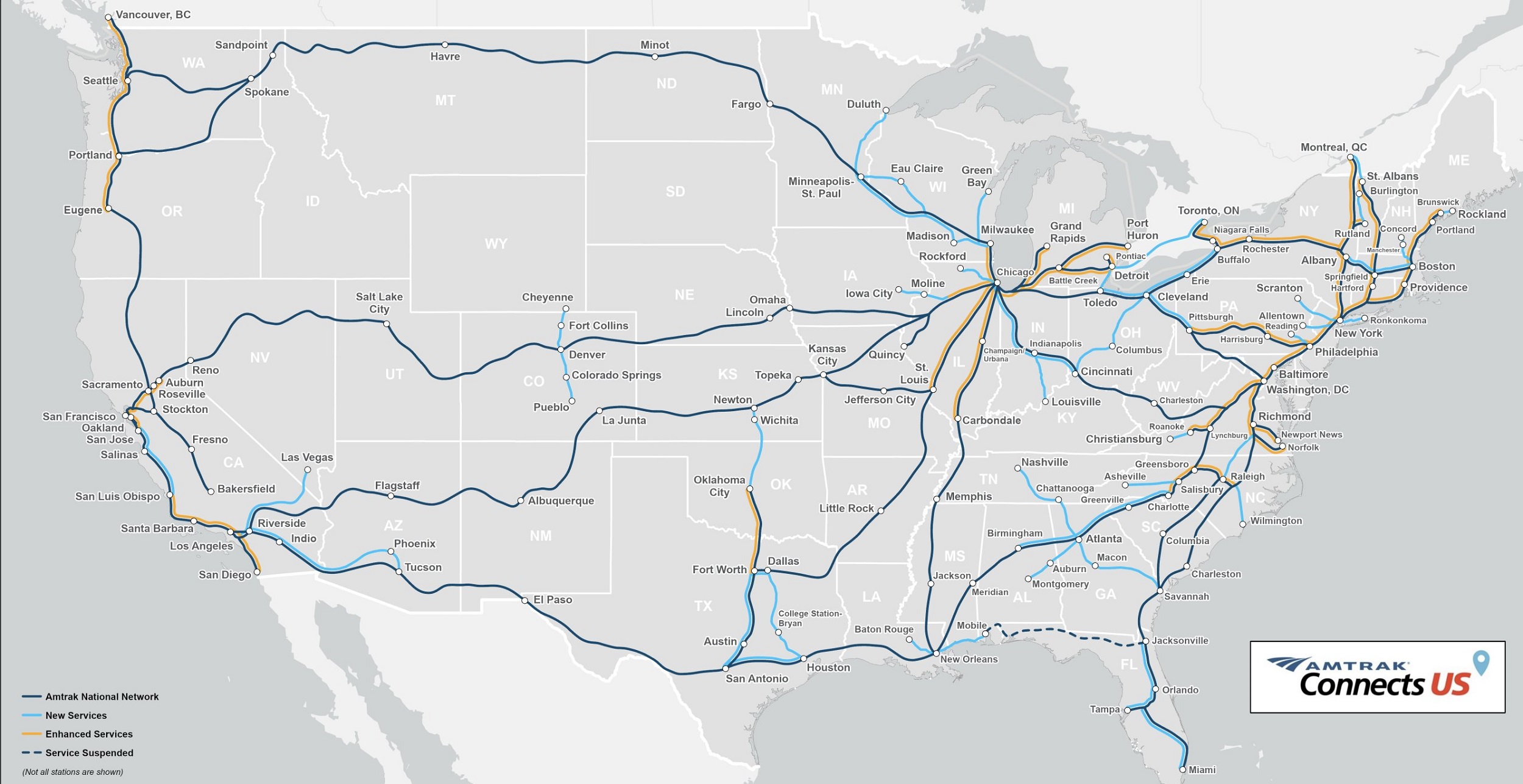
Here is the original map from last year:
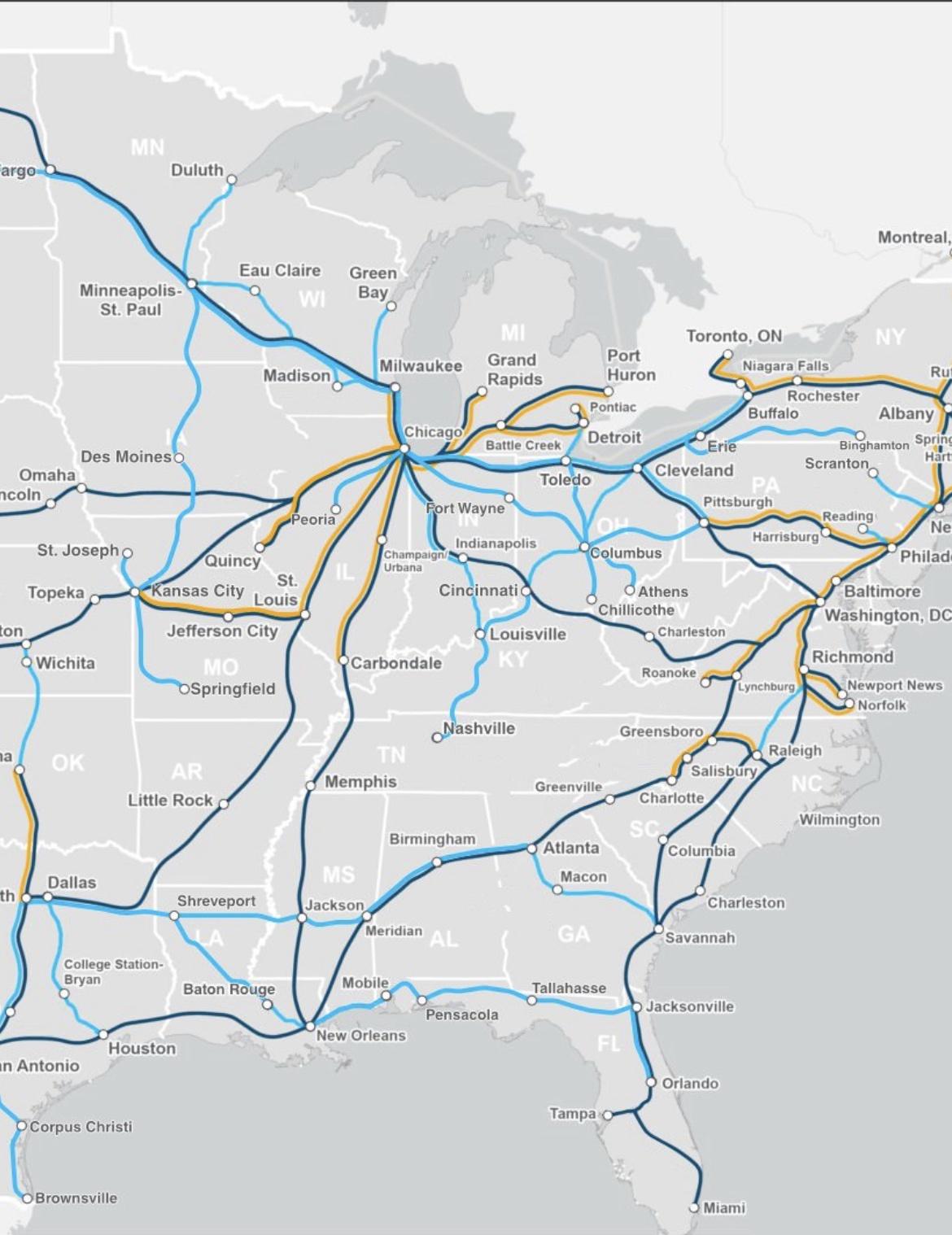
And here is the updated version, recently released:
In the new plan, the Cleveland-Columbus-Dayton-Cincinnati route is maintained, but the following routes would be brand new: Columbus-Chillicothe Columbus-Athens Columbus-Toledo-Detroit Columbus-Pittsburgh Columbus-Fort Wayne-Chicago Louisville-Nashville would be an extension of the Columbus-Dayton-Cincinnati route. So overall, Columbus residents would have direct connections to 12 different cities. Of course, many of those cities would have their own routes, so Columbus residents would have rail access to large parts of the country under the plan.
The timeline for completion is tentatively for 2035. Most of the proposed routes already have existing rail lines, so it would come down to funding any necessary upgrades along with buying the trains, etc. Whether any of these routes are ever actually built and opened remains to be seen, though. Passenger rail, unlike in most of the world, is politically controversial in the US, and public transit remains deeply underfunded and underbuilt in every part of the nation arguably outside of the New York and Northeast Corridor.
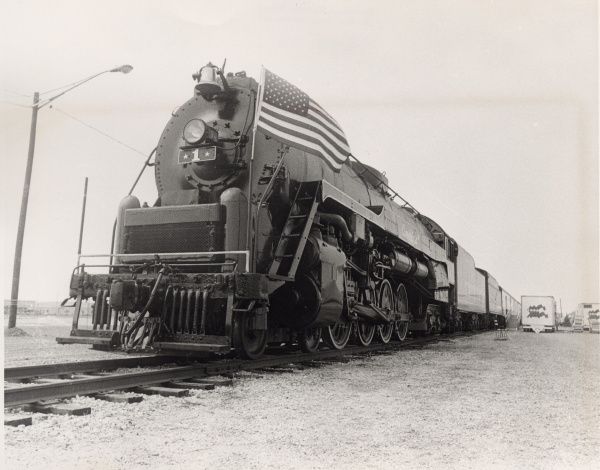
Columbus is the 2nd largest city in the United States without any form of passenger rail. It hasn’t had passenger rail since the last train pulled out of Union Station in 1977. Some might argue that rail is an outdated form of transit, and therefore unnecessary anyway. Others argue that not having a multi-modal transit system holds the city back economically and developmentally.
However one views rail, Amtrak’s latest national route plan, called Connect US is still arguably mediocre. In fact, one could say that the new Amtrak route plan underserves Columbus completely.
The route plan.
As shown in the above map, Columbus would only have direct connections to Cincinnati and Cleveland. To go anywhere else, passengers from Columbus would first have to travel to those cities and then make transfers. While a direct connection to Cleveland and Cincinnati is important, this plan would present more of a challenge to potential travelers who want direct connections outside of the state. Columbus is currently the largest city in Ohio and will soon be the largest metro area. It is one of the fastest-growing cities in the United States and has added more people the past 10 years than any other Midwest city. On top of all that, it is the capital of the 7th most-populated state.
Amtrak’s plan attempts to largely use existing rail lines, but in many places the routes would be brand new. Columbus doesn’t have existing passenger rail routes, so it may be more expensive to build them there. However, it seems to be a wasted opportunity to not make Columbus more of the state’s hub by having direct connections to cities like Chicago, Indianapolis and Pittsburgh. Incidentally, the proposed Hyperloop project would be a Chicago-Columbus-Pittsburgh route that would eventually connect all the way to New York. Most people view Hyperloop as a gimmick more than a real proposal, so more traditional rail is still taken more seriously.
It is in all our best interests to want the best possible infrastructure. Amtrak’s plan treats Columbus as a 2nd or 3rd-rate city. That’s unfortunate, and works against all the momentum the city has had in recent decades. The current Amtrak plan would provide less economic benefit and options to Ohio’s fastest-growing city and capital. The city deserves so much better than being an afterthought.
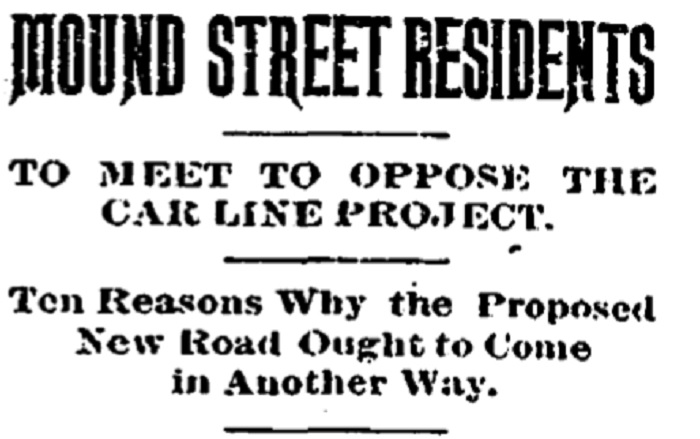
In a January, 1900 debate on Columbus transit, a group of concerned Downtown Columbus residents and business owners voiced their opposition to the Columbus & Newark Traction Company being greenlit to build and operate a streetcar line on Mound Street. Today’s car-dominated environment means most arguments against transit projects would likely revolve around rail being too expensive or that few would ride them. In contrast, 1900 arguments involving transit options showed a very different attitude towards public transit in general.
The opposition group put out a list of 10 reasons why they objected to the project. They were: 1. We believe it to be the interest of prospective passengers of a street railroad from the east over the National Road, that the cars come into the city over the Main Street tracks. 2. Because it would be most direct to the center of the city. 3. Coming over the Main Street line would confine cars of the new line to the established rate of speed while in the city. 4. The proposed line on Mound Street would get but few city passengers. 5. It is not likely that reduced fares would be secured. 6. Transfers over old lines could not likely be had. 7. Cars would be far between. 8. A car line on Mound Street would be useless to residents of the city because too near Main Street where cars are much more frequent than could be expected on a suburban line. 9. Not getting city traffic, cars on the proposed line over Mound Street would run at a high rate of speed, making it dangerous for people in that part of the city and especially so for the residents of Mound Street. 10. We believe that it would be to the general interest of the city and the special interest of the southeastern part, also the interest of a new company that the proposed new line over the National Road from the east should come into the city two or three blocks from, if not on the Main Street line, but never over Mound Street. Besides being somewhat repetitive in places, the given reasons are more practical than the emotional anti-rail tirades often witnessed today. The group wasn’t so much opposed to rail- just the opposite. Instead, they didn’t like that there were too many lines in the same area, thereby making a new one redundant and financially infeasible. They didn’t bring up construction costs, but objections to the potential lack of transfer stops. They weren’t overly worried about the line interfering with other traffic, but whether the service would run enough cars.
Too often in the current transit debate, proposals tend to get bogged down in politics rather than the basic transit needs of the population. A century ago, even opposition groups seemed to fully understand that the issue was not rail itself, but in ensuring that what got built made the best sense possible. Columbus hasn’t had rail in more than 40 years. In its long absence, we’ve perhaps lost the plot on what really matters.
The opposition group lost the fight and Mound Street got its streetcar line. The East Mound section ended service in 1929 as the car became increasingly dominant. The last streetcar trip in the city occurred on September 5, 1948.
Rail in some form existed in Columbus from the 1850s through the mid-1970s. For generations, rail travel was the way to go. It was the connector of distances, the driver of local and state economies. On the local scale, it brought folks to and from their city’s downtown areas for shopping and employment, and the trolley, interurban and other rail systems were as prolific as the horse and buggy before them. So what happened? In this Why Columbus Doesn’t Have Rail Part 1, we will review all of the history of rail travel within the city.
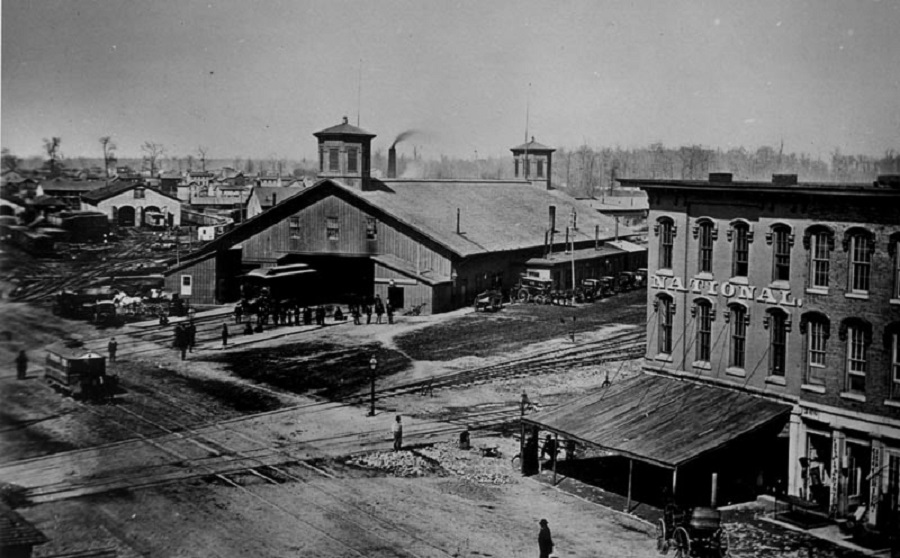
Most people today are aware of the Union Station that existed on High Street where the Convention Center is now, but there were actually 2 more depots that proceeded it. Columbus got it’s first real taste of rail travel in 1851, when the Columbus Union Depot opened, a year after the city’s first railroad, the Columbus & Xenia, entered the city. It was followed by the Cleveland, Columbus & Cincinnati Railroad in 1851. Both railroads wanted their depots to be as close to the downtown area as possible, as this was the center of the city’s population and commercial activity. At the time, the city was significantly smaller than it is now. Today, Chestnut and Naughten Streets are within the heart of Downtown, but in the early 1850s, there was almost no development north of these streets, so the two railroads collaborated and purchased a plot of land at the northeastern corner of the North High Street and Naughten intersection, about where the Hyatt Regency is today. This would be the location of their new terminal, the Columbus Union Depot.
The first Union Station that operated between 1851-1875.
This was the first depot in the city and resembled a barn, in some ways similar to the first North Market building that would go up nearby. It was built to handle 3 railroads but by the early 1870s was handling the traffic of 5, well exceeding capacity. Beyond the inadequate size, the depot’s trains dangerously and regularly blocked traffic on High Street, much to the anger of many residents. The push for a new depot began.
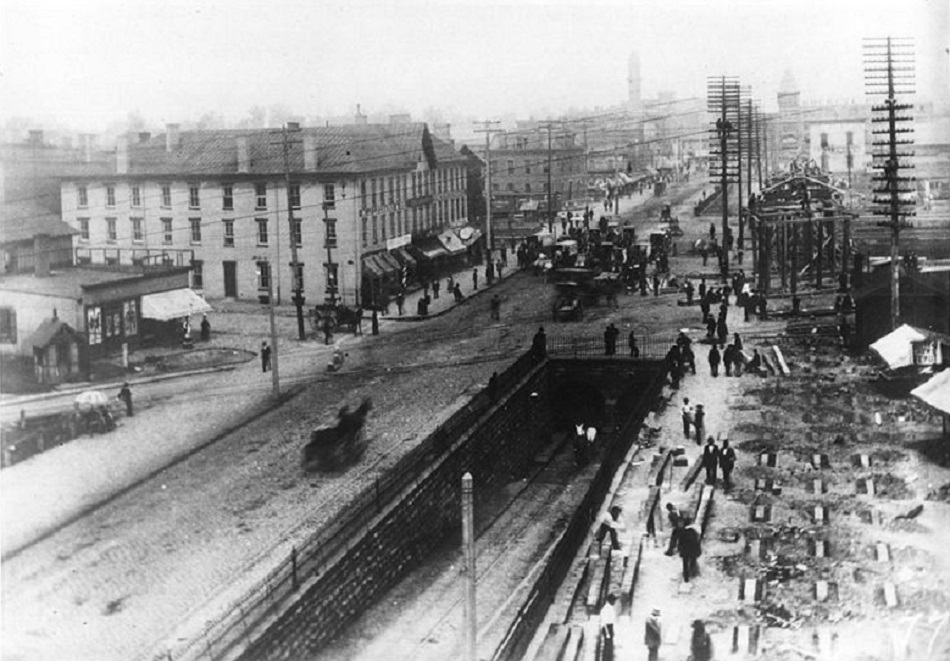
Plans were approved in 1871 for the new depot and it was completed and opened in February 1875, with the old depot torn down and many of the old tracks relocated/rerouted to the much larger depot, now located further east of the old depot location, just north of Naughten. Not only was it much larger, but much grander in design. No longer a giant, single story barn, it was instead a 3-story red brick structure and had many architectural features that the previous depot lacked. Tracks still crossed High, but a 160-ft tunnel underneath helped to relieve congestion. For years, this new setup solved many of the previous problems, but a steady increase in train traffic (there were over 120 daily trains by the early 1890s), as well as pedestrian and horse and buggy traffic getting too and from the depot began to cause major problems in the area once more. A new depot was once again needed.
Union Station 1875-1897.
The High Street tunnel that connected the 2nd depot, around 1888.
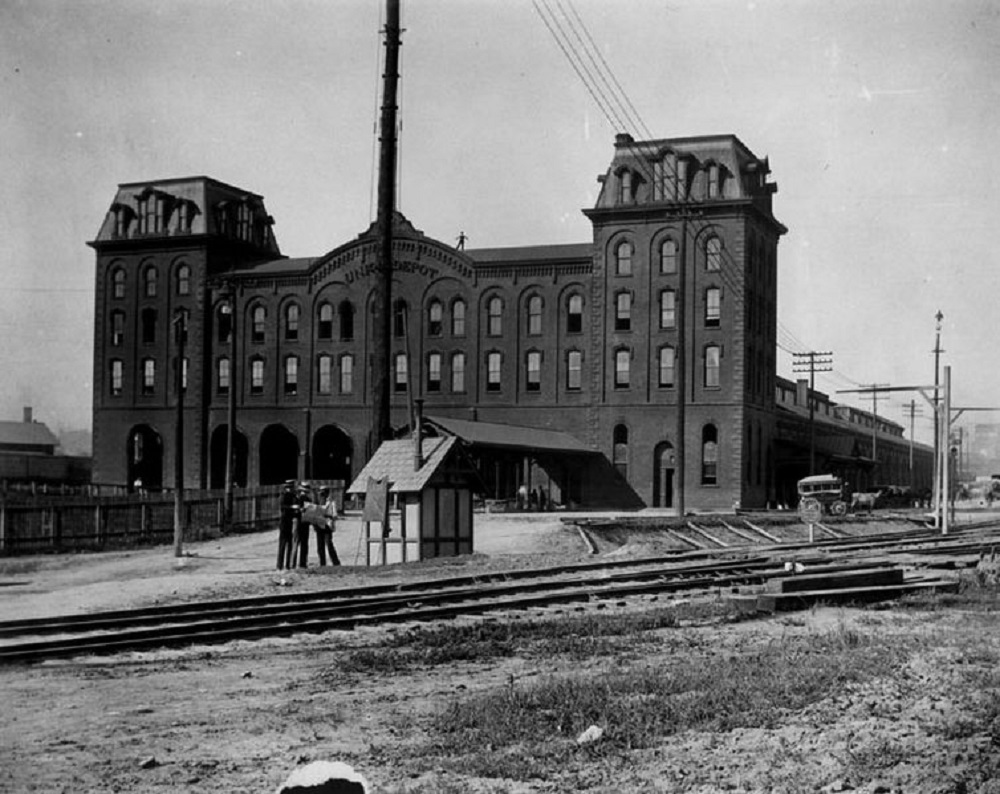
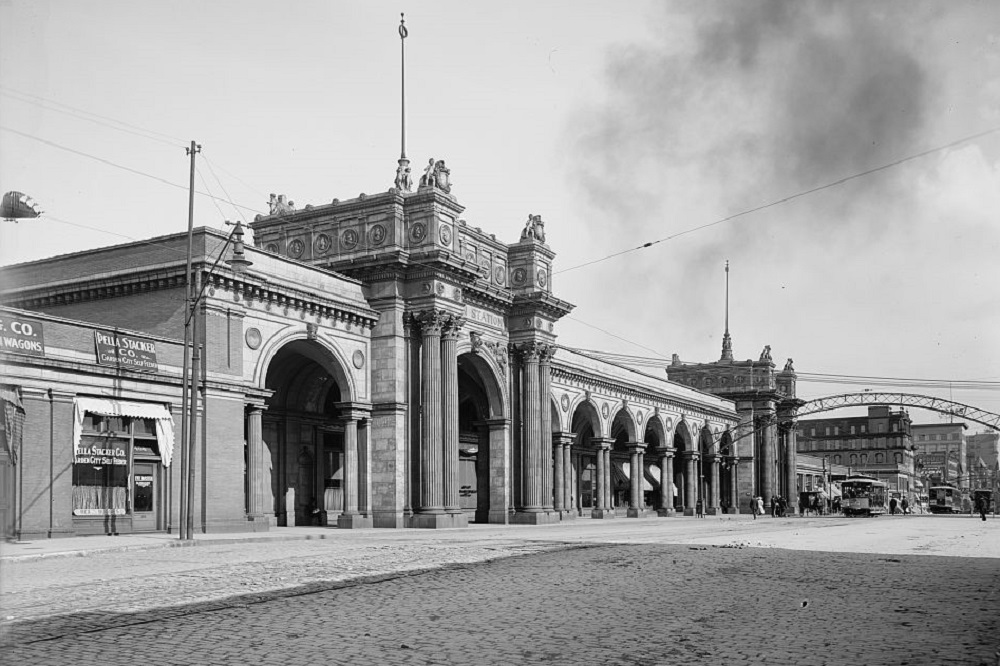
The third and most recognizable depot was completed in 1897: Union Station. It was, by far, the largest and most elaborately designed depot of the three, with 45-ft ceilings, a grand concourse and ornate plaster details. Much of the glamour was lost in a 1920′s remodeling, however, and falling numbers of daily trains gradually eroded maintenance levels. Union Station continued to serve passengers for nearly 50 more years, until the last passenger train passed through Union Station on April 28, 1977, ending over 125 years of passenger rail in the city. Demolition of Union Station had begun almost 7 months earlier, in an underhanded tactic to make way for a proposed convention center. The depot, particularly the arcade section along High Street, had been put on the National Register of Historic Places in 1974, and preservationists had won an injunction to stop demolition. However, a coalition led by Battelle rushed to demolish the building anyway, and by the time preservationists could act, most of it had already been lost. A single archway was all that remained, and today it sits on the northern corner of McPherson Commons park in the Arena District, a lonely testament to what was lost. The rest of the station was demolished by the fall of 1979. Ironically, the best evidence of how preservation attitudes have changed is just a bit further north with the I-670 retail cap. It is designed to resemble the Union Station arcade.
Union Station in 1910. It existed from 1897-1977.
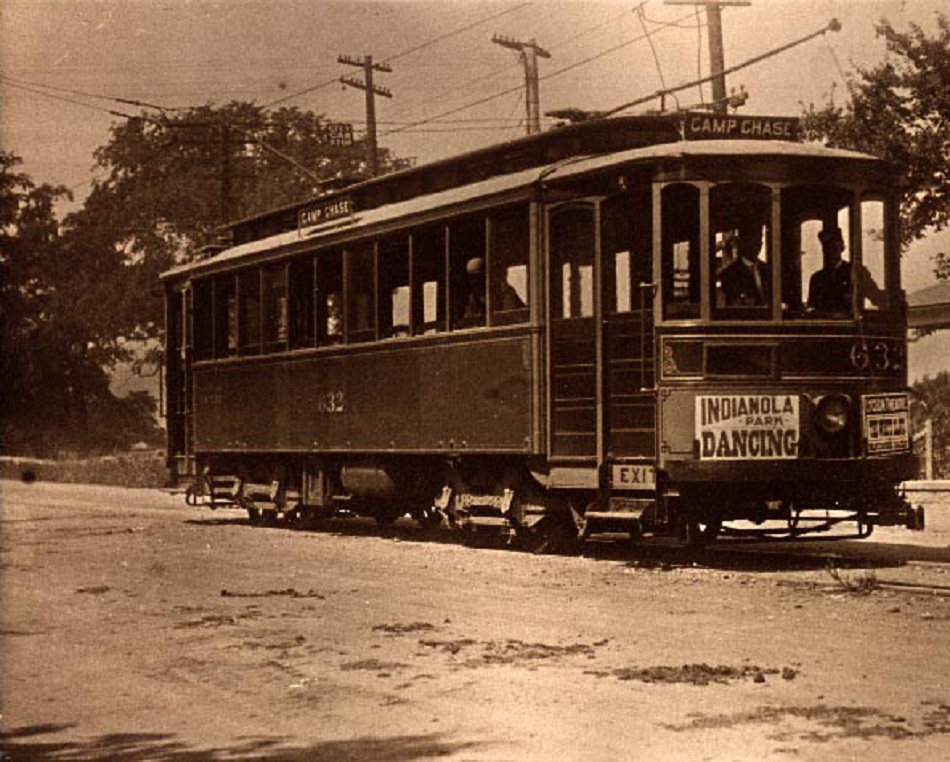
Beyond heavy passenger rail, Columbus also had a streetcar system. The Columbus Street Railroad Company was formed in 1854, but the first streetcar did not come about until June 1863, when a horse-powered car arrived on High Street. By the 1890s, more than a dozen street rail companies were in the city and had almost 35 miles of tracks. Most of these were also horse-drawn until the early 1890s, when electrified lines proved far more efficient, making horse-drawn lines obsolete.
The Camp Chase streetcar.
Electric lines and passenger totals continued to grow over the next few decades and, by the mid 1910s, annual passenger tickets exceeded 65 million, equating to almost one trip per day for every man, woman and child living in Columbus at the time. By the 1920s, streetcar lines had spread to almost all of the urban core neighborhoods and inner ring suburbs, but passenger totals were already falling as the automobile increased in popularity. In the 1930s, an attempt was made to adapt to this changing transit environment and the fixed-track streetcars began to be replaced with trolley buses, with the last streetcar decommissioned in 1948. They too, however, only lasted until 1965, when they were replaced with the standard diesel bus.
In Part 2, I’ll examine what happened and why rail has, to this date, not returned to the city.