Is the Short North Dangerous Now?


Is the Short North dangerous?

There’s been a lot of media attention to recent shootings in the Short North this year. It’s supposedly gotten so bad, that Mayor Ginther has asked local businesses in the neighborhood to close by Midnight.
But has the violence really spiraled out of control, especially compared to other areas in the city. Is the Short North dangerous now? Or is the area just getting more attention due to its status as a hot neighborhood popular with locals and tourists alike?

First, let’s take a look at homicides and homicide rates across Franklin County by Census Tract. The numbers are through May 17th and the rates are total homicides divided by the 100K people per tract.

The first thing that sticks out is that the map has a whole lot of white areas, meaning most of the county and most of Columbus have seen zero homicides so far this year. The areas that have seen them do not appear to be much different than previous years- Hilltop, the Far West, the Near South, parts of Linden, and Northland. The Short North has had 1 homicide this year, which is certainly more than normal, but arguably not an epidemic even if gun violence overall is up. The other thing that sticks out is that most homicides are occurring in relatively small areas, and are often tied to certain streets or even certain businesses or residential complexes.

Using this map, we’ll next take a look at the overall homicide rates of specific neighborhoods and areas in and around Columbus to see where the whole of the Short North really ranks.

The ranking gives the neighborhood, how many tracts make it up, the 2020 population, total homicides and the homicide rate per 100,000 people.
1. Franklinton- 3 Tracts- 6,482- 3 Homicides- 46.28
Franklinton is still the most dangerous part of Columbus, and it’s really not even close. This is despite significant redevelopment in the neighborhood.
2. Near South- 13 Tracts- 35,026- 7 Homicides- 19.99
The Near South comes in a distant 2nd place. It includes a much larger area than Franklinton, but about half of the homicides occurred in the 3 tracts to the southeast of Nationwide Children’s Hospital. Places like German and Merion Village have had none.
3. Weinland Park- 2 Tracts- 6,393- 1 Homicide- 15.64
It seems a little unfair to rank Weinland Park 3rd when it’s only had a single homicide, but that’s just how the math works out. The single homicide has been lumped in with the Short North by some media, but it occurred well north across from Campus.
4. Near East- 9 Tracts- 21,841- 3 Homicides- 13.74
The Near East Side ranks 4th for the year so far. It’s been somewhat quieter than normal in this part of the city.
5. Linden- 14 Tracts- 41,627- 5 Homicides- 12.01
Similar to the Near East, Linden has been a bit more quiet than normal despite the relatively bad year Columbus is having.
5. Hilltop- 16 Tracts- 68,045- 8 Homicides- 11.76
Hilltop has had the 2nd most homicides of any of the neighborhoods looked at, but it’s also one of the largest and highest-populated as well, so the rate was lower than those above.
6. Northland- 18 Tracts- 89,165- 9 Homicides- 10.09
Northland has had the most homicides so far of any area of the city or county. Like Hilltop, however, its higher population means its rate is still relatively lower.
7. Short North- 4 Tracts- 12,472- 1 Homicide: 8.07
The Short North’s single homicide puts the neighborhood in 7th place overall. The rate itself is only slightly above that of the entirety of Columbus, so it doesn’t seem to be much of an outlier.
8. Far West- 11 Tracts- 51,308- 3 Homicides- 5.85
The Far West is the only neighborhood looked at that is entirely outside of I-270. It’s rate is only about 60% of the overall Columbus rate at this point in the year.
9. OSU Campus- 12 Tracts- 55,281- 2 Homicides- 3.62
Another large and heavily-populated area, the Campus neighborhood has been fairly safe so far this year.
10. Downtown- 5 Tracts- 12,297- 0 Homicides- 0.0
Downtown has had no homicides so far this year, a departure from last year in which it had already seen 1 at this point on its way to a total of 4 for 2022.
11. Whitehall- 8 Tracts- 23,054- 0 Homicides- 0.0
Another area I think that has had a somewhat negative reputation for crime is Whitehall, the only non-Columbus area looked at. It’s also had no homicides so far this year.

Overall, the neighborhoods above have accounted for 42 of the 65 total homicides so far this year, or about 65%. Most of the rest were very scattered.

So is the Short North dangerous? Not in terms of homicides, no, but that doesn’t mean that recent crime trends should be ignored. That said, it’s pretty clear other neighborhoods are much more deserving of attention in this regard, but may not have the economic or social clout to demand it.
Of course, it also needs to be said that homicides are just a single type of crime. An examination of other types of crime may show a completely different story, but those other types rarely get the kind of breathless, hyperbolic reporting that homicides do.
Housing Market Update January 2023


Housing market update January 2023

The Housing Market Update January 2023 data, the first of the new year, from Columbus Realtors showed that home sales and overall supply continued to decline, helping to ensure most areas saw continued increases in median prices.
Note: LSD= Local School District, CSD= City School District. In both cases, school district boundaries differ from city boundaries.

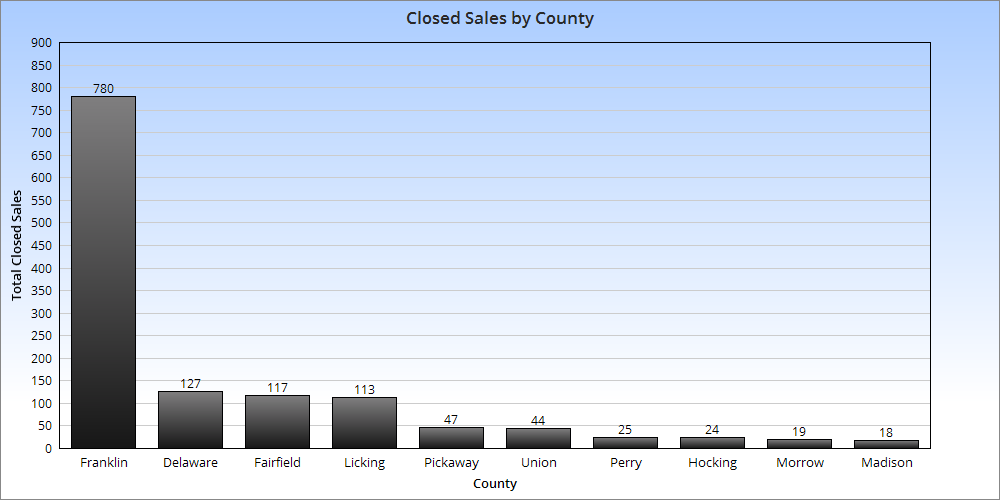
Housing Market Update January 2023 county closed sales
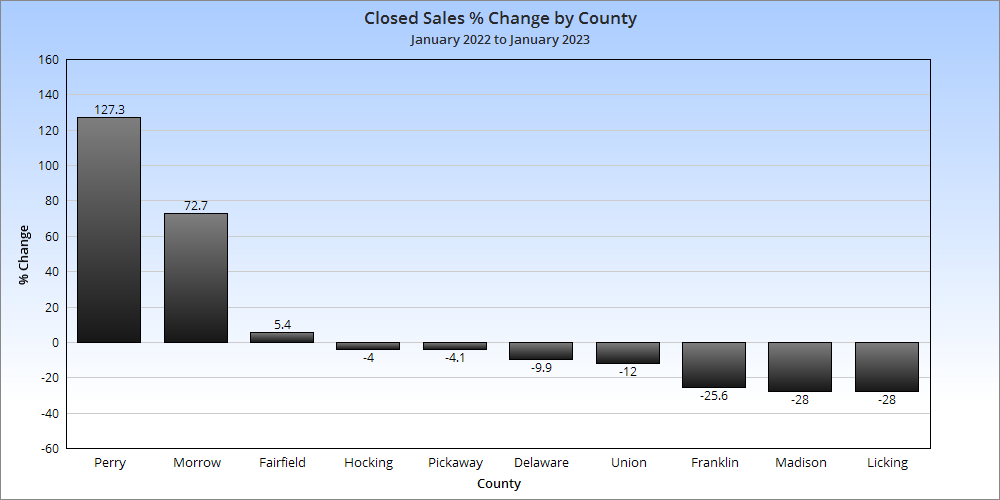
Housing market update January 2023 county closed sales % change
Closed sales are those sales that were completed during the month. 7 of the 10 metro counties saw declines in January
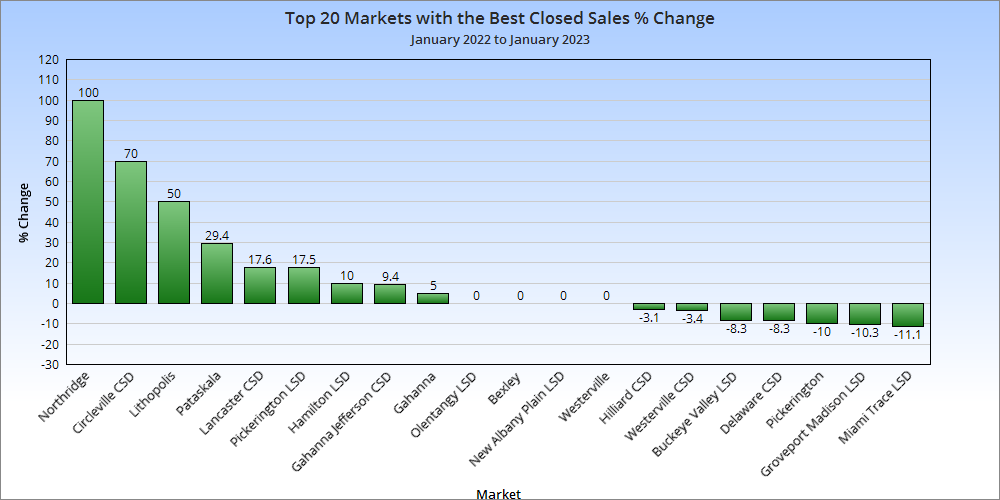
Housing market update January 2023 best closed sales
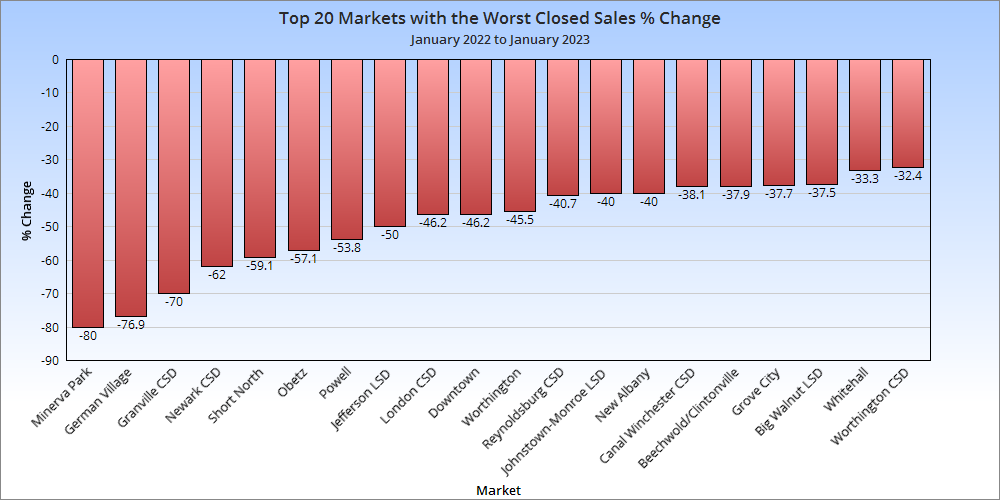
Housing market update January 2023 worst closed sales
Only 9 of more than 40 local markets were up year-over-year.
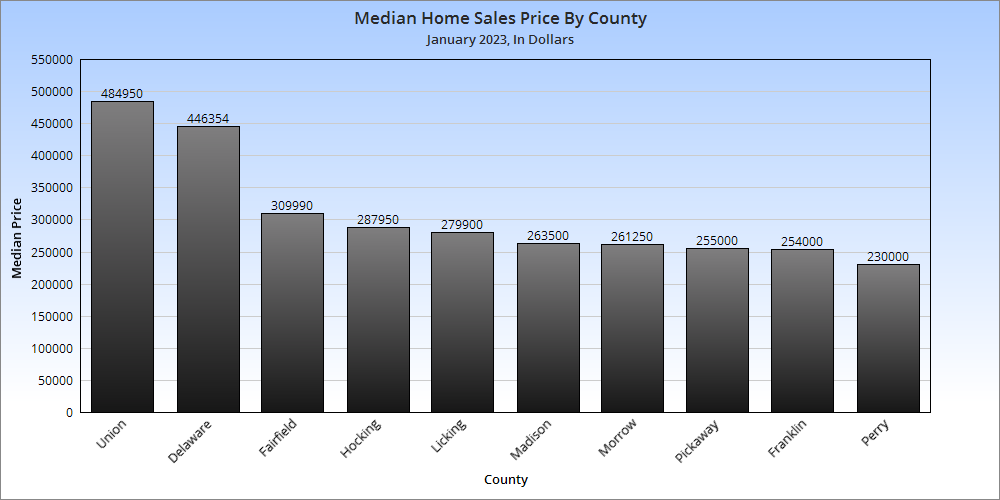
Housing market update January 2023 county median price
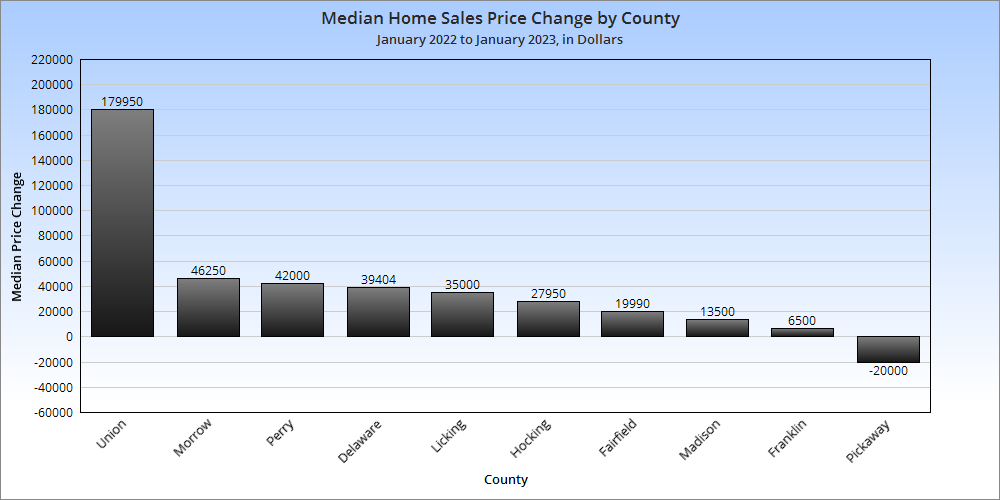
Housing market update January 2023 county median price change
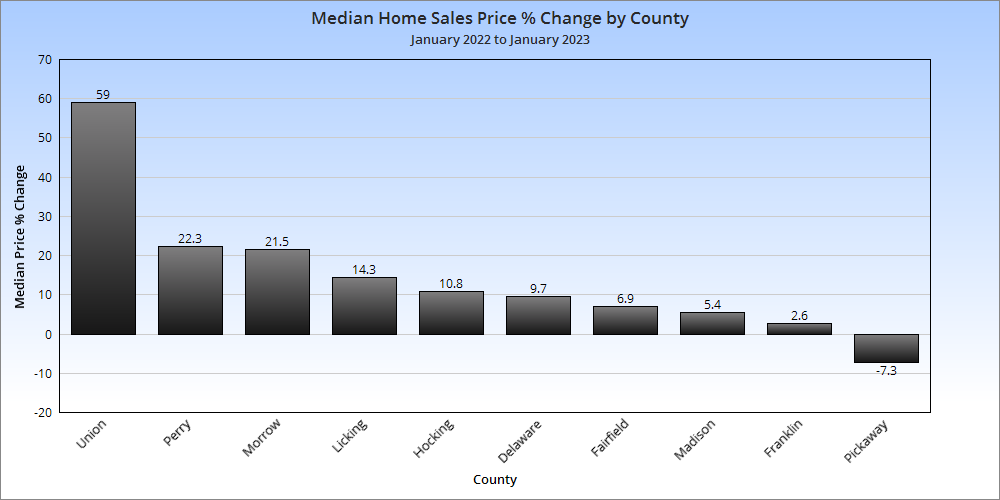
Housing market update January 2023 median price % change
Not sure what was going on in Union County in January, but it was well above all other counties for the month. The market overall continued to be up on price year-over-year, except in Pickaway County.
Overall Market Median Sales Price in January 2023: $307,289
Based on the 10 Columbus Metro Area counties, the metro price saw a more than $39,000 increase over January, 2022.
Overall Market Median Sales Price % Change in January, 2023 vs. January, 2022: +14.6%
Continuing home sale declines had relatively little impact on home prices overall, which saw a strong increase over the year.
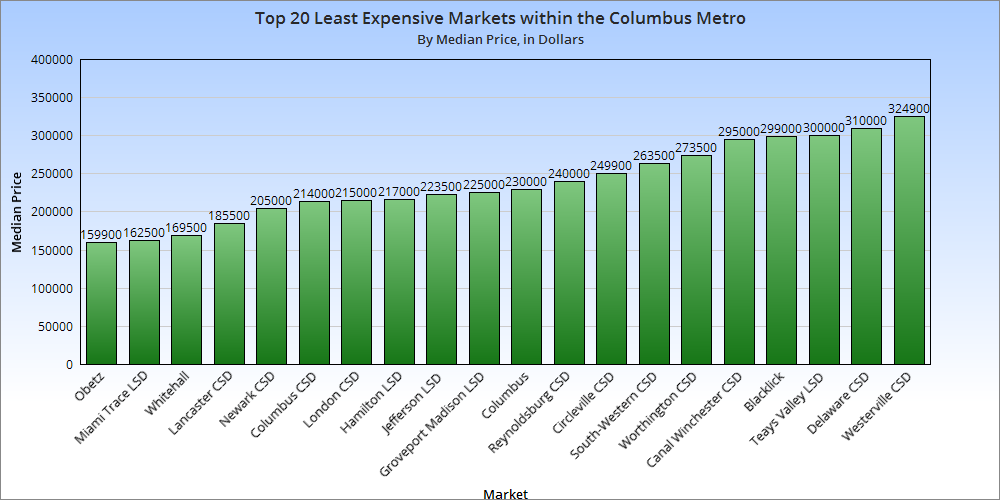
Housing market update January 2023 least expensive markets
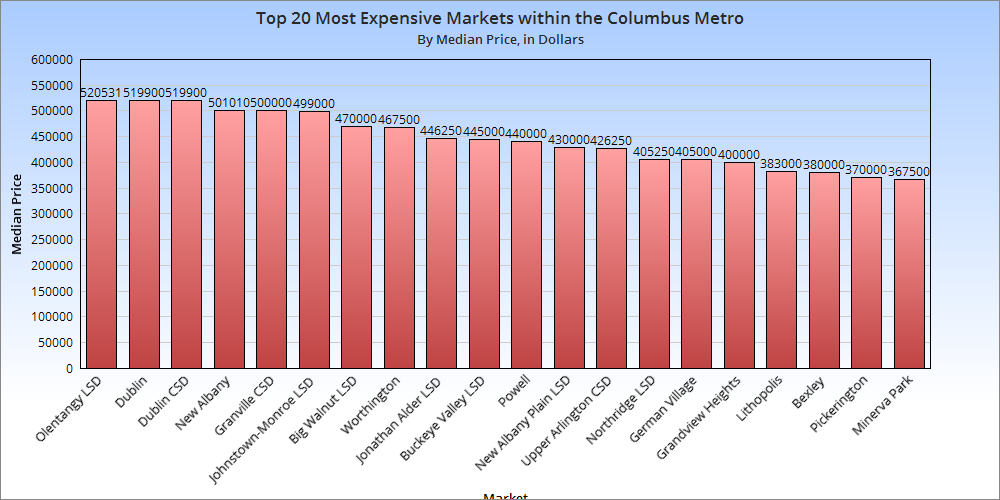
Housing market update January 2023 most expensive markets
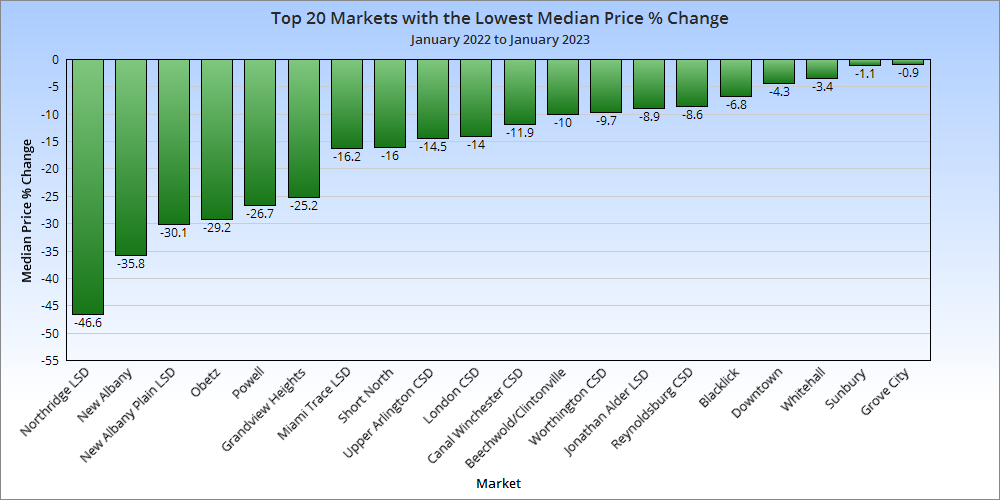
Housing market update January 2023 lowest market price change
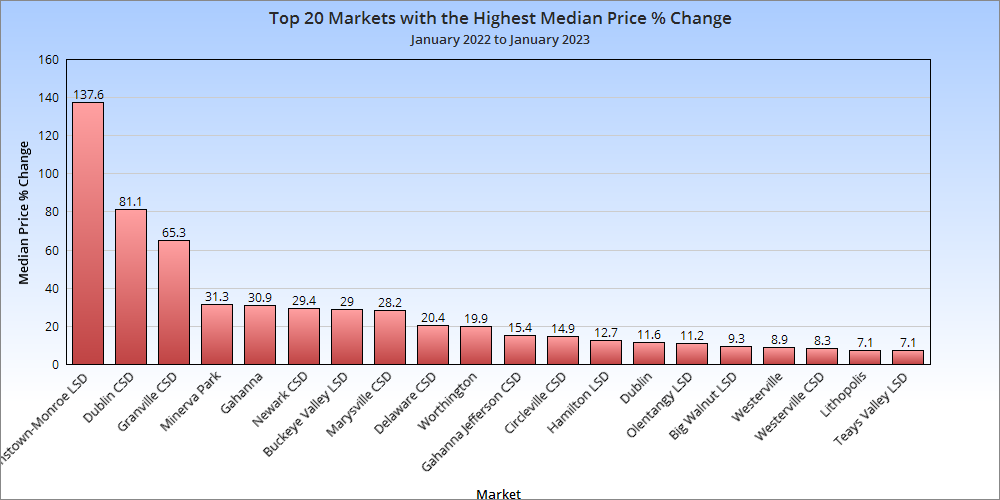
Housing market update January 2023 highest market price change
It seems the Intel project’s impact may finally be making an appearance in housing numbers, with the Johnstown district seeing a huge increase in median home prices versus January 2022, 2 months before the project became official. That said, New Albany had one of the areas largest declines, but that could be due to it generally being one of the most expensive markets last year.
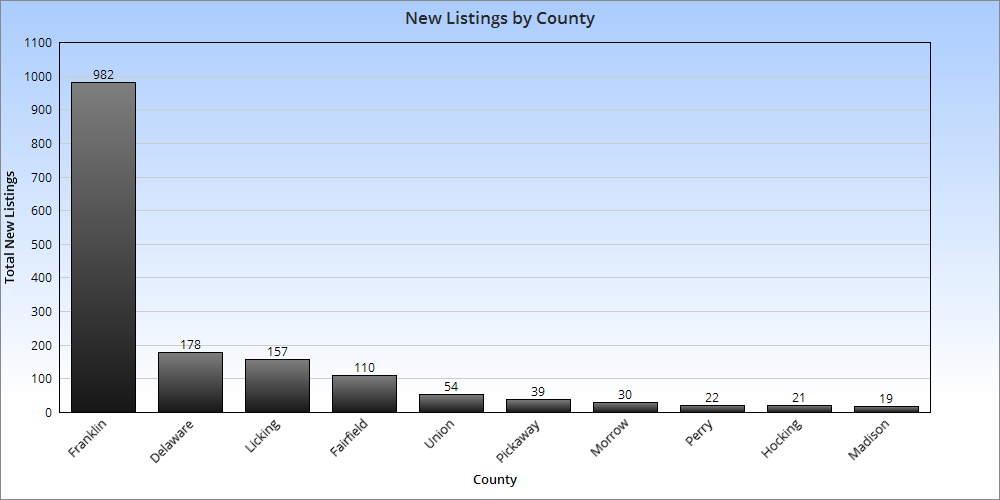
Housing market update January 2023 new listings by county
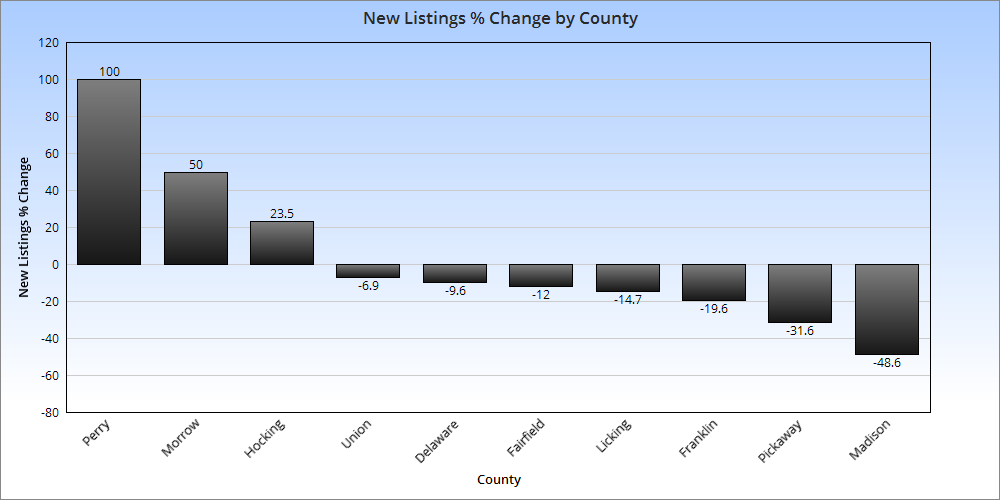
Housing market update January 2023 new listings change
New listings across most of the metro area were down, accounting for most of the median price increase as demand remains strong in the region. Most of the decrease came from Franklin County.
Total Metro New Listings in January, 2023: 1,612
Total Metro New Listings Change from January, 2022 to January, 2023: -316
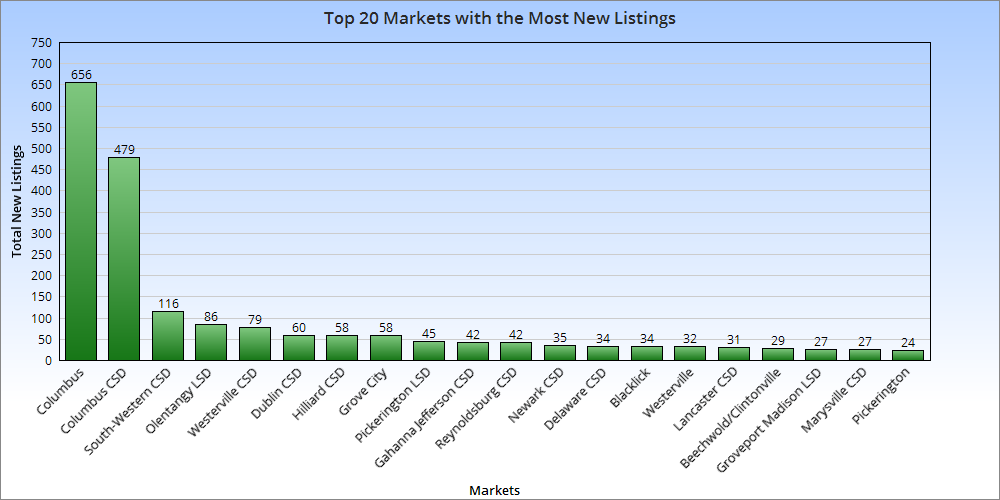
Housing market update January 2023 most market listings
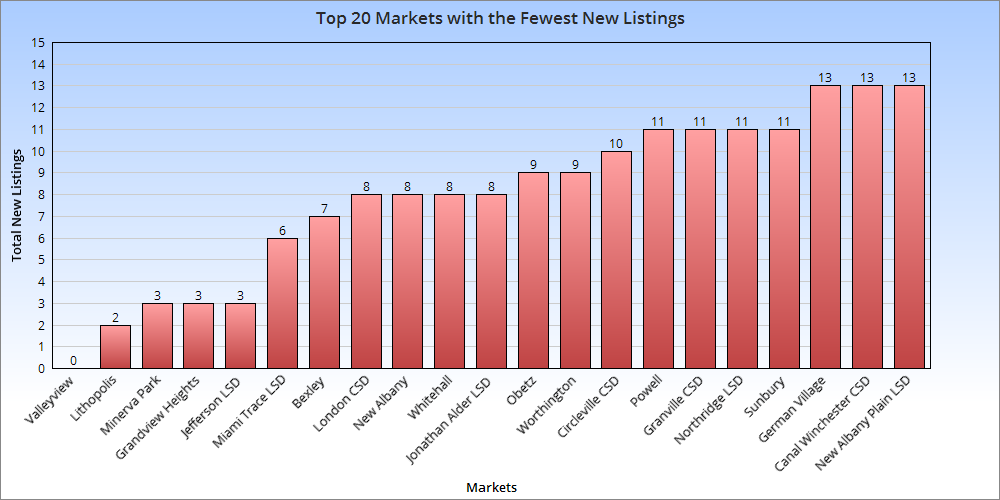
Housing market update January 2023 fewest market listings
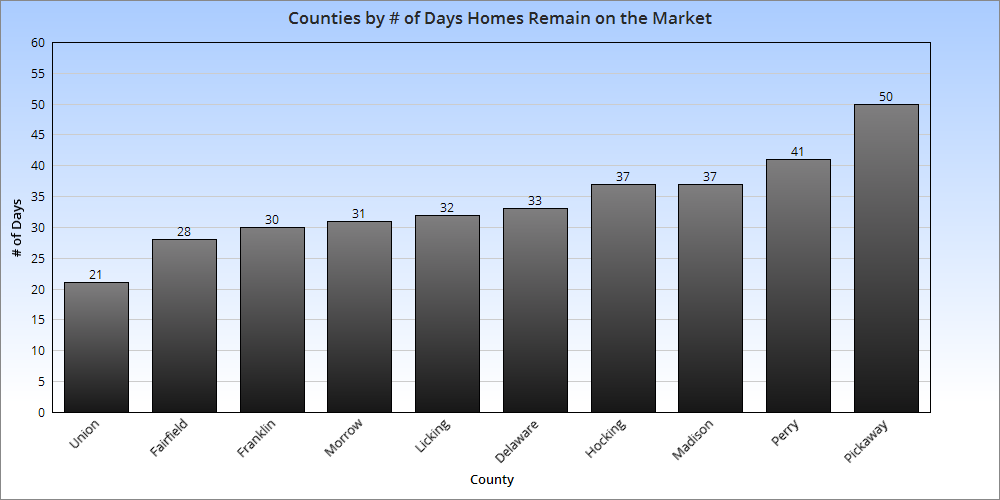
Housing market update January 2023 county days on market
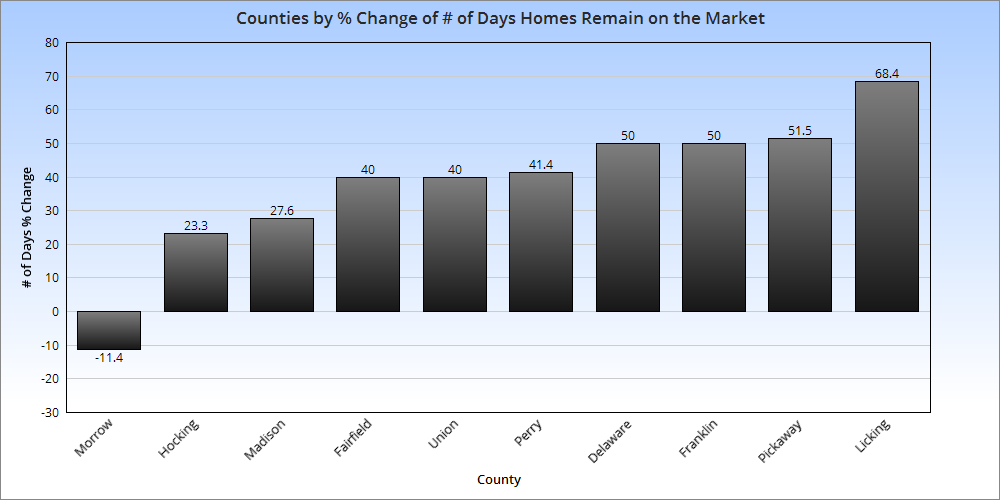
Housing market update January 2023 days on market change
Average # of Days Homes Remain on the Market Before Sale for the Metro Overall in January, 2023: 34.0
# of Days Homes Remain on the Market Before Sale for the Metro January, 2022 to January, 2023: +8.8

Homes continued to sell more slowly than they did a year ago, now more than a week more slowly on average.
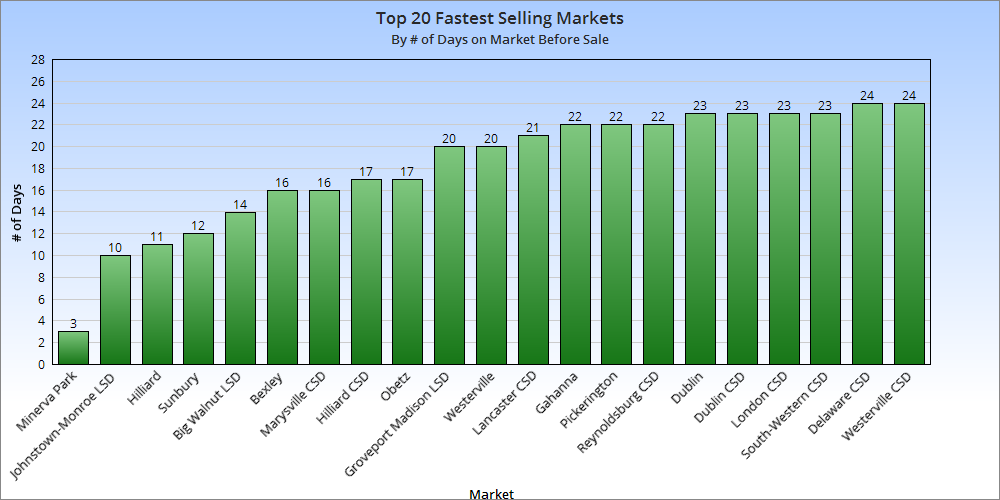
Housing market update January 2023 fastest selling markets
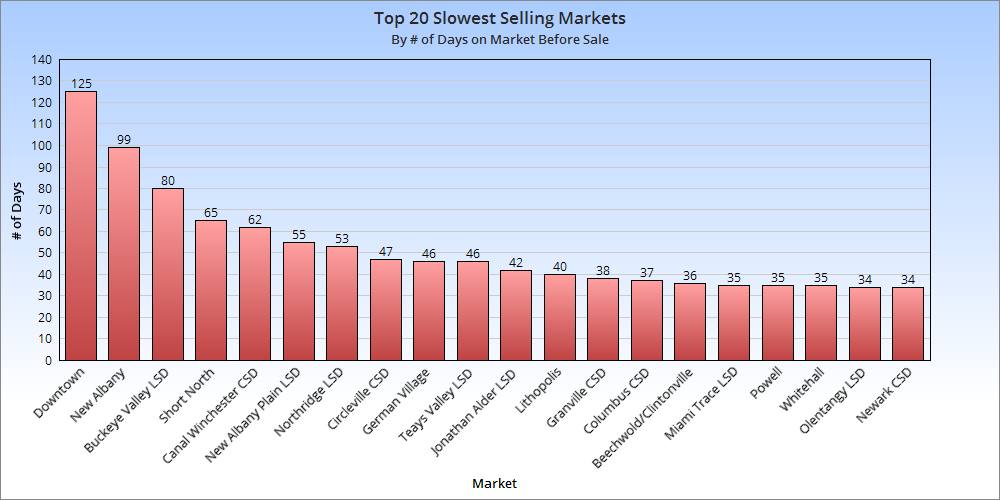
Housing market update January 2023 slowest selling markets
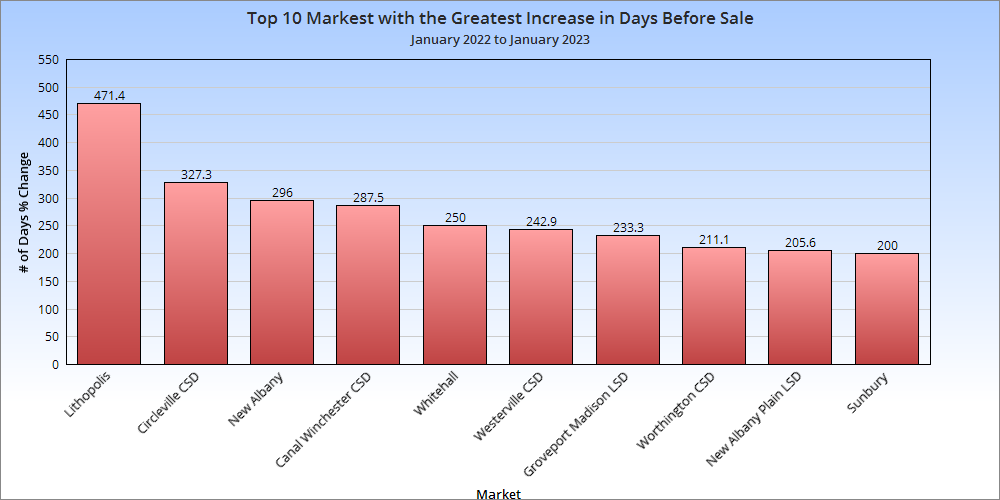
Housing market update January 2023 market sale days increase
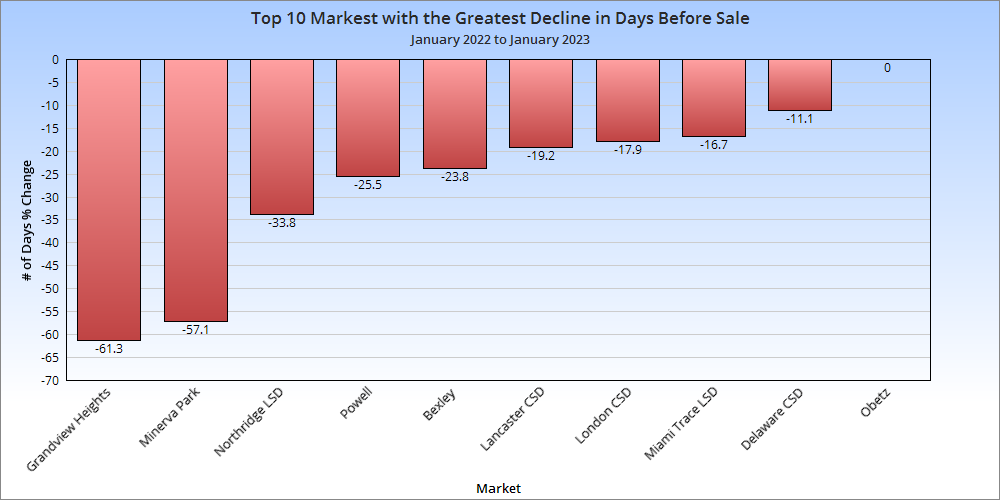
Housing market update January 2023 market sale days decline


2022 Final Housing Market Update


2022 final housing market update Columbus, Ohio

The 2022 final housing market update looks at the overall market performance for the year versus 2021.

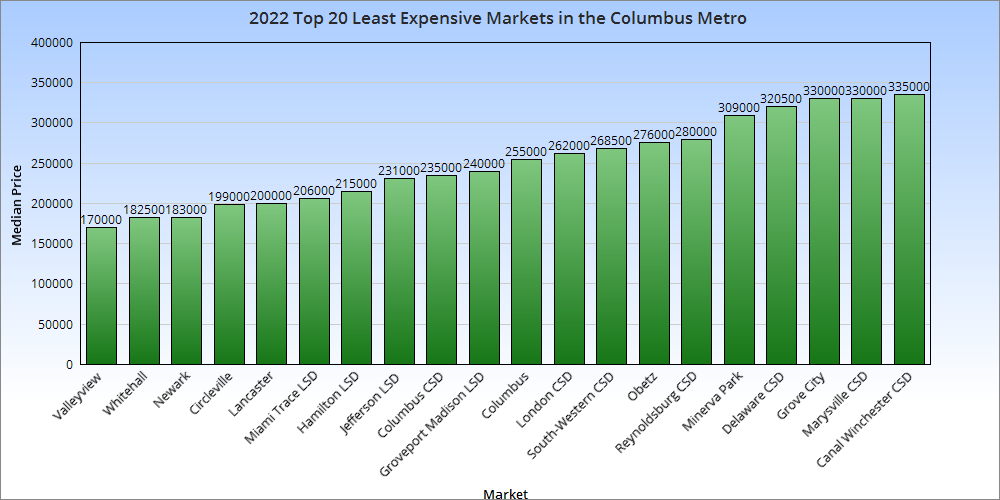
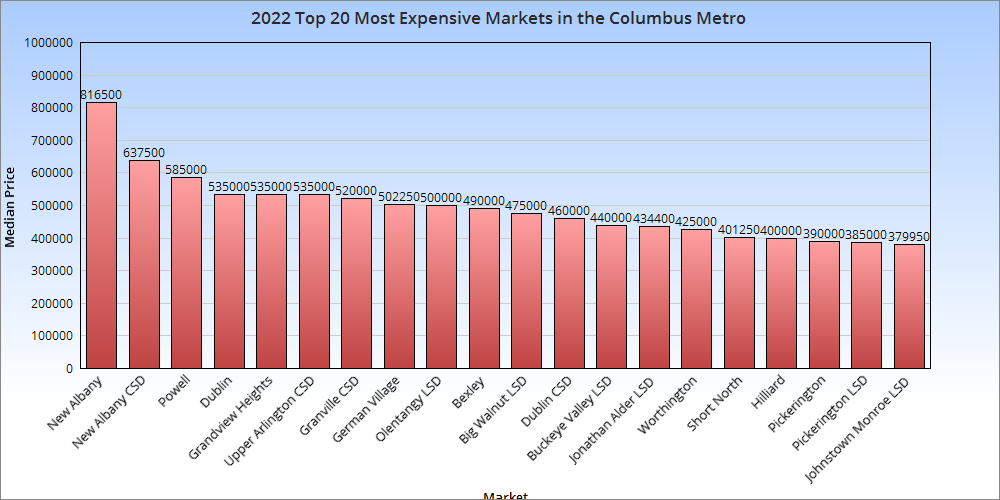
Note: LSD= Local School District, CSD= City School District. In both cases, school district boundaries differ from city boundaries.

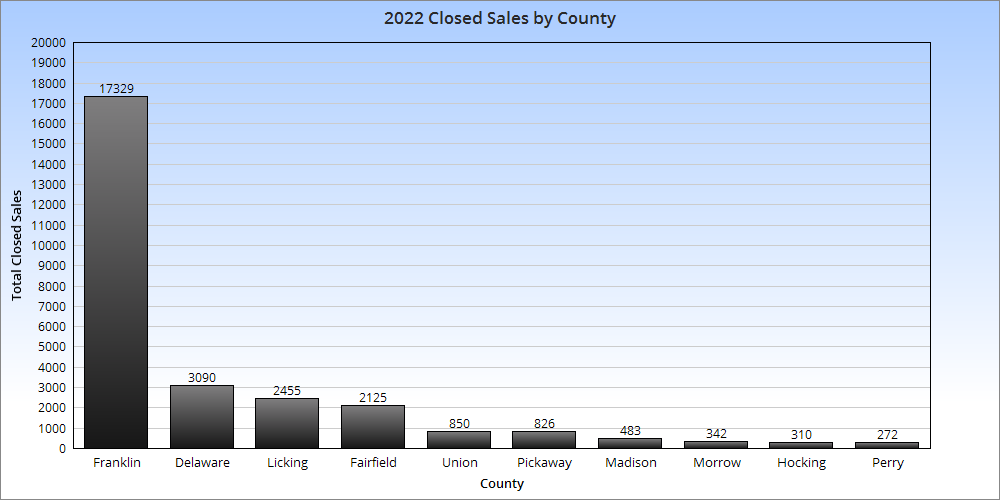
2022 final housing market update county closed sales
2022 final housing market update county closed sales change
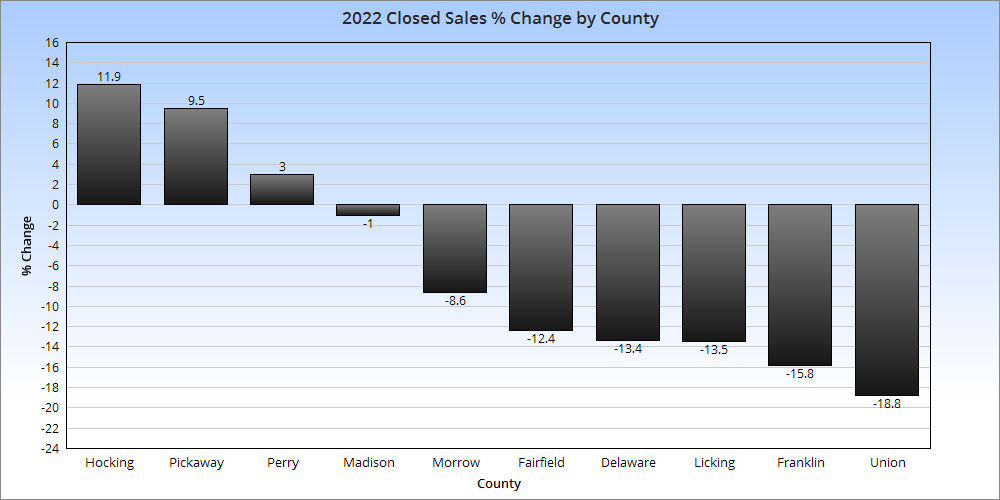
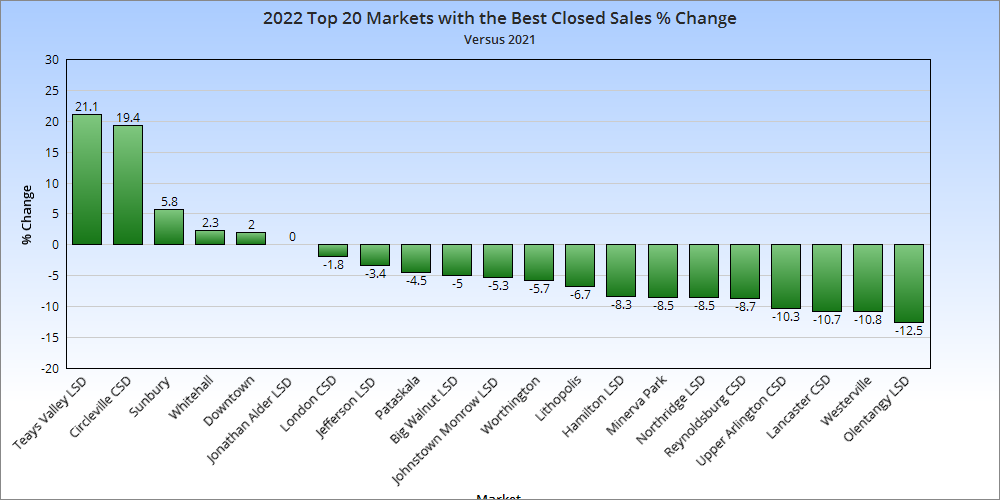
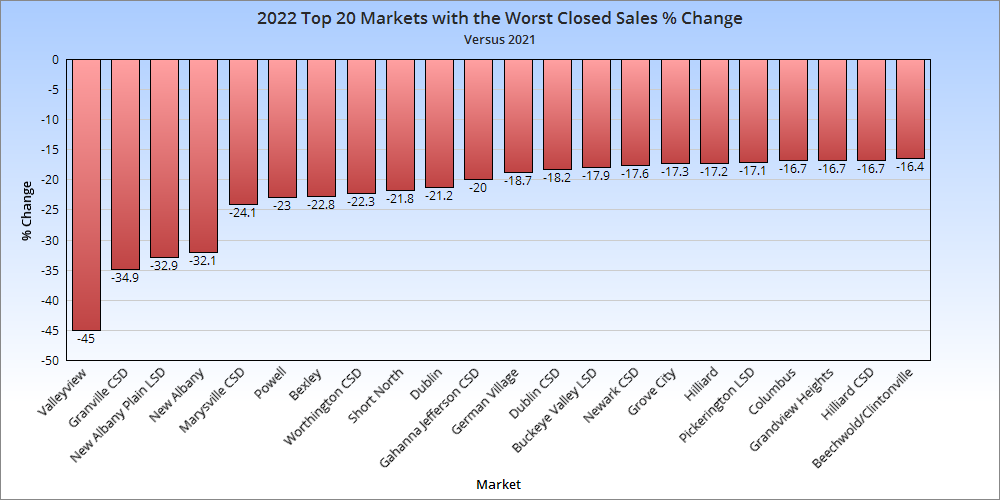
Closed sales are those sales that were completed during the year. 7 of the 10 metro counties saw declines vs. 2021.
2020 final housing market update best markets for closed sales
2022 final housing market update worst markets for closed sales

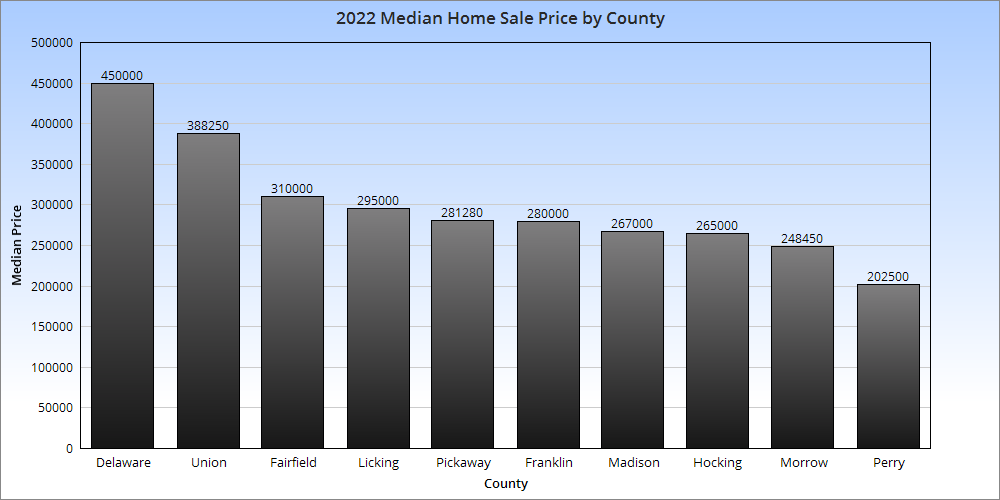
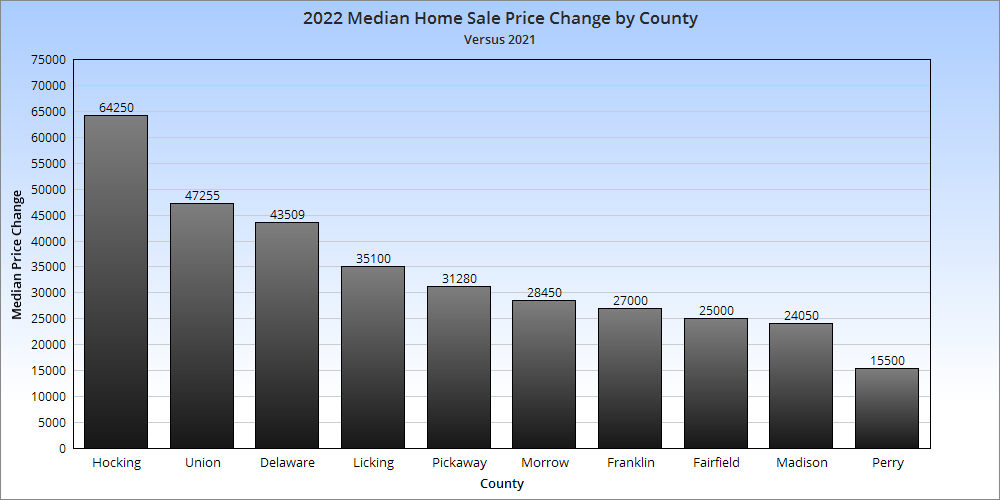
2022 final housing market update county median price
2022 final housing market update county median price change
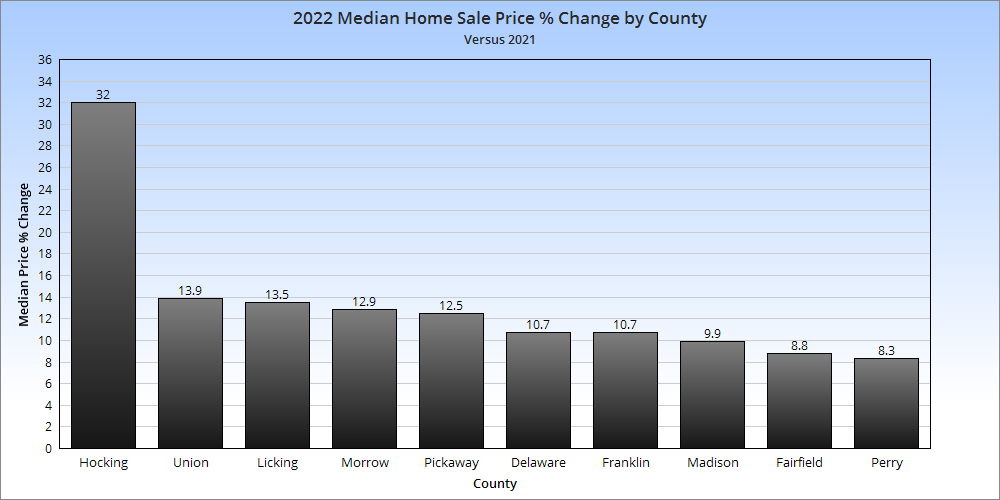
2022 final housing market update county median price % change

Overall Market Median Sales Price in 2022: $298,748
Based on the 10 Columbus Metro Area counties, the median price increased by $34,139 over 2021.
Overall Market Median Sales Price % Change in 2022 versus 2021: +12.9%

2022 final housing market update least expensive markets
2022 final housing market update most expensive markets

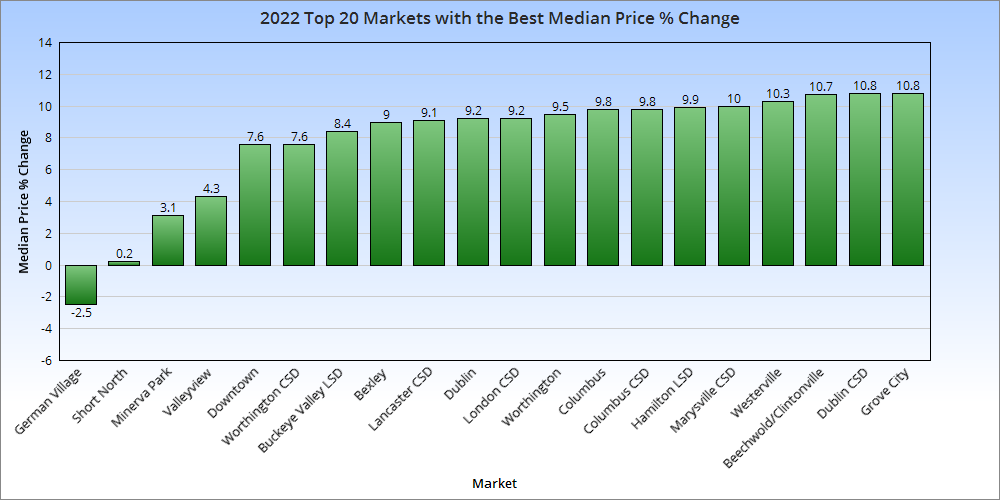
2022 final housing market update best market median price change
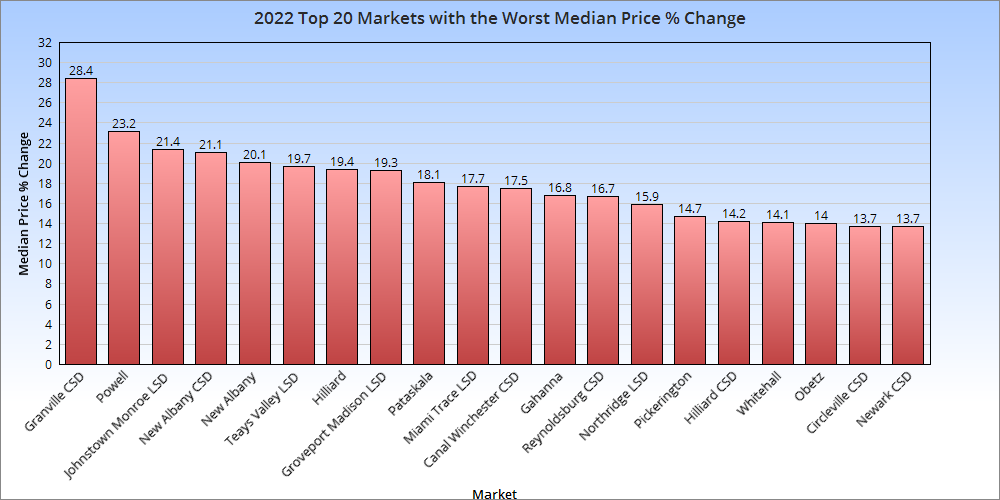
2022 final housing market update worst markets for price change
Best in the case of market median price % change is subjective. For buyers, it would be prices that have increased the least or even declined, while for sellers it would be the largest increases.

2022 final housing market update county new listings
2022 final housing market update county new listings change
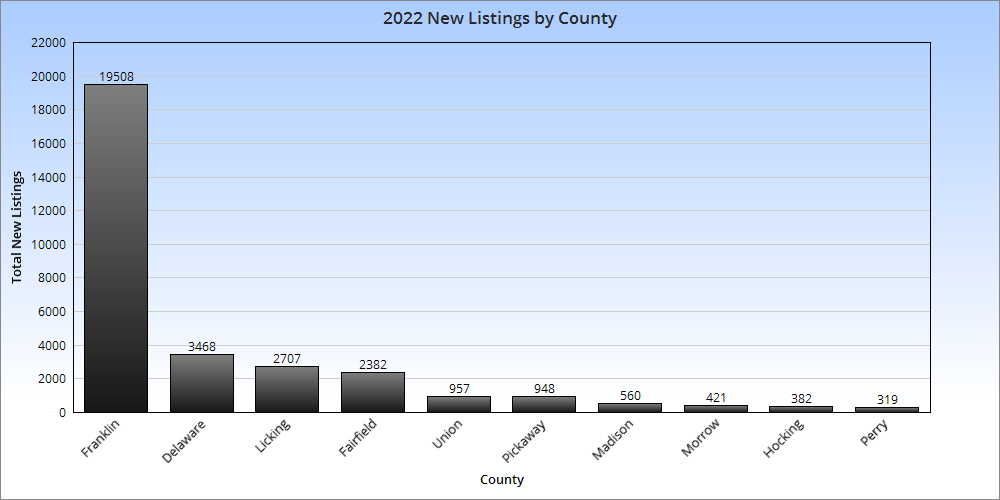
Total Metro New Listings in 2022: 31,652
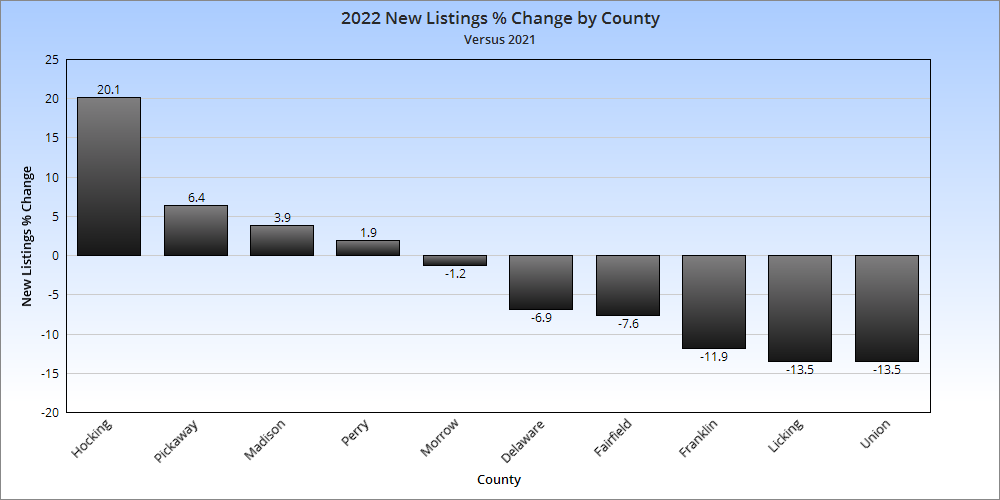
Total Metro New Listings Change from 2021 to 2022: -3,508
Thousands of fewer homes going to market helped keep prices rising across the metro despite a significant slowdown in overall sales.

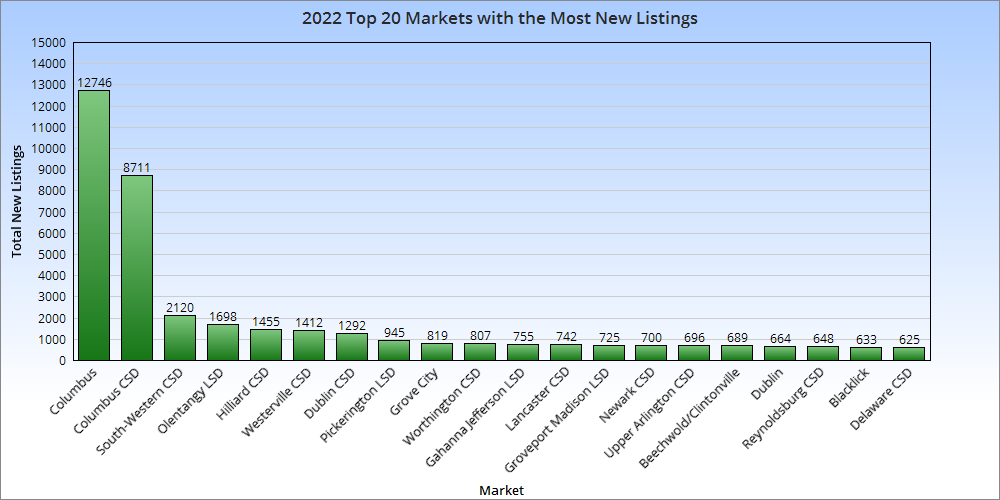
2022 final housing market update most new listings
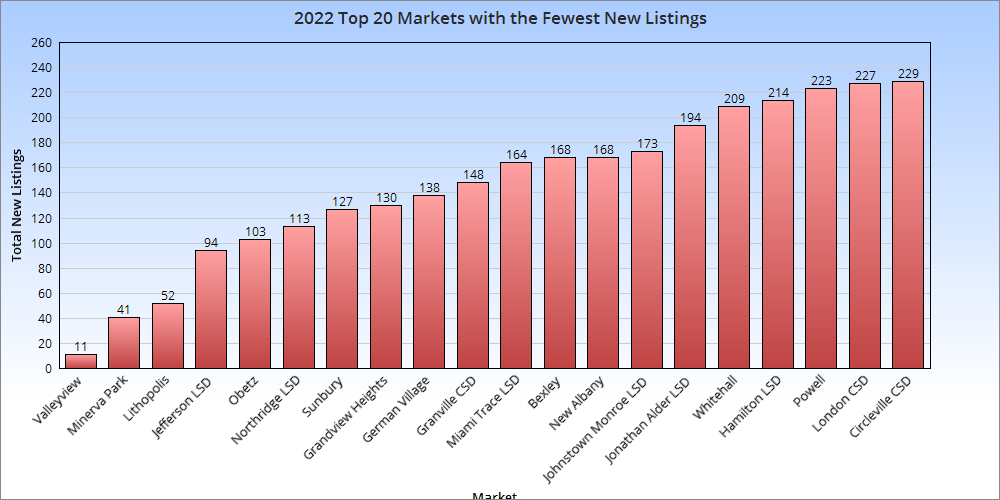
2022 final housing market update fewest new listings

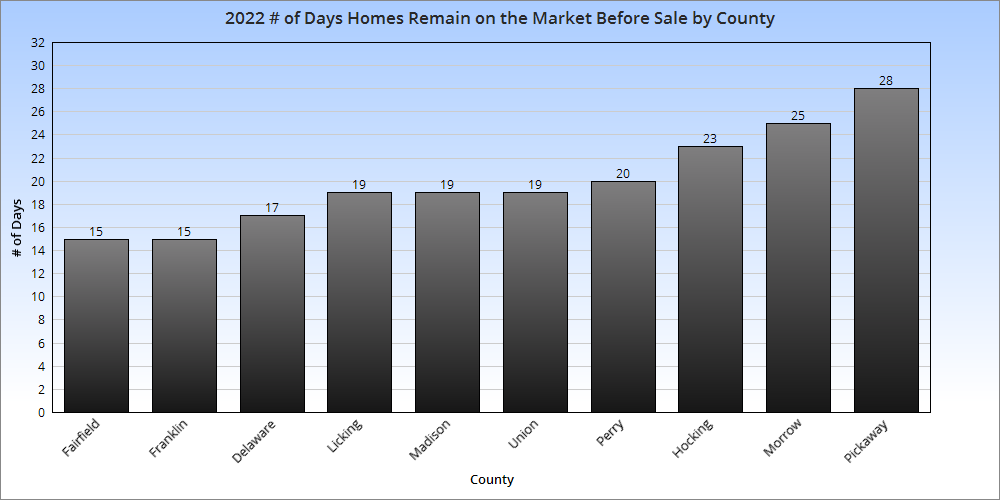
2022 final housing market update county days before sale
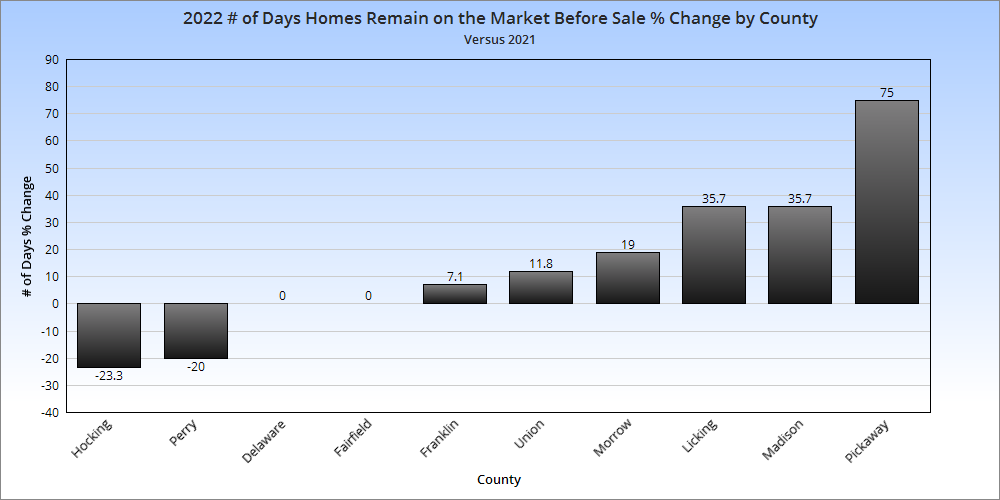
2022 final housing market update county days before sale change
Average # of Days Homes Remain on the Market Before Sale for the Metro Overall in 2022: 20.0
# of Days Homes Remain on the Market Before Sale % Change for the Metro 2021 vs. 2022: +9.3%

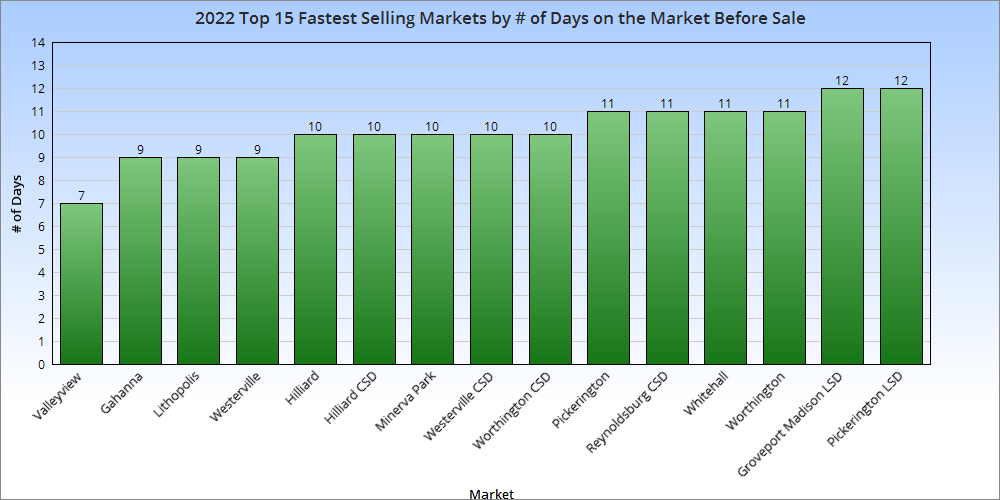
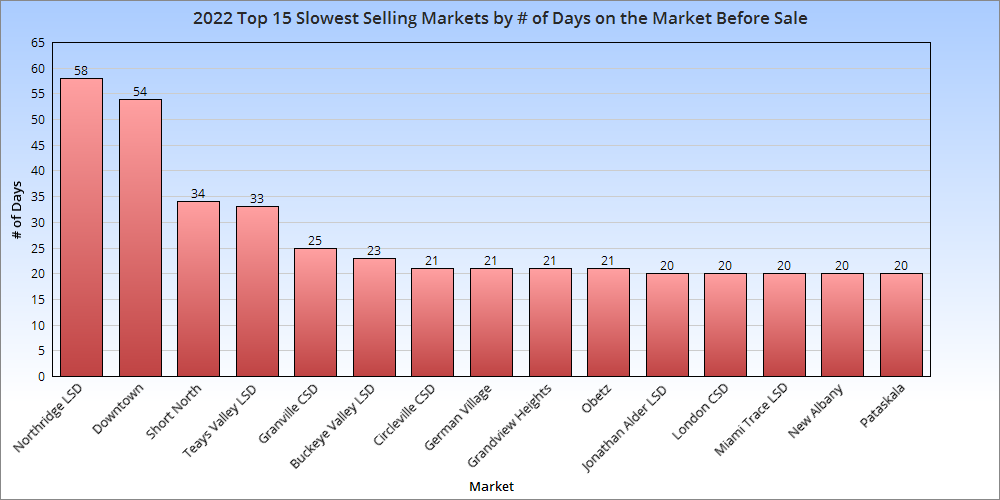
2022 final housing market update fastest selling markets
2022 final housing market update slowest selling markets

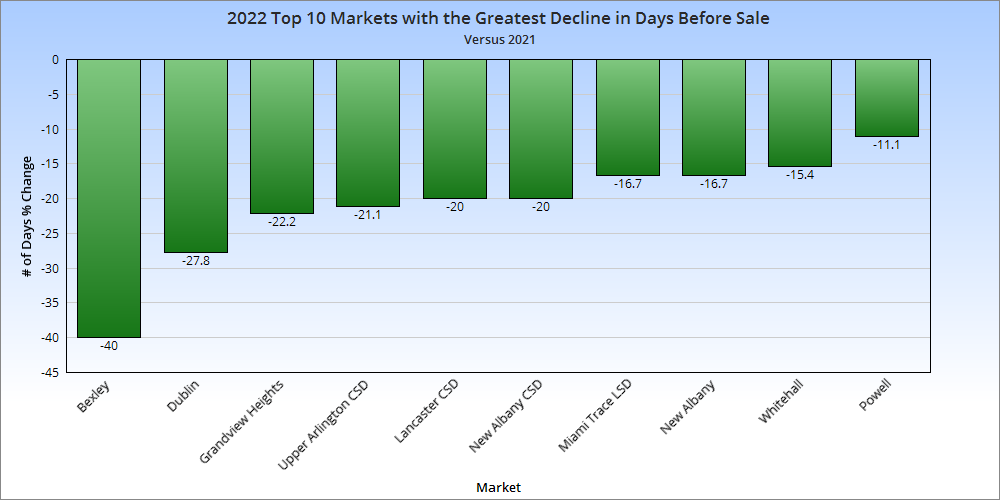
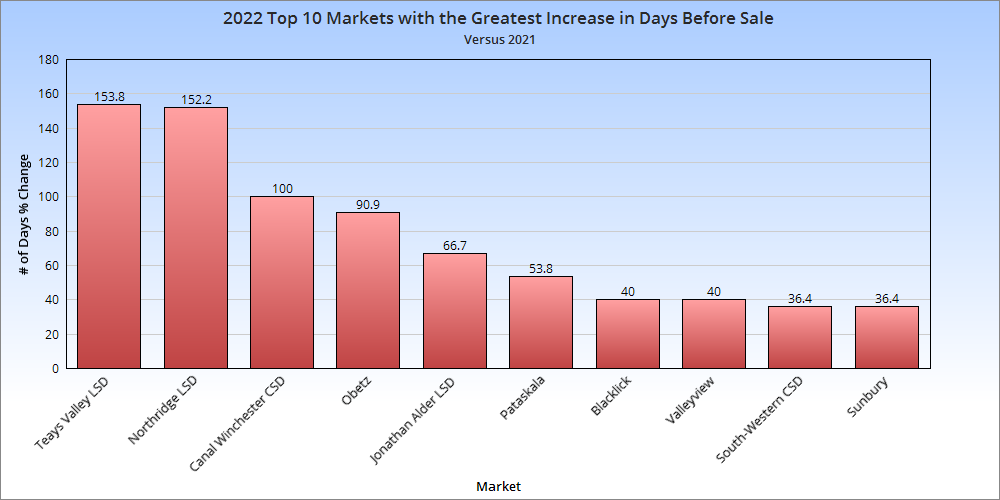
2022 final housing market update fastest selling market change
2022 final housing market update slowest selling market change

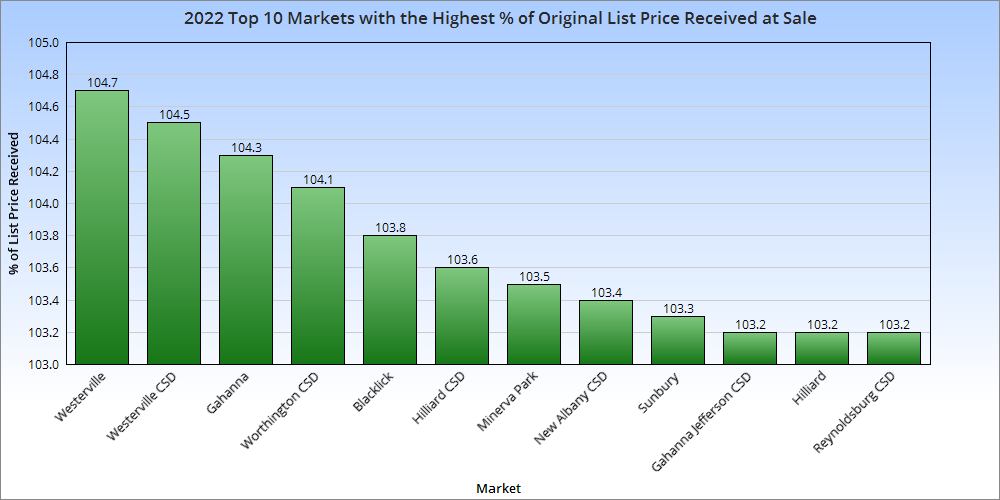
2022 final housing market update highest price received
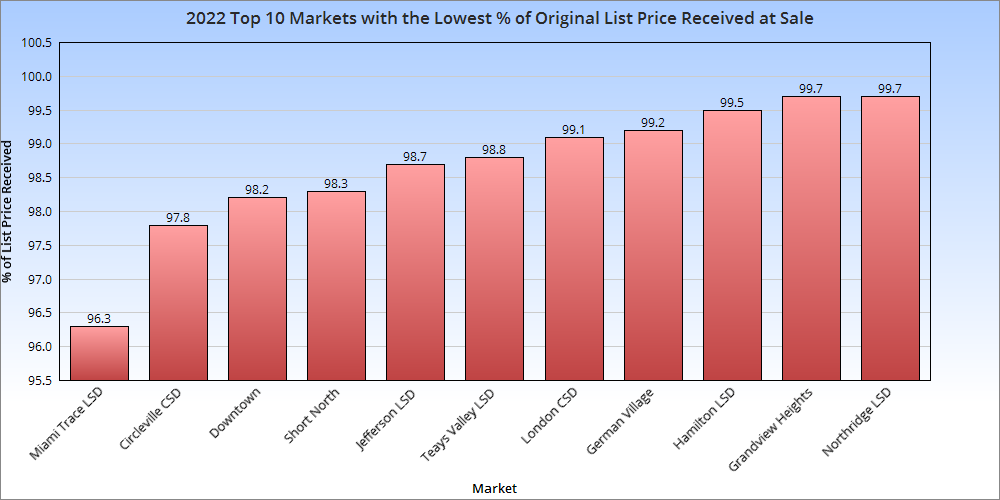
2022 final housing market update lowest list price received
This new data shows whether a market was receiving more or less than the original list price for the homes for sale. Those above 100% were markets that typically had buyer competition to the point where they had to pay more than list. Those below 100% were the opposite, where relatively lower demand allowed some buyers to get a home for under list.

And there you have it, the final housing market update for 2022!


Cool Link University District History

University district history

This link is a great repository of historic photographs of the Ohio State Campus area, including High Street and neighboring Weinland Park. There is also a lot of historical information on events, restaurants, buildings and a lot more.

University District History


What the Intel Semiconductor Fabs Mean for Columbus


What the Intel Semiconductor Fabs Mean for Columbus

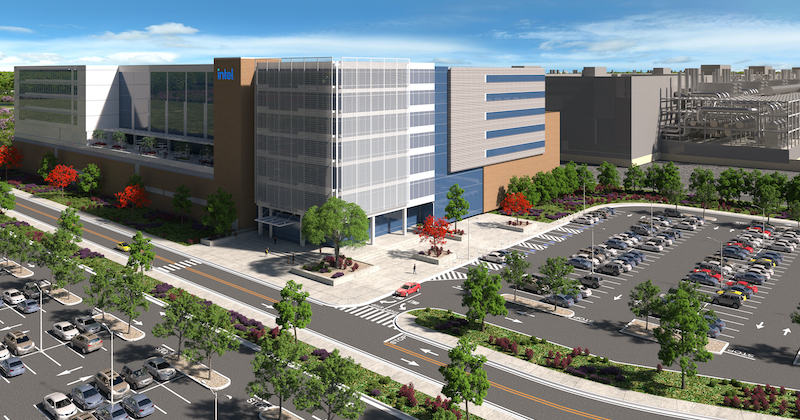
The Columbus area will soon be home to Ohio’s largest private investment in history with the Intel semiconductor fab planned for the Franklin County/Licking County line in New Albany. While this is not within Columbus itself, this project has massive implications for the city, region and possibly even Ohio overall. Let’s examine exactly what the Intel semiconductor fabs mean for Columbus, and some of the potential impacts the project may have for years to come.

What is it?
Semiconductors -at their most basic- conduct electricity, and are essentially what are used to make microchips. As such, they are crucially important for virtually all types of electronics, from cars to computers to ATMS to household appliances. Because they are so important, everyone needs them. Unfortunately, however, their production is more complex than many other types of manufacturing. Their production plants require large amounts of power and water, and manufacturing areas have to be free of things like static electricity and humidity, which can damage semiconductors. Furthermore, the jobs typically require specialized training and degrees. What all this means is that building a semiconductor factory- or fab- is enormously expensive. A single fab can easily cost $10-$20 billion, so there aren’t that many companies in the world that can actually build them- in fact, there are currently just 38 companies in the entire world capable of manufacturing them.

The proposed fab in New Albany is significant in several ways. First of all, as mentioned above, it will be Ohio’s largest single private investment in history, significantly more than any auto manufacturer or other industry. The first phase of the project has been announced, and will include two fabs at a cost of $20 billion, and will provide 3,000 direct jobs, 10,000 ancillary jobs and 7,000 construction jobs. The fab jobs will have an average salary of $135,000, about 2.5x the Ohio average. While this first phase is huge on its own, it seems that it will just be the beginning.

For some time, Intel has been talking about building a “mini-city” type development somewhere in the US. This mini tech city would include up to 8 or more fabs, and along with supporting development would be an investment greater than $100 billion. When news first broke about the New Albany project, there was some speculation that this site would be where this gigantic development would go, especially given that it included more than 3,000 acres of available land. Now, it seems that we have confirmation that Central Ohio is indeed the location of this mini city. In a recent Time article, this section stood out:

“Our expectation is that this becomes the largest silicon manufacturing location on the planet,” Intel CEO Pat Gelsinger told TIME; the company has the option to eventually expand to 2,000 acres and up to eight fabs. “We helped to establish the Silicon Valley,” he said. “Now we’re going to do the Silicon Heartland.”

So now that Central Ohio is about to rocket to the potential forefront of microchip manufacturing on a global scale, what might be the consequences long term?

Impacts

It’s hard to overstate how significant this development will be for the Columbus area. Here are just a few.

Housing Market
While the effects of this project won’t be felt by most right away, the areas and communities nearest to it will likely see home prices escalate fairly quickly. Places like Johnstown, New Albany, Alexandria and Granville, among others, will likely see the fastest- and most significant- realization of this increase, but virtually every community within 50 miles will likely see upward pressure- certainly including Columbus, which will probably end up with a healthy majority of any new workers into the region.
What that means long term is that housing construction will also explode. The region, if anything, has been underbuilding for years despite high demand. Even before this news, it was estimated that Central Ohio needed roughly 2x-4x the residential units constructed each year just to meet existing demand. Because of that existing issue, the area has faced a deep housing shortage and a near monthly new median housing price record.
So housing construction will almost inevitably increase, but the makeup of that housing and where it will be built remains to be seen. No doubt suburban sprawl around the construction area will accelerate, but what happens in Columbus itself is likely to be somewhat different. The city could see a massive upward movement in urban infill projects that make the past decade look paltry in comparison.
You might be wondering why all this development would even occur just because of this one project, no matter how large it is, and that brings us to the next impact.

Population
A project as large as the Intel mini-city doesn’t happen everyday, and arguably nowhere else in the country is going to have something like it in the industry. Because of the scale and notoriety alone, it is inevitable that other companies- and not just tech- take notice and give the Columbus are a new look for investment or relocation. Columbus, and indeed Ohio, doesn’t have the high costs associated with the West Coast or even parts of the Sun Belt. Ohio doesn’t struggle with water supplies like the Southwest, has stable power, does not suffer from significant natural disaster threats, is positioned well for climate change and is arguably the best-located state for access to a majority of the US population. Seeing Intel make such a large investment in the state will attract other investments as well, and these new companies investing will need supporting infrastructure and companies of their own, as well.
In fact, this process has already begun. Intel itself has said that multiple other companies, such as Air Products, Applied Materials, LAM Research and Ultra Clean Technology, among others, are already moving to invest in the area. Many more will follow.
Over time, this will lead to a greater influx of people, spurring more and more development.
Obviously, this is not going to happen overnight. Intel’s first fab isn’t even due to be completed for potentially another 3-4 years, but the stars are aligning for the Columbus population to really begin taking off and enter a true golden age.

Infrastructure
Up to now, the Columbus region’s infrastructure has been more or less sufficient in handling the needs of the population, with some exceptions. The highway system has been more than adequate to ensure that most trips around the area are relatively quick and easy, but should a rapidly-rising population manifest, that highway and road system may quickly fall behind. Even with current growth levels, traffic is becoming more of an issue. It’s been rumored that the State is going to invest up to a billion dollars improving infrastructure in the area surrounding the site, but this most likely is limited to roadway expansion, if anything.
One big negative for the region has always been mass transit. Columbus remains one of the few large US cities without rail service of any kind. It’s certainly possible, if not likely, that MORPC and other local planning groups are going to be faced with increasing pressure to invest in driving alternatives. COTA can only go so far. The plan to build BRT routes in some areas of the city is a start, but rail needs to be part of the longer-term picture. At the very least, a few lines between Downtown and the airport, and perhaps the airport and New Albany is something that needs to seriously be considered. The Columbus region can no longer afford to keep putting these investments off. Planning needs to start now, not later.

John Glenn International Airport is another potential weakness. While it is fine as a regional airport, all this news should put greater emphasis on the plan to replace the current terminal with a new one. Originally, city planners were talking about 2030 or later for this to happen. Due to the pandemic and a drop in overall air traffic, those plans were likely moved back even later, but if anything, the plans should go forward even sooner. This will allow the city to gain more flights- perhaps even some truly international ones- that are going to be increasingly in-demand.

The reality is that these are just a handful of the potential long-term impacts for the city and region, but they are the ones most obviously likely to be impacted the greatest. In effect, Intel’s mini-city is not just a single economic boost for Central Ohio, but it could also be the first wave in a tsunami of transformation that will change Columbus- good or bad- forever.