January 2014 Review


January 2014 review

This kind of post seems obligatory at this time of year. I thought about making just one big post, but there was so much that happened this year that I decided to break it up by month. This won’t include every single piece of news, of course, but rather just the highlights. First up is the January 2014 review.

Development
-The Columbus Zoo began to push for a permanent levy to help pay for upgrades at its existing facility, as well as for adding a new expansion attraction at the Scioto Peninsula Downtown http://www.dispatch.com/content/stories/local/2014/01/09/zoo-wants-vote-on-bigger-permanent-property-tax.html
-Redevelopment of the Barrett Middle School site in Merion Village began to make news. http://www.dispatch.com/content/stories/home_and_garden/2014/01/12/caughtmiddle.html The project should begin sometime this spring, though the exact number of residential units and layout has changed some.
-Columbus adopted Complete Streets. http://www.columbusunderground.com/new-complete-streets-thoroughfare-plan-could-have-big-impact-bw1 This set of standards guides the development of the street layout and design throughout the city. This includes including multi-use and bike paths, as well as better signaling and access for pedestrians.
-A new 40-unit apartment complex was proposed for 122 Parsons Avenue in Olde Towne East. However, very little news has been heard about this project since, as it may be waiting for work on the Parsons section of the 70/71 rebuild to move along first. http://www.columbusunderground.com/forums/topic/new-ote-apartment-complex-proposal-parsons-gustavus-OSU announced plans to renovate several buildings in order to create a sort-of tech campus that partnered with IBM’s new analytics center in Dublin. http://www.bizjournals.com/columbus/news/2014/01/23/osu-in-line-for-53m-from-state.html
-And on the West Side, the huge apartment complex off Georgesville Road once known as Lincoln Park West, was announced to get a major makeover, with the demolition of a few hundred units while the rest would get a high-end renovation. This complex had long been very run down and the site of tragic arson fires, crime and high vacancy. http://www.bizjournals.com/columbus/blog/2014/01/204-apartments-at-former-lincoln-park.html

Economy/Other
-Columbus was named one of the nation’s top Opportunity Cities. http://finance.yahoo.com/news/america-s-new-opportunity-cities-222209099.html
-Columbus was named one of the top 7 Intelligent Communities in the world. http://www.columbusunderground.com/forums/topic/top7-intelligent-communities-of-2014-aka-were-smart-again
-Columbus was predicted to have one of the nation’s best economic performances of 2014. http://blogs.wsj.com/economics/2014/01/22/cities-face-a-good-but-not-great-economic-outlook-for-2014/ The numbers won’t be out for a few months on how the city/metro actually performed, however.
-A study came out detailing how future growth in Columbus would radically alter where people lived and in what type of home and environment they lived. The consensus? Young and urban. http://switchboard.nrdc.org/blogs/dlovaas/discovering_a_new_housing_futu.html
-The unemployment rate rose to 6% in January from December 2013, as it usually rises after seasonal employees are laid off. However, this was 1.1 percentage points lower than the previous January.

Weather
January 2014 continued what December 2013 had started. Snowfall was nearly 2x above normal and temperatures were almost 7 degrees below normal. The month tied for the 15th coldest January and the 16th snowiest. The coldest low was -11 and the low hit 0 or below 7 times, the most since 1994. The biggest snow event occurred on the 25th-26th with 8.3″. This was the 10th largest January snowstorm of all time. Snow depth reached at least 1″ on 19 days.


1913 Hailstorm


1913 hailstorm

Date: July 9, 1913
Event Type: Weather

A severe 1913 hailstorm hit parts of the South Side on that Wednesday afternoon. In an issue of The Democratic Banner out of Mt. Vernon, the headline on July 11th read “Streets Covered with Ice Boulders: Destruction Wrought by Hail Storm at Columbus.”

The article went on:
This city was visited by probably the most disastrous hailstorm in its history. The damage to crops and buildings in this immediate vicinity is estimated conservatively at $125,000. (About $3.1 million today).
South Side florists alone report losses of approximately $50,000. In hundreds of houses practically every window was broken. The ground on the South Side was covered by a thick layer of “ice boulders” for an hour or two afterwards. As a midsummer phenomenon it probably was without a parallel in this state.

Accompanied by 45 mph winds, the hail that fell was reported to be about 3″ in diameter. The hail was large enough to hit and fracture the wrist of J.W. Sprouse, a teamster, and shattered glass from a greenhouse was driven through the arm of William Bernard, a florist.

Winter 2013-2014 Review


Winter 2013-2014 review

For a good portion of the US, the winter of 2013-2014 was one of the worst, if not the worst, in recent memory. Cold and snow hit early in the season and didn’t let up until the first half of March. Now that April is behind us (the last month that snow typically might fall during a season), we can take a look back at the Winter 2013-2014 Review.

A Look Back at Snowfall
For many in Central Ohio, winter provided its first taste on October 23rd, when a cold front briefly changed rain to a wet snow that coated car tops. This was merely a prelude to what would come.

2013-14 Winter Snowfall vs. Normal
Winter 2013-2014 review total snowfall

November Notable Snow Events
November 11-12th, 2013: This was the first real accumulating snowfall of the season, dropping a general 1″-2″ across the area. The highest total in Franklin County was 2″ reported just southeast of Clintonville. A map of the event can be found here.

November 26th-27th, 2013: The months 2nd and larger event occurred towards the end of the month, and dropped 1″-4″ across the county, with the higher totals on the east side of Columbus. A map of the event can be found here.
Winter 2013-2014 review November 2013 snow events
The November total of 4.7″, while not anywhere near record breaking, was a top 20 snowiest, coming in at #14. November 2013 was also the snowiest Columbus had seen since 1972, when 6.3″ fell.

December Notable Snow Events
December 6th, 2013: This was the first major event of the season. A low pressure center brought rain to the area on the 5th. As temperatures cooled, rain gradually changed to freezing rain and then heavy snow, dropping 3″-6″ across the area. A map of this event can be found here.

December 10th, 2013: The second event of the month was a persistent band of snow that set up alon I-71. The cold air produced high ratios, dropping 1″-3″. http://www.erh.noaa.gov/iln/events/20131210/

December 14th, 2013: Rain changed to snow along and north of I-71. http://www.erh.noaa.gov/iln/events/20131214/
Winter 2013-2014 review December 2013 snow events
December’s 12.7″ total was 2 1/2x normal, and the first 10 days of the month were the snowiest on record. It also made the month the 8th snowiest December on record. Further, it was the 2nd consecutive above average December and the 5th since 2007 to be so.

January Notable Snow Events
January 2nd, 2014: The new year started off as snowy as the previous ended, when a low pressure brought occasionally heavy snow and 3″-5″ across the city. http://www.erh.noaa.gov/iln/events/20140102/

January 18th-19th, 2014: A clipper system, Columbus’ most reliable snow producer, brought 1″-2″ across the area. http://www.erh.noaa.gov/iln/events/20140119/

January 25th-26th, 2014: The months’ signature event, a strong storm brough a mixed bag of precipitation, including heavy snow to parts of the city. As the storm passed, additional snow squalls developed into the 26th and brought occasional whiteout conditions. Columbus’ official 2-day total was 8.3″. A map of the event can be found here, though it only lists totals for the 25th:

All told, the 17.7″ of snow for the month was the 16th snowiest on record, and the 8.3″ snow event tied for the 10th largest January event since records began.
Winter 2013-2014 review January 2014 snow events

February Notable Snow Events
February 4th-5th, 2014: A low pressure brought heavy snow and mixed precipitation to the area, and proved to be winter’s largest snow event with 6″-10″ across the city. The 10.6″ at Columbus was the largest storm of the winter, tied as the 3rd largest February snowstorm, and provided the 7th largest daily February snowfall. http://www.erh.noaa.gov/iln/events/20140205/

February 9th, 2014: A weak system brought 1″-3″. http://www.erh.noaa.gov/iln/events/20140209/

February 14th-15th, 2014: Valentines Day brought a storm that skimmed the area with 2″-4″, with much higher totals to the south. http://www.erh.noaa.gov/iln/events/20140215/
Winter 2013-2014 review February 2014 snow events
February’s 15.9″ of snow was the 6th snowiest on record.

March Notable Snow Events
March 2nd-3rd, 2014: A low pressure brought 2-3″ over the city. http://www.erh.noaa.gov/iln/events/20140302/

March 29th, 2014: A storm brought in 1″-2″ in spring’s first week. http://www.erh.noaa.gov/iln/events/20140329/

March did not break any records or have any large events, but it was more or less a capping month to a winter that kept snowing.
Winter 2013-2014 review March 2014 snow events

April saw just one snow event, on the 15th, when half an inch to 1″ fell, ending the snowfall season.

So ultimately, 2013-2014’s 56.4″ of snow ranks it as the 3rd snowiest winter since records began in 1878. It was also the #1 snowiest meteorological winter (December-February) on record. The graph below shows the top 10 snowiest winters. Notice that 4 of the 10 have occurred since 2002, with 3 since 2007. Are we possibly entering a snowier period? That remains to be seen.
W


The Blizzard of 1996


The first two weeks of January 1996 proved to be a very wintry period, culminating in the severe Blizzard of 1996. Although this storm was made famous for its effects on the Eastern Seaboard, it also had a significant impact on areas to the west of the Appalachians, and was one of the worst winter storms the state had seen in nearly 20 years.

This storm developed in the Gulf of Mexico on January 6th and moved up along the East Coast through the 7th. Forecasts for Ohio were not especially indicative of an impending major storm. A weak low pressure moving through the Ohio and Tennessee Valleys was supposed to die out as the main storm on the Coast took over. Therefore, Ohio was not forecast to be hit especially hard from this storm, as the Area Forecast Discussion goes into on the after of January 5th.
FORECAST COORDINATION MESSAGE
NATIONAL WEATHER SERVICE WILMINGTON OH
243 PM EST FRI JAN 5 1996
AGAIN HVG TRBL GETTING GRIDDED DATA. CLDY SKIES WILL KEEP TEMPS FROM PLUMMETING AGAIN OVRNITE. SCT SW– AFT 00Z AS S/W APPCHS FROM
WEST…SEEMS TO BE RIGHT OUT AHD OF NOSE OF S/W. THEN FOR SAT…
SFC TROF SETS UP ON WEST SIDE OF APALACHIANS…WAITING FOR STRONG VORT TO SWING AROUND BASE OF 500 TROF. AFT COORD W/ CLE WILL FOLLOW ETA…WHICH BRINGS MOIST AND RAIN BIT FARTHER NORTH. SFC LO FAR SOUTH…WITH 500 /700 LO TRACKING CLOSE TO OUR REGION. RH FIELD SHWS NRN EDGE OF 90% MVNG OVR NRN KY/SRN OH ON DURING THE DAY SAT. MOIST HOLDS THRU SUN W/ 700/850 LO/S TRACKING SOUTH OF THE REGION. ETA QPF SHWG ABT .10 TO .25 INCH ACROSS SRN PART OF REGION…AFT COORD W/ CLE/IND/SDF ALL THINKING ABT SAME. NRN KY 4-5″ TOTAL THRU SUN…SRN OH 2-4″ AND 2-3″ SE INDIANA. FROM DAY TO CMH NORTH AROUND AN INCH OR LESS. IND HAS SNOW ENDING LATE SAT NITE…W/ ENZDING SPREADING EAST ON SUNDAY.

As the highlighted section shows, the Wilmington office was thinking 1″ or less for the I-70 corridor and points north, including Columbus, with only 2″-4″ in far Southern Ohio.
The first weather advisories for the storm went up at 5:20AM on Saturday, January 6th. For Ohio, this only included a Winter Storm Watch for far Southeast and far South-Central parts of the state, where 4″-6″ were predicted. No advisories were issued for the Columbus area until 4:10PM on the 6th.

SPECIAL WEATHER STATEMENT
NATIONAL WEATHER SERVICE WILMINGTON OH
410 PM EST SAT JAN 6 1996
…WINTER STORM WARNING FOR TONIGHT AND SUNDAY FOR SOUTHERN OHIO AND NORTHERN KENTUCKY…
…SNOW ADVISORIES ARE IN EFFECT FOR EXTREME SOUTHEAST INDIANA FOR
TONIGHT AND FOR THE DAYTON AND COLUMBUS AREAS FOR TONIGHT AND
SUNDAY…
TOTAL SNOW ACCUMULATIONS BY SUNDAY MORNING WILL BE IN THE 8 TO 12 INCH RANGE OVER NORTHEAST KENTUCKY…4 TO 8 INCHES CAN BE EXPECTED ACROSS THE PORTSMOUTH AREA AND ALONG THE OHIO RIVER TO COVINGTON AND DRY RIDGE.
VERSAILLES…CINCINNATI…HILLSBORO AND CHILLICOTHE SHOULD SEE 3 TO 5
INCHES TOTAL ACCUMULATION. ACROSS RICHMOND…DAYTON…LONDON AND
COLUMBUS 1 TO 3 INCHES ARE EXPECTED.
AN INTENSE LOW PRESSURE SYSTEM WILL MOVE NORTHEAST THROUGH THE
APPALACHIANS TODAY. PLENTY OF MOISTURE WILL BE ASSOCIATED WITH THIS LOW AND WILL RESULT IN SIGNIFICANT SNOW ACCUMULATIONS OVER SOUTHERN OHIO…SOUTHEAST INDIANA AND NORTHERN KENTUCKY.
SNOW WILL FALL THROUGH SUNDAY MORNING. EXPECT ROAD CONDITIONS TO
DETERIORATE THIS EVENING. DRIVING CONDITIONS ARE EXPECTED TO REMAIN HAZARDOUS OVERNIGHT WHEN HEAVIER SNOW BEGINS. VISIBILITIES WILL BE REDUCED TO NEAR ZERO BECAUSE OF BLOWING AND DRIFTING SNOW.

The Snow Advisory was only for 1″-3″ for Columbus even as the storm approached from the south. Later forecast updates at 5:55PM and 9:35PM on the 6th, and 12:35AM on the 7th still called for 1″-3″ for Columbus. Snowfall would begin in Columbus around 8PM on the 6th.

I have very vivid memories of seeing the afternoon and evening news on the 6th and being disappointed that the forecasts called for the storm to pass us well to the south and east. However, by the morning of the 7th, it was clear that the forecast had gone very wrong. Heavy snow and strong winds affected mainly the southern 2/3rds of the state, and the I-70 corridor was already reporting 3″-5″ by 6AM. By 11AM, Columbus had 4″-7″. Curiously, Wilmington wouldn’t add the I-70 corridor to a Winter Storm Warning until that time, after more than half of the snow had already fallen.

Blizzard conditions, however, raged across central, west-central and northwestern sections of the state, where winds gusted over 55mph in places. Blowing and drifting snowfall piled drifts several feet deep, and travel across the state was made impassible, particularly on country roads. For many, this was one of the greatest January snowstorms ever, and in some cases, the worst storm since the Great Blizzard of 1978. 8-10″ was common in the southern 2/3rds of the state, but there was as much as 15″ in parts of the Ohio River communities, as well as areas in west-central Ohio.

Some snowfall totals around Ohio:
Cincinnati: 14.4″
Circleville: 9.0″
Columbus: 9.8″
Dayton: 8.0″
Delaware: 7.0″
Mansfield: 8.0″
Westerville: 8.0″
Zanesville: 7.9″

So why had the forecast gone so wrong? The weak low pressure that was supposed to die off as the larger system wound up along the East Coast did not die out as expected. Instead, it moved into the lower Ohio Valley and essentially stalled as it slowly spun itself down. This low helped suck moisture over the mountains and into Ohio. Temperatures were cold enough for this moisture to fall as all snow, and a tight gradient brought with it strong winds. The result was a paralyzing winter storm and one of the all-time forecast busts.


The 1901 Mega Cold Front


1901 mega cold front

The 1901 mega cold front was a massive wake-up call after a relatively tranquil, if not cool, fall. Temperatures through November and early December 1901 had been persistently below normal. 24 days in November had been below normal, and but for a few days very early in December, this pattern continued. However, beginning on December 11th, temperatures began to rise ahead of an approaching weather system. By the 13th, temperatures reached record highs in Columbus when they spiked at 65 degrees. The following day started equally warm with a record high of 65. However, a change was coming.

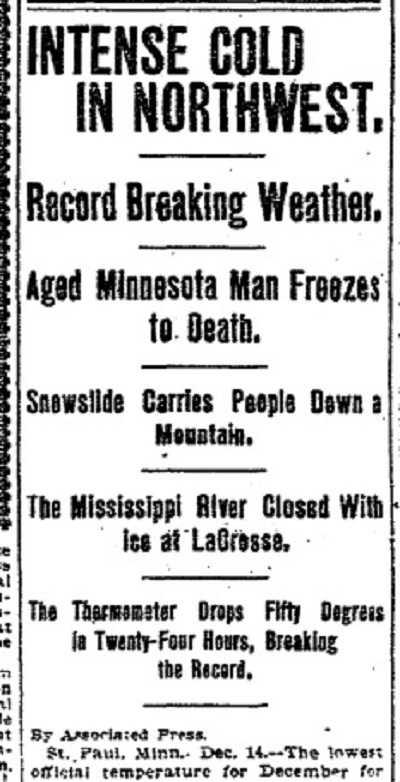
To the northwest of Ohio, temperatures were plunging rapidly as a deep, cold high pressure system was being pulled south. Dispatch headlines warned of the record-breaking cold.

A powerful cold front would move through late on the 14th, and temperatures began to plummet. By midnight, the temperature had dropped all the way down to just 14 degrees, a single day drop of 51 degrees! A driving rain accompanied the frontal passage, but quickly changed over to heavy snow that accumulated 3″-5″ across the area.

On the 15th, the temperature continued to fall, albeit more slowly, and by midnight the reading was -4. This mega-cold front had produced a 69-degree total drop in Columbus, which made it one of the strongest cold fronts ever to move through the Ohio region.

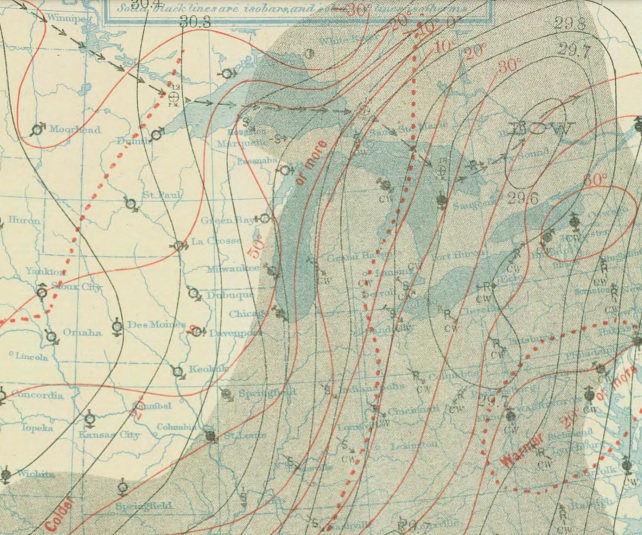
The weather map on December 14, 1901, as the front began pushing through Ohio.

The front would bring a major pattern change. Every day from the 15th-21st featured highs in the teens, which set many daily low maximum records, some of which still stand more than 100 years later.

The winter of 1901-02 was generally cold and snowy in the Ohio Valley, but no future front that winter would come close to December 14-15th of 1901.

To view more local and current weather, visit: Wilmington National Weather Service
And for more historic December records, check out: December Weather Records