Housing Market Update February 2013


housing market update February 2013

The new Columbus Housing Market Update is now available for February 2013!

Note: LSD= Local School District, CSD= City School District. In both cases, school district boundaries differ from city boundaries.

Top 15 Most Expensive Locations By Median Sales Price in February 2013
1. New Albany: $459,000
2. Powell: $300,000
3. Olentangy LSD: $290,000
4. Dublin: $278,000
5. New Albany Plain LSD: $273,000
6. Upper Arlington CSD: $230,000
7. Downtown: $230,000
8. Bexley: $229,900
9. Dublin CSD: $226,500
10. German Village: $218,750
11. Granville CSD: $210,000
12. Buckeye Valley LSD: $209,155
13. Johnstown Monroe LSD: $201,250
14. Gahanna Jefferson CSD: $200,000
15. Gahanna: $200,000

Top 15 Least Expensive Locations by Median Sales Price in February 2013
1. Whitehall: $30,500
2. Jefferson LSD: $56,000
3. Hamilton LSD: $58,000
4. Valleyview: $58,000
5. Newark CSD: $64,000
6. Columbus CSD: $76,500
7. Groveport Madison LSD: $77,778
8. South-Western CSD: $83,000
9. Circleville CSD: $83,900
10. Sunbury: $89,000
11. Reynoldsburg CSD: $96,000
12. Columbus: $97,500
13. Pataskala: $98,950
14. London CSD: $106,500
15. Lancaster CSD: $106,700

Whitehall continued to be the cheapest market for the second month in a row.

Overall Market Median Sales Price in February 2013: $122,143

Top 15 Locations with the Highest Median Sales Price % Growth Between February 2012 and February 2013
1. Jefferson LSD: +64.7%
2. Buckeye Valley LSD: +54.9%
3. Johnstown Monroe LSD: +53.3%
4. Obetz: +43.9%
5. Canal Winchester CSD: +40.1%
6. Gahanna: +37.3%
7. Gahanna Jefferson CSD: +17.0%
8. Dublin CSD: +15.0%
9. Downtown: +15.0%
10. Westerville: +12.2%
11. German Village: +12.2%
12. Groveport Madison LSD: +11.1%
13. Columbus CSD: +10.9%
14. Olentangy LSD: +10.3%
15. London CSD: +8.7%

Far-flung exurban districts seemed to see the largest increases this month.

Top 15 Locations with the Lowest Median Sales Price % Growth Between February 2012 and February 2013
1. Sunbury: -55.0%
2. Big Walnut LSD: -37.1%
3. Hilliard: -29.2%
4. Hamilton LSD: -27.3%
5. Grandview Heights: -26.0%
6. New Albany Plain LSD: -26.0%
7. Circleville CSD: -24.8%
8. Bexley: -22.8%
9. Upper Arlington CSD: -20.0%
10. Pataskala: -19.2%
11. Granville CSD: -17.6%
12. Grove City: -13.1%
13. Whitehall: -12.3%
14. Delaware CSD: -10.1%
15. Hilliard CSD: -9.8%

Overall Market Median Sales Price % Change February 2012 vs. February 2013: -1.5%

Top 10 Locations with the Most New Listings in February 2013
1. Columbus: 1,083
2. Columbus CSD: 677
3. South-Western CSD: 240
4. Olentangy LSD: 177
5. Hilliard CSD: 147
6. Dublin CSD: 134
7. Westerville CSD: 114
8. Grove City: 89
9. Worthington CSD: 88
10. Dublin: 84

Top 10 Locations with the Fewest New Listings in February 2013
1. Valleyview: 0
2. Obetz: 1
3. Lithopolis: 3
4. Minerva Park: 5
5. Grandview Heights: 5
6. Sunbury: 6
7. Johnstown Monroe LSD: 6
8. Jefferson LSD: 8
9. Jonathan Alder LSD: 12
10. Hamilton LSD: 13
11. Whitehall: 14

Total New Listings in the Columbus Metro in February 2013: 2,694
Overall Metro New Listings % Change February 2012-February 2013: +17.9%

Supply improved over a year earlier.

For more information on the local market, go here: Columbus Realtors


An Examination of Franklin County Voting History


**Added data for the 2016 election.

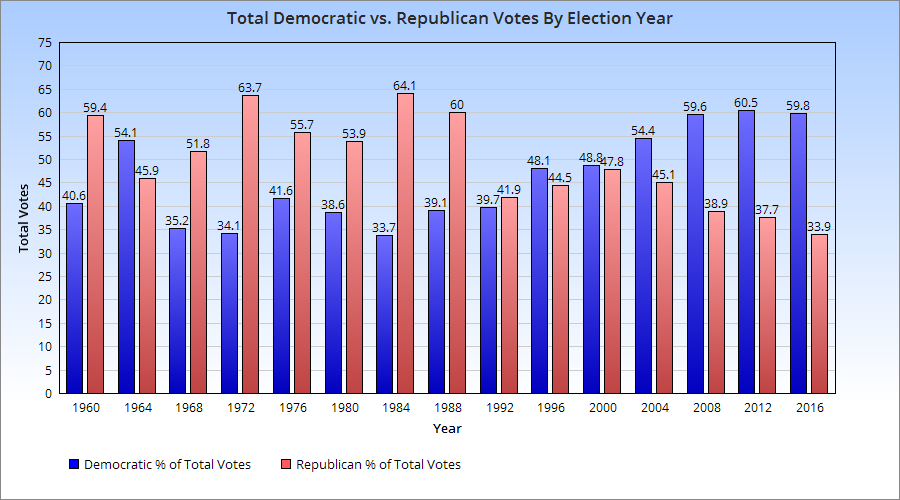
With the presidential election just a few months ago, I thought it might be interesting to look at how Franklin County has voted over time. I went back to the presidential election of 1976 as that is the earliest I could find individual county totals.

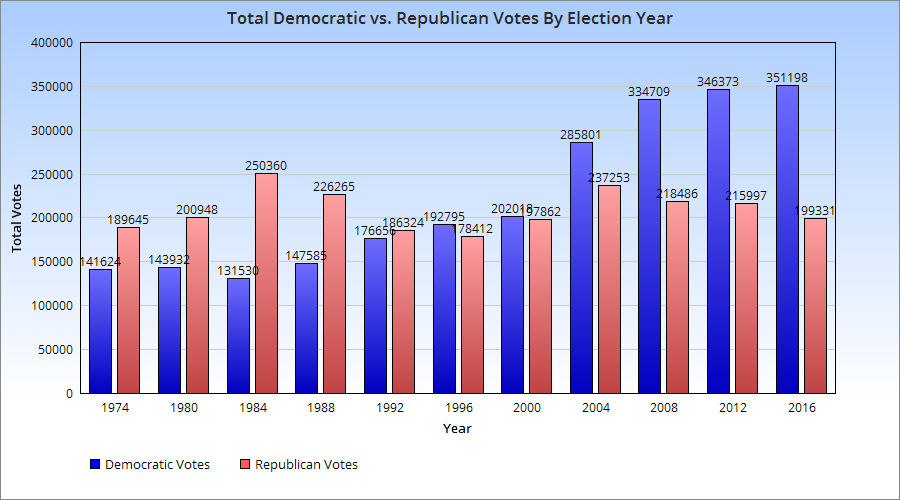
First, let’s look at the total number of votes that were for the Democratic candidates vs the total number of votes for the Republican candidate.
An examination of Franklin County voting history
As the graph above shows, the number of Democratic votes has gradually been rising, and first surpassed Republican votes in the 1996 election. Meanwhile, Republican votes have more or less held steady, seeing no appreciable gains or declines over the course of the period of record.

What about votes as a %? For this, I was able to go back a bit further in the records.

This graph shows a very similar story, only a bit more stark, with Republicans clearly losing its share of the vote over the period with Democrats gaining.

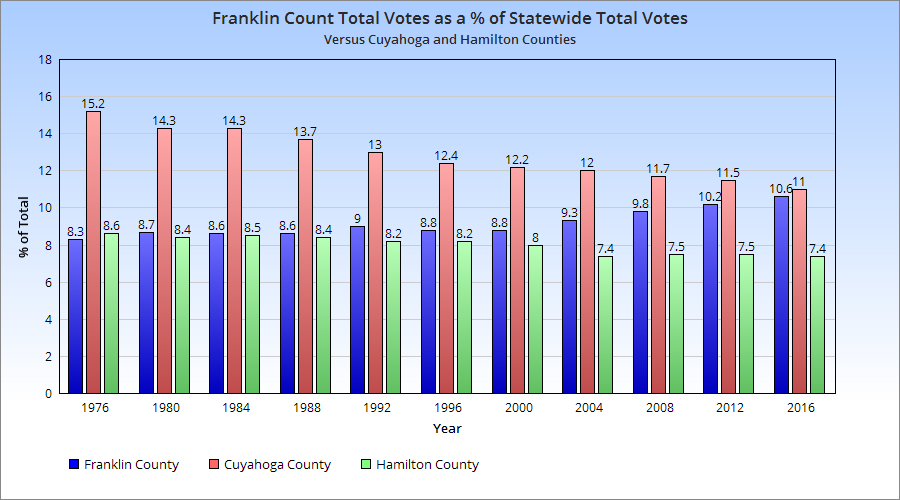
Not only are the voting habits of the county changing, but Franklin County’s share of the statewide vote is also growing. In the graph below, Franklin County is compared to Cincinnati’s Hamilton County and Cleveland’s Cuyahoga County showing the % share of total statewide votes for each. Franklin County’s has been steadily rising over time, while both other counties have lost some share over the period.

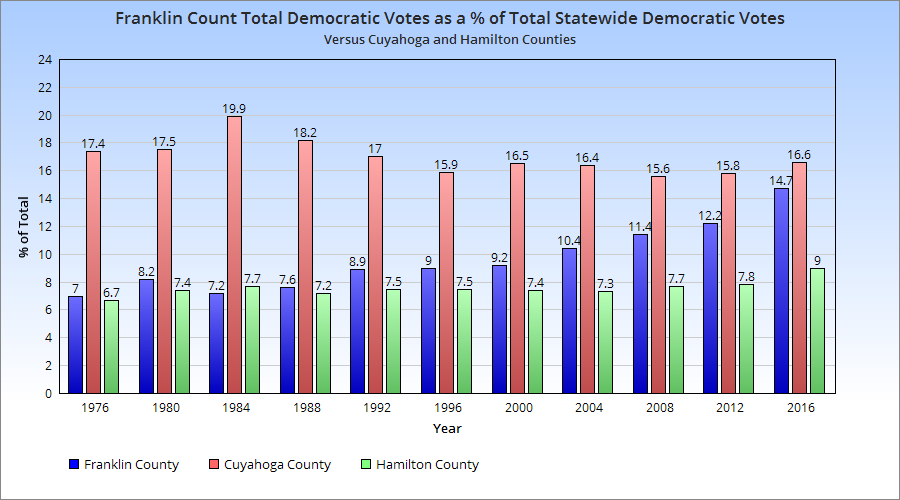
And it is also becoming a bigger player in the statewide % of Democratic votes.

If these trends continue, Columbus’ Franklin County may end up passing Cuyahoga County not only as the most “Blue” county in the state, but the most influential county as well.


Columbus Area Zip Codes and Their Economies


A lot of requests for zip code data come into this site, so I thought it might be a good idea to provide some.

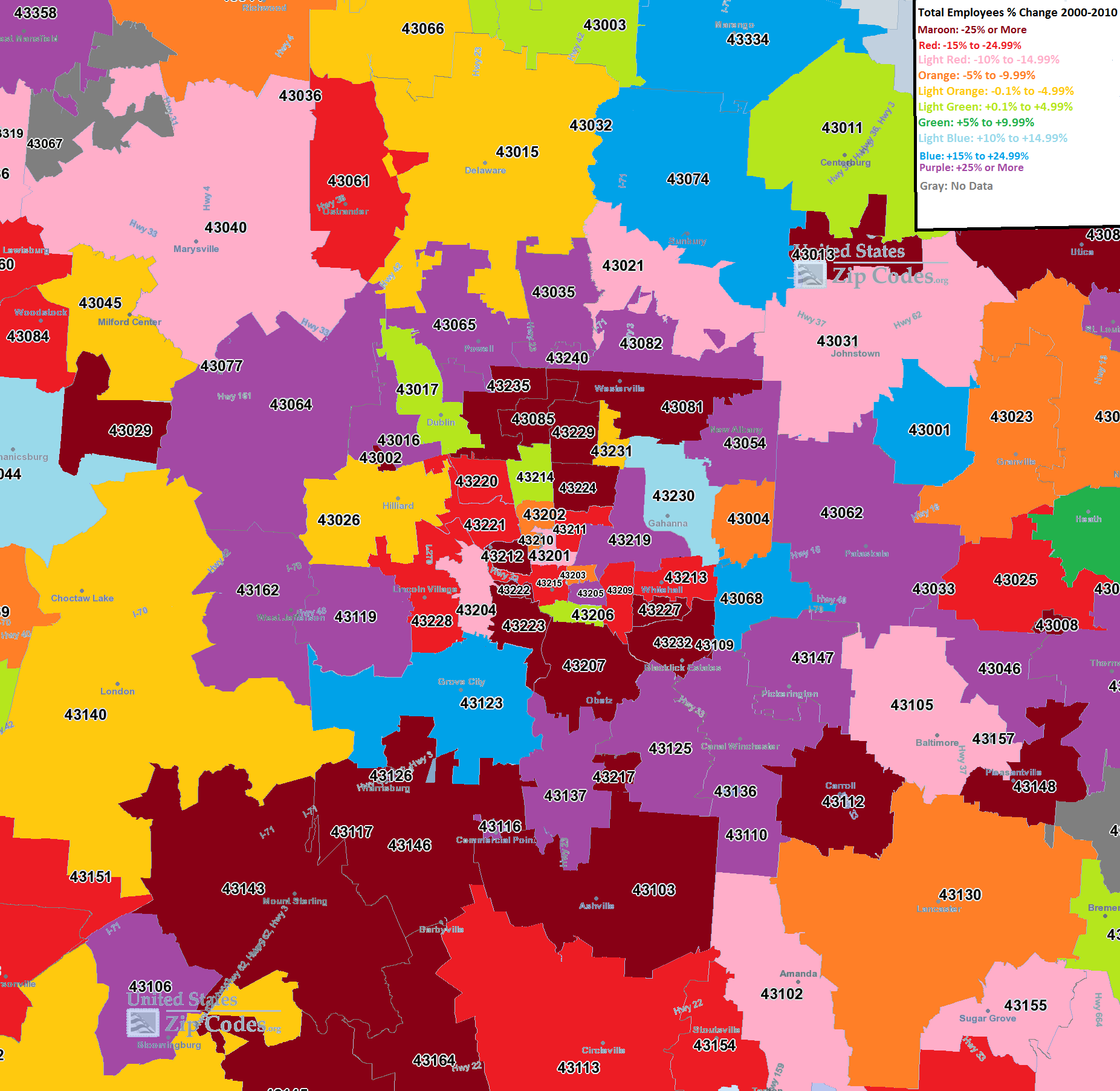
First, we have a map for the Columbus area that includes the % of of employees in a particular zip code from 2000-2010.
Columbus area zip codes and their economies

From this map, the urban areas of Columbus seem to have lost the most % of their employees the last decade, along with the far suburban and rural areas. The biggest growth was in the areas along and just outside of 270. This is an interesting map as it implies that the nearest suburban areas are attracting the most jobs, but that these suburbs are are both pulling from the inner core, but also from much further out.

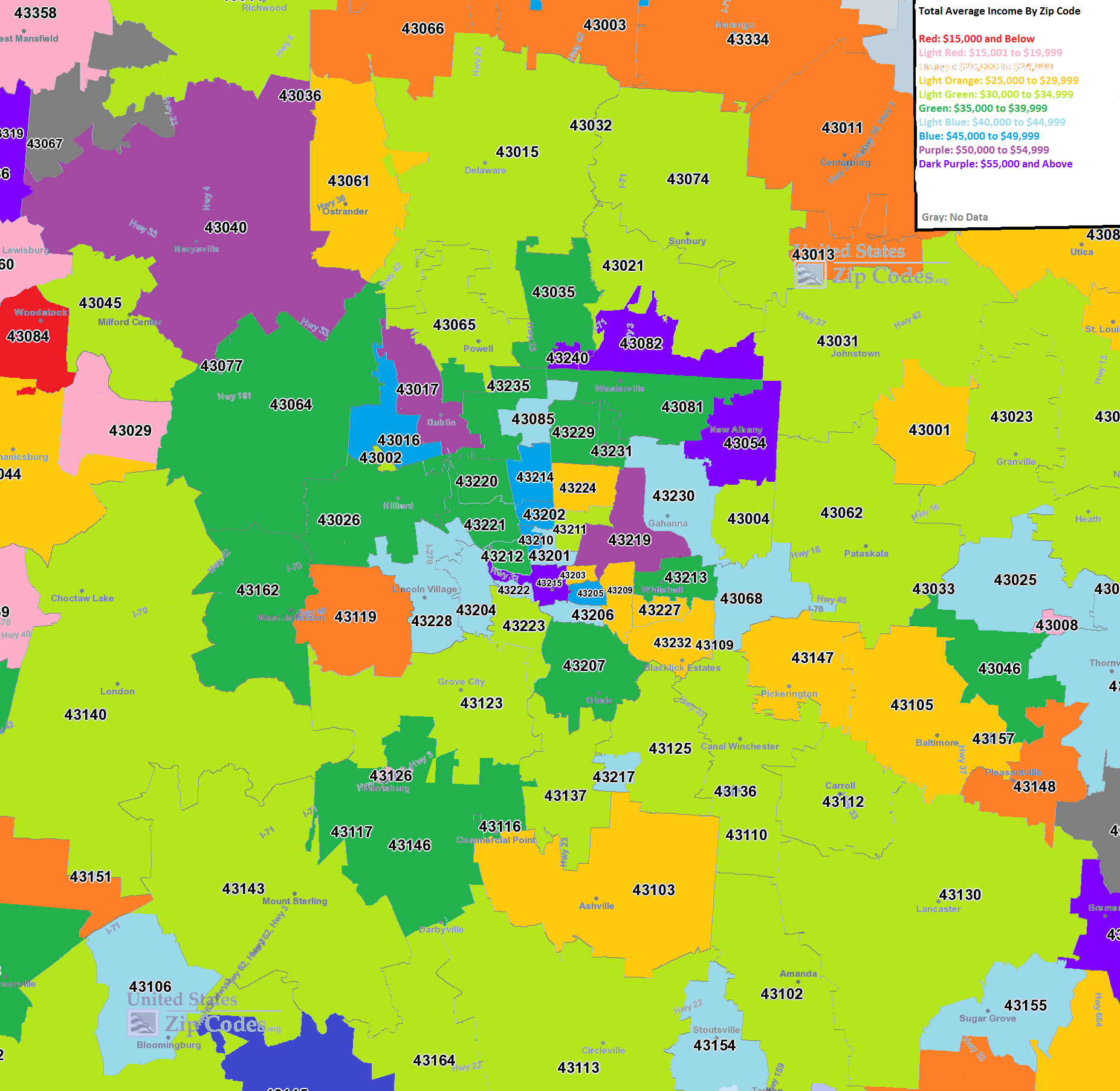
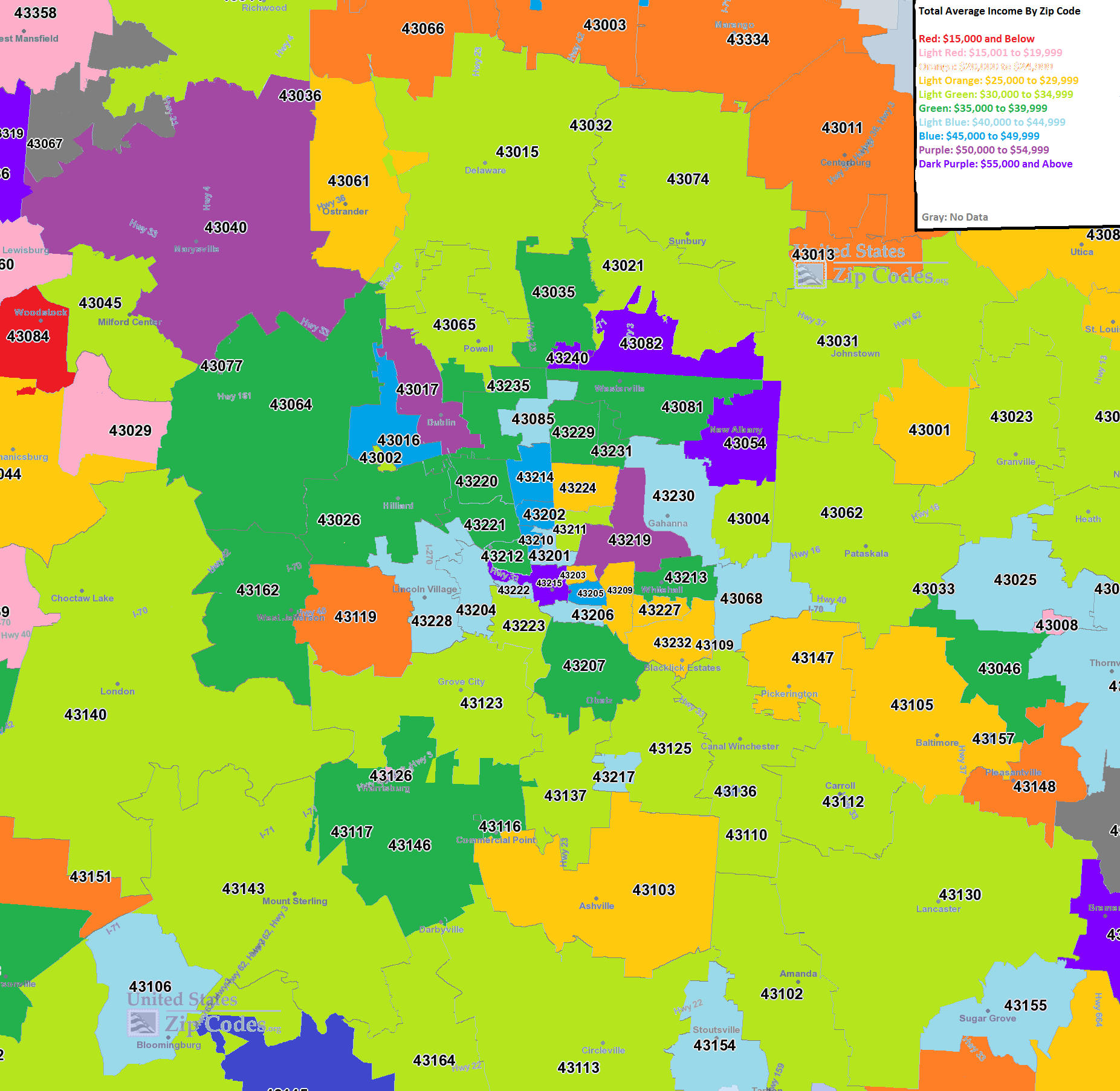
The second map is for average employee income by zip code.

What this map seems to show is that, while jobs may be moving to the I-270 suburbs, pay for those jobs is decidedly mixed across the city. Downtown, for example, averaged some of the highest incomes in the city. Other strong areas include parts of Westerville, New Albany and Dublin. Most of the High Street corridor was fairly strong as well. The lowest incomes were almost entirely in rural and far suburban areas.

Finally, the % change of average income from 2000-2010.

This map is also a mixed bag. Most of the area saw wage growth, but where it occurred the strongest was definitely all over the map. Some suburbs had good and bad, and so did the urban core areas.

So what’s all this mean? Well, certainly it means that the total # of jobs as far as growth shifted to the 270 suburbs the last decade, but at the same time, those jobs that remained in the core areas still grew in income. So it appears that the city is becoming richer about on par with the suburbs, at least the last 10 years. The question becomes, what happens the next decade? If urban trends continue the way they have the past few years (which these maps don’t really take into account), it is entirely possible that some of the job growth will move back inward towards the urban core.

To continue with local and national economic data, the US’ Bureau of Economic Analysis gives the option to look at cities, metro areas and other levels. Zip Code Maps gives population and demographic data in an interactive format.


Housing Market Update January 2013


housing market update January 2013

Columbus housing market update January 2013

We’re starting a new year in this edition of the Columbus Housing Market Update, with new January 2013 data now available!

Note: LSD= Local School District, CSD= City School District. In both cases, school district boundaries differ from city boundaries.

Top 15 Most Expensive Locations By Median Sales Price in January 2013
1. New Albany: $447,500
2. Powell: $342,500
3. Upper Arlington CSD: $320,000
4. New Albany Plain LSD: $314,400
5. Dublin: $284,00
6. Bexley: $269,950
7. Olentangy LSD: $250,101
8. German Village: $241,618
9. Worthington: $228,938
10. Grandview Heights: $223,000
11. Downtown: $210,000
12. Granville CSD: $207,000
13. Dublin CSD: $190,450
14. Big Walnut LSD: $187,000
15. Marysville CSD: $182,000

New Albany continued to be the most expensive market.

Top 15 Least Expensive Locations by Median Sales Price in January 2013
1. Whitehall: $29,750
2. Hamilton LSD: $54,500
3. Columbus CSD: $68,500
4. Groveport Madison LSD: $70,000
5. Lancaster CSD: $71,250
6. Valleyview: $79,850
7. Newark CSD: $84,500
8. Reynoldsburg CSD: $94,500
9. Columbus: $95,000
10. Jefferson LSD: $95,000
11. South-Western CSD: $103,000
12. Circleville CSD: $109,000
13. Canal Winchester CSD: $112,000
14. Pataskala: $120,000
15. London CSD: 122,000

Whitehall was by far the cheapest market to buy into this month.

Overall Market Median Sales Price in January 2013: $120,885

Top 15 Locations with the Highest Median Sales Price % Growth Between January 2012 and January 2013
1. Newark CSD: +83.3%
2. Valleyview: +76.5%
3. Lithopolis: +71.1%
4. Circleville CSD: +61.4%
5. Groveport Madison LSD: +60.9%
6. Marysville CSD: +38.8%
7. London CSD: +34.8%
8. New Albany: +29.7%
9. Columbus CSD: +28.0%
10. Grandview Heights: +27.4%
11. Columbus: +26.7%
12. Upper Arlington CSD: +24.3%
13. Downtown: +19.3%
14. Sunbury: +18.4%
15. South-Western CSD: +16.1%

Downtown and Columbus overall made the top markets for appreciation in the past year.

Top 15 Locations with the Lowest Median Sales Price % Growth Between January 2012 and January 2013
1. Granville CSD: -50.7%
2. Jonathan Alder LSD: -33.0%
3. Westerville: -29.2%
4. Dublin CSD: -23.3%
5. Hamilton LSD: -21.6%
6. Jefferson LSD: -20.8%
7. Big Walnut LSD: -19.7%
8. Bexley: -17.6%
9. Gahanna: -17.0%
10. Johnstown Monroe LSD: -16.2%
11. Westerville CSD: -14.8%
12. Worthington CSD: -12.5%
13. German Village: -10.5%
14. Grove City: -6.4%
15. Whitehall: -4.9%

Overall Market Median Sales Price % Change January 2012 vs. January 2013: +8.6%

Top 10 Locations with the Most New Listings in January 2013
1. Columbus: 957
2. Columbus CSD: 605
3. South-Western CSD: 210
4. Olentangy LSD: 146
5. Hilliard CSD: 126
6. Westerville CSD: 109
7. Dublin CSD: 94
8. Pickerington LSD: 81
9. Grove City: 66
10. Groveport Madison LSD: 65

Top 10 Locations with the Fewest New Listings in January 2013
1. Valleyview: 1
2. Minerva Park: 1
3. Lithopolis: 2
4. Jefferson LSD: 3
5. Obetz: 6
6. Jonathan Alder LSD: 8
7. Grandview Heights: 9
8. Sunbury: 10
9. Johnstown Monroe LSD: 10
10. Hamilton LSD: 12
11. Whitehall: 15

Total New Listings in the Columbus Metro in January 2013: 2,388
Overall Metro New Listings % Change January 2012-January 2013: -3.7%

This month, prices increased as overall supply slipped.

For more information on the local market, go here: Columbus Realtors


The Recovery of Downtown vs. Cleveland and Cincinnati Part 2


Yesterday, I talked about how the 1950 core population had changed the last 50 years. Today I want to focus just on the Downtown, or the Central Business District. This is a much smaller area for all three cities so there are far fewer tracts involved.

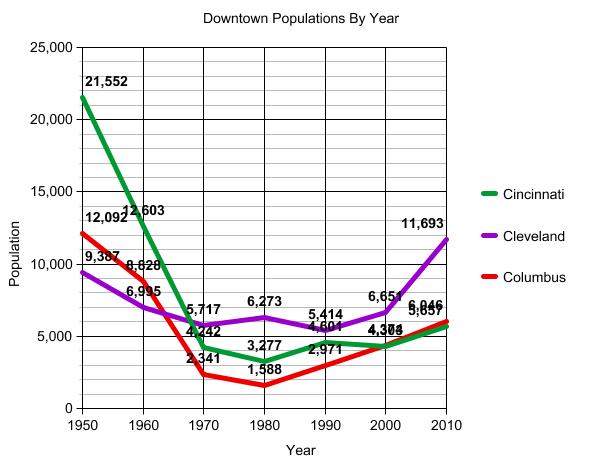
First, let’s look at the total Downtown populations since 1950.
The recovery of Downtown 2 Columbus, Ohio
This graph, I think, will surprise most people. The first surprise is that downtown populations in 1950 were not nearly as high as most would have you believe. Cincinnati did have almost 22K people there, but even a city like Cleveland had less than 10K, and that was during the absolute peak of its city population. Another surprise is that Columbus was not always the lowest populated downtown and was more populated than Cleveland’s in 1950. Finally, the last surprise is that while all the downtowns are now growing, Columbus has regained 2nd place and Cleveland has seen the most growth so far.

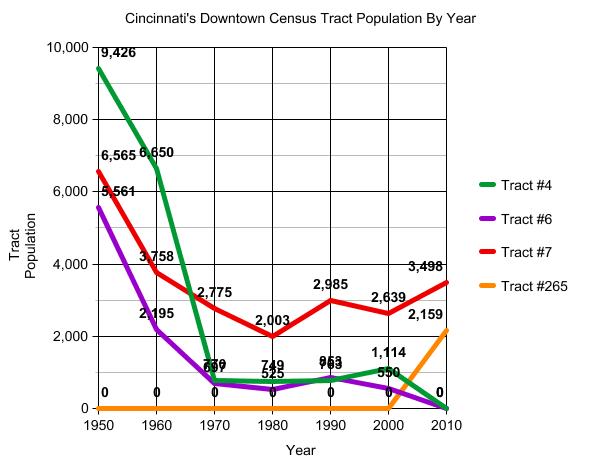
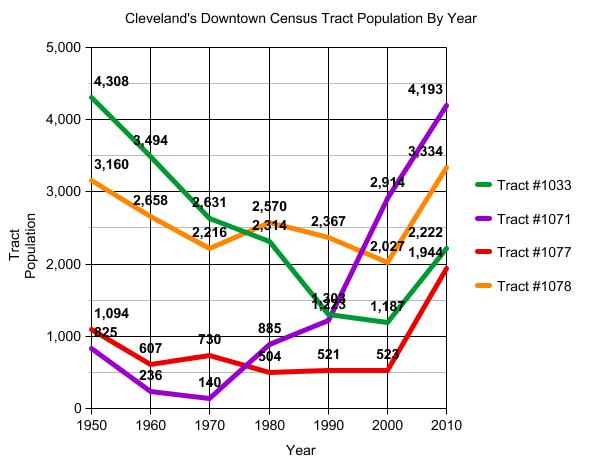
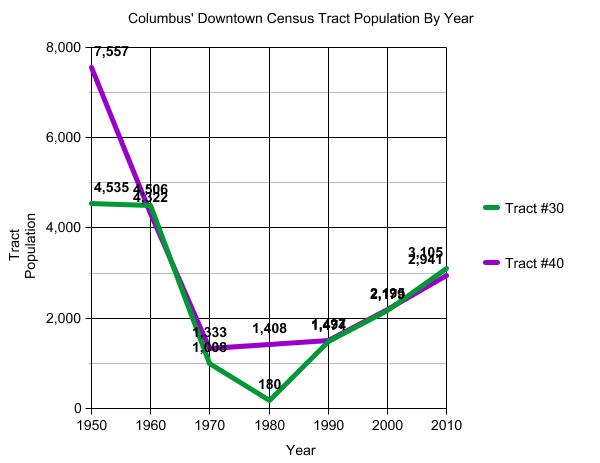
What about tract trends for the downtowns? Well first, here are the population trends for each downtown.

For Cincinnati, Tracts #4 and #6 were combined into #265 in 2010.


So no city had a single Downtown tract that was not growing in 2010. This is good news.


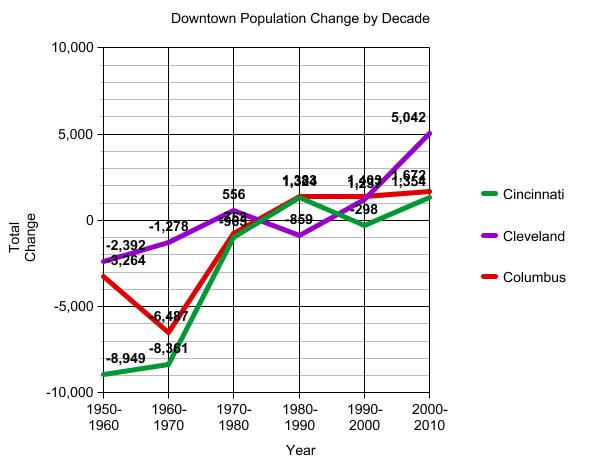
Here is the total population change by Downtown.

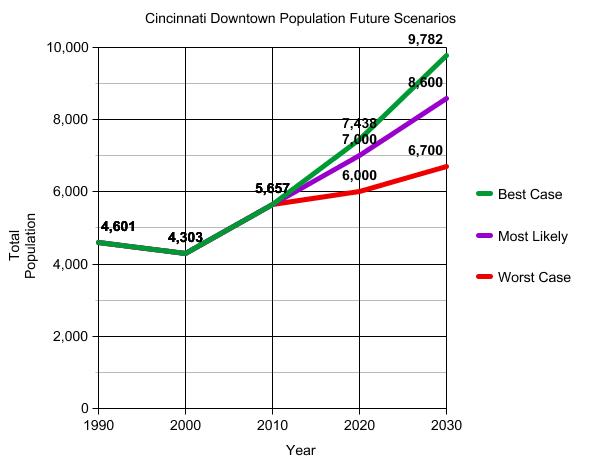
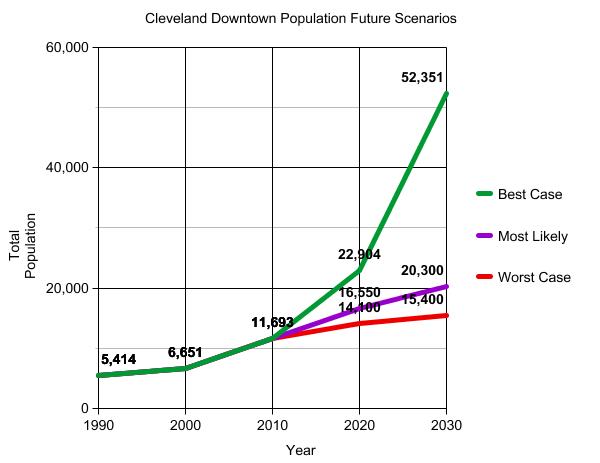
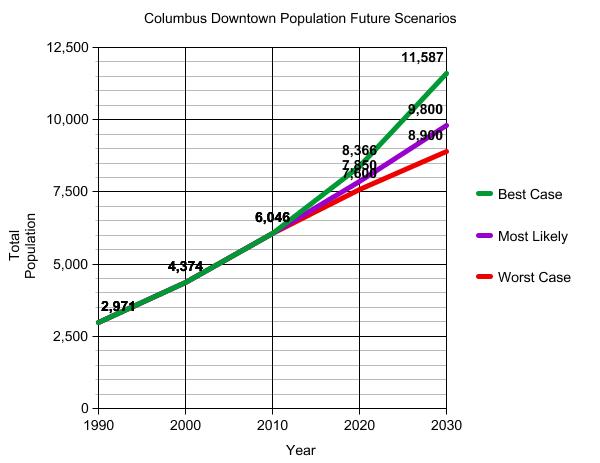
What about if these current trends continue, what might the downtown populations look like in 2020 or 2030?


If you think Cleveland has a very rapid rise for its Best Case scenario, that is because, to get the best case, I used the last decade’s growth rates and just assumed they would continue and compound growth. One of Cleveland’s tracts had a growth rate over 80% while another grew 271%. Still, while it’s the best case, it’s also highly unlikely to maintain growth rates that high for that long, so a more likely case is somewhere closer to Most Likely.

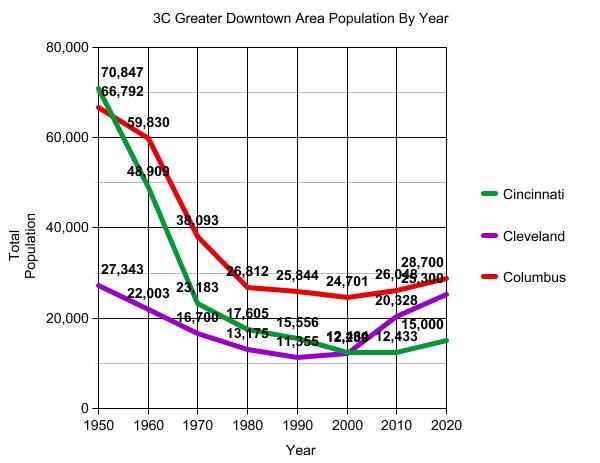
Finally, I wanted to look at more of the downtown area than just the central business district. “Downtown” for many includes more areas than that and may be a “Greater Downtown Area”, the measurement between the full 1950 boundaries and just the CBD.

Here are the tracts I considered to be the Greater Downtown area for each city.

Cincinnati: 2, 9, 10, 11, 263, 264, 265, 268
Cleveland: 1033, 1036, 1042, 1071, 1077, 1078, 1082, 1083, 1084
Columbus: 21, 22, 29, 30, 36, 38, 40, 42, 52, 53, 57

And the graph for the population of these tracts since 1950 and a projection out to 2020.

Cincinnati reached it’s lowest population for the past 60 years for this area in 2010, but just barely. It should be growing again by 2020, but I didn’t project the growth to be that high because it was still coming out of its lowest point. Cleveland’s greater downtown had the bottomed out in 1990 and had the fasted growth the past decade. Columbus managed to maintain the highest population in its greater downtown, bottomed out in 2000 and has grown since. However, not nearly as fast as in Cleveland. I expect Columbus to have better growth this decade and remain on top, but with Cleveland’s area closing the gap.