Columbus’ 2020 Economic Performance


Columbus' 2020 economic performance

As with everywhere else in the country, Columbus has not gone unscathed by the Covid-19 pandemic and its related economic fallout.  Just how bad did the situation get, though, and how was Columbus’ 20202 economic performance overall? Has it recovered since reaching pandemic bottom?

To find out, we’ll look at the latest economic data ending in January 2021.

First, here are the historic and current Ohio Covid-19 numbers.

Covid 19 Cases and Deaths in Ohio
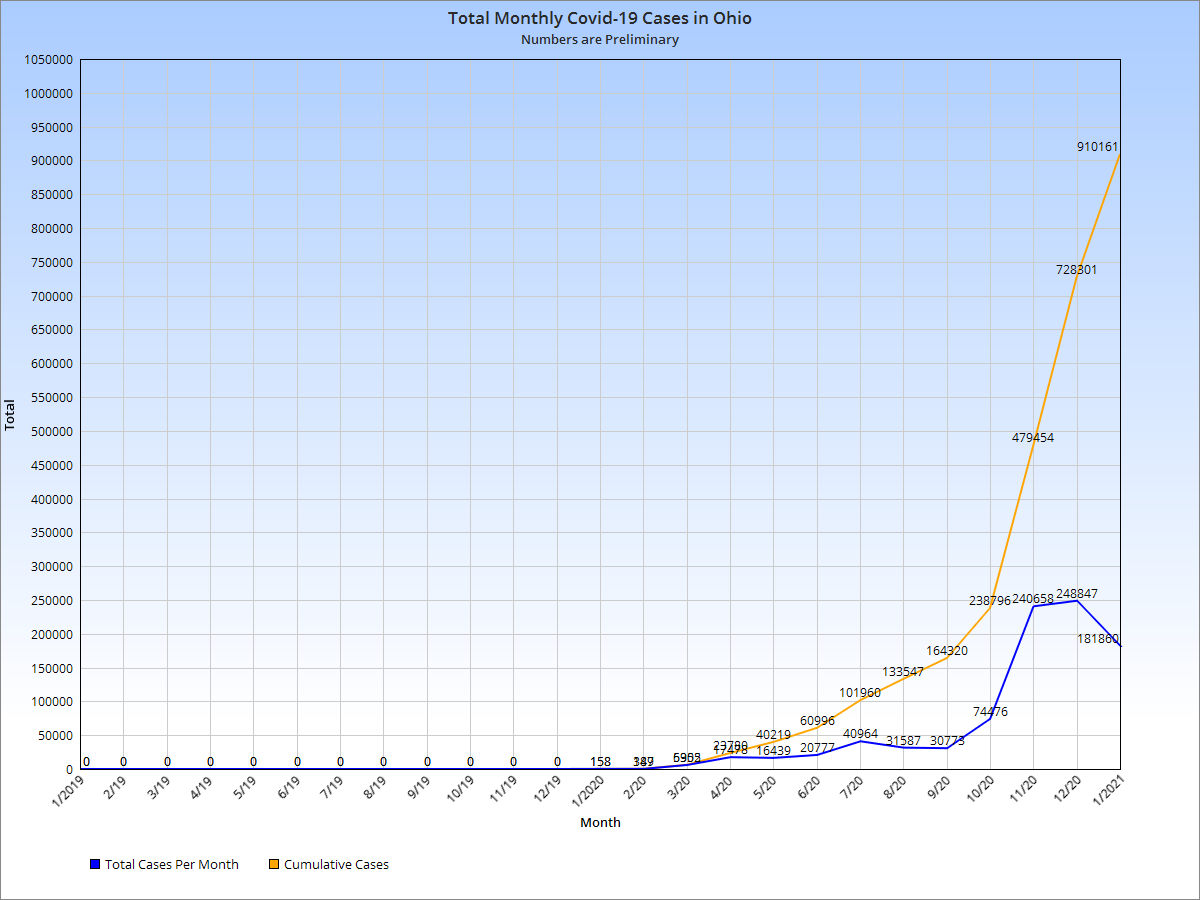

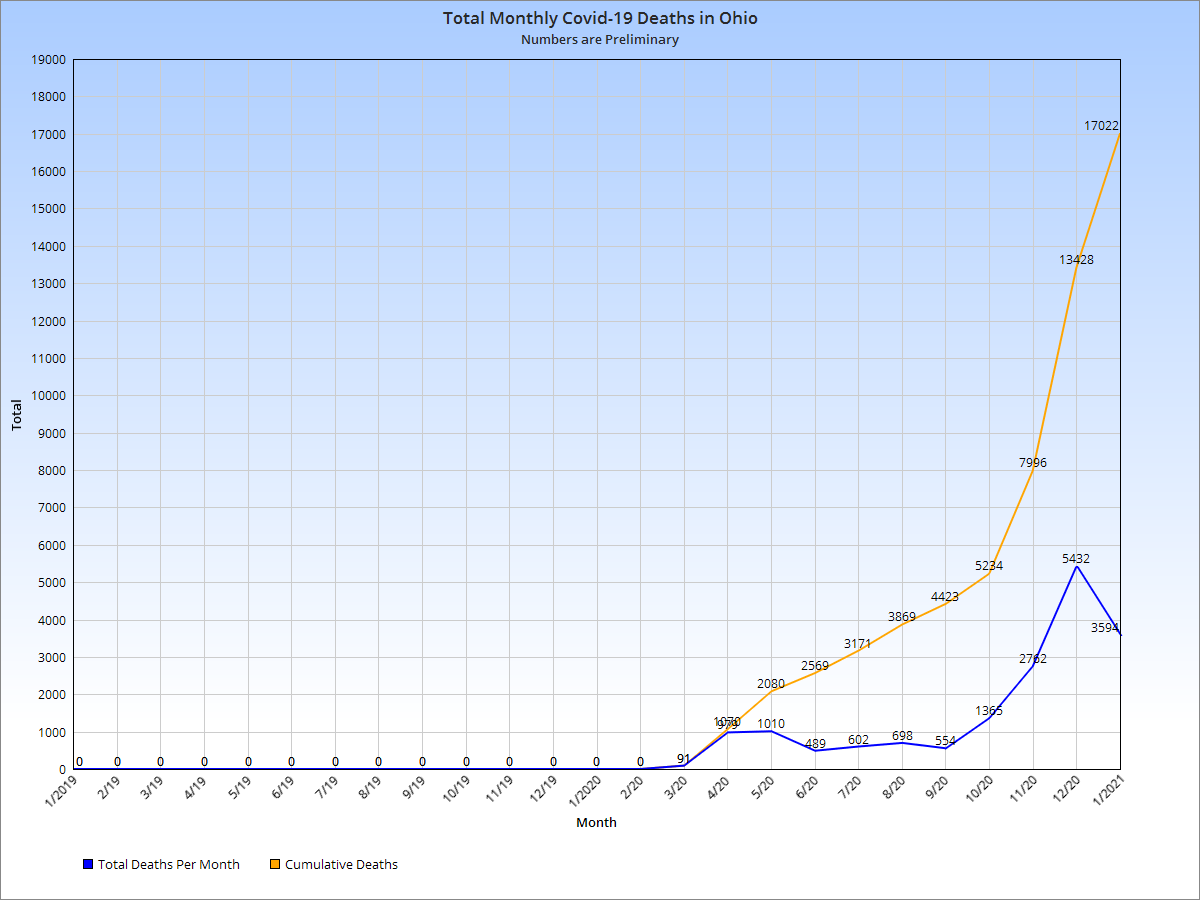
In Ohio, the pandemic generally began in early January, though Ohio didn’t originally announce any cases until the end of February.

March 2020 marked the official beginning of the pandemic. It was on March 11th, 2020, however, that truly brought out the seriousness of the situation. On that day, multiple news stories all happened simultaneously. The WHO finally declared the situation a pandemic, state and local shutdowns began, Trump gave a national televised address announcing travel bans to Europe, and the stock market had one of its largest drops in history. The pile of bad news would begin affecting the economy almost immediately.

In Ohio, cases and deaths also began to add up quickly in March. As stay-at-home orders were issued and people stopped going out, there were mass layoffs across every industry of the economy.

So how was this all reflected in the economic data?

Columbus Metro Labor Force
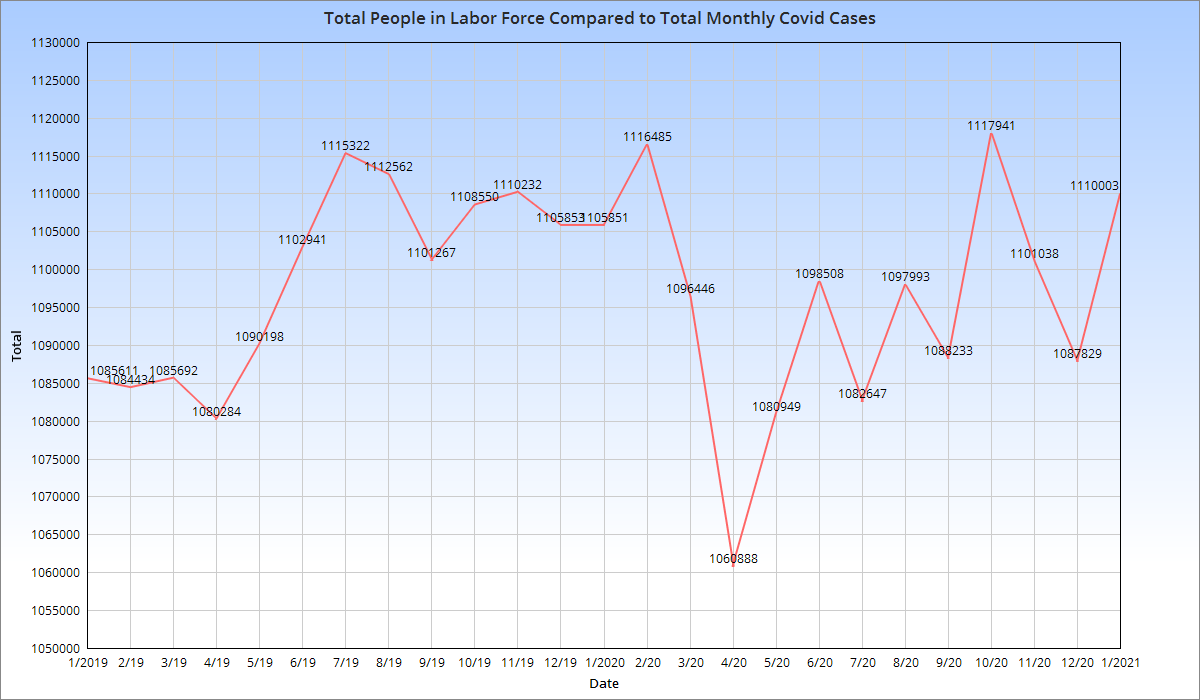
The metro’s labor force was initially unfazed and reached peak in February 2020, slightly higher than the 2019 peak. However, March lost more than 20,000 from the labor force and April lost almost 36,000 more.
The losses were mostly temporary, with a new peak being reached in October. However, the labor forced declined going into the late fall and winter as the 3rd- and worst- wave hit.

Columbus Metro Total Employed and Unemployed
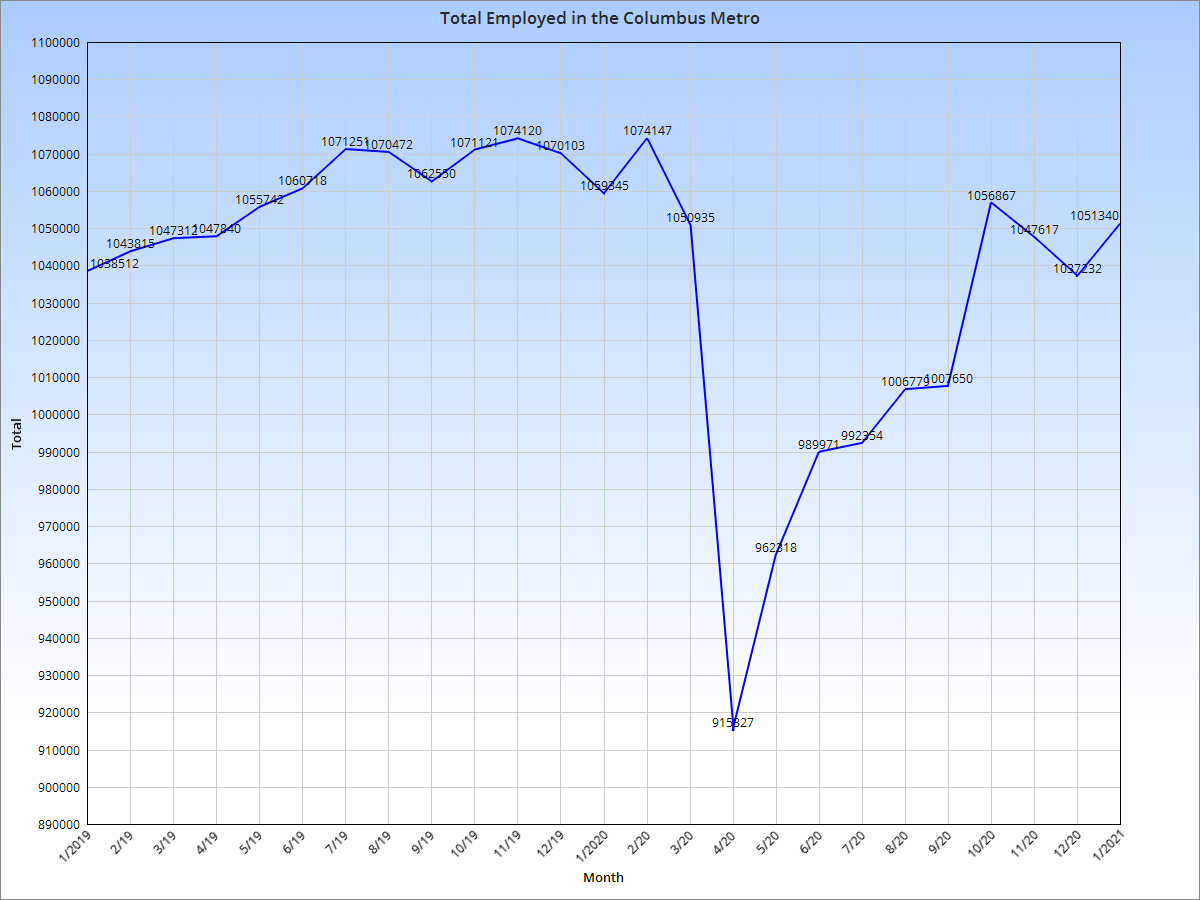

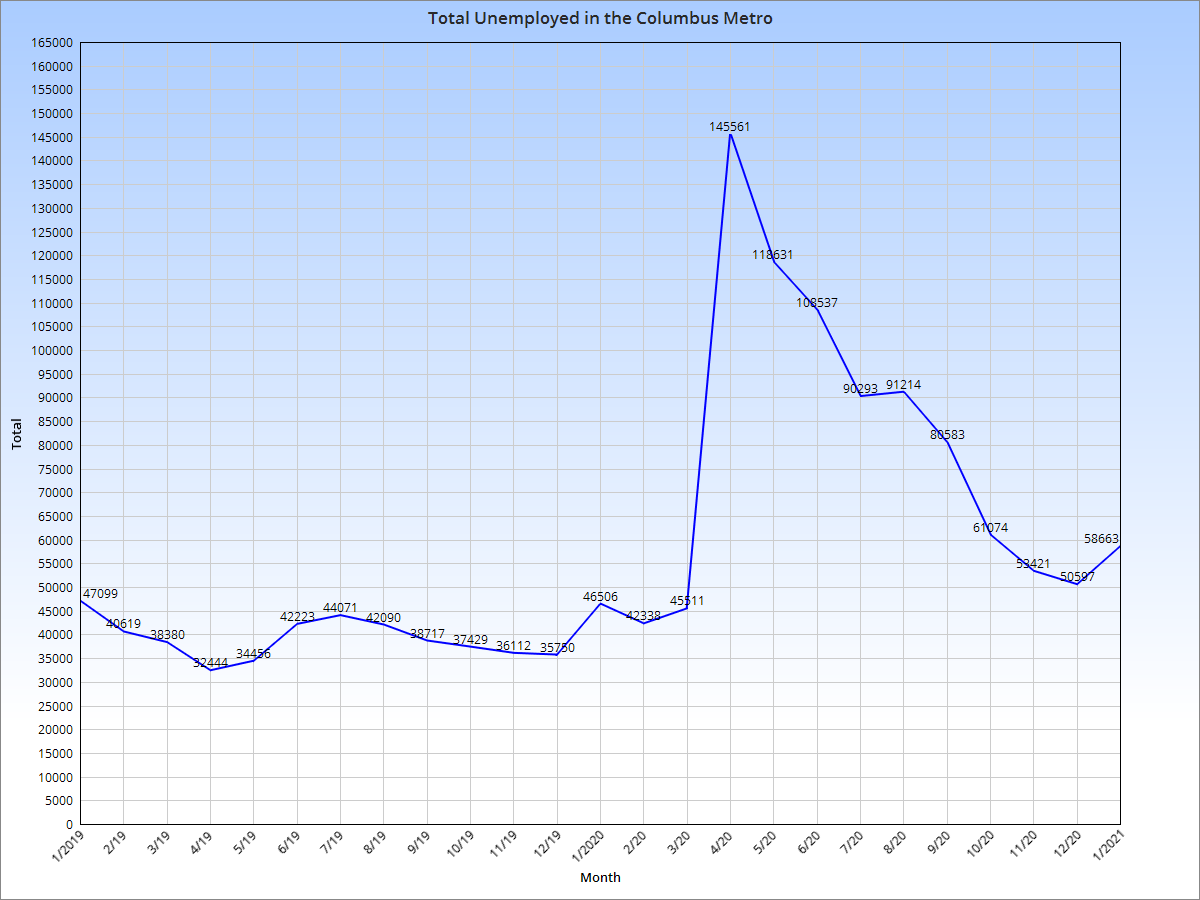
Employed totals were hit far harder than the labor force overall. More than 158K fewer people were employed in April versus February, a nearly 15% drop. Total employed has gone up since the bottom, but was still below the pre-Covid peak through January 2021.

Columbus Metro Unemployment Rate
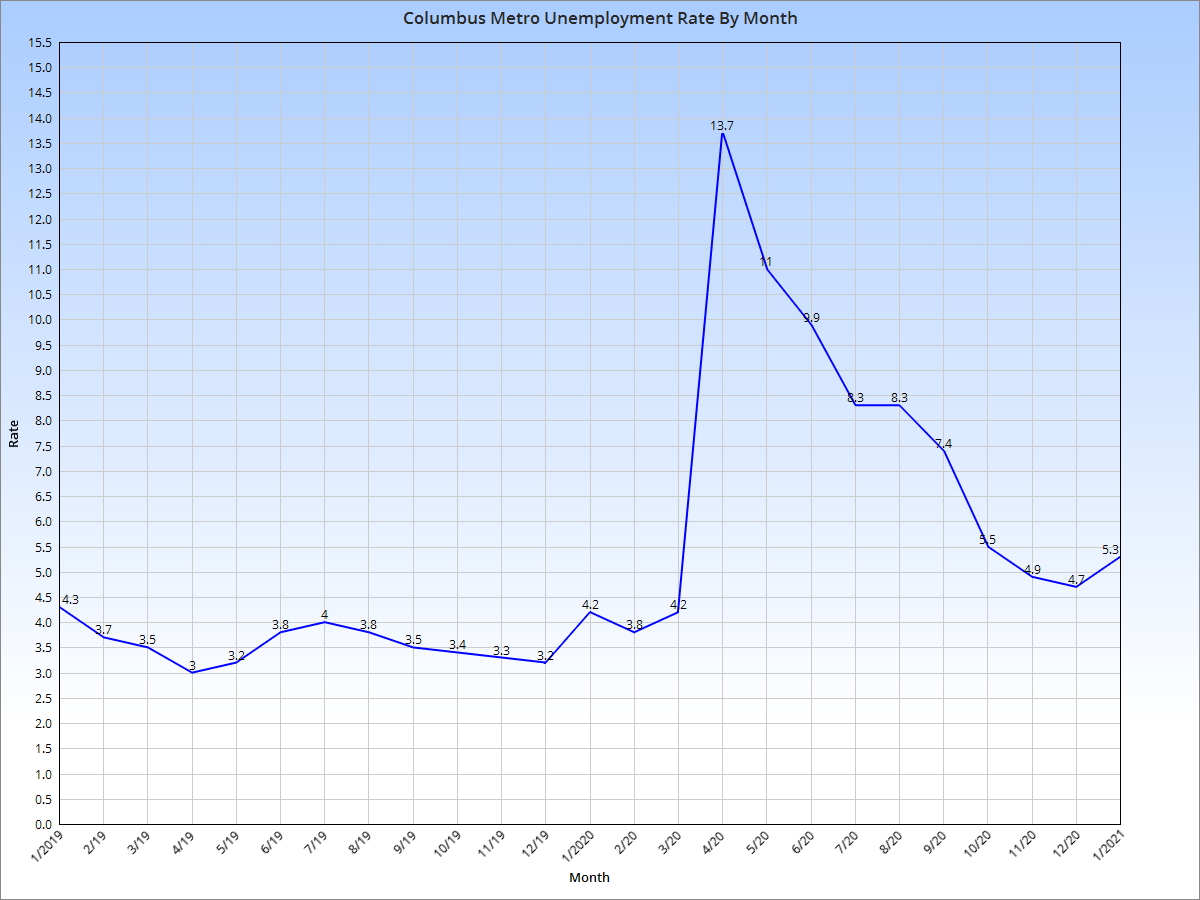
The 13% unemployment in April was one of the highest outside of the Great Depression and nearly 4 points higher than the 2009-2010 recession. Unemployment fell through the end of 2020, but remained higher that pre-Covid levels.
Columbus’ unemployment rate was a full point below the national average in January, a sign of its continuing economic resilience even during some of the worst economic conditions in generations.

Columbus Metro Non-Farm Jobs
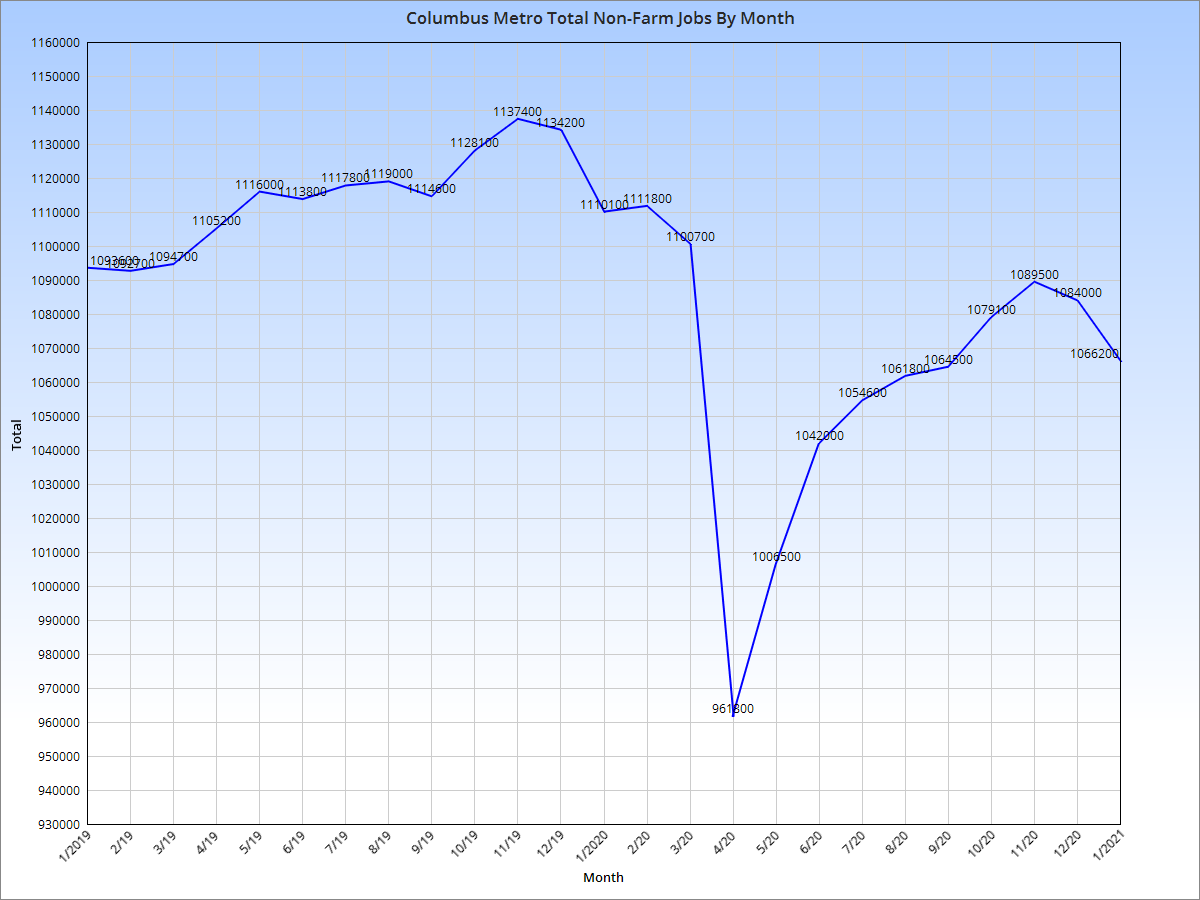
Non-farm jobs in the metro area had peaked in November 2019 and had been declining even before the pandemic set in. Between February and April, 2020, 150,000 non-farm jobs were lost in the metro. As of January 2021, the metro was still short about 71,000 from the 2019 peak.


Now let’s take a closer look at how individual industries have performed.

Columbus Jobs by Industry
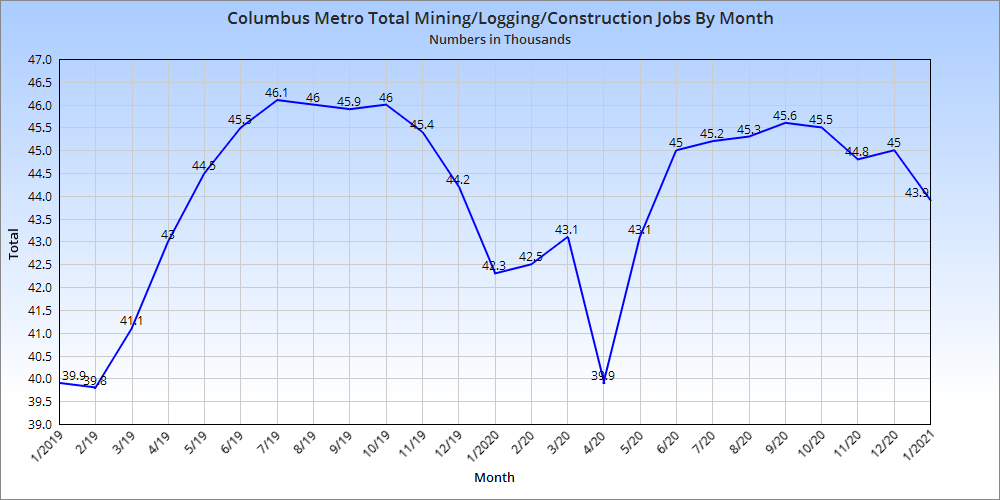
While the mining/logging/construction group did manage to get close to pre-Covid levels, it has been in general decline since last September, likely due to the 3rd wave that began in October.
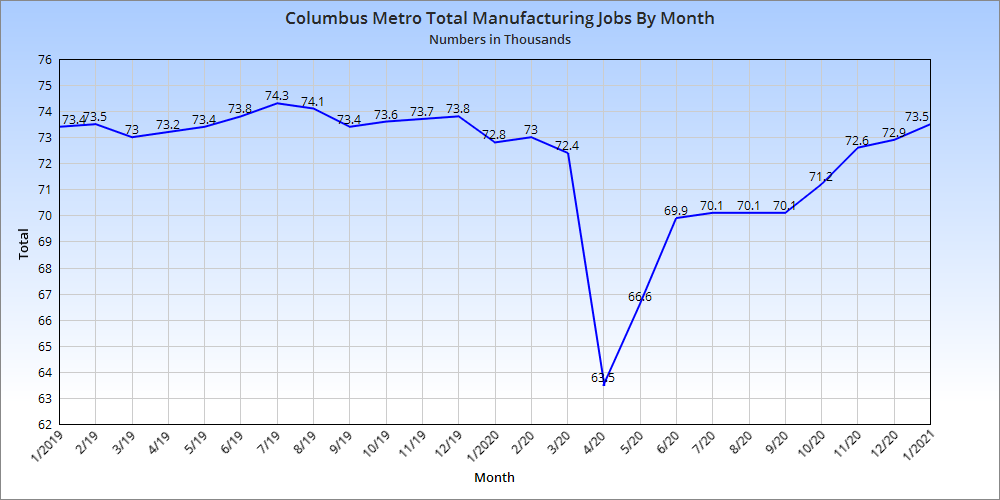

Manufacturing, surprisingly, has recovered completely, and jobs in the industry continued to rise through the 3rd wave.
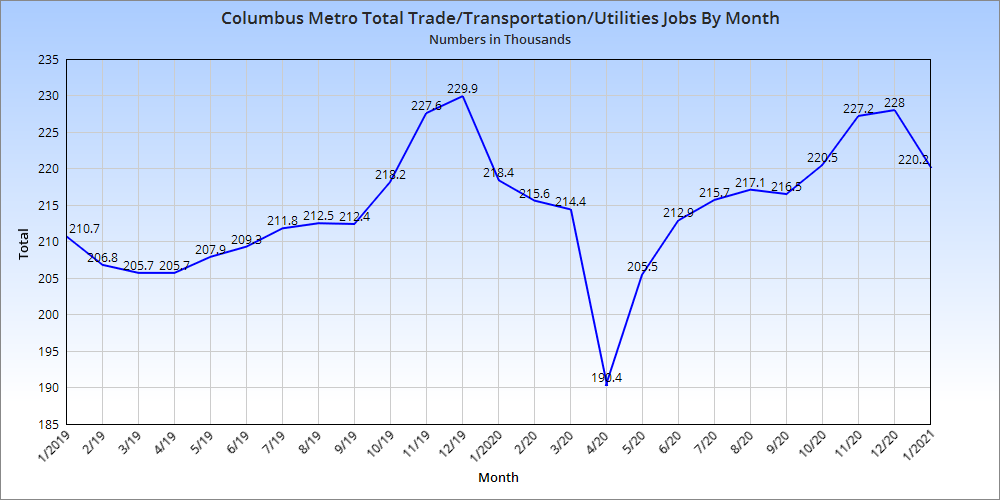

This industry group has also recovered fairly well, being close to where it was pre-Covid.
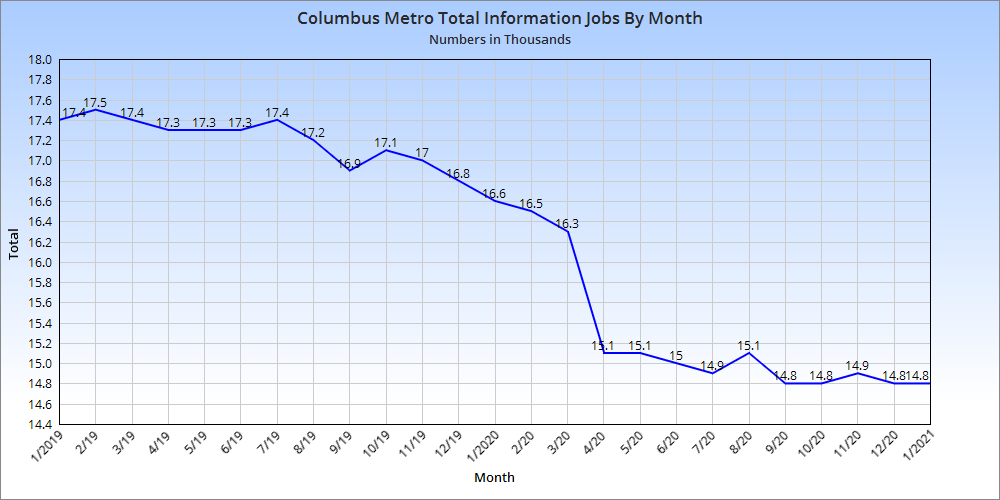

Information jobs were already in a long-term decline before the pandemic, but still faced a steep drop during the spring. Those lost jobs have not come back.
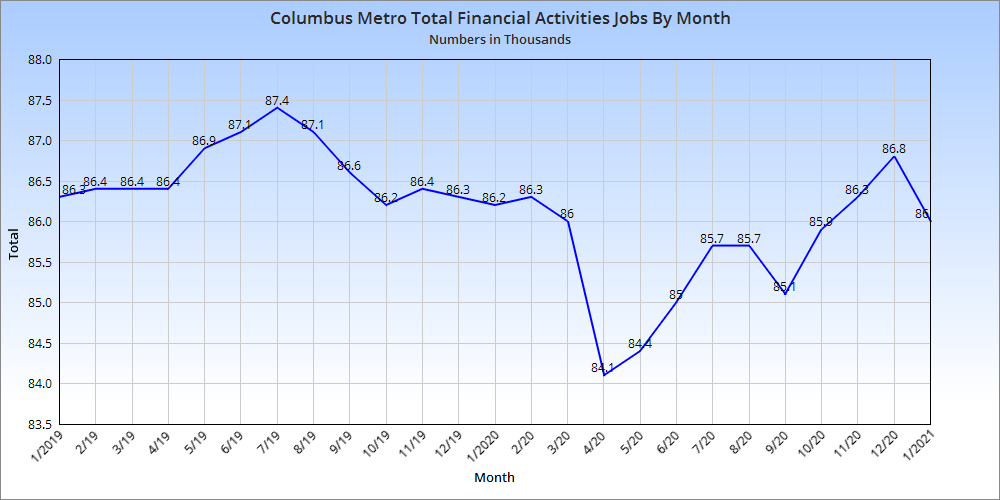

Financial activities jobs did not seem to face a significant decline, and have mostly recovered.
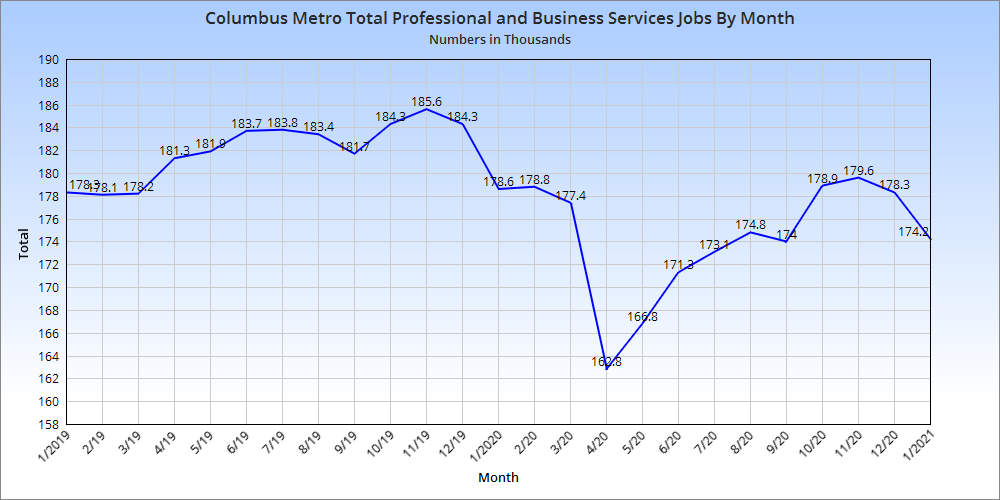

Professional and business services jobs were hit relatively hard during the economic collapse, and have only managed to recover about half of the losses through January.
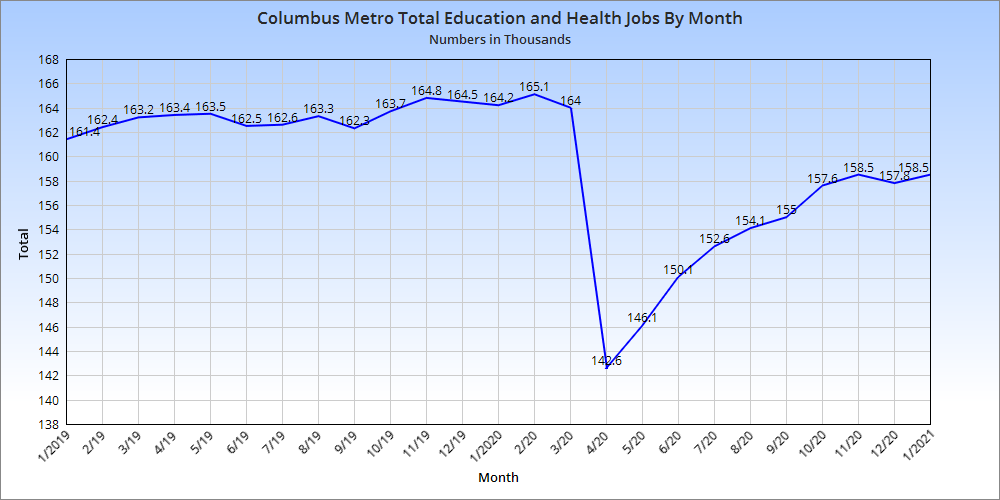

Another hard-hit industry group, the majority of the losses in the Health/Education group probably stem from the education side given that in-person schools have been mostly shut down the past year. Still, the industry group had recovered about 2/3rds of the losses through January.
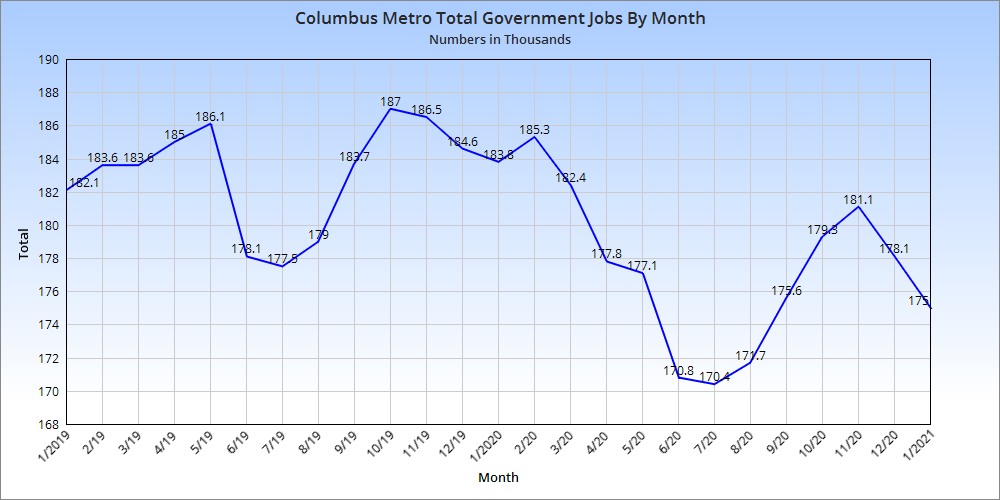

Government jobs typically see a significant mid-year drop, but it was much more severe in 2020. This category has not yet recovered fully.
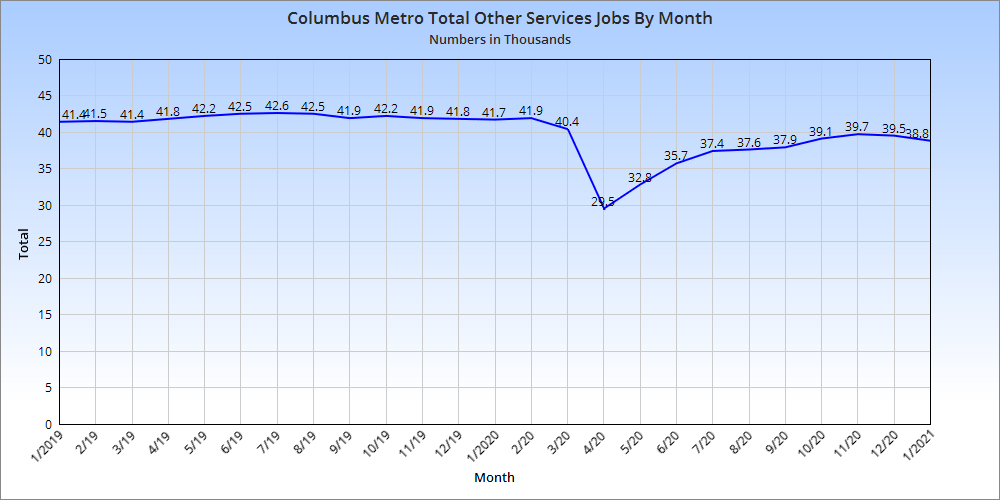

Other services jobs are typically pretty steady year over year and don’t see large changes. Obviously they did during the downturn, however. They have mostly recovered, although seemingly at a readjusted lower level.
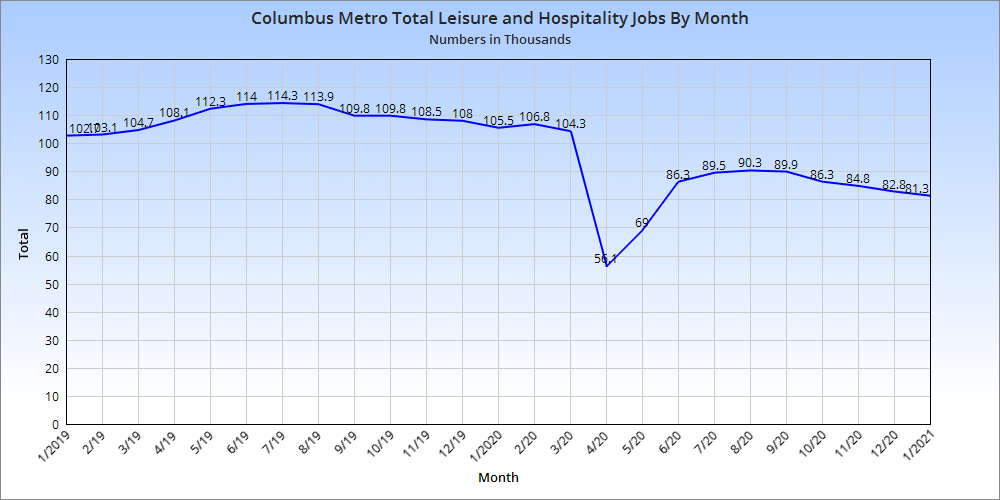

The leisure and hospitality industry was absolutely devastated, losing nearly 50% of all jobs. It has recovered some, but January still featured the fewest jobs in the industry since February 2003.

The Conclusion
So as we can see, recovery for some industries is *far* better than others. Service industries have done much worse overall and continue to be below pre-Covid levels. This is not really all that surprising when restaurants, bars and other entertainment spots have faced the brunt of hardship. It remains to be seen how everything from economic stimulus packages to vaccination rates affect 2021, but it’s hard to imagine anything worse than last year.

To get more local and national economic data, check out The Bureau of Labor Statistics


2014 State GDP


New 2014 state GDP figures were recently released by the Bureau of Economic Analysis. Where does Ohio stand in comparison to other states?

First, let’s look at the top 20 states for total GDP in 2014.

2014 Total, in Millions
1. California: 2,311,616
2. Texas: 1,648,036
3. New York: 1,404,518
4. Florida: 839,944
5. Illinois: 745,875
6. Pennsylvania: 662,890
7. Ohio: 583,261
8. New Jersey: 549,099
9. North Carolina: 483,126
10. Georgia: 476,483
11. Virginia: 463,613
12. Massachusetts: 459,937
13. Michigan: 451,516
14. Washington: 427,052
15. Maryland: 348,631
16. Indiana: 317,840
17. Minnesota: 316,204
18. Colorado: 306,663
19. Tennessee: 300,604
20. Wisconsin: 292,891

Ohio maintained its 7th-place position through 2014.
Now let’s look at the 20 states that had the biggest increases.

Total GDP Growth in Millions 2013-2014
1. California: +98,625
2. Texas: +90,843
3. New York: +62,927
4. Florida: +39,247
5. Pennsylvania: +22,596
6. Illinois: +21,080
7. Ohio: +20,416
8. Georgia: +20,000
9. Washington: +19,892
10. Massachusetts: +18,470
11. Colorado: +18,325
12. Michigan: +16,842
13. North Carolina: +16,051
14. New Jersey: +11,703
15. Oregon: +10,810
16. Tennessee: +10,479
17. Arizona: +9,422
18. Maryland: +9,222
19. Minnesota: +8,934
20. Virginia: +8,629

So Ohio is growing at the same position as its overall ranking. No states below it are set to pass it anytime in the near future. In fact, the gap is widening from its nearest threats.

What about per-capita GDP, which is a measure of the state’s total GDP divided by its population?

Per-Capita GDP, in Dollars 2014
1. Alaska: 66,160
2. North Dakota: 65,225
3. New York: 64,818
4. Connecticut: 64,676
5. Wyoming: 64,309
6. Massachusetts: 63,005
7. Delaware: 60,551
8. New Jersey: 56,405
9. Washington: 55,298
10. California: 54,462
11. Texas: 54,433
12. Maryland: 53,759
13. Illinois: 52,827
14. Minnesota: 52,801
15. Nebraska: 52,724
16. Colorado: 52,214
17. Virginia: 51,338
18. Oregon: 51,329
19. New Hampshire: 49,951
20. Hawaii: 49,686

27. Ohio: 45,887

Ohio is in the bottom half. Not great, as it indicates that it’s actually underperforming in GDP given its population.

So there you have it, a quick 2014 GDP update. Other Ohio data can be found at the Ohio Demographics and Population page.

June 2013 Jobs Data


June 2013 jobs data Columbus, Ohio

These latest June 2013 jobs data numbers are from the Bureau of Labor Statistics

Columbus City
Unemployment Rate: 6.4%
Unemployment Rate Change since June 2012: -0.1
Unemployment Rate Change since January 2013: -0.4
Civilian Labor Force: 438,100
Civilian Labor Force Change since June 2012: +5,000
Civilian Labor Force Change since January 2013: +11,700
Employment: 409,900
Employment Change since June 2012: +5,100
Employment Change since January 2013: +12,600
Unemployment: 28,200
Unemployment Change since June 2012: -100
Unemployment Change since January 2013: -900

Franklin County
Unemployment Rate: 6.4%
Unemployment Rate Change since June 2012: -0.1
Unemployment Rate Change since January 2013: -0.4
Civilian Labor Force: 640,600
Civilian Labor Force Change since June 2012: +7,400
Civilian Labor Force Change since January 2013: +16,900
Employment: 599,600
Employment Change since June 2012: +7,500
Employment Change since January 2013: +18,600
Unemployment: 41,100
Unemployment Change since June 2012: +0
Unemployment Change since January 2013: -1,500

Columbus Metro Area
Unemployment Rate: 6.4%
Unemployment Rate Change since June 2012: +0
Unemployment Rate Change since January 2013: -0.6
Civilian Labor Force: 992,617
Civilian Labor Force Change since June 2012: +12,256
Civilian Labor Force Change since January 2013: +24,712
Employment: 929,158
Employment Change since June 2012: +11,636
Employment Change since January 2013: +28,702
Unemployment: 63,459
Unemployment Change since June 2012: +620
Unemployment Change since January 2013: -3,990

Ohio Overall
Unemployment Rate: 7.2%
Unemployment Rate Change since June 2012: -0.1
Unemployment Rate Change since January 2013 : +0.2
Civilian Labor Force: 5,756,192
Civilian Labor Force Change since June 2012: +9,844
Civilian Labor Force Change since January 2013: +15,900
Employment: 5,343,335
Employment Change since June 2012: +15,079
Employment Change since January 2013: +2,483
Unemployment: 412,857
Unemployment Change since June 2012: -5,235
Unemployment Change since January 2013: +13,417

Metro Non-Farm Jobs
Total: 972,400
Change from June 2012: +15,200
Change from January 2013: +28,800

By Industry
Mining/Logging/Construction Total: 31,900
Change from June 2012: +1,000
Change from January 2013: +5,000

Manufacturing Total: 67,800
Change from June 2012: +1,400
Change from January 2013: +2,800

Trade/Transportation/Utilities Total: 181,600
Change from June 2012: -700
Change from January 2013: -1,600

Information Total: 16,400
Change from June 2012: -400
Change from January 2013: -100

Financial Activities Total: 71,800
Change from June 2012: +0
Change from January 2013: +100

Professional and Business Services Total: 161,900
Change from June 2012: +3,400
Change from January 2013: +6,300

Education and Health Services Total: 142,800
Change from June 2012: +6,600
Change from January 2013: +3,300

Leisure and Hospitality Total: 102,100
Change from June 2012: +4,700
Change from January 2013: +13,600

Other Services Total: 36,600
Change from June 2012: -500
Change from January 2013: +400

Government Total: 159,500
Change from June 2012: -300
Change from January 2013: -1,000

Overall, June was a pretty good month for Columbus and the state. Unemployment rose, but mostly because the labor force had strong growth, which is a sign of more people entering a recovering job market. Most industries saw job growth both year-over-year and year-to-date.


May 2013 Jobs Data


May 2013 jobs data

The latest May 2013 jobs data is now out from the Bureau of Labor Statistics.

Columbus City
Unemployment Rate: 6.0%
Unemployment Rate Change since May 2012: +0
Unemployment Rate Change since January 2013: -0.8
Civilian Labor Force: 431,500
Civilian Labor Force Change since May 2012: +3,600
Civilian Labor Force Change since January 2013: +5,100
Employment: 405,500
Employment Change since May 2012: +3,400
Employment Change since January 2013: +8,200
Unemployment: 26,000
Unemployment Change since May 2012: +100
Unemployment Change since January 2013: -3,100

Franklin County
Unemployment Rate: 6.0%
Unemployment Rate Change since May 2012: +0
Unemployment Rate Change since January 2013: -0.8
Civilian Labor Force: 631,000
Civilian Labor Force Change since May 2012: +5,300
Civilian Labor Force Change since January 2013: +7,300
Employment: 593,100
Employment Change since May 2012: +5,100
Employment Change since January 2013: +12,100
Unemployment: 37,900
Unemployment Change since May 2012: +200
Unemployment Change since January 2013: -4,700

Columbus Metro Area
Unemployment Rate: 6.0%
Unemployment Rate Change since May 2012: +0.1
Unemployment Rate Change since January 2013: -1.0
Civilian Labor Force: 977,400
Civilian Labor Force Change since May 2012: +8,600
Civilian Labor Force Change since January 2013: +9,500
Employment: 919,100
Employment Change since May 2012: +7,800
Employment Change since January 2013: +18,600
Unemployment: 58,300
Unemployment Change since May 2012: +800
Unemployment Change since January 2013: -9,100

Ohio Overall
Unemployment Rate: 7.0%
Unemployment Rate Change since May 2012: -0.3
Unemployment Rate Change since January 2013 : +0
Civilian Labor Force: 5,750,000
Civilian Labor Force Change since May 2012: -5,000
Civilian Labor Force Change since January 2013: +10,000
Employment: 5,345,000
Employment Change since May 2012: +9,000
Employment Change since January 2013: +4,000
Unemployment: 405,000
Unemployment Change since May 2012: -15,000
Unemployment Change since January 2013: +6,000

Metro Non-Farm Jobs
Total: 966,900
Change from May 2012: +12,200
Change from January 2013: +23,300

By Industry
Mining/Logging/Construction Total: 30,600
Change from May 2012: +500
Change from January 2013: +3,700

Manufacturing Total: 66,600
Change from May 2012: +600
Change from January 2013: +1,600

Trade/Transportation/Utilities Total: 180,700
Change from May 2012: -1,200
Change from January 2013: -2,500

Information Total: 16,400
Change from May 2012: -200
Change from January 2013: -100

Financial Activities Total: 71,300
Change from May 2012: -200
Change from January 2013: -400

Professional and Business Services Total: 161,000
Change from May 2012: +1,100
Change from January 2013: +5,400

Education and Health Services Total: 142,600
Change from May 2012: +4,500
Change from January 2013: +3,100

Leisure and Hospitality Total: 99,700
Change from May 2012: +4,900
Change from January 2013: +11,200

Other Services Total: 35,800
Change from May 2012: -600
Change from January 2013: -400

Government Total: 162,200
Change from May 2012: -200
Change from January 2013: +1,700


Cool Link Columbus Job Density


The Brookings Institute recently released a study on job density, or basically where jobs are most heavily concentrated within metro areas.

Here is how Columbus job density compared to other Ohio metros.

Total Jobs Located within 3 Miles of the Central Business District (Downtown) in 2010, Most to Least
1. Columbus: 157,193
2. Cincinnati: 151,956
3. Cleveland: 127,846
4. Dayton: 75,481
5. Akron: 66,247
6. Toledo: 59,552
7. Youngstown: 54,368

% of Total Metro Jobs Located within 3 Miles of the Central Business District (Downtown) in 2010, Highest to Lowest
1. Youngstown: 27.3%
2. Akron: 24.9%
3. Dayton: 24.5%
4. Toledo: 23.8%
5. Columbus: 21.2%
6. Cincinnati: 17.7%
7. Cleveland: 15.4%

So Columbus has the highest total number of jobs within 3 miles of the CBD, but is in the bottom half for % of total metro jobs in that area.

Jobs Change from 2000-2010 for all Jobs Located within 3 Miles of the CBD, Best to Worst
1. Toledo: -15,412
2. Akron: -16,700
3. Youngstown: -17,307
4. Columbus: -30,338
5. Cincinnati: -31,717
6. Dayton: -32,420
7. Cleveland: -54,134

% Jobs Change from 2000-2010 for all Jobs Located within 3 Miles of the CBD, Best to Worst
1. Cincinnati: -1.9%
2. Cleveland: -2.1%
3. Akron: -2.5%
4. Columbus: -2.5%
5. Toledo: -2.5%
6. Youngstown: -2.9%
7. Dayton: -3.9%

At first glance, this may seem like horrible news, and while it’s not necessarily good, almost all metros lost jobs in this area, even high growth cities like Charlotte, Atlanta, Dallas, etc. This has a lot to do with the suburbanization of the nation over the last several decades, including during most of the 2000s. Jobs left the central core to spread out into the suburban areas people were moving to.

Total Jobs Located Between 3 and 10 Miles from the CBD in 2010, Highest to Lowest
1. Columbus: 321,508
2. Cleveland: 317,128
3. Cincinnati: 252,789
4. Dayton: 164,453
5. Toledo: 137,339
6. Akron: 117,986
7. Youngstown: 89,711

% of Total Metro Jobs Located Between 3 and 10 Miles from the CBD in 2010, Highest to Lowest
1. Toledo: 54.8%
2. Dayton: 53.4%
3. Youngstown: 45.1%
4. Akron: 44.3%
5. Columbus: 43.4%
6. Cleveland: 38.1%
7. Cincinnati: 29.5%

% Jobs Change 2000-2010 for all Jobs Located Between 3 and 10 Miles from the CBD, Best to Worst
1. Dayton: +1.5%
2. Youngstown: +1.1%
3. Akron: +0.7%
4. Toledo: -0.1%
5. Cincinnati: -1.4%
6. Cleveland: -1.4%
7. Columbus: -2.4%

The positive % changes even while the area lost jobs has to do with how many the share of total metro jobs. While the area may have lost jobs, its share of the entire metro grew as other areas shrank faster.

Finally, the far suburbs…

Total Jobs Located between 10 and 35 Miles from the CBD in 2010, Highest to Lowest
1. Cincinnati: 452,895
2. Cleveland: 386,727
3. Columbus: 262,003
4. Akron: 82,260
5. Dayton: 67,838
6. Youngstown: 54,709
7. Toledo: 53,736

% of Total Metro Jobs Located Between 10 and 35 Miles from the CBD in 2010, Highest to Lowest
1. Cincinnati: 52.8%
2. Cleveland: 46.5%
3. Columbus: 35.4%
4. Akron: 30.9%
5. Youngstown: 27.5%
6. Dayton: 22.0%
7. Toledo: 21.4%

% Jobs Change 2000-2010 for all Jobs Located Between 10 and 35 Miles from the CBD, Best to Worst
1. Columbus: +5.0%
2. Cleveland: +3.5%
3. Cincinnati: +3.3%
4. Dayton: +2.5%
5. Toledo: +2.5%
6. Akron: +1.7%
7. Youngstown: +1.7%

So what do all these numbers show? Well, the larger the metro, the more spread out it seems to be as far as where jobs are located. Smaller metros like Akron and Dayton are more compact. Columbus is the most compact of the 3-Cs and has the most total jobs, by far, within 10 miles of its core of any metro, but not by %. None of the metros saw real jobs growth within 10 miles of their cores, which is to be expected. However, in recent years, urban development has exploded, and companies seem to be shifting jobs closer to the center. It remains to be seen if these are long term trends or just a blip.