This link breaks down parks and other areas that have sled hills by side of the city/metro area. The list has dozens of places, so it should not be difficult to find a new favorite sledding place.
New Years weather has historically been surprisingly tranquil, with some exceptions. Highs have generally been in the 30s or 40s and significant snowfalls have been rare. The records for New Year’s climatology run back to 1878.
New Year’s Eve Normals High: 37 Low: 24 Mean: 30 Precipitation: 0.09″ Snowfall: 0.2″
New Year’s Day Normals High: 37 Low: 23 Mean: 30 Precipitation: 0.10″ Snowfall: 0.3″
White Christmases are pretty rare in the Columbus, Ohio area. An inch or more has fallen on the date only 11 times since 1878. An official White Christmas, however, is defined as having 1″ or more snow on the ground, not necessarily falling on the day itself. That has only happened 21 times since 1939, with only 4 of those times coming since 2000. So these white holidays are relatively rare.
A white Christmas Eve has been even less likely. 1″ or more has been on the ground on December 24th just 16 times since 1939.
Accumulating snow is not all that rare for Christmas Eve. It’s occurred 31 times since 1878, or about once every 4-5 years. So not exactly an annual occurrence, but it happens at least a few times per decade. However, most of those instances were less than 1″ of snow- in fact, 27 of the 31 times were less than 1″. That means 1″ or more of snow has fallen on Christmas Eve just 4 times in the last 142 years, a very rare event indeed.
The largest Christmas Eve snowfall until this year was just 2.7″ in 1980. This year’s Christmas Eve snowstorm brought anywhere from 2″-8″ across the Columbus metro area. In Franklin County, 3″-5″ was common. Officially, the airport received 3.4″ on the 24th, which counts as the largest Christmas Eve snowstorm in Columbus history. Snow was still falling lightly Christmas day, so a little more could be added to the final storm total, but another official White Christmas has gone into the books.
Halloween in Columbus has historically not been as volatile as some other holidays. If anything, a bit of rain and chilly temperatures are what ruin the festivities more often than not. This post examines Columbus Halloween climatology across several categories. Data comes from historic records and the Wilmington National Weather Service.
Here are the temperature extremes that have occurred.
Republished with data through the 2019-2020 winter.
As we go into the winter season, it’s time to talk about how this one might end up. There’s a belief that fall weather is a good sign of how cold or warm winter will be. Let’s see if that holds true.
First, let’s just look at October temperatures. The October normal mean temperature for Columbus is 55 degrees.
Between 1878 and 2019, there have been 47 Octobers that featured a mean temperature of 53.9 degrees or lower, what we’re considering a Cold October for the purposes of this comparison. Of those 47 Octobers, 27 of the 47 had following winters that were colder than normal, or 57.4%, 13 had average temperature winters, or 27.7%, and the remaining 7 were warmer than normal, or 14.9%. Interestingly, this category contains both the warmest winter on record- 1889-1890 and the coldest on record- 1976-1977- as shown by the chart below.
Next, we look at Normal Octobers, which are +/- 1 degree of the 1981-2010 Average of 55 degrees. Between 1878 and 2019, there were 45 normal Octobers. Of those, 21 had colder than normal following winters, or 46.7%. 11 were followed by normal winters, or 24.4%, and 13 had warmer than normal winters, or 28.9%.
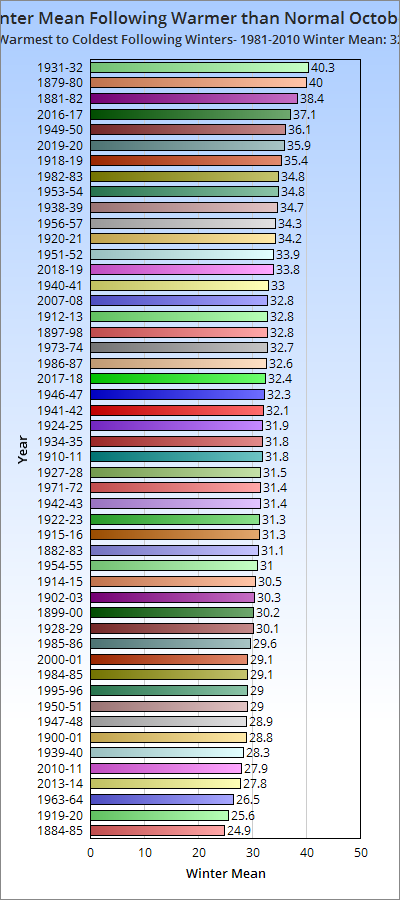
Finally, let’s look at warm Octobers, which are those with means of 56.1 degrees or higher. There were 49 Octobers with warmer than normal means since 1878. Of those, 18 featured following winters that were colder than normal, or 36.7%. Another 19, or 38.8%, were followed by average winters. The final 12 winters, or 24.5%, were warmer than normal. Here’s the graph.
So just based on the October mean temperature, Octobers that are colder than normal are almost twice as likely as normal Octobers and almost 4x as likely as warm Octobers to be followed by a cold winter. But what about Novembers? It is closer to winter itself, so does its weather matter even more?
Colder than normal Novembers- 43.3 degrees or lower- included 80 Novembers since 1878. Of those, 38 or 47.5% had colder than normal winters. 22 (27.5%) had normal winters and 19, or 23.8%, had warmer than normal winters.
With the 39 normal Novembers, 43.4 to 45.4 degrees, there were 18 that had colder than normal winters, or 46.2%, with 12 normal winters (30.8%) and 9 warmer than normal winters (23.1%).
Finally, there were 24 warmer than normal Novembers since 1878- 45.5 degrees or higher. Only 6, or 25%, were followed by cold winters. An additional 9 (37.5%) were normal, while the last 9 (37.5%) were warmer than normal.
To reiterate, here are the ranked percentages of cold winters by the preceding October or November. 1. Cold Octobers: 57.4% 2. Cold Novembers: 47.5% 3. Normal Octobers: 46.7% 4. Normal Novembers: 46.2% 5. Warm Octobers: 36.7% 6. Warm Novembers: 25.0%
It should be no surprise that cold Octobers and Novembers have a stronger correlation to the following winters also being colder, with colder winters becoming increasingly unlikely as those months warm. What is surprising is that October weather, across the board, was more predictive of cold winters than Novembers were.
Going further, though, what about bi-monthly combinations?
Rank of Bi-Monthly Combinations and the percentage of colder than normal following winters, along with total years in sample: Normal October/Normal November: 87.5% 8 Years Cold October/Warm November: 57.1% 7 Years Cold October/Cold November: 53.8% 26 Years Normal October/Cold November: 48.1% 27 Years Warm October/Cold November: 40.7% 27 Years Cold October/Normal November: 38.5% 13 Years Warm October/Warm November: 28.6% 7 Years Warm October/Normal November: 25.0% 16 Years Normal October/Warm November: 0.0% 8 Years
So a normal fall is clearly the best, but the sample size is not particularly high. Normal to Warm is unanimously warm, but again, it has a small sample size.
So does fall weather ultimately have a correlation to winter severity? To some degree yes, as patterns established in the fall tend to appear in the winter as well, but October, rather than November, has a clear higher correlation. But as with everything, there are many other factors involved.
October 2020 looks to at least begin with below normal temperatures, but it remains to be seen how it ends up.