Ohio’s Greatest Arctic Outbreak


Ohio's Greatest Arctic Outbreak

The fall of 1993 had been largely uneventful and a bit warm after the Halloween Snowstorm. November had been quiet and the first 20 days of December averaged almost 6 degrees above normal with just a trace of snowfall. Temperatures gradually cooled through the 3rd week of the month and then went below normal by the 23rd with highs generally from the upper teens to mid-20s. Along with the colder pattern came persistent snowshowers that lasted the rest of the month, but it was nothing out of the ordinary. January was about to change that.

Two snowstorms struck the state in January, the first on January 3-4 and the second, larger event on the 16th and 17th. It was this storm that pulled in a vast reservoir of arctic air into the Ohio region. A very cold high pressure area had been parked just north of the US-Canada border beginning on the 14th, bringing highs in the single digits on the 15th and lows below zero from the 14th on.

WINTER PLUNGING CITY INTO FIRST DEEP FREEZE
Columbus Dispatch, The (OH) – January 14, 1994

Columbus will begin to slide into the deep freeze today with temperatures plunging below zero tonight and Saturday night. The wind chill will average 30 below zero during the cold spell.
The weather will be the coldest of this winter thus far – and the first time Columbus temperatures have fallen below zero since last Feb. 18 when it dipped to minus 2.
The cold spell won’t linger.

“We will start to notice a rebound in temperature, maybe not on Sunday but certainly on Monday,” said Ken Reeves, senior meteorologist for Accu-Weather.

The Accu-Weather forecast calls for temperatures in the midteens at 7 a.m. today and falling to the single digits by day’s end. The overnight low will be minus 5. Saturday’s daytime high will be about 4.
Saturday night the temperature will fall to minus 8, recovering to 15 above Sunday. The low Sunday night will be 11 above. Temperatures should be in the 20s by Monday.
The cause of the cold is a shift in the jetstream, which normally brings air from southern Canada. The shift will bring colder arctic air from northern Canada, which will plunge the Northern Plains, the Midwest and the Northeast into very cold weather. Minnesota and the eastern sections of North Dakota and South Dakota will have temperatures of 20 to 30 below zero Saturday.
Residents will need to dress warmly under the sudden surge of cold air here. Those with poor circulation, particularly the elderly, should be especially careful.
Layers of clothing provide the best protection because layers trap air, which serves as insulation.

“The more layers, the better,” said Reeves.

He said mittens are preferable to gloves, which isolate the fingers. Care should be taken not to cramp the toes by wearing two thick pairs of socks. Cramping can restrict circulation, which is needed to warm extremities.

“If you wear two pairs, don’t wear two thick pairs,” said Reeves. “The key is, you don’t want to slow the circulation. The blood supply is what keeps your hands and feet warm.”

Noses should be covered, and parents should make sure their children are properly dressed, he said.
Faucets should be left dripping in poorly insulated houses and homes where pipes are subject to cold-weather freezing.
Typically, extreme cold weather sends more people into shelters for the homeless. “It brings in the people who would normally try and rough it, the people who don’t like the shelter,” said Charles Oris, director of men’s services for Faith Mission.
Oris expected no problems providing shelter during the weekend for more homeless people. The mission can provide extra sleeping areas and has an overflow facility at the downtown YMCA at Long and Front streets.

As you can see, there was no mention of the snowstorm that would begin just a few days later. The following day, Saturday, January 15, 1994, the paper did mention the upcoming snowfall, but only 2-4″ were forecast.

By the early morning of Sunday, January 16th, Wilmington issued a Winter Storm Watch for Sunday Night into Monday. This was the first indication the storm would be much more significant.

COLUMBUS AND VICINITY FORECAST
NATIONAL WEATHER SERVICE COLUMBUS OH
406 AM EST SUN JAN 16 1994
…WINTER STORM WATCH TONIGHT AND MONDAY…
.SUNDAY…PARTLY SUNNY EARLY…THEN BECOMING CLOUDY WITH A CHANCE OF SNOW BY LATE AFTERNOON. HIGH NEAR 20. MAINLY SOUTH WINDS 10 TO 15 MPH. CHANCE OF SNOW 40 PERCENT.
.TONIGHT…SNOW…POSSIBLY HEAVY AT TIMES. SIGNIFICANT ACCUMULATIONS
LIKELY. TEMPERATURES NEARLY STEADY IN THE UPPER TEENS EARLY…THEN RISING INTO THE MIDDLE 20S BY DAYBREAK. SOUTH WINDS 10 TO 20 MPH. CHANCE OF SNOW 100 PERCENT.
.MONDAY…SNOW…POSSIBLY HEAVY IN THE MORNING…DIMINISHING TO FLURRIES IN THE AFTERNOON. HIGH IN THE MIDDLE 20S. CHANCE OF SNOW 80 PERCENT.

At the time, official forecasts did not go much past 3-5 days. By Sunday afternoon, the Watch had changed to a Heavy Snow Warning, a type of advisory that is no longer in use.


COLUMBUS AND VICINITY FORECAST
NATIONAL WEATHER SERVICE COLUMBUS OH
337 PM EST SUN JAN 16 1994
…HEAVY SNOW WARNING FOR TONIGHT AND MONDAY…
TONIGHT…SNOW…HEAVY AT TIMES. SNOW ACCUMULATING 2 TO 4 INCHES.
TEMPERATURE RISING INTO THE MIDDLE 20S BY DAYBREAK. SOUTH WINDS 10
TO 15 MPH. CHANCE OF SNOW NEAR 100 PERCENT.
.MONDAY…SNOW…HEAVY AT TIMES…TAPERING TO FLURRIES IN THE
AFTERNOON. ADDITIONAL ACCUMULATIONS EXPECTED. HIGH IN THE UPPER 20S. SOUTH WINDS 10 TO 20 MPH BECOMING WEST. CHANCE OF SNOW NEAR 100 PERCENT.
.MONDAY NIGHT…VARIABLE CLOUDINESS WITH A CHANCE OF FLURRIES. BITTERLY COLD WITH A LOW AROUND ZERO. CHANCE OF SNOW 40 PERCENT.
.TUESDAY…VARIABLE CLOUDINESS WITH A CHANCE OF FLURRIES. BITTERLY COLD WITH A HIGH OF ZERO TO 5 ABOVE. CHANCE OF SNOW 40 PERCENT.

Aside from the storm itself- which was now forecast to drop 4″-8″- the public was alerted to the extreme cold coming on the backside.

The storm itself was significant and larger than expected for many areas. By the end of the day on the 17th, 7.8″ had fallen at Port Columbus. Almost all of the state had at least 6″ from the storm, but 20″-30″ fell to the south and east of Columbus. During the height of the storm, Chillicothe reported a snowfall rate exceeding 5″ per hour! As this storm moved away, it pulled cold air directly south, which failed to warm over the fresh snowpack.

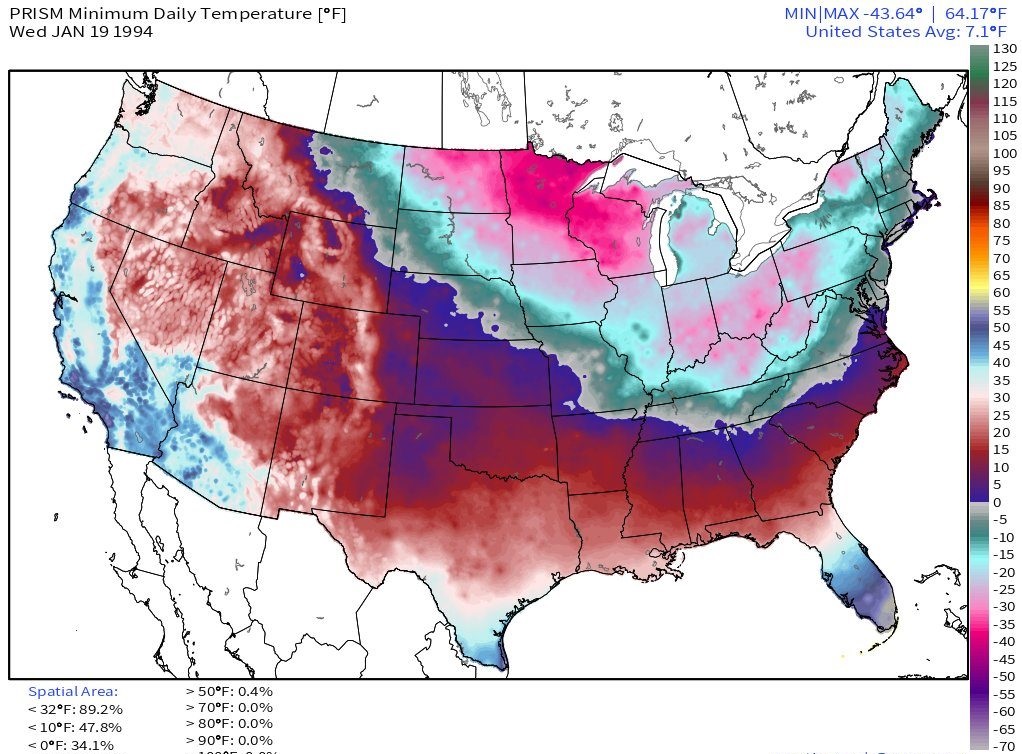
Temperatures in Columbus fell to 0 by midnight on the 17th and continued to drop throughout the next day. The Noon temperature on the 18th was -9 degrees, -13 by 7pm and -17 by midnight. The peak of the cold was reached at 6am on Wednesday, January 19th when the temperature at Port Columbus dropped to 22 degrees below zero. This temperature was the lowest official temperature ever recorded in the city, beating out the 3 times that the city recorded -20 (1879, 1884, 1899).

Across the state, temperatures were 20-35 degrees below zero, and these extremely low readings were more widespread than in any other previous arctic outbreak on record, securing its place in history as the worst arctic outbreak of all time for Ohio.

Some of the State’s Coldest Low Temperatures for January 18-19, 1994
Logan: -37
New Lexington: -35
Eaton: -33
Chillicothe: -29
Delaware: -28
Bellefontaine: -27
Westerville: -27
Akron: -25
Dayton: -25
Marysville: -25
Cincinnati: -24
Newark: -24
Wilmington: -24
Circleville: -22
Columbus: -22
Youngstown: -22
Cleveland: -20

The https://www.dispatch.com/article/20120119/BLOGS/301199667″>Columbus Dispatch provides a greater look back.
You can peruse through all the winter information you could ever want on the Weather History links page.


Columbus as a Tech City


Columbus has been mentioned a few times over the years as a growing tech job market. Forbes named it the #1 Up and Coming Tech City in 2008, for example, although Forbes seems to randomly choose cities for its exhausting number of rankings each year, so that can be taken with a grain of salt. So is Columbus as a tech city really a thing? The latest ranking suggests it might be.

The actual tech growth numbers aren’t subjective. Out of the 51 largest metros, here is how Columbus ranked the last decade or so in STEM jobs (Science, Technology, Engineering and Mathematics).

2001-2012 % Growth in Total STEM Jobs: +10.4% Rank of 51: 13th
2005-2012 % Growth in Total STEM Jobs: +12.8% Rank of 51: 9th
2010-2012 % Growth in Total STEM Jobs: +4.7% Rank of 51: 16th
2012 Location Quotient*: 1.27 LQ Rank of 51: 14th
2001-2012 Location Quotient Change: +7.6% Change Rank of 51: 5th

*Location Quotient is the local share of STEM jobs divided by the national share of STEM jobs. Anything above 1.0 indicates that the local share is higher than the national average.

So Columbus is clearly doing well and is handily beating out many much larger cities. It is one of only two Midwestern cities in the top 15 (Indianapolis is #15), and its rate of growth in concentration of STEM jobs is in the top 5 nationally. As the article discusses, traditional tech centers are actually losing STEM jobs while other areas, like Columbus, are gradually becoming bigger players. A well-educated workforce is paramount, and one of Columbus’ greatest strengths is its abundance of colleges and universities and young population. There are over 100,000 students in the area, and this ensures a strong workforce available for tech jobs. An example of how this attracts new STEM jobs was the recently announced plan by IBM to open its worldwide HQ for Advanced Analytics in Dublin along with 500 new jobs. The article with more details on this project can be found here.


Some Great Economic News


First, http://www.bizjournals.com/columbus/morning_call/2013/01/columbus-hangs-on-to-no-4-spot-in.html
In this ranking, Columbus was 4th behind OKC, Austin and Houston on the overal “Economic Vitality Index”, a measure that uses 18 catergories to determine the strength of an economy.

Second is this: http://www.bizjournals.com/columbus/news/2013/01/15/columbus-only-midwest-city-to-regain.html
This link shows that the Columbus metro is one of only 14 major metros nationally (out of 102) that had gained more jobs through November 2012 than it lost during the Great Recession, meaning it has exceeded a 100% recovery from the downturn. It was also the only Midwestern metro to have achieved this feat.

Stories and rankings like this prove that Columbus has little or nothing in common with its nearby Rust Belt neighbors. It has long had a steady, growing economy that has been able to recover quickly from economic downturns. Say what you will about weather or other factors, but the #1 reason for people to move somewhere has to do with economics. So long as there are jobs available and a decent cost of living, people should continue to flock to that place. In that regard, Columbus definitely seems to have a bright future.

Columbus Retail History The Markets


In this edition of Columbus retail history, we will talk about how the markets of the city were once a vibrant and important part of daily life.
As in most cities, shopping in Columbus prior to 1950 was almost exclusively a function of Downtown. This was for the simple reason that widespread suburbs did not exist yet and Downtown was the heart of the city, where almost everyone lived and worked, and therefore did all of their shopping there as well. Most of this shopping occurred in family owned shops and small marketplaces, but as the city grew, the need for larger centers of commerce began to rise. Beginning in 1849 and continuing through early 1850, Central Market was built at S. 4th and E. Town Streets. Opening on June 1, 1850, Central Market was designed to be an economic center for the city, but also served as City Hall from May 1851 until 3/28/1872 when the new City Hall opened.

Central Market C. 1860-1880
Columbus retail history the markets
Central Market was a very popular market for decades, and at its height, attracted some 20,000 shoppers during weekend days. Its success allowed for the creation of other, smaller markets nearby. East Market was located at the intersection of Mt Vernon and Miami Avenues in the King-Lincoln neighborhood. West Market was located on S. Gift Street in Franklinton. North Market, the last to be built, was finished in 1876 and located at the intersection of Spruce and N. Hight Streets.

Original North Market: 1876-1948

As time passed, each of these markets succumbed, most notably through fire. East and West Markets were gone by the 1940s, and North Market, too, burned to the ground in February 1948. Central Market was spared fire and significant alteration, existing almost exactly as it was built through the entirety of its lifetime. It also continued to serve as a marketplace, albeit with steadily declining traffic, through the 1950s. Its future, however, was doomed. With no widespread preservation groups at the time and with the push for Urban Renewal, a historic relic like Central Market had no chance. So, in June 1966, Central Market was demolished to make way for a new Greyhound Bus terminal, an exceedingly ugly building built in the brutalist style that was popular during the time.
Central Market’s Demolition: 1966

North Market’s replacement did survive somewhat, but was in pretty bad shape by the 1980s. In 1988, the North Market Development Authority was formed to bring the old market back to life. Unfortunately, the old building was not feasible to reuse as the market.
The 1948 North Market building from Spruce Street: 1990

In 1992, Nationwide Insurance sold the NMDA a former warehouse just to the west of the original location. A $5 million renovation of the warehouse was completed and the new North Market opened in November 1995. Today, North Market remains a very popular destination and has played a role in the area’s revitalization, especially along Park Street, which has become a popular spot for new bars and restaurants. It has become a strong incubator for area small businesses and helped launch concepts such as Jeni’s Ice Creams.
North Market: 2018

Although much has been lost to time, markets are now returning as an important part of urban life. With North Market’s success and a now increasing population in the Downtown area, a need for the market has returned. A Hills Market grocery store is now in the works at Grant Avenue and should be opening within the next month or two. While lacking the scale and nature of 19th century marketplaces, it will serve new generations of Downtown residents who are helping to bring back this urban neighborhood.

See Shopping Centers for the continuation of the local retail story.


January 1999 Snowstorm


the January 1999 snowstorm Columbus, Ohio

Snow rollers in Columbus after the January 2-3, 1999 event.

In this episode of weather history, we’ll look at the January 1999 snowstorm that pummeled the Columbus area. New Year’s Day, 1999 dawned partly cloudy and cold in Ohio, a tranquil early January day in what had been until then a very warm fall and beginning to winter. Both November and December 1998 had been very warm months. December even had highs reaching into the 70’s early in the month, a truly rare occurrence. However, by the end of December, conditions had taken a turn.

On December 21, 1998, a cold front moved through Ohio, bringing copious amounts of rain. Most cities in Ohio received more than 1″ of rainfall, with several getting 2-3″. This front was the beginning of a very active period that would last for the next three weeks into mid-January. This pattern is not uncommon in La Nina winters, where the Midwest and Ohio Valley, in particular, are often much wetter than normal.

In any event, temperatures fell behind the front and remained generally below normal through the rest of the month of December, though no significant snow events came with the colder weather. That was about to change.

National radars on January 1, 1999 showed blossoming snow in the Great Plains, with cold air pushing south and abundant moisture pushing north from the Gulf of Mexico. Forecasts called for a significant winter storm beginning late on the 1st and lasting through the 2nd. The storm arrived a bit later than expected, but arrived in most areas during the overnight hours of the 1st/2nd as heavy snowfall. The snow initially fell at the rate of at least 1″ per hour, and thundersnow was reported from Cincinnati up through Dayton and Columbus.

During the day on the 2nd, warm air began to affect upper layers of the atmosphere, and the snow gradually began to change over to sleet and freezing rain, with an accumulation of ice of up to 1/2″ in some areas on top of the snow. By then, though, the damage was done. 4-6″ of snow fell in the Cincinnati area, with 6-10″ along the I-70 corridor. Up to 12″ fell to the north of there. Gusty winds created blowing and drifting snow at times, particularly in the northern areas that received less of a coating of ice.

Temperatures turned colder as the storm passed, and what precipitation remained changed back to snow showers by the 3rd of January. Temperatures would remain in the low to mid-teens for highs during the next two days before another storm would set eyes on the state.

Snow Totals for January 2-3, 1999
Dayton: 7.5″
Columbus: 6.6″
Cincinnati: 4.2″

The blizzard of 1999 affected areas far outside of Columbus.
Columbus weather history is full of such interesting events.