Ohio’s Greatest Arctic Outbreak


Ohio's Greatest Arctic Outbreak

The fall of 1993 had been largely uneventful and a bit warm after the Halloween Snowstorm. November had been quiet and the first 20 days of December averaged almost 6 degrees above normal with just a trace of snowfall. Temperatures gradually cooled through the 3rd week of the month and then went below normal by the 23rd with highs generally from the upper teens to mid-20s. Along with the colder pattern came persistent snowshowers that lasted the rest of the month, but it was nothing out of the ordinary. January was about to change that.

Two snowstorms struck the state in January, the first on January 3-4 and the second, larger event on the 16th and 17th. It was this storm that pulled in a vast reservoir of arctic air into the Ohio region. A very cold high pressure area had been parked just north of the US-Canada border beginning on the 14th, bringing highs in the single digits on the 15th and lows below zero from the 14th on.

WINTER PLUNGING CITY INTO FIRST DEEP FREEZE
Columbus Dispatch, The (OH) – January 14, 1994

Columbus will begin to slide into the deep freeze today with temperatures plunging below zero tonight and Saturday night. The wind chill will average 30 below zero during the cold spell.
The weather will be the coldest of this winter thus far – and the first time Columbus temperatures have fallen below zero since last Feb. 18 when it dipped to minus 2.
The cold spell won’t linger.

“We will start to notice a rebound in temperature, maybe not on Sunday but certainly on Monday,” said Ken Reeves, senior meteorologist for Accu-Weather.

The Accu-Weather forecast calls for temperatures in the midteens at 7 a.m. today and falling to the single digits by day’s end. The overnight low will be minus 5. Saturday’s daytime high will be about 4.
Saturday night the temperature will fall to minus 8, recovering to 15 above Sunday. The low Sunday night will be 11 above. Temperatures should be in the 20s by Monday.
The cause of the cold is a shift in the jetstream, which normally brings air from southern Canada. The shift will bring colder arctic air from northern Canada, which will plunge the Northern Plains, the Midwest and the Northeast into very cold weather. Minnesota and the eastern sections of North Dakota and South Dakota will have temperatures of 20 to 30 below zero Saturday.
Residents will need to dress warmly under the sudden surge of cold air here. Those with poor circulation, particularly the elderly, should be especially careful.
Layers of clothing provide the best protection because layers trap air, which serves as insulation.

“The more layers, the better,” said Reeves.

He said mittens are preferable to gloves, which isolate the fingers. Care should be taken not to cramp the toes by wearing two thick pairs of socks. Cramping can restrict circulation, which is needed to warm extremities.

“If you wear two pairs, don’t wear two thick pairs,” said Reeves. “The key is, you don’t want to slow the circulation. The blood supply is what keeps your hands and feet warm.”

Noses should be covered, and parents should make sure their children are properly dressed, he said.
Faucets should be left dripping in poorly insulated houses and homes where pipes are subject to cold-weather freezing.
Typically, extreme cold weather sends more people into shelters for the homeless. “It brings in the people who would normally try and rough it, the people who don’t like the shelter,” said Charles Oris, director of men’s services for Faith Mission.
Oris expected no problems providing shelter during the weekend for more homeless people. The mission can provide extra sleeping areas and has an overflow facility at the downtown YMCA at Long and Front streets.

As you can see, there was no mention of the snowstorm that would begin just a few days later. The following day, Saturday, January 15, 1994, the paper did mention the upcoming snowfall, but only 2-4″ were forecast.

By the early morning of Sunday, January 16th, Wilmington issued a Winter Storm Watch for Sunday Night into Monday. This was the first indication the storm would be much more significant.

COLUMBUS AND VICINITY FORECAST
NATIONAL WEATHER SERVICE COLUMBUS OH
406 AM EST SUN JAN 16 1994
…WINTER STORM WATCH TONIGHT AND MONDAY…
.SUNDAY…PARTLY SUNNY EARLY…THEN BECOMING CLOUDY WITH A CHANCE OF SNOW BY LATE AFTERNOON. HIGH NEAR 20. MAINLY SOUTH WINDS 10 TO 15 MPH. CHANCE OF SNOW 40 PERCENT.
.TONIGHT…SNOW…POSSIBLY HEAVY AT TIMES. SIGNIFICANT ACCUMULATIONS
LIKELY. TEMPERATURES NEARLY STEADY IN THE UPPER TEENS EARLY…THEN RISING INTO THE MIDDLE 20S BY DAYBREAK. SOUTH WINDS 10 TO 20 MPH. CHANCE OF SNOW 100 PERCENT.
.MONDAY…SNOW…POSSIBLY HEAVY IN THE MORNING…DIMINISHING TO FLURRIES IN THE AFTERNOON. HIGH IN THE MIDDLE 20S. CHANCE OF SNOW 80 PERCENT.

At the time, official forecasts did not go much past 3-5 days. By Sunday afternoon, the Watch had changed to a Heavy Snow Warning, a type of advisory that is no longer in use.


COLUMBUS AND VICINITY FORECAST
NATIONAL WEATHER SERVICE COLUMBUS OH
337 PM EST SUN JAN 16 1994
…HEAVY SNOW WARNING FOR TONIGHT AND MONDAY…
TONIGHT…SNOW…HEAVY AT TIMES. SNOW ACCUMULATING 2 TO 4 INCHES.
TEMPERATURE RISING INTO THE MIDDLE 20S BY DAYBREAK. SOUTH WINDS 10
TO 15 MPH. CHANCE OF SNOW NEAR 100 PERCENT.
.MONDAY…SNOW…HEAVY AT TIMES…TAPERING TO FLURRIES IN THE
AFTERNOON. ADDITIONAL ACCUMULATIONS EXPECTED. HIGH IN THE UPPER 20S. SOUTH WINDS 10 TO 20 MPH BECOMING WEST. CHANCE OF SNOW NEAR 100 PERCENT.
.MONDAY NIGHT…VARIABLE CLOUDINESS WITH A CHANCE OF FLURRIES. BITTERLY COLD WITH A LOW AROUND ZERO. CHANCE OF SNOW 40 PERCENT.
.TUESDAY…VARIABLE CLOUDINESS WITH A CHANCE OF FLURRIES. BITTERLY COLD WITH A HIGH OF ZERO TO 5 ABOVE. CHANCE OF SNOW 40 PERCENT.

Aside from the storm itself- which was now forecast to drop 4″-8″- the public was alerted to the extreme cold coming on the backside.

The storm itself was significant and larger than expected for many areas. By the end of the day on the 17th, 7.8″ had fallen at Port Columbus. Almost all of the state had at least 6″ from the storm, but 20″-30″ fell to the south and east of Columbus. During the height of the storm, Chillicothe reported a snowfall rate exceeding 5″ per hour! As this storm moved away, it pulled cold air directly south, which failed to warm over the fresh snowpack.

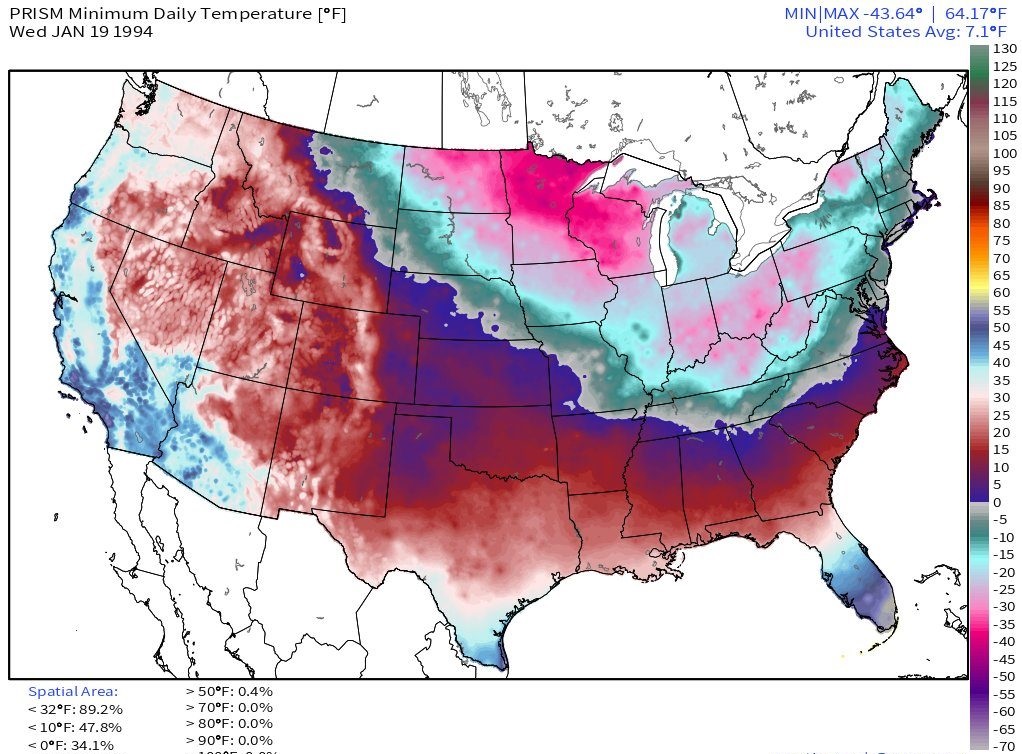
Temperatures in Columbus fell to 0 by midnight on the 17th and continued to drop throughout the next day. The Noon temperature on the 18th was -9 degrees, -13 by 7pm and -17 by midnight. The peak of the cold was reached at 6am on Wednesday, January 19th when the temperature at Port Columbus dropped to 22 degrees below zero. This temperature was the lowest official temperature ever recorded in the city, beating out the 3 times that the city recorded -20 (1879, 1884, 1899).

Across the state, temperatures were 20-35 degrees below zero, and these extremely low readings were more widespread than in any other previous arctic outbreak on record, securing its place in history as the worst arctic outbreak of all time for Ohio.

Some of the State’s Coldest Low Temperatures for January 18-19, 1994
Logan: -37
New Lexington: -35
Eaton: -33
Chillicothe: -29
Delaware: -28
Bellefontaine: -27
Westerville: -27
Akron: -25
Dayton: -25
Marysville: -25
Cincinnati: -24
Newark: -24
Wilmington: -24
Circleville: -22
Columbus: -22
Youngstown: -22
Cleveland: -20

The https://www.dispatch.com/article/20120119/BLOGS/301199667″>Columbus Dispatch provides a greater look back.
You can peruse through all the winter information you could ever want on the Weather History links page.


January 1999 Snowstorm


the January 1999 snowstorm Columbus, Ohio

Snow rollers in Columbus after the January 2-3, 1999 event.

In this episode of weather history, we’ll look at the January 1999 snowstorm that pummeled the Columbus area. New Year’s Day, 1999 dawned partly cloudy and cold in Ohio, a tranquil early January day in what had been until then a very warm fall and beginning to winter. Both November and December 1998 had been very warm months. December even had highs reaching into the 70’s early in the month, a truly rare occurrence. However, by the end of December, conditions had taken a turn.

On December 21, 1998, a cold front moved through Ohio, bringing copious amounts of rain. Most cities in Ohio received more than 1″ of rainfall, with several getting 2-3″. This front was the beginning of a very active period that would last for the next three weeks into mid-January. This pattern is not uncommon in La Nina winters, where the Midwest and Ohio Valley, in particular, are often much wetter than normal.

In any event, temperatures fell behind the front and remained generally below normal through the rest of the month of December, though no significant snow events came with the colder weather. That was about to change.

National radars on January 1, 1999 showed blossoming snow in the Great Plains, with cold air pushing south and abundant moisture pushing north from the Gulf of Mexico. Forecasts called for a significant winter storm beginning late on the 1st and lasting through the 2nd. The storm arrived a bit later than expected, but arrived in most areas during the overnight hours of the 1st/2nd as heavy snowfall. The snow initially fell at the rate of at least 1″ per hour, and thundersnow was reported from Cincinnati up through Dayton and Columbus.

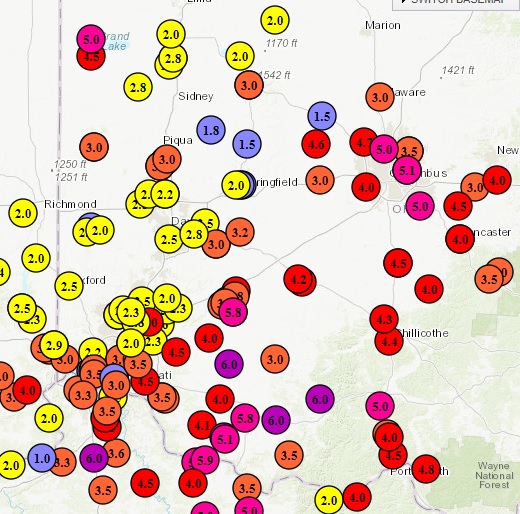
During the day on the 2nd, warm air began to affect upper layers of the atmosphere, and the snow gradually began to change over to sleet and freezing rain, with an accumulation of ice of up to 1/2″ in some areas on top of the snow. By then, though, the damage was done. 4-6″ of snow fell in the Cincinnati area, with 6-10″ along the I-70 corridor. Up to 12″ fell to the north of there. Gusty winds created blowing and drifting snow at times, particularly in the northern areas that received less of a coating of ice.

Temperatures turned colder as the storm passed, and what precipitation remained changed back to snow showers by the 3rd of January. Temperatures would remain in the low to mid-teens for highs during the next two days before another storm would set eyes on the state.

Snow Totals for January 2-3, 1999
Dayton: 7.5″
Columbus: 6.6″
Cincinnati: 4.2″

The blizzard of 1999 affected areas far outside of Columbus.
Columbus weather history is full of such interesting events.


December 2012 Weather Recap


December 2012 weather recap Columbus, Ohio

Snow totals in the area from the December 29, 2012 snowstorm.

For this December 2012 weather recap, we’ll quickly review what was probably one of the strangest months ever for weather. The first three weeks were extremely warm, being almost 10 degrees above normal. The last 10 days cooled off, but not enough to make up for the warmth. The mean was 39.4 degrees, or 5.9 degrees above normal, and December ended up being the 10th warmest on record.

Although the month was very wet from the beginning (3rd wettest), there was also only a trace of snowfall through the 20th, and it looked like the month might end with below normal snowfall. Then 4 separate snow events dropped 14.9″ the last 10 days, making the month the 4th snowiest December of all time. Not only that, but two of the snowfalls (5.9″ and 4.9″) were two of the top 20 snowfalls for a December.

December 2012 will definitely go down as one of those months that defied expectations.

There is so much weather history to be discovered in Columbus. The Wilmington National Weather Service is a good place to look for current weather in any month.

2008 Ohio Windstorm


2008 Ohio windstorm Hurricane Ike

2008 was a year of extreme weather events, but aside from the March Blizzard, the biggest story of the year was its severe wind events. Let’s take a look back at these events, but particularly at the Hurricane Ike disaster.

January 8th-9th Severe Weather
Record warm temperatures in the upper 60s on the 7th-8th of January, 2008 gave way to storms and even a rare January Tornado Watch on the evening of the 8th. Winds had been gusty all during the day of the 8th, but reached their peak with the frontal passage storms. Rain and thunderstorms began moving into Ohio during the late afternoon and increased in intensity through the evening, prompting the NWS to issue a Tornado Watch just after 10pm. Although no tornadoes were reported anywhere in Ohio on the night of the 8th-9th, the storms brought with them rains of 1-2″ and winds of up to 70mph, causing many reports of minor structural damage and scattered power outages.

January 29th-30th Windstorm
The second, more intense wind event for January in Ohio came during the last few days of the month. A very strong low pressure moved north and west of Ohio as strong high pressure moved south into the Plains. The resulting gradient caused winds to increase. Winds were sustained between 30-35mph most of the 29th. When the front arrived during the evening hours, winds ramped up even more, with winds sustained at 40-45 with gusts between 60-70mph. There was very little precipitation with this front. Reports of the event showed widespread high winds and minor to moderate damage in spots.
On a personal note with this event, I witnessed several power poles bent over and large business signs blown out from the force of the January 29th-30th wind event.

Hurricane Ike and Ohio’s Worst Windstorm
On September 1st, 2008, a tropical depression formed in the central Atlantic Ocean. That same day, the depression strengthened enough to gain a name: Ike. No one in Ohio anticipated that this storm, far out in the Atlantic, would cause the most widespread, destructive windstorm the state had ever seen.

Ike gradually became a hurricane and roared west and then southwest over Cuba as a Category 4 before turning back to the northwest and into the Gulf of Mexico. He churned westward growing in size as he went. The wind field of the hurricane was gigantic. Hundreds of miles from the center, tropical storm force winds were pounding parts of the Gulf Coast, giving an indication of the long-duration wind and surge potential.

Hurricane Ike made landfall near Galveston, Texas early on Saturday, September 13th with maximum sustained winds of 110mph. After landfall, the system turned to the north and then to the northeast as it hooked up with a frontal boundary that was draped across the Midwest. The system became extratropical by the end of the day on the 13th and gradually accelerated to the north and east towards the Great Lakes.

Now, at this point, that would normally be the end of the story. A dying tropical system far inland tends to produce a lot of rain and flooding, but wind is not usually an issue. And indeed, parts of Indiana, Missouri, and Illinois saw major and disastrous flooding from a combination of the frontal boundary and the remains of Ike. However, a very unusual situation occurred.

Over the Gulf of Mexico and up through landfall, Ike was never quite able to translate upper level high winds down to the surface. The sustained reading of 110mph at landfall never seemed to actually materialize in reports on the ground, and the vast majority of the damage along the Texas coastline was due to significant storm surge brought in by the massive size of the storm. However, Ike’s inability to translate the highest winds to the surface was about to change.

Ike maintained a very low pressure of between 986 and 990 throughout the journey through the OV and Great Lakes, and as he transitioned from tropical to extratropical, the remains actually intensified and Ike retained a large amount of his original wind field, particularly on the eastern side.

No one forecasted this. The NWS, as late as Saturday evening, had forecast winds of 30mph in gusts for much of Ohio and for the Columbus area, as seen in the September 13th forecast below.

OHZ045-046-054>056-140830-
UNION OH-DELAWARE-MADISON-FRANKLIN OH-LICKING-
INCLUDING THE CITIES OF…MARYSVILLE…DELAWARE…LONDON…
COLUMBUS…NEWARK
404 PM EDT SAT SEP 13 2008

.TONIGHT…PARTLY CLOUDY THIS EVENING…THEN BECOMING MOSTLY
CLOUDY. SCATTERED SHOWERS AND THUNDERSTORMS. LOWS IN THE LOWER
70S. SOUTHWEST WINDS 10 TO 15 MPH. CHANCE OF RAIN 30 PERCENT.
.SUNDAY…PARTLY SUNNY IN THE MORNING…THEN BECOMING MOSTLY
CLOUDY. A CHANCE OF THUNDERSTORMS. A CHANCE OF SHOWERS IN THE
MORNING…THEN SHOWERS LIKELY IN THE AFTERNOON. HUMID WITH HIGHS
IN THE UPPER 80S. SOUTH WINDS 15 TO 20 MPH WITH GUSTS UP TO
30 MPH. CHANCE OF RAIN 70 PERCENT.
.SUNDAY NIGHT…THUNDERSTORMS IN THE EVENING. SHOWERS. BREEZY
WITH LOWS IN THE LOWER 60S. SOUTHWEST WINDS 15 TO 25 MPH…
BECOMING WEST 10 TO 15 MPH AFTER MIDNIGHT. CHANCE OF RAIN
90 PERCENT.

Just 12 hours after the above forecast was made, on the morning of Sunday, September 14th, 2008, the National Weather Service in Wilmington had issued a Wind Advisory for its forecast area calling for gusty winds of 20-30mph with gusts up to 40mph.

URGENT – WEATHER MESSAGE
NATIONAL WEATHER SERVICE WILMINGTON OH
423 AM EDT SUN SEP 14 2008

…WIND ADVISORY IN EFFECT THIS AFTERNOON INTO THIS EVENING…
.THE REMNANTS OF HURRICANE IKE WILL COMBINE WITH A QUICK MOVING COLD FRONT TO BRING WINDY CONDITIONS TO THE REGION TODAY.
WAYNE-FAYETTE IN-UNION IN-FRANKLIN IN-RIPLEY-DEARBORN-OHIO-
SWITZERLAND-CARROLL-GALLATIN-BOONE-KENTON-CAMPBELL-OWEN-GRANT-PENDLETON-BRACKEN-ROBERTSON-MASON-LEWIS-HARDIN-MERCER-AUGLAIZE-DARKE-SHELBY-LOGAN-UNION OH-DELAWARE-MIAMI-CHAMPAIGN-CLARK-MADISON-FRANKLIN OH-LICKING-PREBLE-MONTGOMERY-GREENE-FAYETTE OH-PICKAWAY-FAIRFIELD-BUTLER-WARREN-CLINTON-ROSS-HOCKING-HAMILTON-CLERMONT-BROWN-HIGHLAND-ADAMS-PIKE-SCIOTO-
423 AM EDT SUN SEP 14 2008
…WIND ADVISORY IN EFFECT FROM NOON TODAY TO 9 PM EDT THIS EVENING…
THE NATIONAL WEATHER SERVICE IN WILMINGTON HAS ISSUED A WIND
ADVISORY…WHICH IS IN EFFECT FROM NOON TODAY TO 9 PM EDT THIS
EVENING.
THE REMNANTS OF HURRICANE IKE WILL COMBINE WITH A QUICK MOVING
COLD FRONT TO BRING WINDY CONDITIONS TO THE REGION TODAY. SURFACE
WINDS WILL BEGIN TO INCREASE THIS MORNING…WITH SUSTAINED SOUTH
WINDS OF 25 TO 35 MPH AND GUSTS ABOVE 40 MPH EXPECTED BY THIS
AFTERNOON. THE STRONG WINDS WILL CONTINUE THROUGH THE AFTERNOON AND INTO THE EARLY EVENING UNTIL A COLD FRONT PASSES THROUGH THE REGION.
A WIND ADVISORY IS ISSUED WHEN SUSTAINED WINDS ARE FORECAST TO BE
31 TO 39 MPH OR GUSTS WILL RANGE BETWEEN 46 AND 57 MPH. WINDS OF
THESE MAGNITUDES MAY CAUSE MINOR PROPERTY DAMAGE WITHOUT EXTRA
PRECAUTIONS. MOTORISTS IN HIGH PROFILE VEHICLES SHOULD USE
CAUTION UNTIL THE WINDS SUBSIDE.

However, even the wind advisory quickly became obsolete. Kentucky was already getting rocked with high winds of over 50mph, and the winds seemed to intensify even more as the core began to move into Ohio through Cincinnati.

By late morning, winds in Cincinnati had reached a *sustained* speed of 54mph with gusts to hurricane force! These heavy winds began to ride up the I-71 corridor, reaching Wilmington by noon and Columbus by 2pm. Wilmington didn’t upgrade its advisory to a High Wind Warning until 12:49PM, when parts of the state were already getting walloped by damaging winds.
For several hours, high winds pounded the area. Sustained winds over 50mph were common, and gusts of 70-80mph were widespread. The winds did not begin to die down until after 6pm, and by 8pm, the area had gone almost completely calm.  There had been almost no precipitation whatsoever during the entire event.

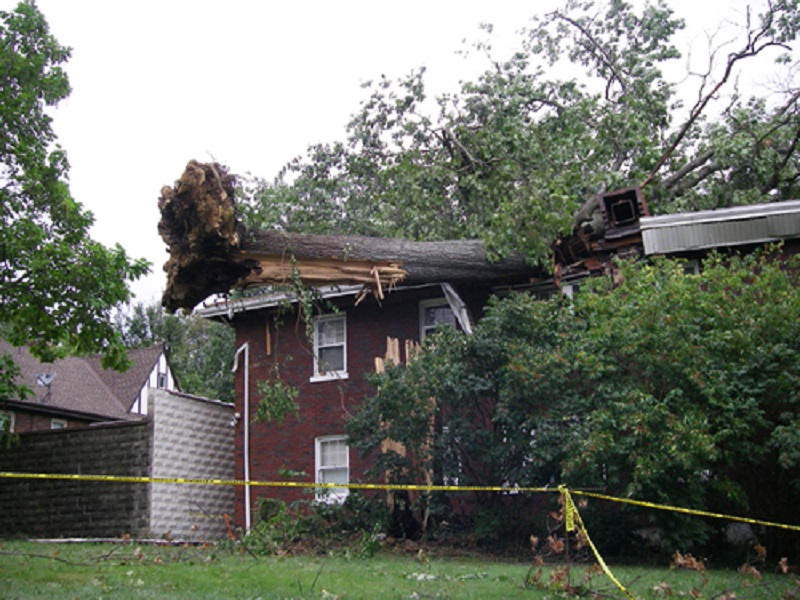
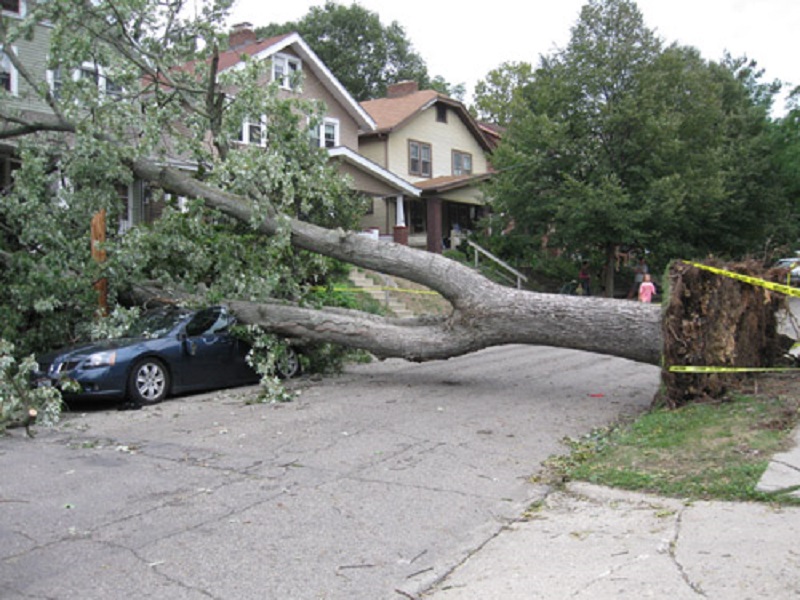
When the storm was over, more than 2.5 million Ohio residents were without power, including more than 55% of Columbus, one of the largest outages ever known in state and local history. Tens of thousands of trees had fallen and debris of all kinds was everywhere. Power lines had been snapped, signs had been blown down, billboards had been destroyed, and thousands of homes and buildings had sustained damage from broken windows to siding and parts of roofs blown off. Power remained out for thousands for up to two weeks after the storm passed, and there was a sea of blue tarps covering roofs throughout Central Ohio for months.

The story was the same up and down I-71 up through Cleveland, although damage there was less than that in central and southern parts of Ohio. The severe wind field was about 100 miles across and centered through the major cities on I-71. Insured losses from this storm totaled well over a billion dollars, and total damage was at least double that figure. This made the storm one of the most damaging natural disasters in Ohio history, exceeding those like the Blizzard of 1978, the 1974 Xenia Tornado and perhaps even the Great Flood of 1913 in adjusted dollars. Additionally, 7 people lost their lives in the storm.

Highest Wind Gusts in Ohio on 9/14/2008
Highest measured wind gusts — official observations
75 mph — Port Columbus International Airport (Franklin County, OH)
74 mph — Cincinnati-Northern Kentucky Int’l Airport (Boone County, KY)
74 mph — Airborne Airpark, Wilmington, OH (Clinton County, OH)
69 mph — Bolton Field (Franklin County, OH)
69 mph — Rickenbacker Airport (Franklin County, OH)
68 mph — Dayton-Wright Brothers Airport (Montgomery County, OH)
63 mph — OSU Airport (Franklin County, OH)
61 mph — Cincinnati Lunken Municipal Airport (Hamilton County, OH)
60 mph — Dayton International Airport (Montgomery County, OH)
59 mph — Wright-Patterson Air Force Base (Greene County, OH)

Highest measured wind gusts — unofficial observations
84 mph — West Chester, OH (Butler County)
78 mph — Lebanon, OH (Warren County)
77 mph — Wilmington, OH (Clinton County)
73 mph — Anna, OH (Shelby County)
66 mph — St. Mary’s, OH (Auglaize County)
65 mph — Baltimore, OH (Fairfield County)
65 mph — Trenton, OH (Butler County)
63 mph — Beavercreek, OH (Greene County)
61 mph — Springfield, OH (Clark County)
60 mph — Cleves, OH (Hamilton County
58 mph — Hamilton, OH (Butler County)
56 mph — Cincinnati, OH (Hamilton County)
49 mph — Greenville, OH (Darke County)

As in most cases, recording equipment only captured a small snapshot of actual winds, with many areas seeing higher gusts than were officially recorded by instruments.  Overall, the highest wind gusts and sustained winds on September 14, 2008 were not the highest ever recorded in Columbus and other places, but they were generally in the top 5. However, previous events had generally been recorded during severe thunderstorms, and so were rather brief in duration. That September day, winds roared at top strength for 3-5 hours, allowing the damage to be far more widespread than it would’ve been in a thunderstorm. Therefore, it stands as one of the worst wind events in Ohio history.

Videos from around Ohio on 9/14/2008
Columbus


Cincinnati

Dayton

Elsewhere

Weather events like this are truly rare, but history is full of severe weather of all types across the Columbus area. Weather History provides links to all sorts of records and event descriptions.