In a related post to the recent metro population comparison of Columbus to its peer 1.5-2.5 million group, I wanted to see where the metros stood as far as their current racial makeup as well as where they are trending. So here are the current Columbus metro diversity trends, along with 17 other peer metros, according to the US Census.
First, let’s take a look at the breakdown of race by metro in 2012, the last year that data is available.
Columbus had the 5th highest % of its metro population as White, non-Hispanic. Columbus came in at #8 for the % of its metro population being Black, non Hispanic. Columbus ranks 9th for its % of metro population that is Asian, non-Hispanic. Columbus ranked poorly in this group, coming in at 15th of 18. Finally, Columbus ranked 7th in the population of Other, non-Hispanic as a % of the total metro population.
So currently, what is the overall diversity ranking of the 18 metros? To find out, I used a simple formula: Each metro would be assigned points (1-18) based on the ranking position in each racial group. Here are the final rankings. Overall, Columbus comes in as the 8th most-diverse metro in its 18-peer group. So a bit better than average and perhaps a bit surprising to some.
But what about where this diversity is trending? To find out, I looked at 2005 and 2012 and calculated how each racial group had changed over the period. Columbus did relatively well with Non-Hispanic Whites, growing at the 5th best pace. The Columbus metro came in the top 10, at #7, for Non-Hispanic Black population growth. The metro didn’t fare as well on growth in the Asian population, coming in at 10th. Columbus came in at #6 for this group. So using the same point system from above, what were the fastest diversifying metros as of 2012?
The Columbus metro was the 5th fastest diversifying metro in its peer group in 2012.
Overall, Columbus ranks higher than and much higher than average in both current racial diversity and the rate of racial diversity growth, respectively. The Columbus vs. Other Cities page examines many types of similar population and demographic comparisons.
The recent Census release of updated population numbers gives new figures on metro populations. In previous articles, I talked mostly about density, so this time, the data is being expanded a bit for a full 2013 metro area comparison.
Metro Area Population on July 1, 2012 and July 1, 2013 By Rank 2012————————————–—-2013 1. Pittsburgh: 2,360,989— 1. Pittsburgh: 2,360,867 2. Charlotte: 2,294,990—2. Charlotte: 2,335,358 3. Portland, OR: 2,289,038—3. Portland, OR: 2,314,554 4. San Antonio, TX: 2,234,494—4. San Antonio, TX: 2,277,550 5. Orlando: 2,223,456—5. Orlando: 2,267,846 6. Sacramento, CA: 2,193,927—6. Sacramento, CA: 2,215,770 7. Cincinnati: 2,129,309—7. Cincinnati: 2,137,406 8. Cleveland: 2,064,739—8. Cleveland: 2,064,725 9. Kansas City: 2,038,690—9. Kansas City: 2,054,473 10. Las Vegas: 1,997,659—10. Las Vegas: 2,027,868 11. Columbus: 1,944,937—11. Columbus: 1,967,066 12. Indianapolis: 1,929,207—12. Indianapolis: 1,953,961 13. San Jose, CA: 1,892,894—13. San Jose, CA: 1,919,641 14. Austin, TX: 1,835,110— 14. Austin, TX: 1,883,051 15. Nashville: 1,726,759—15. Nashville: 1,757,912 16. Virginia Beach, VA: 1,698,410—16. Virginia Beach, VA: 1,707,369 17. Providence, RI: 1,601,160—17. Providence, RI: 1,604,291 18. Milwaukee: 1,566,182—18. Milwaukee: 1,569,659
Total Metro Population Change, 2012-2013, By Rank 1. Austin: +47,941 2. Orlando: +44,390 3. San Antonio: +43,056 4. Charlotte: +40,368 5. Nashville: +31,153 6. Las Vegas: +30,209 7. San Jose: +26,747 8. Portland: +25,516 9. Indianapolis: +24,754 10. Columbus: +22,129 11. Sacramento: +21,843 12. Kansas City: +15,783 13. Virginia Beach: +8,959 14. Cincinnati: +8,097 15. Milwaukee: +3,477 16. Providence: +3,131 17. Cleveland: -14 18. Pittsburgh: -122
**Some of the changes in rates are due to boundary changes. For example, part of the growth rate for Columbus 2000-2010 was a retroactive population addition when boundaries were changed in 2013. The actual growth rate changed very little.
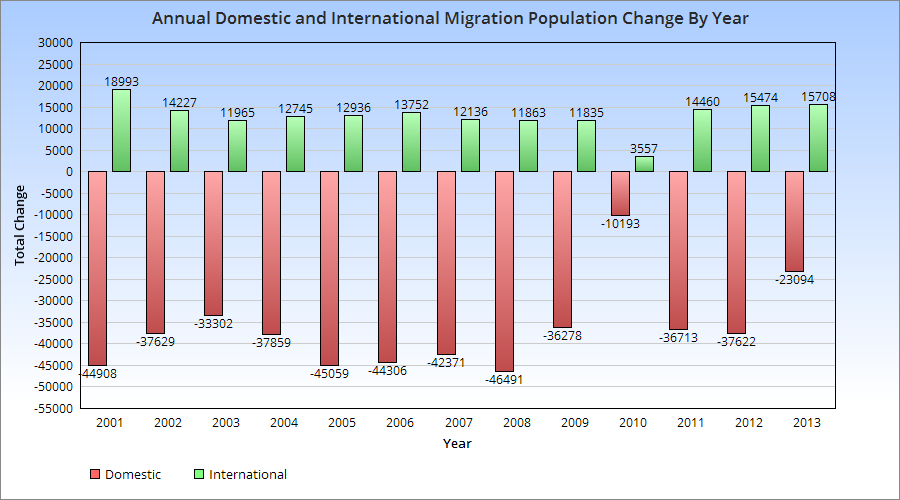
Back in November, I wrote about Ohio’s improving growth outlook. In that post, I examined domestic out-migration and domestic in-migration 2005-2012, and discovered that the net change had been improving. The state was losing fewer people over time domestically, and the difference had declined to under 2,000 people by 2012, a HUGE improvement from the start of the period.
Recently, the US Census released 2013 state population estimates, along with components of population change for the July 1st, 2012-July 1st, 2013 period. More positive news was to be found in those estimates.
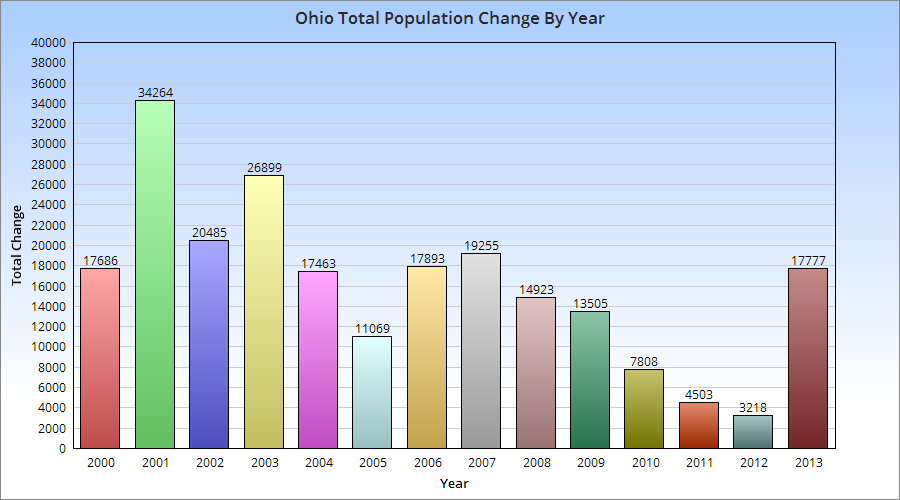
First, Ohio’s population increased to 11,570,808, representing an annual increase of 17,777. While the increase is not particularly great, especially in comparison to states nationally, there are some positive nuggets with that number. The state held on to its position as the 7th most populous state, and the increase was the highest since pre-recession. The state moved up 18 spots in the total annual growth rankings 2012-2013 vs. 2011-2012. This was the best increase of all 50 states. It was also the best growth for the state since 2007. Did the state bottom out in 2012? Perhaps, but way too early to tell. Still, a very good improvement that halted a general decline.
The components of change are also interesting.
The migration patterns show a few things. First, 2013 had the 2nd highest rate since 2000 of in-international migration. It was also one of the best years (since 1996) for domestic in-migration.
The question is, can Ohio keep improving or is this just a temporary blip? Time will tell.
2013 was a pretty significant year for Columbus, if only because it saw its busiest residential developmentyear in and around the urban core in many years. Here are the highlights of some of the biggest 2013 residential projects.
1. The South Campus High Rise and Addition Project # of New Units: 360 Project Cost: $171.6 Million Project Height: 7-8 Stories in Multiple Buildings Some might suggest that this isn’t strictly a residential project because it was student housing. However, I disagree with that. The projects added significant additions to already existing Park, Stradley, Steeb and Smith Halls by connecting the pairs together with what essentially amounted to a brand new building stuck in-between. It also involved significant renovations to other residential buildings in South Campus. This was the first part of a major renovation and expansion project for housing on OSU’s campus.
2. HighPoint at Columbus Commons # of New Units: 302 Project Cost: $50 Million Project Height: 6 Stories in 2 Buildings HighPoint was a rather unexpected surprise for Downtown. When Columbus Commons was being constructed, the plan called for residential buildings running along High Street on the west side of the park. Unfortunately, that plan was not supposed to happen for perhaps a decade or more, depending on development interests. Within a year of the completion of the park, however, HighPoint was being proposed. While not exactly the most inspired design or preferred height for such a prominent location Downtown, the projects potential 450+ residents will greatly help the neighborhood’s goal of increased vitality and 24-hour activity. In fact, it may not be too much to assume that this project has encouraged others, such as the 12-story 250 High Project and LC’s double 8-story tower project, both of which will begin construction soon just across the street from HighPoint and the park. Collectively, they will add, at minimum, over 650 new residents.
3. Liberty Place, Phase II Address: 250 Liberty Street # of New Units: 207 Project Cost: $25-$30 Million Project Height: 4 Stories Liberty Place, in the Brewery District, was completed in 2006, the last of a slew of development projects in the Brewery District beginning in the 1990s and came in the middle of a relative quiet period that began when the Arena District stole some of the neighborhoods momentum. That momentum has returned in recent years as urban living has gained significant traction in public opinion. Phase II of Liberty Place was supposed to have been built years ago, but the recession and the uncertainty regarding the exact layout of the rebuilt I-70/I-71 split which runs past the site put the project on hold. All told, Liberty Place now has 342 units.
4. Tribeca Address: 700 West Third Avenue # of New Units: 205 Project Cost: Unknown Project Height: 4 Stories Tribeca, from Edwards Communities, was built along Third Avenue in the 5thxNW neighborhood. While adding significant density to the area, the project is mostly known for its strange layout. Dubbed the “Fortress” or the “prison”, the project has a long, blank wall along Third Avenue with tower-like structures along it, resembling the fortifications of a prison. The ugly design and lack of interaction with Third because of this layout caused the project to receive a lot of criticism.
5. Lennox Flats Address: Kinnear Road, Lennox Town Center # of New Units: 194 Project Cost: Unknown Project Height: 3 Stories Lennox Flats was built over two phases, the first with 92 units and the second with 102. Built in a mostly vacant lot just to the west of Lennox Town Center (across the railroad tracks), these were built in modern-styles and were targeted at students from OSU.
6. 600 Goodale Address: 600 West Goodale Street # of New Units: 174 Project Cost: Unknown Project Height: 5 Stories 600 Goodale is likely the most strangely located new project of 2013. It was built on a small strip of land located north of Goodale Street across from White Castle’s HQ building. The location is strange because the land is bordered by the Olentangy River on the west and a highway exit ramp to the north and east sides. In fact, the site sits on a section of land between 315, 670 and major ramps for both to the north. The land is not directly connected to any major neighborhood. Despite the strange location, the modern building was, at last count, 96% leased.
So those were the top 6 largest projects from 2013. More than 2,200 total units were completed in the urban areas of Columbus.
But what’s coming for 2014? Here are the top 5.
1. Jeffrey Park Phase 1 Address: E. 1st Avenue and N. 4th Street, Italian Village # of New Units: 334 Project Cost: $180 Million+ For all phases. Project Height: 4 Stories The Jeffrey Manufacturing site has long been planned for redevelopment. It is, by far, the largest undeveloped site in Italian Village or anywhere in the Short North. Previous plans from the early-mid 2000s fell through, but were revived by a new developer in recent years. The first phase calls for the completion of a mix of townhomes and apartments in a mix of styles. A community center is also planned with a gym and pool. Although this project was supposed to start in the fall of 2013, calls are now for it to begin before winter is over. This may delay the finish for this project into 2015, but for now, it’s still the biggest project for 2014. The entire Jeffrey site will eventually have more than 1,300 new units.
2. Taylor House Address: 5005 Olentangy River Road # of New Units: 329 Project Cost: Unknown Project Height: 4 Stories This project along Bethel Road will go into the site of a former K-Mart. Construction began over the fall and should wrap up toward the end of the year.
3. View on 5th Address: 965 West 5th Avenue # of New Units: 285 Project Cost: $50 Million Project Height: 6 Stories The View on 5th, in 5thxNW, is a 2-building complex along 5th and Holly Avenues. The 6-story building along 5th will contain 153 apartments with ground-floor retail, while the Holly Avenue building would be 3-stories and contain 132 units. The project is scheduled for completion this coming summer.
4. Berkeley House Address: Bethel Road and Riverside Drive # of New Units: 256 Project Cost: Unknown Project Height: 4-5 Stories Berkeley House is being built by the same company as Taylor House, only on opposite ends of Bethel Road. This will be a mixed-use complex featuring apartments and offices. There was some controversy surrounding this project as it sought to demolish a small stone house from around 1808. Unfortunately, no one seemed to realize the historical significance or age of the structure until the project was set to begin construction. The lack of time made it impossible to raise the money to move the house, so it was demolished. The Upper Arlington Historical Society saved the stone from the house and plans to build some type of marker with it.
Unfortunately, I have not seen any renderings for this project yet, but it has begun construction.
5. Neighborhood Launch Address: East Long Street, Downtown # of New Units: 130 Project Cost: Unknown Project Height: 5 Stories Neighborhood Launch is an ongoing project Downtown. About 200 units have already been completed along and near the Gay Street Corridor. The project is continuing with the first of 2 buildings, each containing 130 units, along Long Street. The first of these 2 should be complete later this year, with the 2nd beginning construction over the summer.