2024 City Population Estimates

2024 city population estimates

The US Census has released 2024 city population estimates. These estimates are for all incorporated places.

First, let’s look at the top 25 largest Ohio cities on July 1, 2024.
Purple cities moved up in the ranking since 2020 and red moved down.

Rank

City

2020

2023

2024

1

Columbus

905,939

920,569

933,263

2

Cleveland

372,626

364,276

365,379

3

Cincinnati

309,561

312,703

314,915

4

Toledo

270,877

265,798

265,638

5

Akron

190,408

189,142

189,664

6

Dayton

137,677

135,936

136,346

7

Parma

81,121

79,310

79,,350

8

Canton

70,743

69,230

69,211

9

Lorain

65,218

65,413

65,751

10

Hamilton

63,393

63,516

63,953

11

Youngstown

60,047

59,195

59,123

12

Springfield

58,644

58,041

58,138

13

Kettering

57,860

57,035

57,028

14

Elyria

52,668

53,181

53,604

15

Middletown

50,986

51,882

52,291

16

Newark

49,970

51,162

51,424

17

Cuyahoga Falls

51,116

50,865

50,979

18

Lakewood

50,940

49,564

49,517

19

Dublin

49,315

49,292

49,456

20

Euclid

49,689

48,439

48,421

21

Beavercreek

46,562

47,327

48,012

22

Mansfield

47,530

47,676

47,593

23

Mentor

47,442

47,000

47,113

24

Delaware

41,327

45,364

46,521

25

Strongsville

46,487

45,719

45,768

Columbus gained 12,694 residents July 1, 2023 to July 1, 2024. This was the 14th highest numeric change of all US cities at or above 20,000 in population. In doing so, it became Ohio’s all-time largest city by population in history, surpassing Cleveland’s historic high of 914,80 in 1950.

Now let’s look at all incorporated places within the Columbus Metro Area, their rank on July 1, 2024, and their total population change July 1, 2023 to July 1, 2024.
Blue places moved up in the rankings since 2020, while red moved down.
1. Columbus: 933,263 +12,694
2. Newark: 51,424 +262
3. Dublin: 49,456 +164
4. Delaware: 46,521 +1,157
5. Grove City: 44,019 +875
6. Reynoldsburg: 42,897 +1,386
7. Lancaster: 41,671 +191
8. Hilliard: 38,832 +1,202
9. Westerville: 38,612 +119
10. Upper Arlington: 36,140 +96
11. Gahanna: 35,544 +86
12. Marysville: 29,276 +821
13. Pickerington: 25,814 +546
14. Whitehall: 19,940 +41
15. Pataskala: 18,493 +113
16. Worthington: 14,649 +31
17. Powell: 14,613 +50
18. Circleville: 14,433 +210
19. Bexley: 12,793 -97
20. New Albany: 11,604 +179
21. Heath: 10,822 +70
22. London: 10,743 +193
23. Canal Winchester: 10,060 +213
24. Sunbury: +1,324
25. Grandview Heights: 9,184 +275
26. Obetz: 7,306 +287
27. Logan: 7,142 -33
28. Granville: 6,308 +23
29. Groveport: 5,867 +11
30. Johnstown: 5,356 +31
31. West Jefferson: 4,943 +454
32. Ashville: 4,758 +77
33. New Lexington: 4,463 +7
34. Plain City: 4,374 +23
35. South Bloomfield: 3,747 +241
36. Mount Gilead: 3,543 +18
37. Commercial Point: 3,221 +51
38. Baltimore: 3,089 +35
39. Lithopolis: 2,859 +143
40. Buckeye Lake: 2,575 +12
41. Richwood: 2,575 +78
42. Hebron: 2,406 +15
43. Crooksville: 2,401 -1
44. Cardington: 2,203 +102
45. Utica: 2,131 +12
46. Mount Sterling: 2,070 +35
47. Minerva Park: 1,961 +3
48. Roseville: 1,744 +0
49. Bremen: 1,520 +9
50. Somerset: 1,483 +9
51. Hanover: 1,351 +35
52. Ashley: 1,350 +25
53. Ostrander: 1,227 +25
54. Thornville: 1,093 +2
55. Galena: 1,021 +9
56. Williamsport: 1,016 +17
57. Urbancrest: 1,013 +4
58. Millersport: 993 +15
59. Pleasantville: 954 +8
60. Shawnee Hills: 939 +18
61. Milford Center: 932 +26
62. New Holland: 831 +13
63. Junction City: 723 +3
64. Amanda: 678 +1
65. Marble Cliff: 663 +30
66. Valleyview: 653 -1
67. New Straitsville: 649 +1
68. Thurston: 610 +3
69. Riverlea: 580 -1
70. Stoutsville: 580 +3
71. Buchtel: 519 +3
72. Laurelville: 505 -5
73. Shawnee: 503 +1
74. Carroll: 501 +0
75. Alexandria: 497 +2
76. Corning: 484 +1
77. Kirkersville: 479 +2
78. Edison: 443 +2
79. Hartford: 413 +2
80. Sugar Grove: 408 +0
81. St. Louisville: 365 +1
82. Murray City: 335 -4
83. South Solon: 330 +2
84. Harrisburg: 314 +3
85. Rushville: 305 +1
86. Magnetic Springs: 302 +9
87. Marengo: 281 +1
88. Midway: 273 +2
89. Tarlton: 266 +5
90. Fulton: 251 +3
91. Unionville Center: 235 -3
92. Lockbourne: 232 +0
93. Gratiot: 217 +1
94. Chesterville: 200 +5
95. Darbyville: 189 +2
96. West Rushville: 164 -2
97. Glenford: 163 -2
98. Hemlock: 147 +0
99. Sparta: 123 +0
100. Brice: 101 +9

90% of Columbus metro places were either steady or saw outright growth 2023-2024. These numbers are much improved from the Covid era where many places were seeing population declines, especially the larger cities and suburbs.

Columbus’ growth represented 73% of Franklin County’s total growth 2023-2024 and 84.1% of the county’s growth 2020-2024. Additionally, Columbus alone repesented 41.8% of the metro’s growth 2023-2024 and 31.6% of the metro’s growth 2020-2024.

To see the original estimates from 2023, visit 2023 Population Estimates of Columbus Area Places

2024 County and Metro Population Estimates

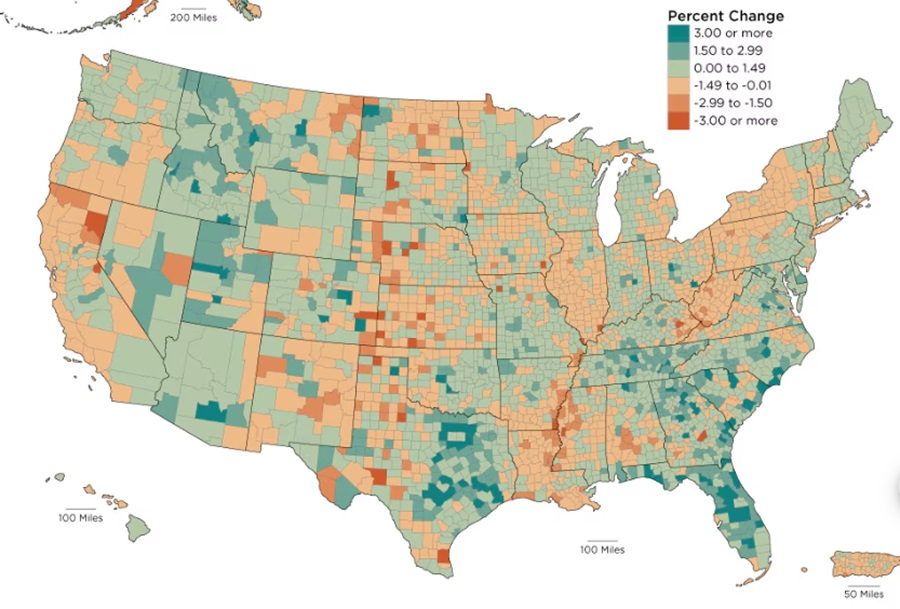
Percent Change in County Populations[Source: U.S. Census Bureau]

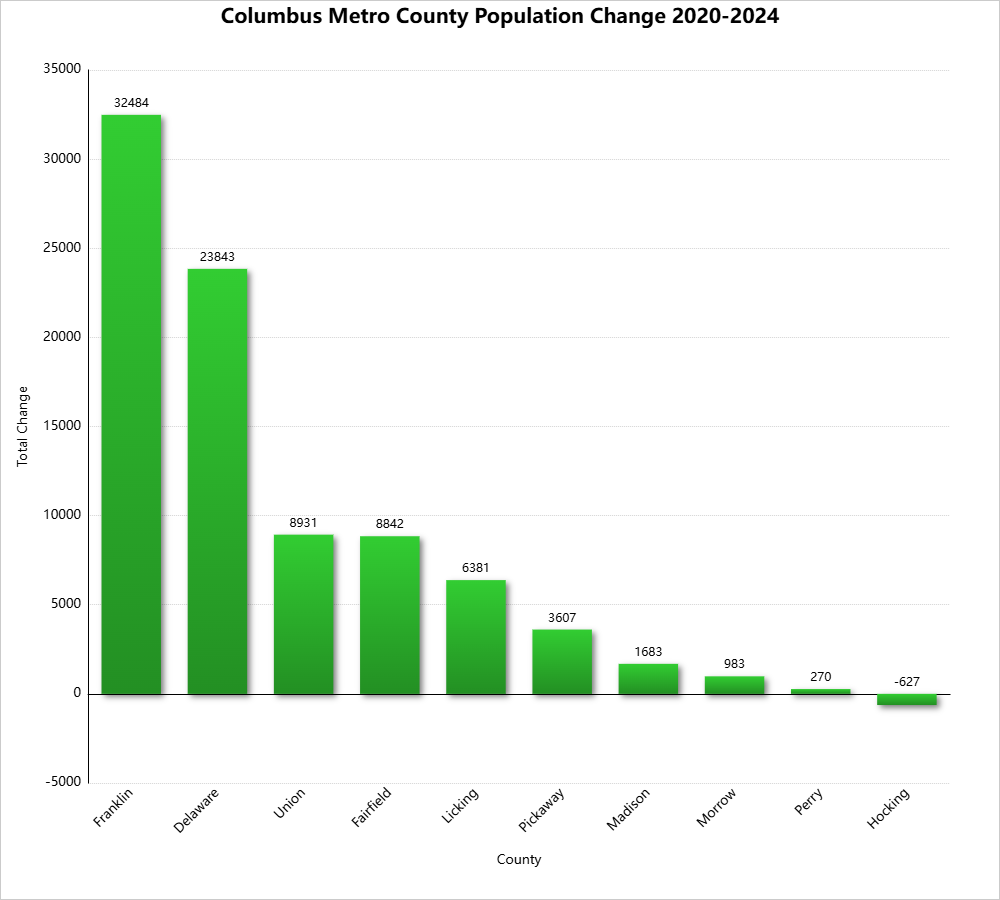
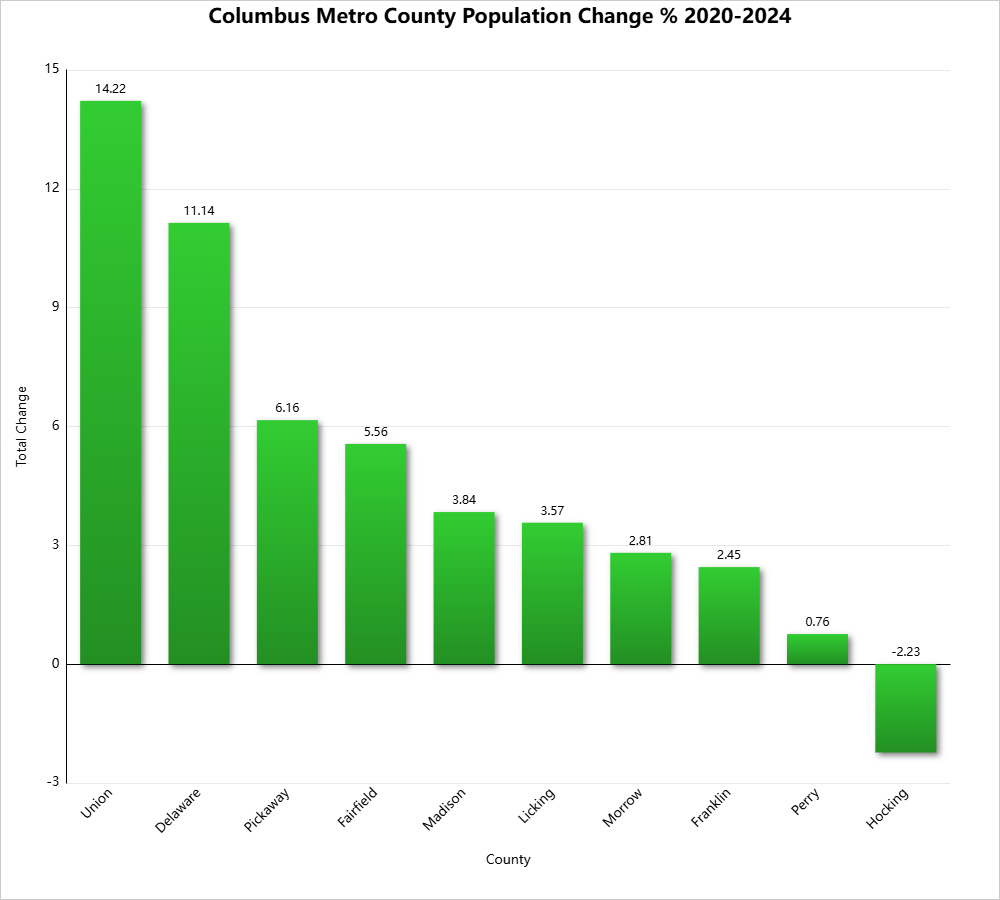
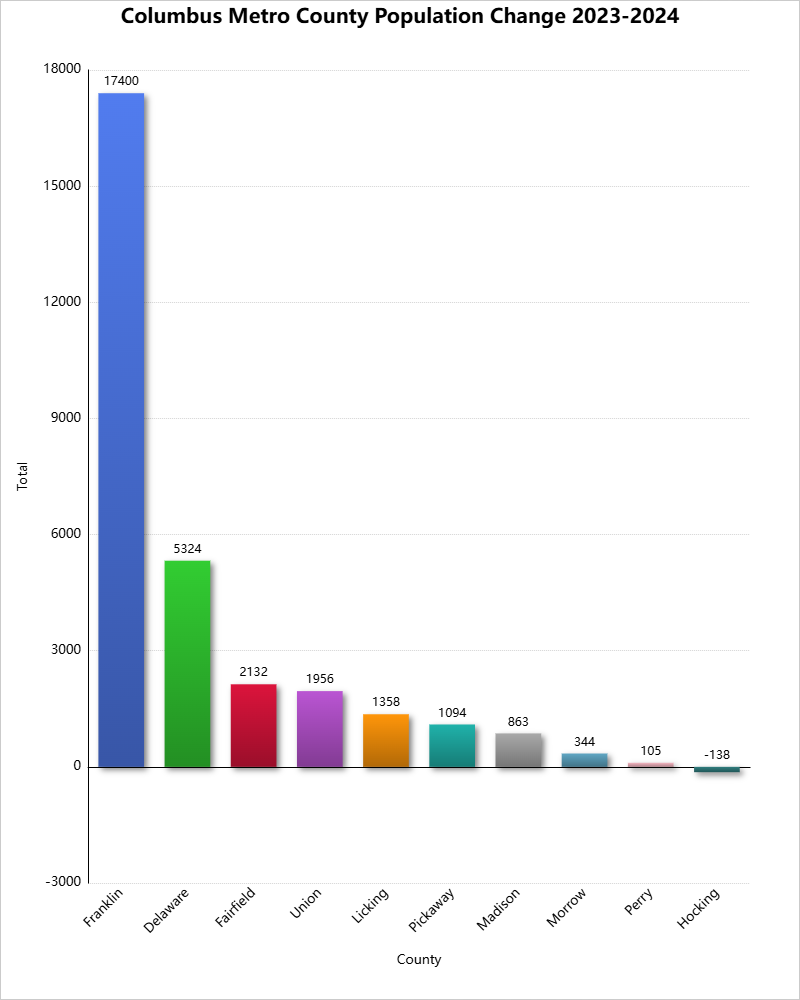
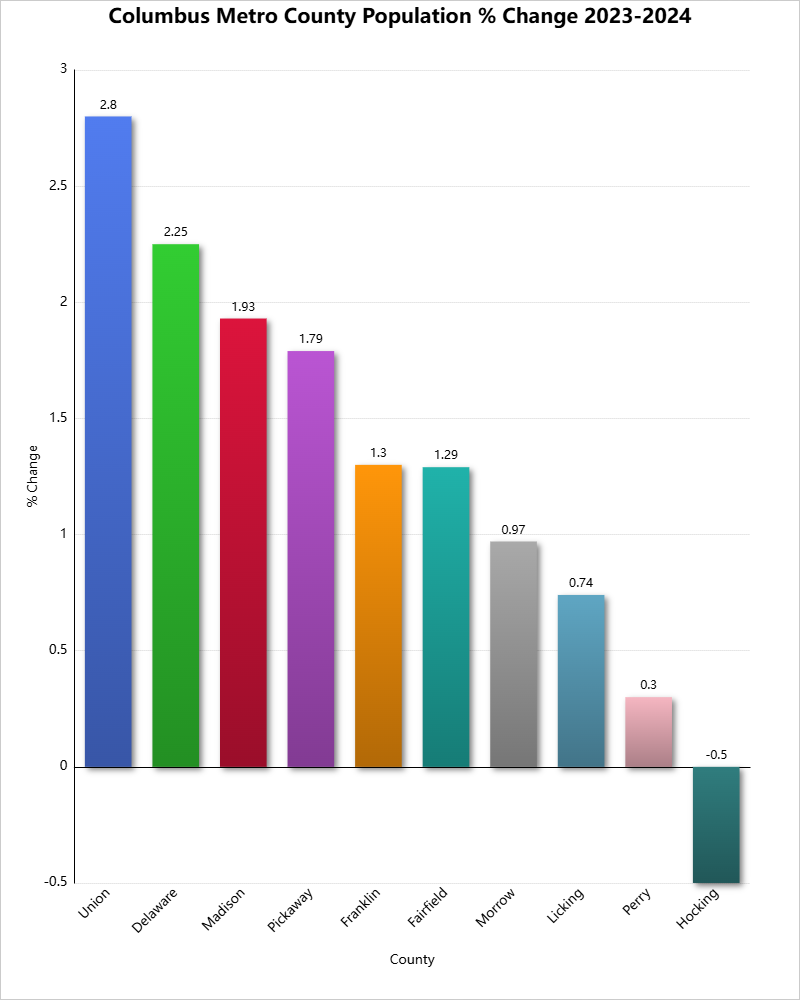
The US Census has released 2024 county and metro population estimates. The estimates generally show a further continuation of the post-pandemic recovery in the numbers. In fact, older estimates have also been revised upwards. Let’s break down the numbers.

Metro County

2020 Census

2023 Population

2024 Population

Delaware

214,123

232,732

237,966

Fairfield

158,920

165,630

167,762

Franklin

1,323,819

1,338,903

1,356,303

Hocking

28,056

27,567

27,429

Licking

178,517

183,540

184,898

Madison

43,848

44,668

45,531

Morrow

34,944

35,583

35,927

Perry

35,412

35,577

35,682

Pickaway

58,551

61,064

62,158

Union

62,790

69,765

71,721

As you can see, all counties but Hocking grew in both the 2020-2024 and 2023-2024 periods. Most of the estimates were improvements over the 2023 version, as mentioned. For example, Franklin County’s estimates population in 2023 was 1,326,063, but the 2024 version for 2023 was revised to 1,338,903, indicating growth was significantly stronger than originally estimated.

2024 metro population estimates county population

Franklin County continued its very long run of being the top county in the metro for total growth.

2024 metro population estimates county percent change

2024 metro population estimates population change

2024 metro population estimates county population percent change

Here were the top 25 largest Ohio counties in 2024.
1. Franklin: 1,356,303
2. Cuyahoga: 1,240,594
3. Hamilton: 837,859
4. Summit: 538,370
5. Montgomery: 537,443
6. Lucas: 426,291
7. Butler: 399,542
8. Stark: 374,091
9. Lorain: 322,030
10. Warren: 256,059
11. Delaware: 237,966
12. Lake: 232,360
13. Mahoning: 225,786
14. Clermont: 214,123
15. Trumbull: 200,300
16. Licking: 184,898
17. Medina: 184,625
18. Greene: 172,347
19. Fairfield: 167,762
20. Portage: 163,839
21. Clark: 134,985
22. Wood: 133,077
23. Richland: 124,853
24. Wayne: 116,632
25. Miami: 111,950

Metro Area

2020

2024

Change

Akron

702,211

702,209

-2

Canton

401,594

400,551

-1,043

Cincinnati

2,249,812

2,302,815

53,003

Cleveland

2,185,745

2,171,877

-13,868

Columbus

2,138,980

2,225,377

86,397

Dayton

814,040

821,740

7,700

Toledo

606,234

601,396

-4,838

Youngstown

430,675

426,086

-4,589

2023 Population Estimates of Columbus Metro Places


2023 population estimates

New 2023 population estimates of Columbus metro places were just released by the US Census. In general, they showed that most places are now recovering from the pandemic population decline blip.

First, the full list of all available population estimates for Columbus metro area incorporated places. This list does not include Census Designated Places, as estimates for those are only done once per decade. Red places have moved down in the rankings, green have moved up.


Out of Ohio’s 925 incorporated communities, 660 showed a population loss between 2020-2023, or 71.35%. 27 saw no population change, and 238- or 25.73%- saw population growth.
In the Columbus metro, however, 60% of its communities saw growth, with 6% seeing no change and 34% seeing a loss. The Columbus metro places represented just 5.15% of the total communities seeing loss within the state, but 25.73% of all the communities seeing growth. This shows just how poorly most of the state is doing in comparison to the Columbus area.

2023 County and Metro Population Estimates


2023 county and metro population estimates

National county map for 2022-2023 population change.

I haven’t done an annual population estimates post since before the 2020 Census. This is because the pandemic- and political actions- screwed up counting quite a bit, and I haven’t felt confident in posting them. The 2023 county and metro population estimates have just been released., and since 3 years have gone by since the census, perhaps some of the kinks have been worked out. That said, the news isn’t all that great for Ohio and Columbus.

2020-2023 County Population Change

Prior to 2020, Franklin County was the fastest-growing county in the state by total growth. Since 2020, it’s fallen to 10th. While that may not seem that bad, only 30 of Ohio’s 88 counties have even seen growth since 2020. On the bright side, Franklin was the only major urban county in the state to see any growth at all. The majority of the 30 counties that saw growth in the state were metro suburban counties, including 8 of the 9 suburban counties within the Columbus Metro Area. Lingering effects of the pandemic are at least partially responsible for this shift, as some people sought to leave highly-populated areas, but wanted to otherwise remain close to core cities.
Another factor is likely the ongoing housing shortage. Housing just isn’t getting built in Franklin County like it was before, which is continuing to cause price increases, making the area less affordable than it used to be.
Additionally, extreme state politics may be driving some people away- or stopping them from moving locally altogether.

Still, the news isn’t all bad. The total Columbus metro population growth is gradually improving. From 2020-2021, the metro change was +7,986, 2021-2022 it was +14,560, and from 2022-2023, it was +18,205. Still a far cry from the pre-pandemic period when annual totals were 25K-30K. Hopefully, the upward trend continues through the rest of the decade.

Now that we know that overall population change, let’s take a closer look at the specific components of change since 2020.

Top 10 Counties by Natural Change 2020-2023
1. Franklin: +18,738
2. Hamilton: +4,233
3. Delaware: +2,072
4. Holmes: +1,309
5. Union: +662
6. Butler: +652
7. Warren: +650
8. Mercer: +543
9. Putnam: +86
10. Shelby: +67
Incidentally, only these 10 counties saw positive net natural change 2020-2023. That’s a terrible statistic for Ohio’s counties. Columbus’ 3 counties in the top 10 provided more natural change than all other 85 counties combined.

Top 10 Counties by Domestic Change 2020-2023
1. Delaware: +13,998
2. Warren: +7,424
3. Union: +6,011
4. Lorain: +5,969
5. Fairfield: +5,932
6. Licking: +4,592
7. Clermont: +3,117
8. Pickaway: +2,783
9. Miami: +2,433
10. Medina: +2,018
Again, Columbus metro counties- aside from Franklin- do relatively well here, with half of the top 10.

Top 10 Counties by International Migration Change 2020-2023
1. Franklin: +20,391
2. Cuyahoga: +8,557
3. Hamilton: +7,037
4. Butler: +3,551
5. Montgomery: +2,885
6. Summit: +2,593
7. Warren: +1,821
8. Delaware: +1,557
9. Lucas: +1,237
10. Greene: +839
Franklin again leads the pack and is generally doing better annually this decade than before the pandemic, the lone bright spot in the numbers.

Finally, here were the overall metro changes, both for 2022-2023 and 2020-2023.

2023 Total Metro Area Population
1. Cincinnati: 2,271,479
2. Columbus: 2,180,271
3. Cleveland: 2,158,932
4. Dayton: 814,363
5. Akron: 698,398
6. Toledo: 600,141
7. Youngstown: 425,969
8. Canton: 399,474
Columbus continues to leave Cleveland behind and close the gap with Cincinnati.

2022-2023 Metro Area Population Change
1. Columbus: +18,205
2. Cincinnati: +12,854
3. Dayton: +1,649
4. Akron: +887
5. Canton: +3
6. Toledo: -378
7. Youngstown: -679
8. Cleveland: -1,769

2020-2023 Metro Area Population Change
1. Columbus: +41,330
2. Cincinnati: +21,698
3. Dayton: +313
4. Canton: -2,106
5. Akron: -3,827
6. Youngstown: -4,707
7. Toledo: -6,100
8. Cleveland: -26,795

Columbus Area Housing Permits


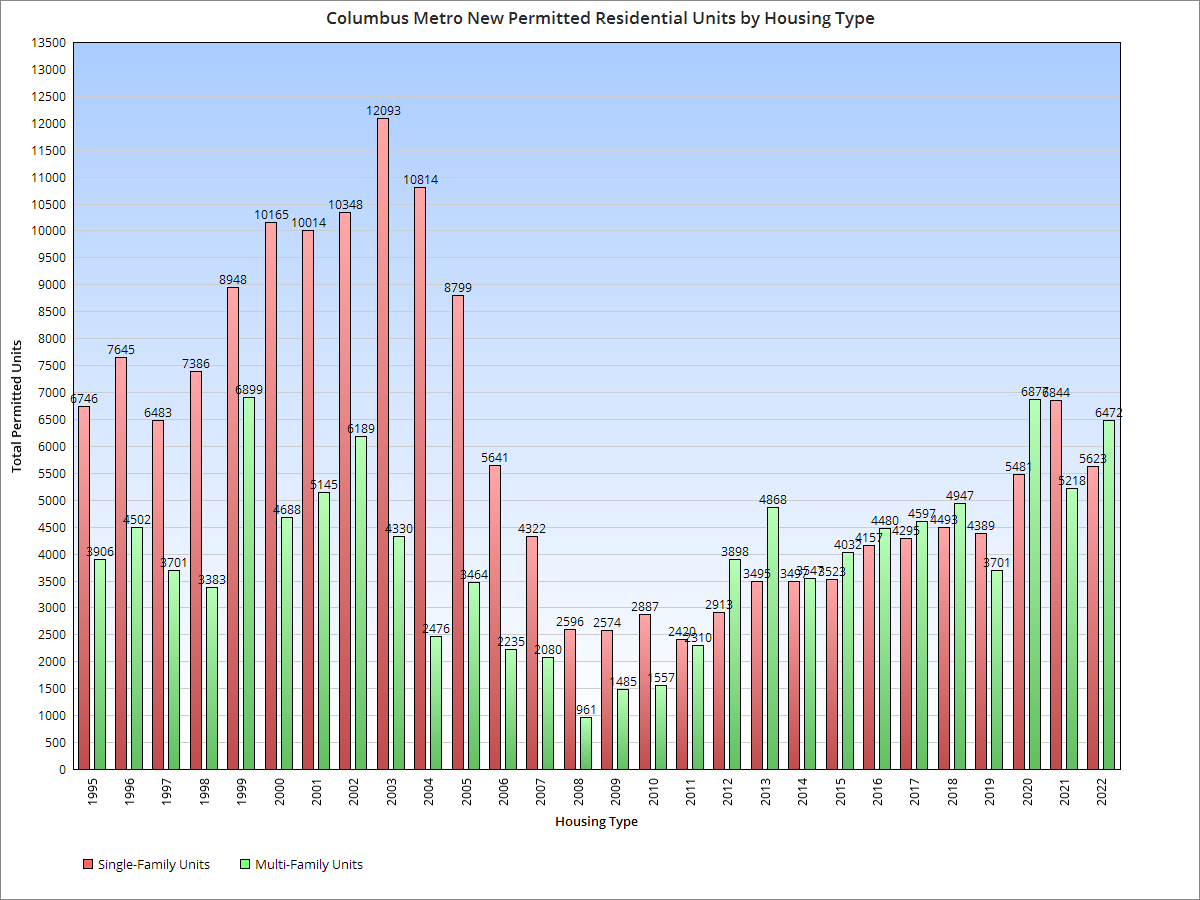
I talked about housing permits before- almost a decade ago now- and thought it would be a good time to update and expand the information. The following graphs detail Columbus area housing permits as they pertain to new residential units being permitted for construction.

Up first, the below graph shows all permitted units by type for the entire metro area since 1995.
Columbus area housing permits metro area total permits
What most stands out about the graph is how single-family construction dominated until the late 2000s. When the Great Recession hit, it completely changed that dynamic. Since then, multi-family units have mostly been on top in most years, perhaps because more money could be made with them with less financial risk.

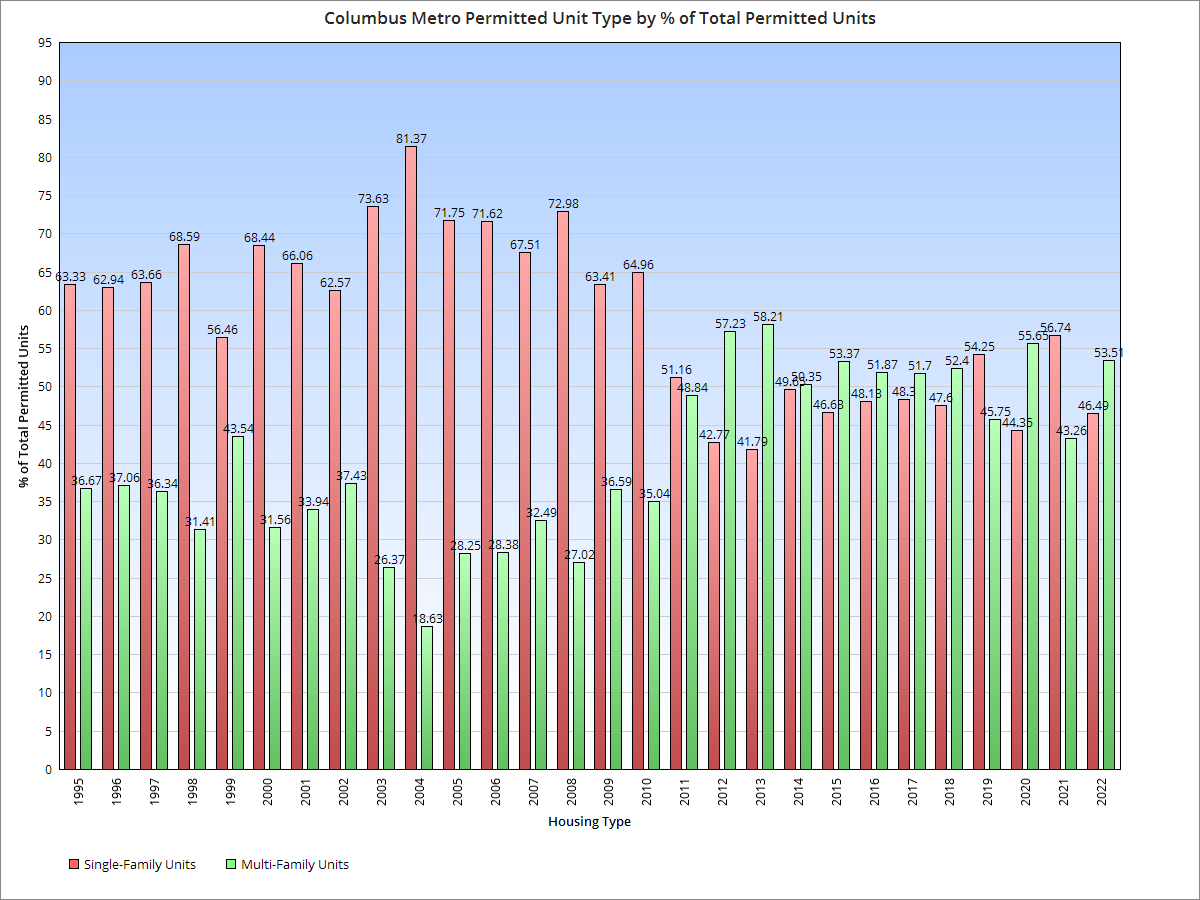
Here is the permitted housing type as a % of total permitted units.
Columbus area housing permits % of total units
Between 1995-2010 the average breakdown was 67.46% Single-Family and 32.54% Multi-Family. Since 2010, the breakdown has been 48.16% Single-Family and 51.84% Multi-Family, representing a full 38.6-point margin change towards Multi-Family.

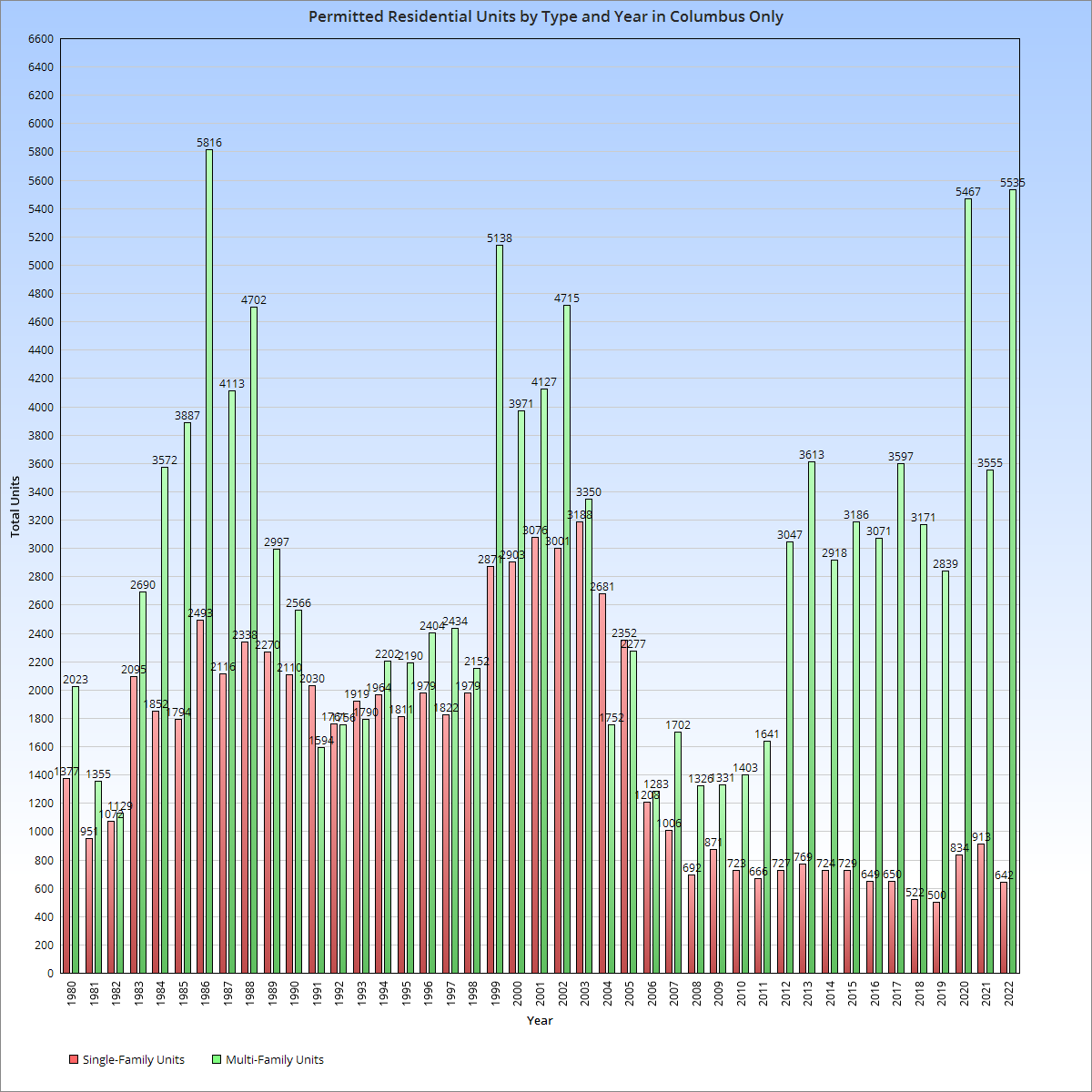
But what about what is actually getting permitted within just the city of Columbus, rather than the entire metro? City-exclusive data is available going back to 1980.
Columbus area housing permits Columbus city permits
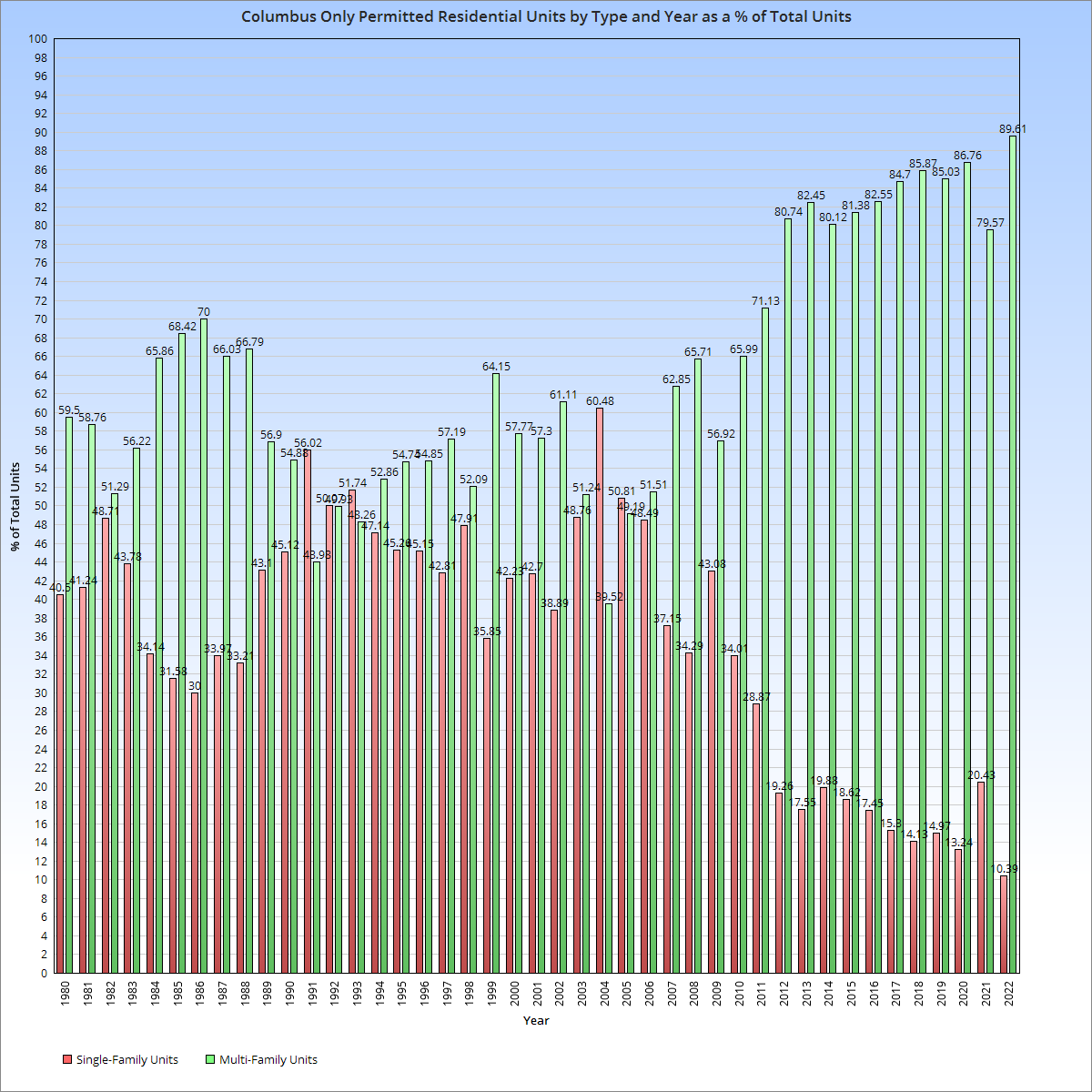
The city experienced the same shift as the overall metro, but much more drastically.

The % of total units by type for the city shows that single-family housing has been steadily becoming a smaller part of new construction permits since around 2003.
Columbus area housing permits Columbus % of total units

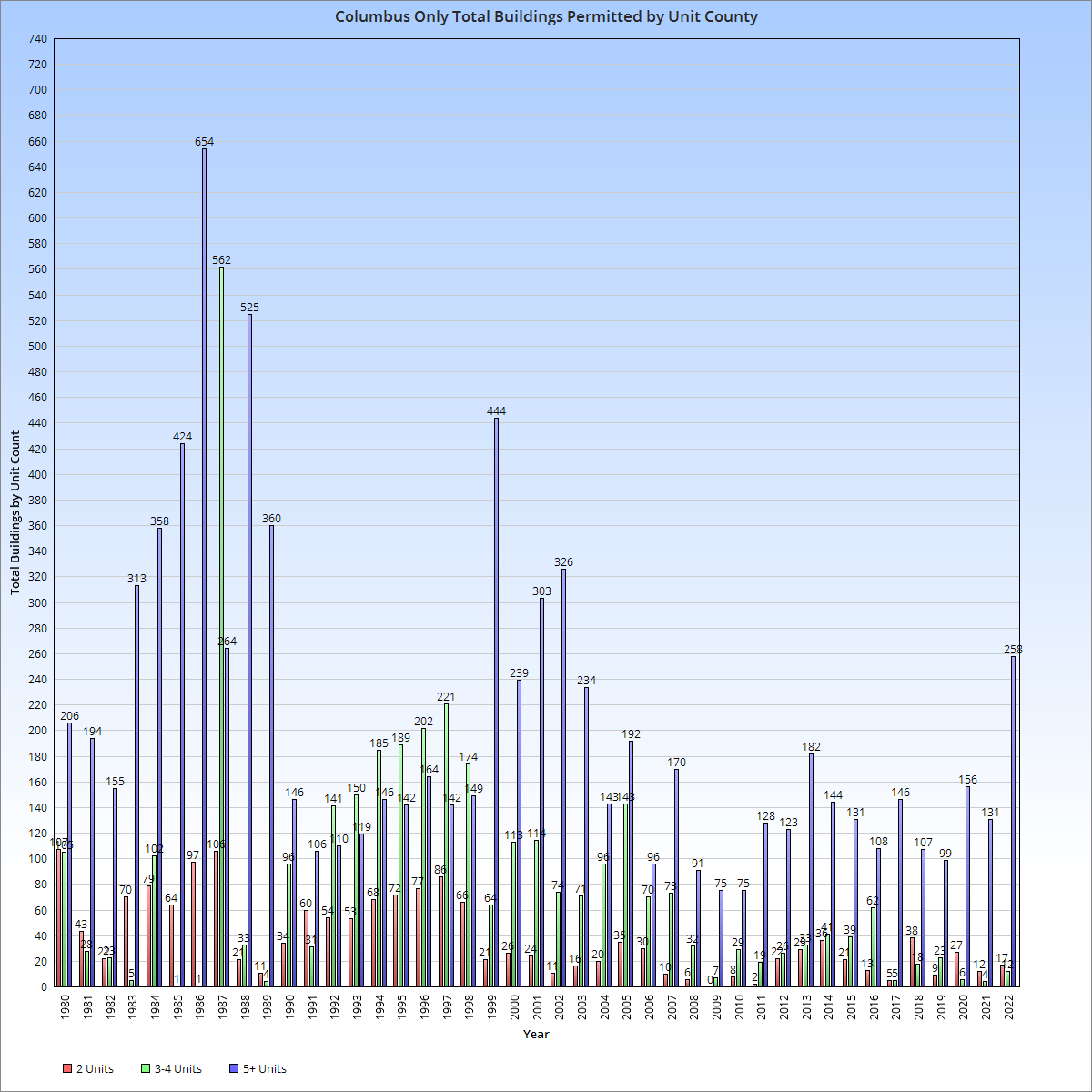
Finally, let’s break down multi-family permits by total number of buildings per unit count for the city only.
Columbus area housing permits Columbus multi-family buildings
Except for during the 1990s, 5+-unit buildings have been dominant, but it seems that fewer overall buildings are being built despite total units being high, suggesting that project size has increased over the years.