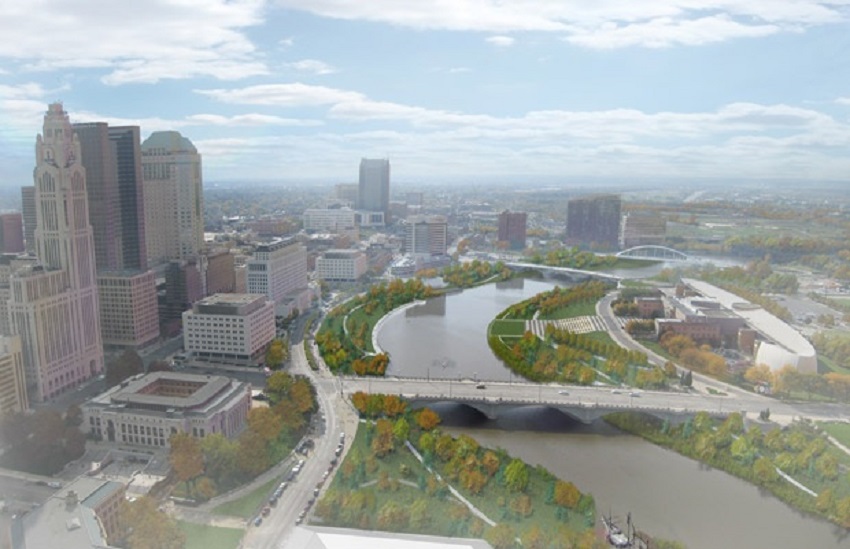
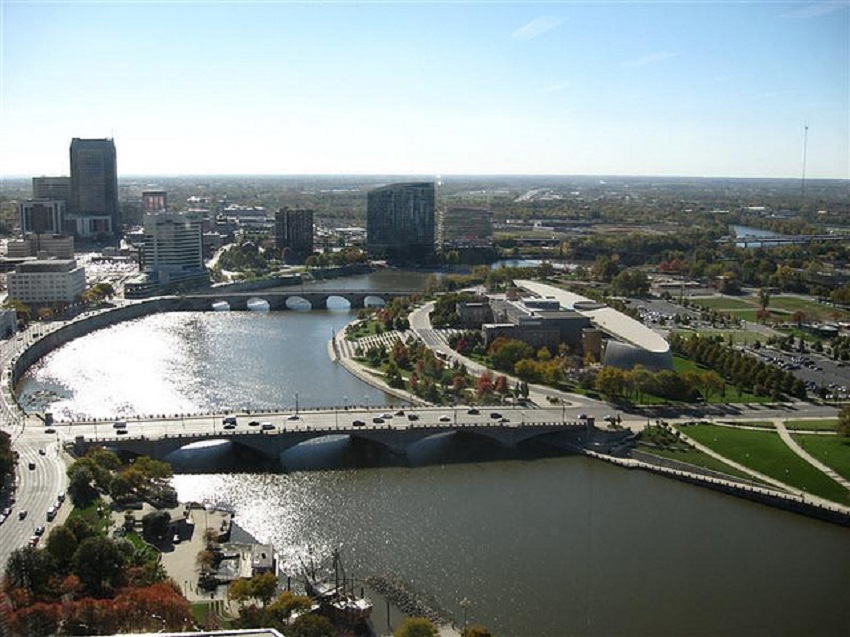
Major Ohio State Housing Project


Ohio State University has been engaged in long-term housing developmentand improvements on its campus for a few years now, and is set to begin the next and largest phase to date.

The first phase along W. 11th Avenue, called the South Campus High Rise Renovation and Addition Project, is nearing completion. The $171 million project began in 2010 and focused on Stradley, Smith, Park, Steeb and Siebert Halls. The residential buildings, which were all constructed between 1957 and 1960, would see major changes.

-New 12-story additions would connect Park with Stradley and Steeb to Smith.
-10-story Siebert Hall would receive a major renovation.
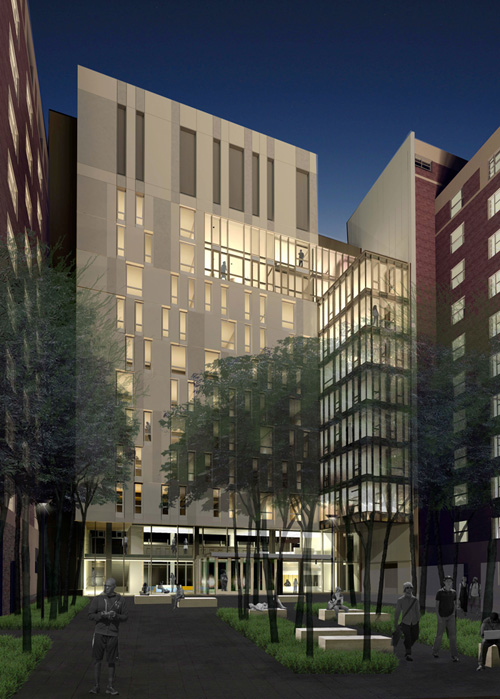
Major Ohio State housing project Columbus, Ohio

Rendering of the additions between Park/Stradley and Steeb/Smith.


In addition to the building additions, air conditioning, new elevators, lobbies and other improvements were made. The air conditioning was provided by drilling 450 geothermal wells. The additions would bring an additional 360 student beds.

Also renovated and added to was the William H. Hall housing complex at W. 11th and Worthington Street. Opened in August 2012, the building added 530 new beds.

The South Campus High Rise Renovation and Addition Project will ultimately add about 900 new student beds, but this is a far cry from the project just beginning along Lane Avenue.

Announced around the same time as SCHRRAP, the North Campus Residential District Project began just this past week. This project focuses on the large cluster of dorms and other buildings at the southwest corner of N. High Street and W. Lane Avenue. Most were built in the 1960s and 1970s and look it.
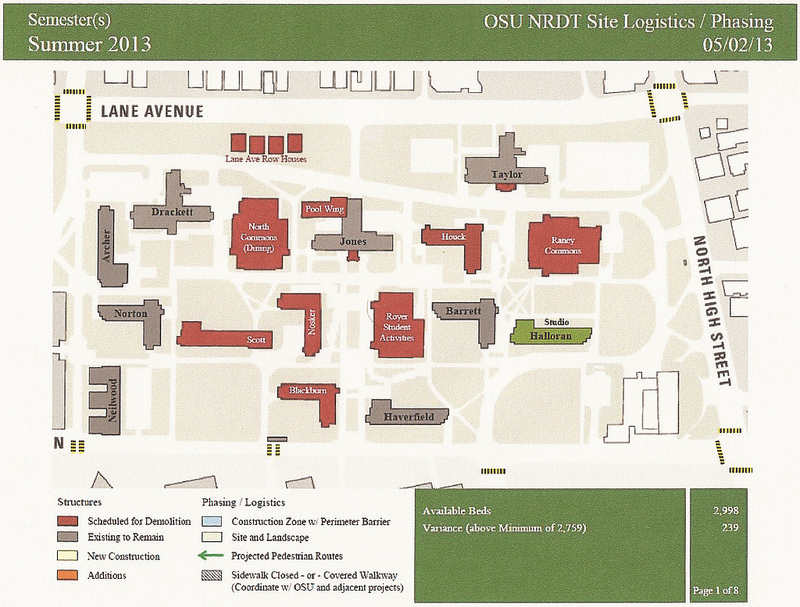
North Campus in 2013.


The image above shows how the area looks currently. As the key says, the buildings in red are scheduled to be demolished. The road that goes through the complex, Curl Drive, is also scheduled to be removed.
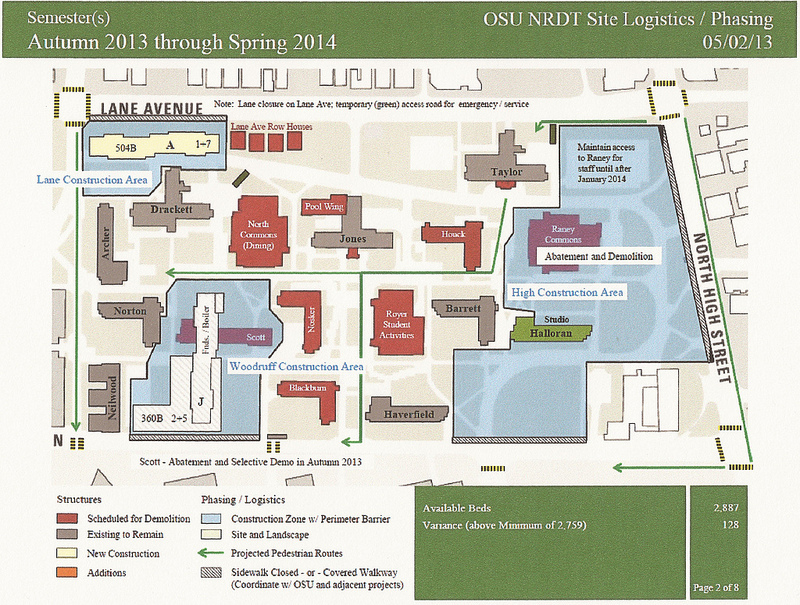
The image above shows the first phases of construction through Spring 2014. As you can see, there will be 3 main areas of construction during this period.
-A new dorm will be constructed at the southeast corner of W. Lane and Neil Avenues. This area is currently a surface parking lot.
-Scott Hall will be demolished and the site will be replaced with a much larger building.
-Raney Commons will be demolished, and site preparation will take place for new buildings, as well as removing Curl Drive and other infrastructure.
-Once site preparation is complete, 3 new dorm buildings will be constructed at the corner of N. High and W. Lane.
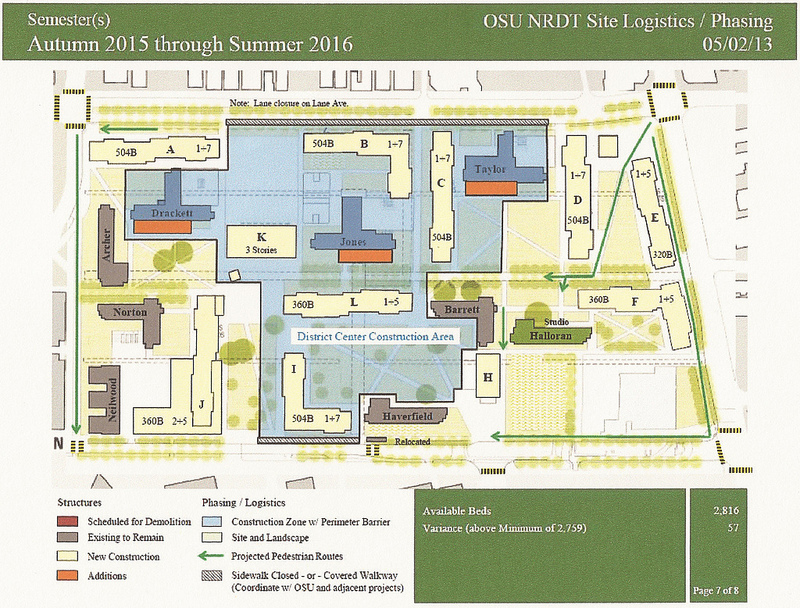
The last image above shows the final phase of construction, from Fall 2015 to Summer 2016. During this period, several changes take place.
-4 row homes along W. Lane will be demolished, as well as North Commons, Houck, Blackburn and Nosker Halls, the Royer Student Activities building and the Jones Pool.
-5 new buildings will be built in this area, as well as new addtions to Taylor, Jones and Drackett Halls.
-A central pedestrian corridor will be completed through the entire complex.
-High and Lane will be landscaped, and park spaces will be created throughout.
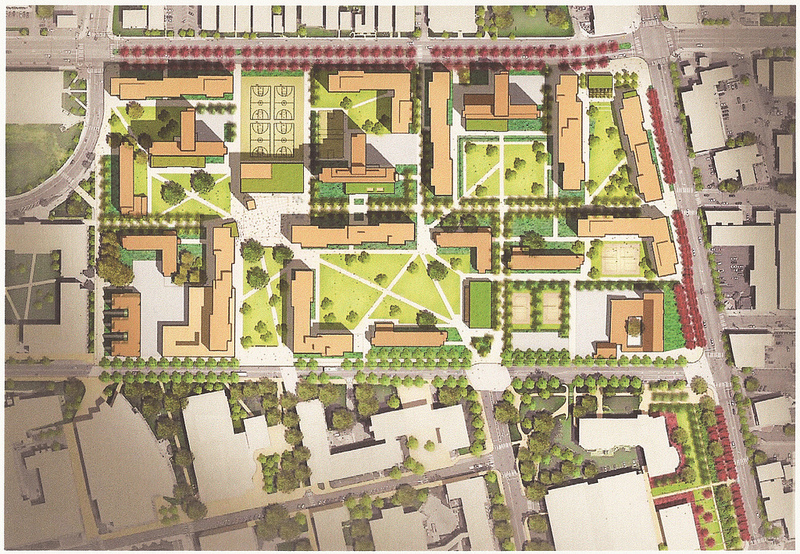
Final rendering.


In the end, 3,200 new beds will be created in the $370 million project. This will drastically change the look and feel of this area, and will continue to add density to the campus area, already Columbus’ most dense.


Columbus Housing Market July 2013


Columbus housing market July 2013

In this edition of the Columbus Housing Market July 2013, we see from Columbus Realtorsthat the housing market has been pretty white hot, and metro area sales set monthly records in July with an increase over 28%. July also featured the 3rd highest sales of any month on record.

I looked at the 21 major areas of Franklin County (11 urban, 10 suburban). Here is what the July market looked like.

Top 10 July Sales Totals
1. Columbus: 1,055
2. Dublin: 95
3. Upper Arlington: 91
4. Clintonville: 85
5. Westerville: 68
6. Grove City: 66
7. Hilliard: 60
8. Reynoldsburg: 46
9. Gahanna: 42
10. Pickerington: 38

Top 10 July Sales Increases Over July 2012
1. Minerva Park: +300.0%
2. German Village: +154.5%
3. Grove City: +83.3%
4. Reynoldsburg: +70.4%
5. Canal Winchester: +60.0%
6. Whitehall: +55.6%
7. Pataskala: +41.2%
8. Clintonville: +37.1%
9. Columbus: +35.8%
10. New Albany: +32.0%

Top 10 Total YTD Sales Through July
1. Columbus: 6,072
2. Dublin: 480
3. Upper Arlington: 447
4. Clintonville: 423
5. Westerville: 375
6. Grove City: 363
7. Hilliard: 338
8. Gahanna: 315
9. Reynoldsburg: 310
10. Pickerington: 203

Top 10 YTD Sales Increases Through over July 2012
1. Whitehall: +42.7%
2. Hilliard: +42.0%
3. Bexley: +38.7%
4. Reynoldsburg: +36.6%
5. Pataskala: +35.9%
6. German Village: +34.7%
7. Pickerington: +34.4%
8. Minerva Park: +31.3%
9. Clintonville: +31.0%
10. Westerville: +29.8%

Average Sales July 2013
Urban: 124.7
Suburban: 50.4
Urban without Columbus: 31.7

Average % Change July 2013 vs. July 2012
Urban: +48.3%
Suburban: +35.0%
Urban without Columbus: +54.0%

Average Sales YTD Through July
Urban: 699.1
Suburban: 283.4
Urban without Columbus: 161.8

Average % Change YTD vs. YTD 2012 (Through July)
Urban: +19.7%
Suburban: +28.2%
Urban without Columbus: +18.8%

Top 10 Average Sales Price
1. New Albany: $563,891
2. Upper Arlington: $389,264
3. Bexley: $370,056
4. Dublin: $350,545
5. Downtown: $329,266
6. German Village: $325,721
7. Worthington: $272,706
8. Grandview Heights: $254,470
9. Hilliard: $240,506
10. Westerville: $209,706

Top 10 Average Sales Price % Increases vs. July 2012
1. Upper Arlington: +22.3%
2. Hilliard: +18.7%
3. Grandview Heights: +13.1%
4. Downtown: +12.5%
5. Pickerington: +12.4%
6. Pataskala: +11.6%
7. Canal Winchester: +11.3%
8. Worthington: +7.5%
9. Dublin: +6.7%
10. Columbus: +6.5%

Top 10 Average Sales Price YTD
1. New Albany: $545,545
2. Upper Arlington: $355,993
3. Bexley: $347,920
4. Dublin: $333,285
5. German Village: $310,179
6. Downtown: $285,807
7. Worthington: $243,009
8. Grandview Heights: $219,100
9. Hilliard: $218,104
10. Gahanna: $202,527

Top 10 Average YTD Sales Price % Change vs. YTD 2012
1. Whitehall: +33.5%
2. Downtown: +18.6%
3. Gahanna: +13.8%
4. Minerva Park: +13.0%
5. Upper Arlington: +12.4%
6. Reynoldsburg: +9.9%
7. New Albany: +9.1%
8. Hilliard: +5.5%
9. Gahanna: 5.0%
10. Canal Winchester: +4.9%

Average Price July 2013
Urban: $230,605
Suburban: $236,871
Urban without Columbus: $239,388

Average Price % Change vs. July 2012
Urban: +1.8%
Suburban: +6.3%
Urban without Columbus: +1.3%

Average Price YTD
Urban: $214,207
Suburban: $223,511
Urban without Columbus: $223,053

Average Price % Change YTD vs. YTD 2012
Urban: +6.3%
Suburban: +5.0%
Urban without Columbus: +6.6%

Top 10 Fastest Selling Markets July 2013 (based on # of Days listings sell)
1. Grandview Heights: 9
2. Obetz: 9
3. Hilliard: 25
4. Worthington: 26
5. Upper Arlington: 29
6. Bexley: 31
7. Westerville: 38
8. Reynoldsburg: 40
9. New Albany: 42
10. Clintonville: 44

Top 10 Fastest Selling Markets YTD
1. Worthington: 36
2. Grandview Heights: 47
3. Upper Arlington: 47
4. Clintonville: 56
5. Westerville: 56
6. Hilliard: 58
7. Dublin: 59
8. New Albany: 60
9. Gahanna: 62
10. Pataskala: 62

Average # of Days before Sale, July 2013
Urban: 49.8
Suburban: 48.7
Urban without Columbus: 48.8

Average # of Days before Sale, YTD
Urban: 64.6
Suburban: 62.3
Urban without Columbus: 64.4

Top 10 Lowest Housing Supplies (based on # of months to sell all listings), July 2013
1. Worthington: 1.9
2. Grandview Heights: 2.4
3. Upper Arlington: 2.4
4. Clintonville: 2.5
5. Hilliard: 2.7
6. Westerville: 2.8
7. Dublin: 3.1
8. Bexley: 3.2
9. Gahanna: 3.6
10. Downtown: 4.0

Average # of Months to Sell All Listings
Urban: 3.7
Suburban: 4.2
Urban without Columbus: 3.6

Average % Change of Single-Family Home Sales, July 2013 vs. July 2012
Urban: +55.0%
Suburban: +33.4%
Urban without Columbus: +58.0%

Average % Change of Condo Sales, July 2013 vs. July 2012
Urban: +78.4%
Suburban: +89.0%
Urban without Columbus: +82.3%

Average % Change of Single-Family Home Sales YTD vs. YTD 2012
Urban: +14.4%
Suburban: +28.5%
Urban without Columbus: +13.0%

Average % Change of Condo Sales YTD vs. YTD 2012
Urban: +42.8%
Suburban: +32.7%
Urban without Columbus: +44.0%

Seems like most areas are doing fairly well, including the urban core. Of course, these number do not measure rentals, which is what is really booming right now in the residential scene.


May 2013 Jobs Data


May 2013 jobs data

The latest May 2013 jobs data is now out from the Bureau of Labor Statistics.

Columbus City
Unemployment Rate: 6.0%
Unemployment Rate Change since May 2012: +0
Unemployment Rate Change since January 2013: -0.8
Civilian Labor Force: 431,500
Civilian Labor Force Change since May 2012: +3,600
Civilian Labor Force Change since January 2013: +5,100
Employment: 405,500
Employment Change since May 2012: +3,400
Employment Change since January 2013: +8,200
Unemployment: 26,000
Unemployment Change since May 2012: +100
Unemployment Change since January 2013: -3,100

Franklin County
Unemployment Rate: 6.0%
Unemployment Rate Change since May 2012: +0
Unemployment Rate Change since January 2013: -0.8
Civilian Labor Force: 631,000
Civilian Labor Force Change since May 2012: +5,300
Civilian Labor Force Change since January 2013: +7,300
Employment: 593,100
Employment Change since May 2012: +5,100
Employment Change since January 2013: +12,100
Unemployment: 37,900
Unemployment Change since May 2012: +200
Unemployment Change since January 2013: -4,700

Columbus Metro Area
Unemployment Rate: 6.0%
Unemployment Rate Change since May 2012: +0.1
Unemployment Rate Change since January 2013: -1.0
Civilian Labor Force: 977,400
Civilian Labor Force Change since May 2012: +8,600
Civilian Labor Force Change since January 2013: +9,500
Employment: 919,100
Employment Change since May 2012: +7,800
Employment Change since January 2013: +18,600
Unemployment: 58,300
Unemployment Change since May 2012: +800
Unemployment Change since January 2013: -9,100

Ohio Overall
Unemployment Rate: 7.0%
Unemployment Rate Change since May 2012: -0.3
Unemployment Rate Change since January 2013 : +0
Civilian Labor Force: 5,750,000
Civilian Labor Force Change since May 2012: -5,000
Civilian Labor Force Change since January 2013: +10,000
Employment: 5,345,000
Employment Change since May 2012: +9,000
Employment Change since January 2013: +4,000
Unemployment: 405,000
Unemployment Change since May 2012: -15,000
Unemployment Change since January 2013: +6,000

Metro Non-Farm Jobs
Total: 966,900
Change from May 2012: +12,200
Change from January 2013: +23,300

By Industry
Mining/Logging/Construction Total: 30,600
Change from May 2012: +500
Change from January 2013: +3,700

Manufacturing Total: 66,600
Change from May 2012: +600
Change from January 2013: +1,600

Trade/Transportation/Utilities Total: 180,700
Change from May 2012: -1,200
Change from January 2013: -2,500

Information Total: 16,400
Change from May 2012: -200
Change from January 2013: -100

Financial Activities Total: 71,300
Change from May 2012: -200
Change from January 2013: -400

Professional and Business Services Total: 161,000
Change from May 2012: +1,100
Change from January 2013: +5,400

Education and Health Services Total: 142,600
Change from May 2012: +4,500
Change from January 2013: +3,100

Leisure and Hospitality Total: 99,700
Change from May 2012: +4,900
Change from January 2013: +11,200

Other Services Total: 35,800
Change from May 2012: -600
Change from January 2013: -400

Government Total: 162,200
Change from May 2012: -200
Change from January 2013: +1,700


The Scioto Peninsula Reborn


The Scioto Peninsula reborn

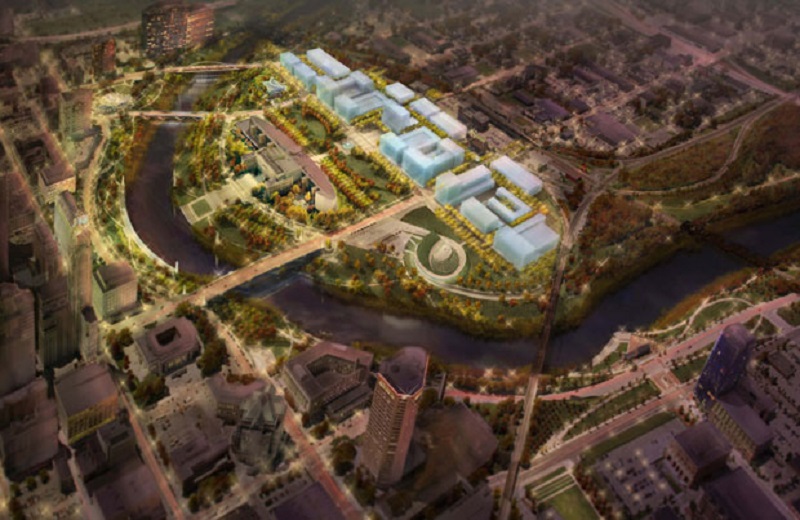
The Scioto Peninsula looking east.

The history of the Scioto Peninsula is much the same as the Franklinton neighborhood it resides in. Since Franklinton’s founding in 1797 (Columbus’ oldest neighborhood and predates Columbus itself by 15 years), it did not take long to figure out the area’s one major flaw: Floods. Essentially built upon a river flood plain, Franklinton flooded several times during the 19th century, but the most devastating came in 1913 and 1959. The 1913 flood, Ohio’s deadliest and most widespread natural disaster, inundated Franklinton with up to 20 feet of water in places, and the neighborhood flooded all the way back to where present-day I-70 cuts through the far western border. Franklinton suffered massive damage, and over 100 people died along the Scioto in Columbus. The flood in 1959 was less severe, thanks to flood protections put into place after 1913, but one consequence of this flood was that new construction and most renovation was all but prohibited due to the flood risk. This helped to stagnate the entire neighborhood, and combined with the urban decline for the next several decades, Franklinton gradually fell into disrepair. The Scioto Peninsula, the far eastern section of the neighborhood just across from Downtown, was always the hardest hit by flooding. As such, the 56-acre peninsula gradually became a manufacturing and warehouse site, although a few thousand people did live there in low-income housing projects. Central High School also helped to maintain a residential presence.

As manufacturing declined and more people left the urban core, the warehouses and businesses closed shop. Many were bulldozed into vacant lots. Central High was closed as a school in the early 1980s. By the mid-1990s, the area was largely empty except for Veteran’s Memorial and a handful of housing developments and businesses. Plans were in the works to help bring Franklinton back, however, and construction of the Franklinton Floodwall began at this time. This construction helped encourage COSI to move into Central High, renovating and expanding the old building in exhibit and museum space. Most of the rest of the peninsula became surface parking. In 2004, with the completion of the floodwall, building restrictions were finally lifted, but for several years, little happened. The stigma of a neighborhood in decline kept development interests away.

In 2010, Columbus came out with a list of 12 projects it wanted to accomplish in the downtown area. Some of them have come to pass, such as the renovation of the riverfront with Scioto Mile and the redevelopment of City Center into Columbus Commons. Another one of these projects was the redevelopment of the Scioto Peninsula. The city saw an opportunity in so much empty land so close to Downtown, especially coinciding with the emerging back-to-the-city movement. This prime real estate was ripe. The city began planning of this project early in 2012, as East Franklinton itself began to emerge as an artist destination. The Short North has, more or less, reached the final stage of gentrification. It’s become upscale, attracting high end retail and residential, as the number of art galleries has gradually declined due to rising rents. Franklinton has proven to be an attractive alternative, with such live-work projects as 400 Rich, which grew rapidly in its first year. Residential projects are now in the works, as well as more artist space, warehouse conversions and new bars and restaurants.

General plan for the Peninsula.

A few months back, details of the Peninsula’s redevelopment plan began to trickle out, but the official announcement finally came yesterday. Here is what we now know of the plan:

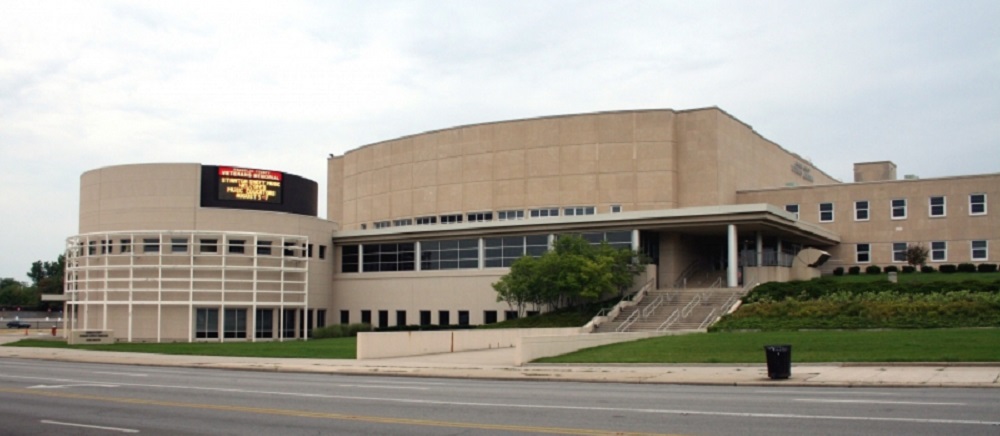
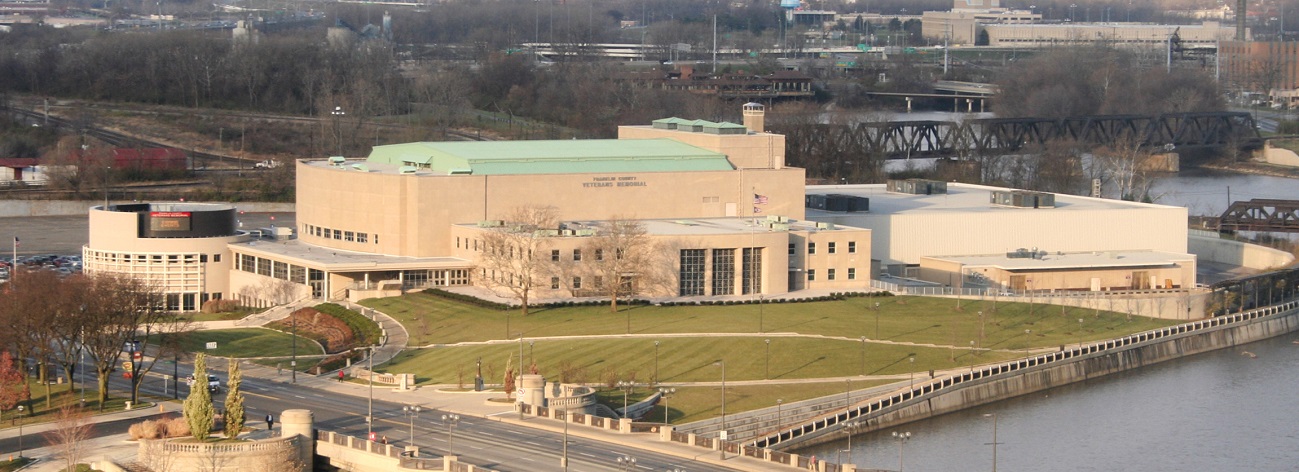
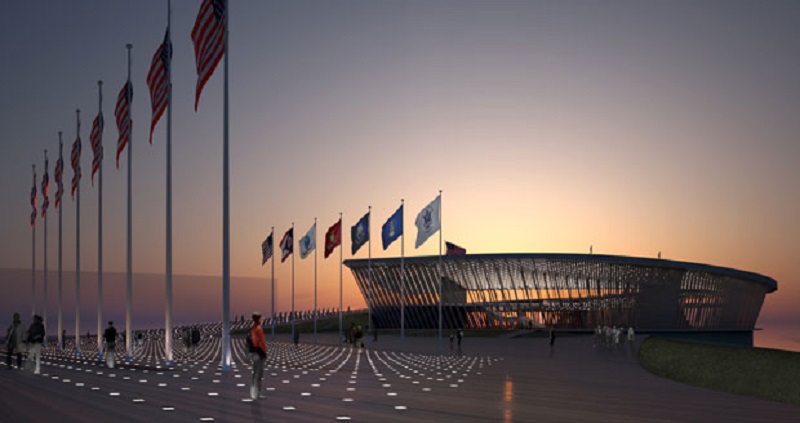
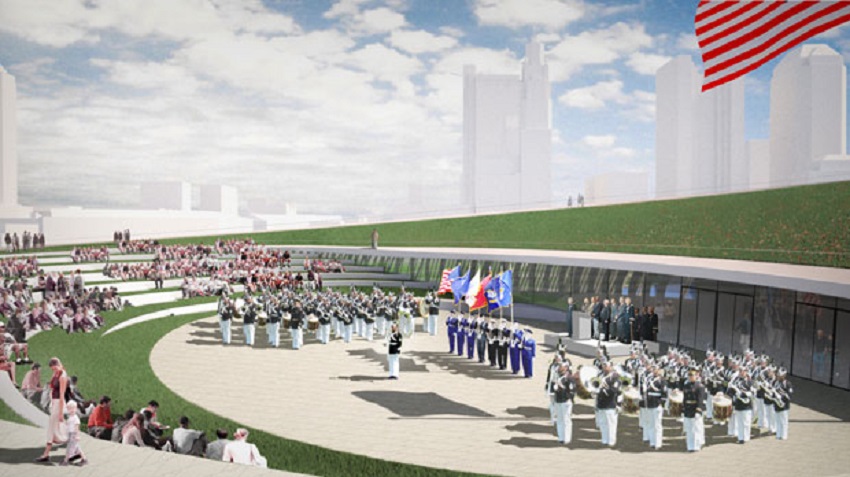
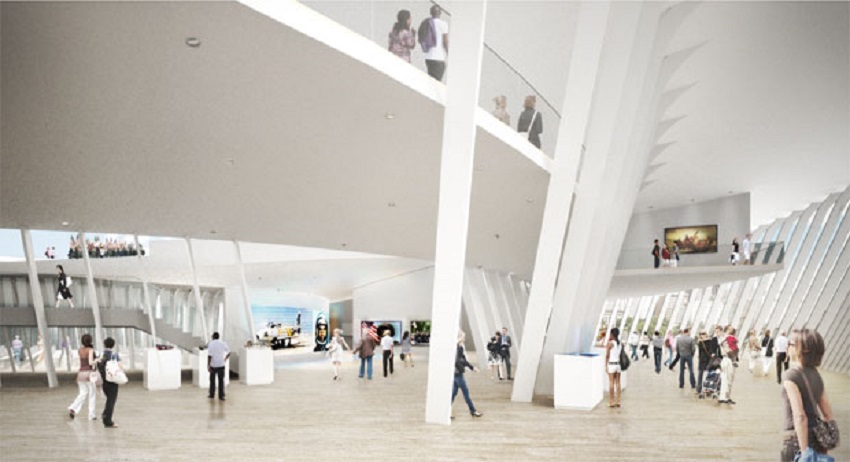
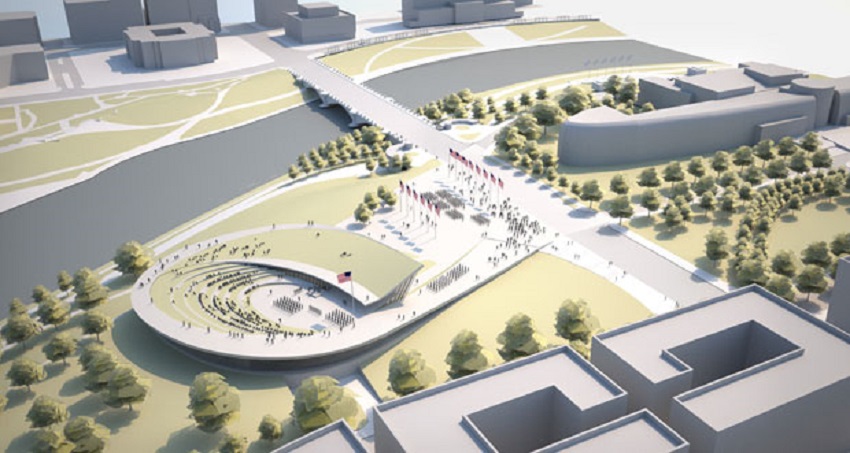
1. Veterans Memorial, built in 1955 and expanded/renovated a few times over the years, will be torn down and replaced with a new Vets. This new Vets will be of modern design, spiral in shape with glass walls and a rooftop, outdoor amphitheater. Inside will be an Ohio military museum, along with meeting and event space. Estimated costs run around $50 million.
Old Vets Memorial


New Veterans Memorial


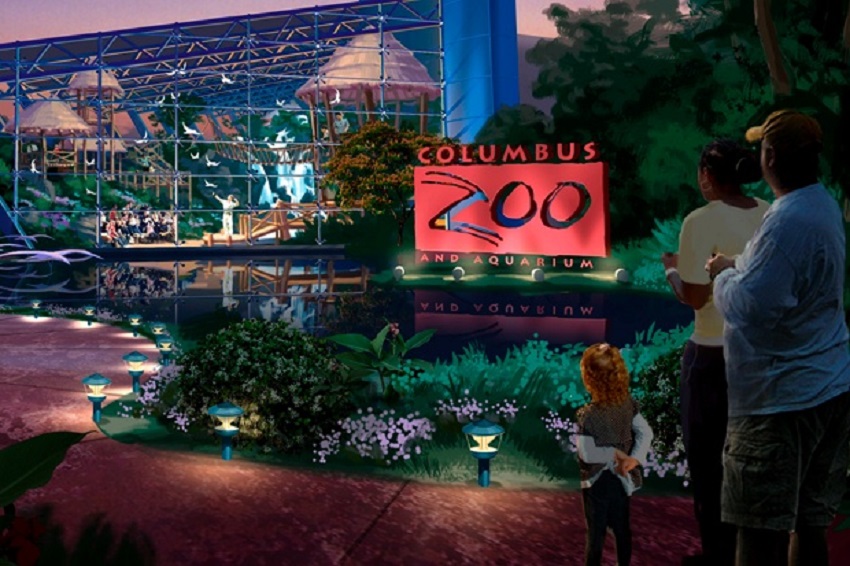
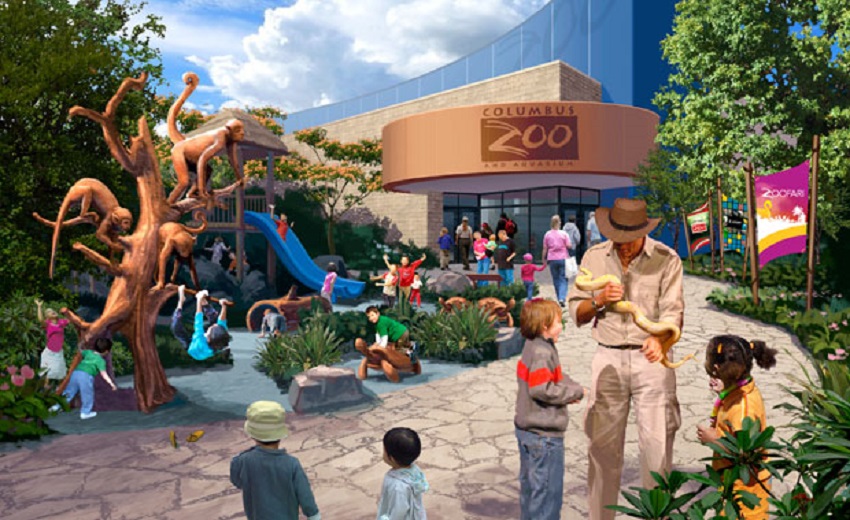
2. Southwest of COSI, the Columbus Zoo will build a $50+ million, 50,000 square foot zoo extension. The building will include an aquarium, rainforest, outdoor zoo-themed playground and other exhibits.

3. Where the current COSI parking lots are, a large underground parking garage will be constructed to serve the 3 attractions. Once complete, the garage will be covered by a large central park.
4. While not yet designed and weren’t talked about yesterday, previous details have included elevated walkways connecting all 3 buildings across the peninsula.
5. Between Bell Street and the railroad tracts that run along the western border of the peninsula, a mix of low, mid and high-rise mixed-use buildings will go in. Ground floor retail will line streets while upper floors will be mostly residential. Between 1,000 and 1,200 residential units are planned, but private interests could easily include more given the very high demand for urban residential and the fantastic location with views of Downtown and the river. Estimated costs exceed $100 million.
6. Not included specifically in the peninsula plan, but surely also impacting it, will be the Scioto River itself. Another one of the 12 projects is the removal of low-head dams through Downtown. This will lower the river level through Downtown, creating 33 acres of new land that will be landscaped into park space. Bike paths and walkways will also be constructed on this new land. The river itself will run faster, cleaner and open up more potential recreational uses. This project is set to begin this fall and complete in 2015. Estimated costs for the project are around $25 million.

The Riverfront after reconstruction.

The Riverfront now.

7. After the completion of the river restoration project, another one of the 12 ideas should begin. That will be the construction of a signature pedestrian bridge connecting North Bank Park in the Arena District with the Scioto Peninsula near the new Vets. There are no cost estimates at this time.

So given all this, the Scioto River and the Scioto Peninsula are looking at several hundred million in investment and development over the next several years. This will radically change the riverfront, and has the potential to jumpstart Franklinton, especially eastern parts, in ways not seen in many decades.

Much more about local development can be found here:
Development Under Construction
Proposed Development


April 2013 Jobs Data


April 2013 jobs data

That latest April 2013 jobs data comes from the Bureau of Labor Statistics.

Columbus City
Unemployment Rate: 5.7%
Unemployment Rate Change since April 2012: -0.6
Unemployment Rate Change since January 2013: -1.1
Civilian Labor Force: 425,600
Civilian Labor Force Change since April 2012: +200
Civilian Labor Force Change since January 2013: -800
Employment: 401,400
Employment Change since April 2012: +2,800
Employment Change since January 2013: +4,100
Unemployment: 24,200
Unemployment Change since April 2012: -2,500
Unemployment Change since January 2013: -4,900

Franklin County
Unemployment Rate: 5.7%
Unemployment Rate Change since April 2012: -0.5
Unemployment Rate Change since January 2013: -1.1
Civilian Labor Force: 622,300
Civilian Labor Force Change since April 2012: +600
Civilian Labor Force Change since January 2013: -1,400
Employment: 587,100
Employment Change since April 2012: +4,100
Employment Change since January 2013: +6,100
Unemployment: 35,200
Unemployment Change since April 2012: -3,400
Unemployment Change since January 2013: -7,400

Columbus Metro Area
Unemployment Rate: 5.7%
Unemployment Rate Change since April 2012: -0.4
Unemployment Rate Change since January 2013: -1.3
Civilian Labor Force: 964,400
Civilian Labor Force Change since April 2012: +1,700
Civilian Labor Force Change since January 2013: -3,500
Employment: 909,800
Employment Change since April 2012: +6,300
Employment Change since January 2013: +9,300
Unemployment: 54,600
Unemployment Change since April 2012: -4,600
Unemployment Change since January 2013: -12,800

Ohio Overall
Unemployment Rate: 7.0%
Unemployment Rate Change since April 2012: -0.3
Unemployment Rate Change since January 2013 : +0.0
Civilian Labor Force: 5,741,116
Civilian Labor Force Change since April 2012: -22,664
Civilian Labor Force Change since January 2013: +824
Employment: 5,341,401
Employment Change since April 2012: -1,270
Employment Change since January 2013: +549
Unemployment: 399,715
Unemployment Change since April 2012: -21,394
loyment Change since January 2013: +275

Non-Farm Jobs
Total: 954,100
Change from April 2012: +7,000
Change from January 2013: +9,500

By Industry
Mining/Logging/Construction Total: 28,400
Change from April 2012: -500
Change from January 2013: +1,500

Manufacturing Total: 66,500
Change from April 2012: +700
Change from January 2013: +1,500

Trade/Transportation/Utilities Total: 179,600
Change from April 2012: -900
Change from January 2013: -3,600

Information Total: 16,400
Change from April 2012: -300
Change from January 2013: -100

Financial Activities Total: 71,400
Change from April 2012: +300
Change from January 2013: -300

Professional and Business Services Total: 158,300
Change from April 2012: +1,000
Change from January 2013: +2,700

Education and Health Services Total: 141,000
Change from April 2012: +3,000
Change from January 2013: +1,500

Leisure and Hospitality Total: 95,200
Change from April 2012: +3,800
Change from January 2013: +6,700

Other Services Total: 36,100
Change from April 2012: -100
Change from January 2013: -100

Government Total: 161,200
Change from April 2012: +0
Change from January 2013: +700