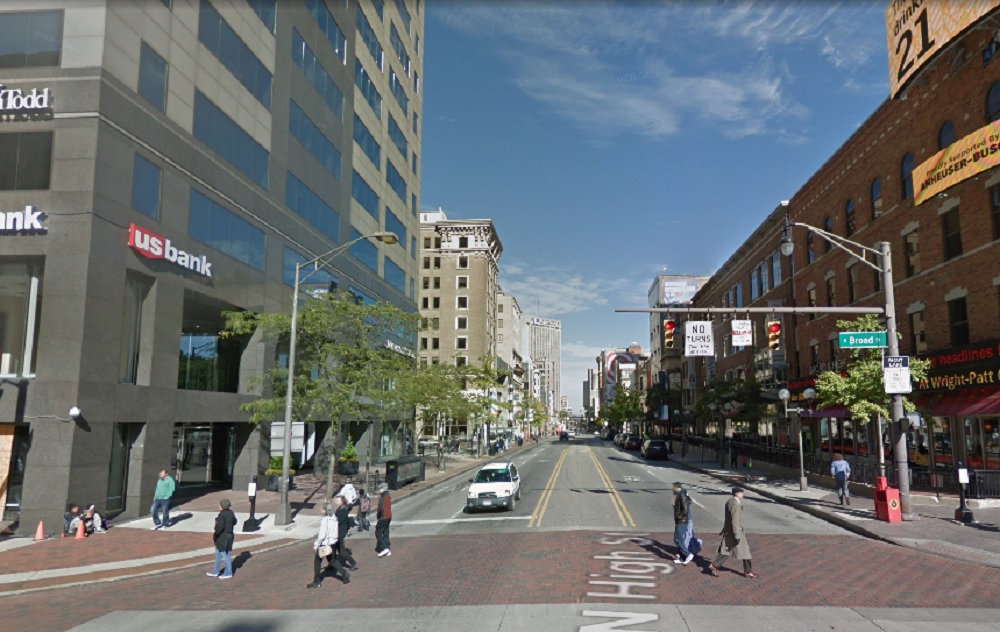
For the Random Columbus Photos 9 edition, we take a not-so-distant look back for a change.
Photo Location: High and Broad intersection, looking north. Photo Date: August 31, 1991 Photo History: The Celebrate Them Home Columbus parade occurred as an event to honor returning Gulf War and Operation Desert Storm veterans, as well as veterans of previous wars. The event was held only one time. National patriotism was unusually high during this short war, and helped to revive Lee Greenwood’s 1984 song “God Bless the USA”, which often played on the radio during the conflict. Contrary to what may be popular belief, the Beetle Bailey character represented in the balloon does not date back to WWII. Instead, he first appeared in comic strips in 1950 and continues to run today.
The same view today. Not much has changed since the 1991 photo. A few buildings have been renovated and the streetscape has seen improvements, but otherwise, the view is largely the same.
Ever looked at a building and wondered if it was ever a former Pizza Hut? Or wanted to know how long Kahiki was in business? Columbus Restaurant History is a fantastic link for all of the local area’s foodie history. Not only are there stories about individual restaurants and chains, but you can look up former restaurant locations, dates of existence, old menus and so much more! It’s just a really cool link for a niche part of Columbus’ history.
For the Columbus economy July 2022 report, we find several local industries in record high territory, but with a metro labor force that is barely growing. The data comes from the Bureau of Labor Statistics.
Overall Metro Area July 2022 and Change from July 2021 Labor Force: 1,136,345 +1,050 Employed: 1,093,966 +13,074 Unemployed: 42,379 -12,024 Unemployment Rate: 3.7% -1.1 Total Non-Farm Jobs: 1,126,200 +16,400 Numbers continued the trend of improvement year-over-year, but labor force growth remained relatively slow.
Overall Metro Area July 2022 and Change from February 2020 (Pre-Pandemic) Labor Force: 1,136,345 +15,541 Employed: 1,093,966 +17,126 Unemployed: 42,379 -1,585 Unemployment Rate: 3.7% -0.2 Total Non-Farm Jobs: 1,126,200 +14,800 The overall metro area remained better in July than the last month prior to the pandemic.
Now let’s view the results by industry.
Mining/Logging/Construction 7/2020———–7/2021———-7/2022 45,200————46,800———48,200 These industries remain near their all-time highs for total metro jobs. Mining/Logging/Construction Jobs as a % of Total Metro Jobs 7/2020————7/2021———7/2022 4.3——————4.2————–4.3
Manufacturing 7/2020———–7/2021———-7/2022 70,100———–72,700———-72,900 Manufacturing has largely recovered from pandemic losses, but remains well below historic highs achieved decades ago. Manufacturing Jobs as a % of Total Metro Jobs 7/2020————7/2021———-7/2022 6.7——————6.6—————6.5
Trade/Transportation/Utilities 7/2020———–7/2021———-7/2022 215,000———-225,400———240,200 These industries are at historic highs. Trade/Transportation/Utilities Jobs as a % of Total Metro Jobs 7/2020————7/2021———7/2022 20.4—————–20.3———–21.3
Information 7/2020———–7/2021———-7/2022 15,300———–16,000———-17,000 While nowhere near previous highs of the late 1990s-early 2000s “Dot.com” boom, this industry has been steadily growing since it hit a pandemic bottom in late 2020, and has returned to levels last seen in 2019. Information Jobs as a % of Total Metro Jobs 7/2020————7/2021———-7/2022 1.5——————1.4—————1.5
Financial Activities 7/2020———–7/2021———-7/2022 85,200———–85,900———-85,600 Financial jobs initially recovered from the pandemic recession, but then in late 2021 through part of 2022 plummeted to their lowest levels in 6 years. However, since May, they have been shooting back up and are once again close to historic highs. Financial Activities Jobs as a % of Total Metro Jobs 7/2020————7/2021———-7/2022 8.1——————7.7—————7.6
Professional and Business Services 7/2020———–7/2021———-7/2022 172,800———-183,800———181,200 These industries have been hovering around their highs since about 2015, so it seems like these jobs have not been changing much in recent years. Professional and Business Services Jobs as a % of Total Metro Jobs 7/2020———–7/2021———-7/2022 16.4—————-16.6————–16.1
Education and Health Services 7/2020———–7/2021———-7/2022 152,100———-159,800———161,800 While these industries have not fully recovered to pre-pandemic levels, they are relatively close to doing so. Education and Health Services Jobs as a % of Total Metro Jobs 7/2020———–7/2021———-7/2022 14.4—————-14.4————-14.4
Leisure and Hospitality 7/2020———–7/2021———-7/2022 90,600———–105,600————108,000 This industry should be near historic highs by the holiday season, despite being hit the hardest during the recent recession. Leisure and Hospitality Jobs as a % of Total Metro Jobs 7/2020————7/2021————7/2022 8.6——————9.5——————9.6
Other Services 7/2020———–7/2021———-7/2022 37,400———–41,100———-41,900 This industry is near historic highs. Other Services Jobs as a % of Total Metro Jobs 7/2020———–7/2021———-7/2022 3.5—————–3.7—————-3.7
Government 7/2020———–7/2021———-7/2022 170,100———-172,700———169,400 Government jobs have been in a slow decline since the pandemic recession. Government Jobs as a % of Total Metro Jobs 7/2020———–7/2021———-7/2022 16.1—————15.6————–15.0
Columbus has a rapidly-growing immigrant population, with nearly 13% of the total population being foreign-born in 2020. But where exactly are these immigrant coming from, and where are they settling down in Columbus and Franklin County? To answer these questions, I visited the US Census and made this immigrant place of birth map from the raw data.
Click on any census tract to see the total immigrant population in 2020, a percentage breakdown by continent of origin and the top 5 nations of origin for each tract.
From the map, we can see that the Northwest and Northeast parts of Columbus and Franklin County are dominated by immigrants of Asian origin. Hilltop, Linden and parts of the Southeast are much more North American in origin, with the 161/Morse corridors and the Far East largely have African origins. There are relatively few South American or European dominated areas, but they do exist scattered about. Some common misconceptions are debunked, however. Hilltop through Lincoln Village has long been thought to be the hub of the Mexican immigrant population, but several Latin American nations have significant populations there, including Honduras, El Salvador and Colombia. Many Mexicans seem to be settling in the Linden area now, instead. Meanwhile, Somalia is often considered as the origin of many immigrants in the Morse/161 corridors, and while that population does exist there, these corridors are far more diverse than common thinking.
2020 census tract maps are currently available for all sorts of other demographic and population data. This information in tract format is generally available for Columbus going back to 1930.
Perhaps the beaches of Florida aren’t the best place to retire after all?
There are a LOT of rankings out there related to the best states for retirement. And yet none of them produce the same list. Because of different criteria used, websites produce vastly different rankings. Some lists prioritize climate, others tax rates, others still healthcare costs. Some others having a long criteria list. No two are exactly alike. Further complicating the matter is that while there are hundreds of websites that list rankings, the vast majority of them just reprint a half-dozen or so studies from other websites, but with slightly different framing. What I haven’t seen, however, is an average of all those rankings. That is what I attempted here. I tried to find as many rankings using original criteria and that ranked all 50 states and DC, and then averaged all those rankings into a new number. This helped to smooth out the varying criteria that can offer wildly opposing results into a more consistent ranking.
I definitely went into this thinking that Florida, Arizona, Texas and other warm-weather states would all come out near or at the very top, but it didn’t quite work out that way. Instead, the top 25 positions were much more mixed, and the Sunbelt region did not have the most states. Instead, the Midwest led the way with 10, followed by the Southeast with 8, the West with 6 and the Northeast with 5. If going purely by average score, here is the breakdown of states by region with a score of under 25 versus those with an average score over 25, indicating the line between top and bottom-ranking states. Score Below 25 Midwest: 9 Southeast: 6 Northeast: 5 West: 4 Score Above 25 West: 9 Southeast: 8 Northeast: 7 Midwest: 4
This all suggests that the Midwest is the best overall region to retire. The cold winters may not be everyone’s favorite, but favorable tax rates, quality of life metrics, low healthcare costs, low housing costs and other metrics make it otherwise a very attractive region. Ohio, too, comes in fairly favorable in the overall rankings, though it seems many retirees don’t consider Ohio or the greater Midwest as a retirement destination, and that’s to their detriment. It all comes down to what individuals prefer and prioritize, of course. The US Census does “Reason for Move” estimates of those people who move from one state or region to another, and they support that most people move for family, employment, education or health reasons. Contrary to popular belief, change of climate is way down at the bottom of the list. Cold-weather states, then, are perhaps just not capitalizing on their own net positives to attract more people.