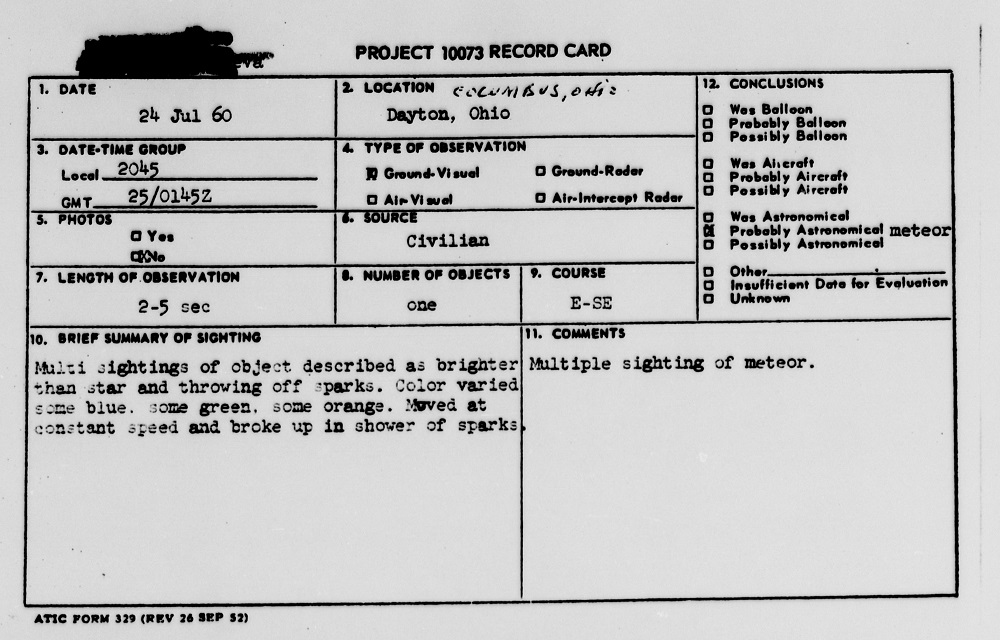
The July 24, 1960 meteor occurred during the early morning hours, and at first was reported to Lockbourne AFB as a possible UFO. The case was actually investigated as a Project Blue Book case, but the description and multiple eyewitness reports across the region supported that this was a meteor.
Unfortunately, much of the original report notes beyond the introductory page have faded to the point where it is difficult or impossible to read them. Still, the forms are provided below in a PDF. Perhaps someone is able to make out more than I could. Full Report
In this short installment of Strange Columbus, we talk about the 1955 OSU Explosion that occurred early on the morning of Thursday, January 6th. The event happened at the War Research Building on Ohio State’s main campus. Half a pound of pyridine exploded during an experiment, though there were no injuries as the lab was unoccupied at the time of the explosion. The blast shattered four windows on the 2nd floor of the building, and generally caused a mess in the lab itself. However, because no fire occurred during the event, damage was described as light. Several pieces of lab equipment were sent to the Columbus Fire Department to be checked out for further danger, but the event was labeled a freak accident. It went unmentioned in the local news as to the nature of the experiment and why explosive materials were being used. The exact building this occurred in seems unclear, as old articles do not mention the location. Unfortunately, this event would be far from the last in terms of university lab accidents.
Columbus has far less explosive history to discover.
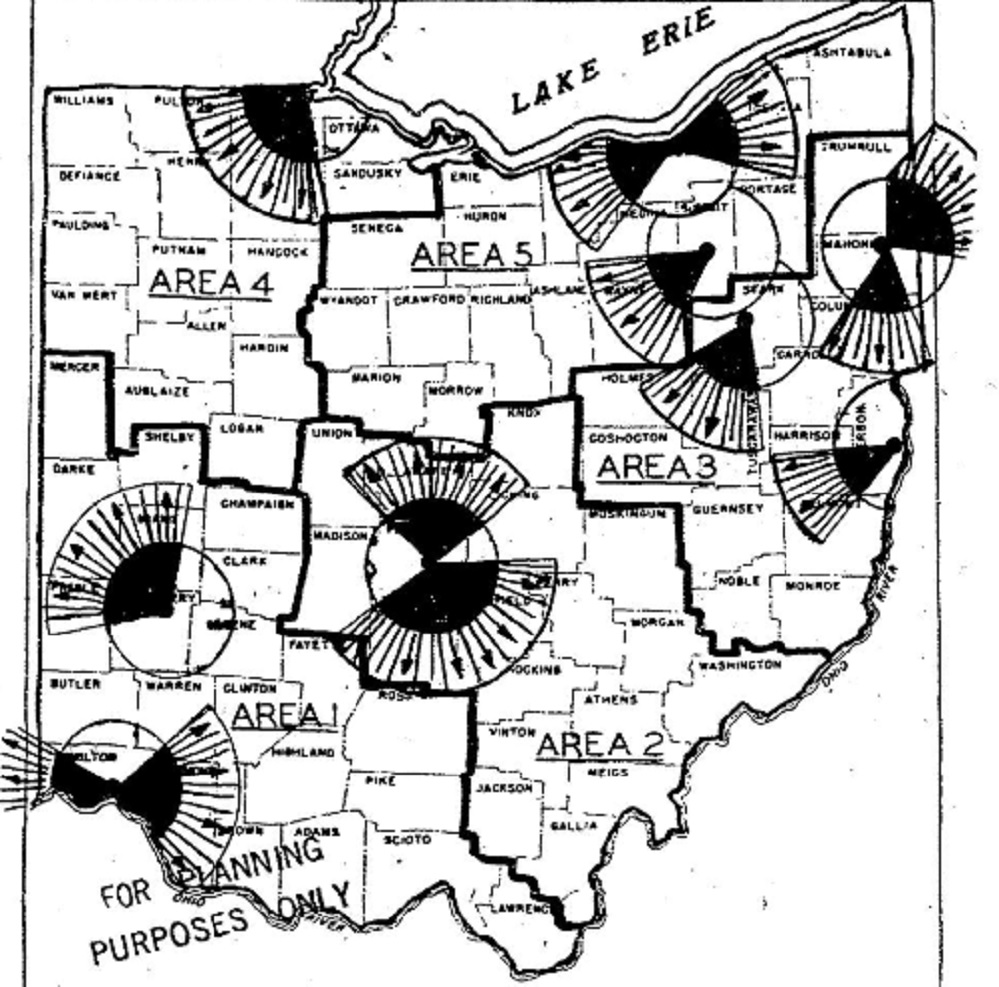
In this short edition of Strange Columbus Things, we look at Ohio’s atomic bomb evacuation routes. Back in the 1950s, many were still grappling with the implications of the birth of the Atomic Age. The US was busily testing bombs both on and outside of US soil, and souring relationships with international adversaries presented the threat of nuclear war. In March, 1955, the director of Ohio’s Civil Defense, Major General Leo M. Kreber, release evacuation routes for Ohio’s major cities should an attack take place.
For Columbus, it was either north or south. In the description of why these directions are preferred, it was suggested that it was to prevent conflict with evacuees from the Dayton area to the west, but in reality, the truth is much darker. In the event of a nuclear attack, it wouldn’t just be Columbus. Dayton and Cincinnati would also be hit, and due to prevailing winds in this part of the world, fallout would generally move eastward. Therefore, the safest routes were thought to be up towards Morrow County or south and southeast towards Hocking County. The logic hasn’t changed much in the past 70 years. North and south would still be the safest evacuation routes. However, evacuation from targeted locations would only offer temporary refuge. The cruel reality is that in the event of a true, global nuclear war, few places anywhere on the planet would be left unscathed. If not destroyed by bombs or irradiated by fallout, nuclear winter would bring incredibly devastation to most of the planet, even those completely untouched by bombs. As true today as it was in 1955, the only way to really be safe is for no one to ever push the button.