From 1945 until an atmospheric test moratorium in July, 1962, atomic bomb testing in Nevada was so common that Las Vegas tourists would hold parties just to watch the tests from their hotel rooms. Little was known, at least in the beginning, about the effects of nuclear fallout, or just how far it could actually spread.
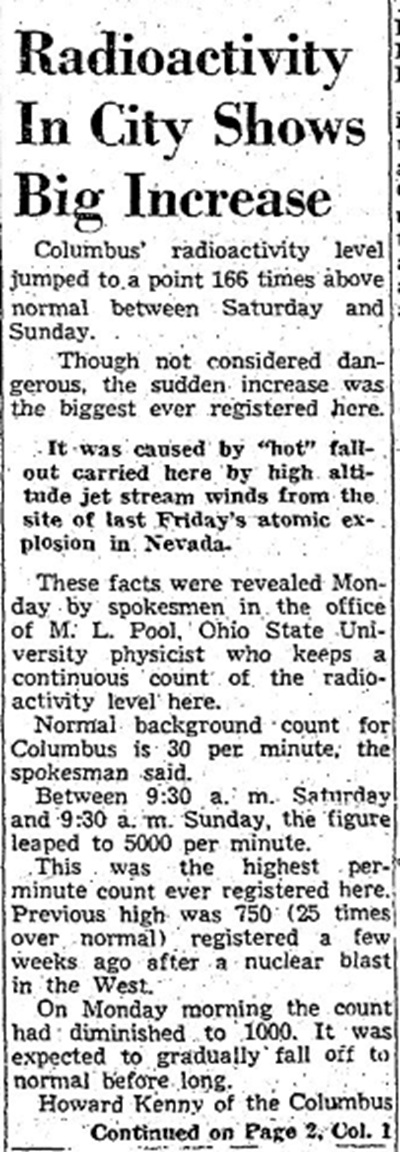
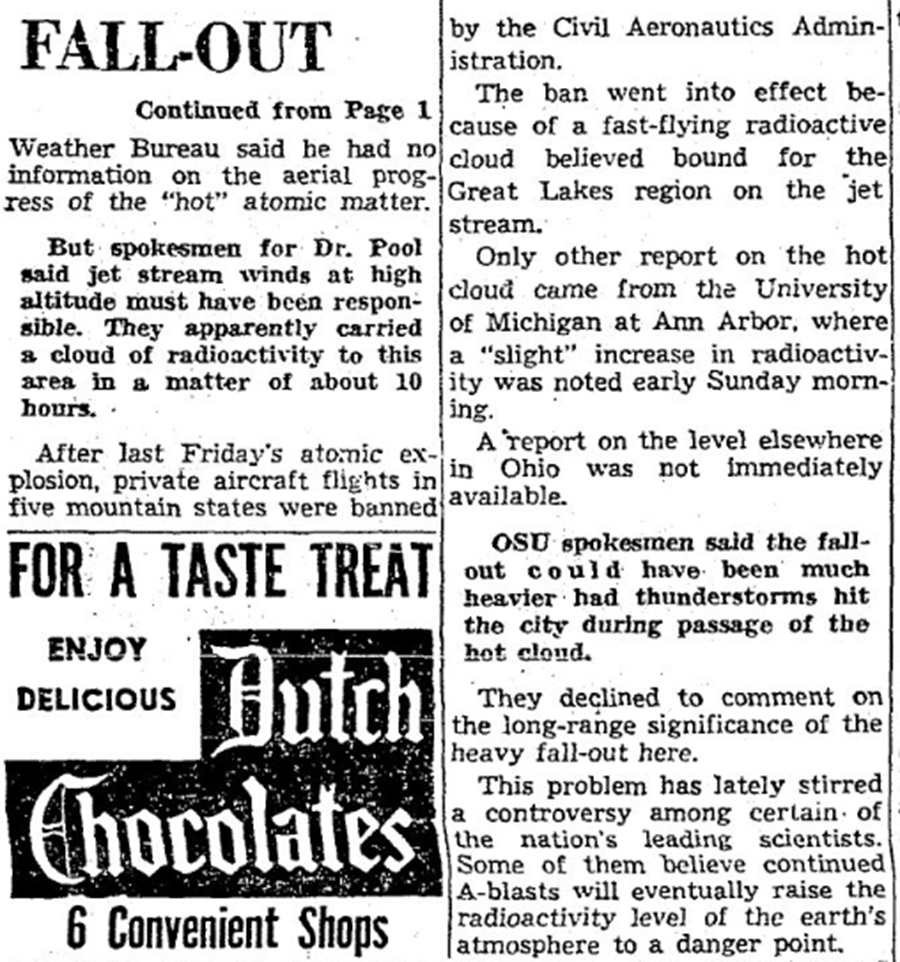
On April 18, 1955, during what was known as Operation Teapot, the Columbus Dispatch reported that radiation from the testing site had reached Columbus.
The radiation had come from the MET test which occurred on April 15, 1955. The bomb was 22 kilotons in size. The video above is from the MET test itself.
Events like this happened several times as the jet stream carried radioactive fallout across the country, and the 1955 nuclear test fallout wouldn’t be the last. It’s unclear whether this fallout had any substantial health impacts long-term, locally or otherwise, but today we understand that even relatively low doses of radiation increase one’s risk for developing cancers down the road. Luckily, these increased levels tended to last a day or two only.
The earthquake of May, 1897 struck on the 31st at around 1PM. It had an epicenter near Pearisburg, Virginia, right on the West Virgina state line. The earthquake was estimated to have had a magnitude of 5.8-6.0, with a Modified Mercalli Scale (MMI) maximum rating of VIII. All of Ohio felt this earthquake, though southern and eastern sections felt it most strongly. Shaking strength was estimated to be in the MMI range of III-V across much of the state.
A MMI of V occurred at Cincinnati during the earthquake of May, 1897. A V is described as the following: Felt by all, frightens some. Pictures and lighting sway, a few objects fall from shelves or are overturned. A few instances of cracked plaster or windows. The Times-Star in Cincinnati made the following report the following day: Felt “here and in the suburbs…. The printers ran out of the Times-Star office. The occupants of other buildings were alarmed, and at Coney Island, Chester Park, the Zoo gardens, and elsewhere there was consternation among the holiday crowds. At the Lagoon, on the Kentucky side, there was a panic among several thousand people on the grounds. The waters in the Lagoon were so rough that the life-saving crew went to the relief of those out on the electric pleasure boats.”
Zanesville experienced an MMI of V. It was reported that the Courier Building, “experienced decided vibrations” to such an extent that “the employees on the fourth and third floors deserted their posts, greatly frightened.”
In other places, where the exact MMI is not known or estimated, there were reports of light damage and general panic.
In Pomeroy, it was reported to The Columbus Dispatch that, “This city was considerably shaken up by an earthquake at 1:30 yesterday. Buildings were badly shaken, dishes knocked from shelves and several persons on the streets were stunned, almost to insensibility.”
In Nelsonville, the Dispatch reported, “An earthquake shock was plainly discernible here at 1 o’clock yesterday. In one house, a lamp was shaken from the table. Many persons were frightenend.”
At Batavia, it was reported that, “Quite a perceptible earthquake shock was felt here yesterday, about 1 o’clock and lasing for a full minute’s duration. Windows rattled, and in a number of cases, dishes were thrown down and broken.”
In Jackson, the report was that, “At the county infirmary, situated about two miles east of this city, the earthquake shock on Monday was very violent. The terrified inmates ran screaming from the buildings. Upon examination it was found that the shock had cracked the walls in many places. Window panes were also broken.”
In Columbus, the earthquake likely registered at a III at most. Many people did not feel it at all. The Dispatch reported that a “Mr. King, in his room in the Neil House, detected the earthquake the instant of its occurrence, took note of the time, reported the facts at the office, and was laughed at good naturedly by the clerks, but when The Evening Dispatch brought his vindication they cheerfully admitted that Mr. King knew an earthquake when he felt it.”
Near the epicenter in Western Virginia, the quake damaged many buildings, felled many chimneys, and even a train was derailed due to area landslides.
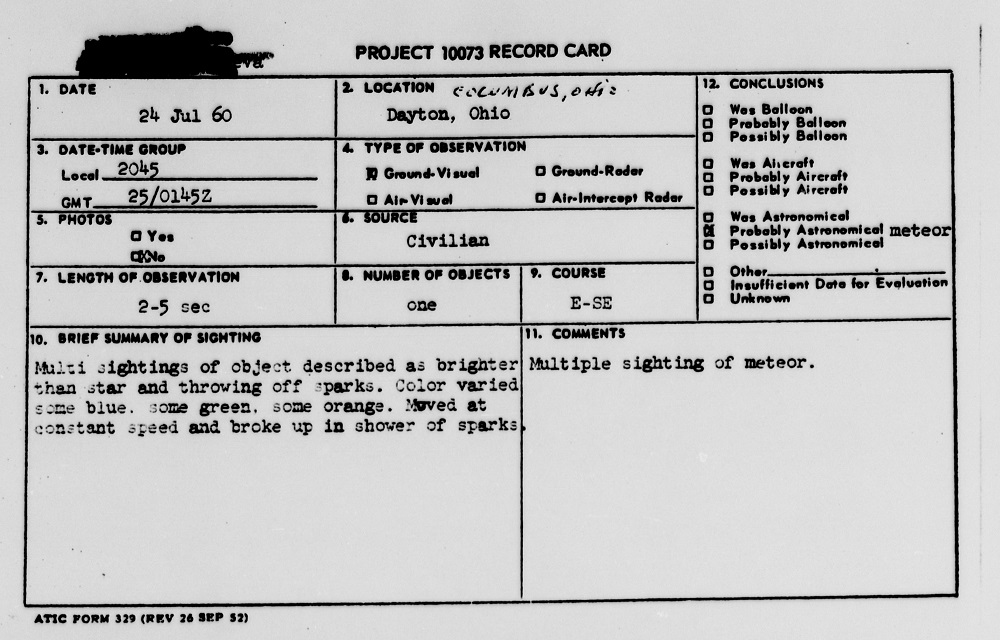
The July 24, 1960 meteor occurred during the early morning hours, and at first was reported to Lockbourne AFB as a possible UFO. The case was actually investigated as a Project Blue Book case, but the description and multiple eyewitness reports across the region supported that this was a meteor.
Unfortunately, much of the original report notes beyond the introductory page have faded to the point where it is difficult or impossible to read them. Still, the forms are provided below in a PDF. Perhaps someone is able to make out more than I could. Full Report
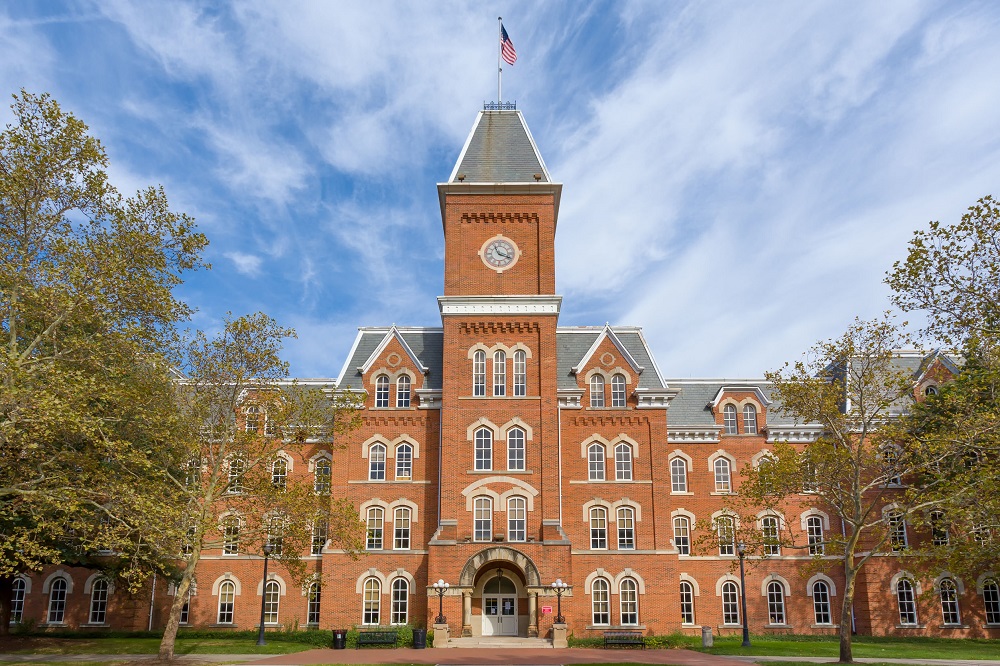
In this short installment of Strange Columbus, we talk about the 1955 OSU Explosion that occurred early on the morning of Thursday, January 6th. The event happened at the War Research Building on Ohio State’s main campus. Half a pound of pyridine exploded during an experiment, though there were no injuries as the lab was unoccupied at the time of the explosion. The blast shattered four windows on the 2nd floor of the building, and generally caused a mess in the lab itself. However, because no fire occurred during the event, damage was described as light. Several pieces of lab equipment were sent to the Columbus Fire Department to be checked out for further danger, but the event was labeled a freak accident. It went unmentioned in the local news as to the nature of the experiment and why explosive materials were being used. The exact building this occurred in seems unclear, as old articles do not mention the location. Unfortunately, this event would be far from the last in terms of university lab accidents.
Columbus has far less explosive history to discover.
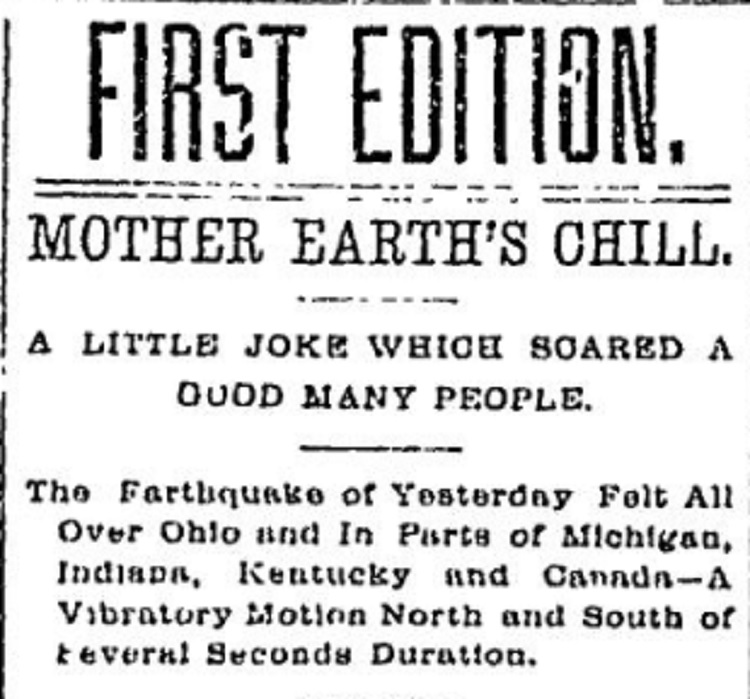
Columbus Dispatch headline from September 20, 1884.
This Strange Columbus 1884 Earthquake edition reviews a fairly rare event in the state-a damaging seismic event. While most earthquakes felt within the state have epicenters outside of Ohio- either west in the Missouri/Illinois area or north in Ontario or Quebec- the September, 1884 quake was one of the few damaging ones that had its origins within state borders. At around 2:45PM on the 19th, an estimated magnitude 4.8 tremor struck northwest Ohio. While 4.8 is not particularly strong as far as earthquakes go, Ohio’s geology allows even relatively weak quakes to shake the land with much greater force than in other parts of the country. The earthquake was felt across all of Ohio and several surrounding states. The Crestline Advocate, from small Crestline, Ohio to the west of Mansfield, provided accounts from all over the region a week after the event. Here are just a few.
From Crestline itself: A genuine earthquake visited this locality last Friday afternoon at 2:45, in which houses were made to tremble and furniture rattle. Several persons ran from dwellings and business houses, expecting everything to “fall in.” The swaying motion was very distinct, running east and west. The sensation was something new in this section. The experience here was the same as that telegraphed from numerous portions of the State. Our neighboring towns, also, reported a lively shaking up. James Booth says that, at the time of the occurrence, he was thrown from a lounge on which he was lying, then bounded up from the floor, whirled around, and went scooting out of his front door up into the air, and when he collected his scattered senses he found himself on the roof of his domicile, standing on his head. He didn’t say this in just so many words, but this was inferred from the experience he related.
COLUMBUS, O., September 20. – At 2:40p.m. yesterday, a shock of earthquake was felt in different parts of this city, the vibrations lasting over thirty seconds. At the Capitol (sic) University the chandeliers swayed to and fro and students left their rooms amid great excitement.
CLEVELAND, Ohio., September 20. – Yesterday afternoon an earthquake was felt in many parts of this city. Tables and furniture were moved in the houses, pictures on the walls were shaken, causing quite an excitement among the inmates. The motion was from west to east and was confined to three distinct rockings finally subsiding and dying away in a sort of a tremor.
CINCINNATI, O., September 20. – At 2:30 yesterday afternoon the shock of an earthquake was felt in this city and in Covington, Ky. There was a slight trembling of buildings and rocking motion felt, which was sufficiently marked to cause astonishment and comment. The motion was from north to south and was a gentle undulation, without any tremor or upheaval. The shocks lasted about ten seconds, there being a perceptible pause between the first and second. A gentleman, who was writing at home on Cutter Street, said he felt his table vibrate. It stopped and then moved again less violently than before. Reports from Mt. Vernon and Delaware, Ohio, say the shock was felt at their places.
A 1998 report on the event further described some of the damage and range of the earthquake. The earthquake caused damage at Lima, where the shock was “of considerable violence and caused much excitement.” Plaster was shaken from ceilings east and southeast of Columbus at Zanesville, Ohio, and Parkersburg, W. Va. Windows and dishes were broken at Defiance and Norwalk, Ohio; to the west at Fort Wayne and Muncie, Ind.; to the north at Lansing, Mich.; and to the east at Wheeling, W. Va. Furniture was displaced and 14 buildings were heavily shaken at Urbana, Ohio, in Champaign County, and at many other towns in the regions. Also felt in Iowa, Kentucky, Pennsylvania, and western Ontario, Canada, and at Washington, D.C. by workmen on top of the unfinished Washington Monument.
The exact epicenter was never determined, but research long after put the likely origin in Allen County.
The United Stated Geological Survey, or USGS, puts out an earthquake map with all current and past earthquakes from around the world. Users can select regions and search for earthquakes going back a century or more, or search based on magnitudes.