2019 Metro Population Estimates


2019 metro population estimates

The Census has released 2019 metro population estimates. This comparison uses those figures to rank the Columbus metro with other metros under the following categories:
Ohio metros with at least 250,000 people.
Midwest metros with at least 500,000 people.
National metros with 1.5-2.599 million people.

Total Metro Area Population Census 2010, July 1, 2018 and July 1, 2019
Census 2010——————————-July 1, 2018————————July 1, 2019

1. Chicago, IL: 9,461,105————-1. Chicago: 9,484,158———–1. Chicago: 9,458,539
2. Detroit, MI: 4,296,250—————2. Detroit: 4,322,084————-2. Detroit: 4,319,629
3. Minneapolis, MN: 3,348,8459—-3. Minneapolis: 3,610,061–3. Minneapolis: 3,640,043
4. St. Louis, MO: 2,787,701———-4. St. Louis: 2,803,958———4. St. Louis: 2,803,228
5. Pittsburgh, PA: 2,356,285——5. San Antonio: 2,512,379—5. San Antonio: 2,550,960
6. San Juan, PR: 2,350,126———-6. Portland: 2,473,350———6. Portland: 2,492,412
7. Portland, OR: 2,226,009——-7. Sacramento: 2,341,940—–7. Sacramento: 2,363,730
8. Sacramento, CA: 2,149,127—–8. Pittsburgh: 2,322,653——–8. Pittsburgh: 2,317,600
9. San Antonio, TX: 2,142,516—–9. Las Vegas: 2,226,115——-9. Las Vegas: 2,266,715
10. Cincinnati: 2,114,580———–10. Cincinnati: 2,211,936——-10. Austin: 2,227,083
11. Cleveland: 2,077,240———–11. Austin: 2,165,497———–11. Cincinnati: 2,221,208
12. Kansas City, MO: 2,009,342-12. Kansas City: 2,144,427–12. Kanas City: 2,157,990
13. Las Vegas, NV: 1,951,269—–13. Columbus: 2,104,194—–13. Columbus: 2,122,271
14. Columbus: 1,901,974——-14. Cleveland: 2,053,795—–14. Indianapolis: 2,074,537
15. Indianapolis, IN: 1,887,877—15. Indianapolis: 2,052,368—15. Cleveland: 2,048,449
16. San Jose, CA: 1,836,911—16. San Juan: 2,022,139———16. San Juan: 2,023,227
17. Austin, TX: 1,716,289————17. San Jose: 1,993,804—–17. San Jose: 1,990,660
18. Virginia Beach, VA: 1,676,822—18. Nashville: 1,904,726—18. Nashville: 1,934,317
19. Nashville: 1,670,890—19. Virginia Beach: 1,763,713–19. Virginia Beach: 1,768,901
20. Providence, RI: 1,600,852—-20. Providence: 1,622,379—20. Providence: 1,624,578
21. Milwaukee, WI: 1,555,908—–21. Milwaukee: 1,573,995—21. Milwaukee: 1,575,179
22. Jacksonville, FL: 1,345,596-22. Jacksonville: 1,532,663–22. Jacksonville: 1,559,514
23. Grand Rapids: 988,938–23. Grand Rapids: 1,071,370-23. Grand Rapids: 1,077,370
24. Omaha, NE: 865,350————–24. Omaha: 940,970—-24. Omaha: 949,442
25. Dayton: 799,232——————–25. Dayton: 805,088—–25. Dayton: 807,611
26. Akron: 703,200———————26. Akron: 703,855——–26. Akron: 703,479
27. Wichita, KS: 630,919————27. Des Moines: 690,915—27. Des Moines: 699,292
28. Toledo: 610,001——————28.Madison: 659,927——–28. Madison: 664,865
29. Madison, WI: 605,435———–29. Toledo: 643,089——–29. Toledo: 641,816
30. Des Moines, IA: 569,633——-30. Wichita: 637,519——30. Wichita: 640,218
31. Youngstown: 565,773———–31. Lansing: 548,674—–31. Lansing: 550,391
32. Lansing, MI: 534,684————32. Youngstown: 538,226—32. Youngstown: 536,081
33. Canton: 404,422——————33. Canton: 401,165—-33. Canton: 399,927

Charlotte and Orlando metros, previous national peers, have grown past the population standard limit of 2.599 million and are no longer used. Lansing and San Juan have been added.

Metro Area Total Growth Census 2010-July 1, 2019 and July 1, 2018-July 1, 2019
Census 2010-July 1, 2019—————————–July 1, 2018-July 1, 2019

1. Austin: +510,794————————————–1. Austin: +61,586
2. San Antonio: +408,452——————————2. Las Vegas: +40,600
3. Las Vegas: +315,446——————————–3. San Antonio: +38,581
4. Minneapolis: +306,410——————————4. Minneapolis: +29,982
5. Nashville: +288,117———————————-5. Nashville: +29,591
6. Portland: +266,403———————————–6. Jacksonville: +26,851
7. Columbus: +220,297——————————–7. Indianapolis: +22,169
8. Sacramento: +214,603——————————8. Sacramento: +21,790
9. Jacksonville: +213,918——————————9. Portland: +19,062
10. Indianapolis: +186,660—————————-10. Columbus: +18,077
11. San Jose: +153,749——————————–11. Kansas City: +13,563
12. Kansas City: +148,648—————————–12. Cincinnati: +9,272
13. Des Moines: +92,817——————————-13. Omaha: +8,472
14. Omaha: +84,092————————————-14. Des Moines: +8,377
15. Grand Rapids: +83,700—————————–15. Grand Rapids: +6,000
16. Cincinnati: +83,541———————————-16. Virginia Beach: +5,188
17. Madison: +59,430————————————17. Madison: +4,938
18. Virginia Beach: +54,947—————————-18. Wichita: +2,699
19. Providence: +23,726——————————–19. Dayton: +2,523
20. Detroit: +23,379—————————————20. Providence: +2,199
21. Milwaukee: +19,271———————————21. Lansing: +1,717
22. Wichita: +17,157————————————-22. Milwaukee: +1,184
23. Lansing: +15,707————————————23. San Juan: +1,088
24. St. Louis: +15,527———————————–24. Akron: -376
25. Dayton: +8,379—————————————25. St. Louis: -730
26. Akron: +279——————————————-26. Canton: -810
27. Chicago: -2,566————————————–27. Toledo: -1,273
28. Canton: -6,902—————————————28. Youngstown: -2,45
29. Toledo: -9,613—————————————-29. Detroit: -2,455
30. Cleveland: -28,791———————————-30. San Jose: -3,144
31. Youngstown: -29,692——————————-31. Pittsburgh: -5,053
32. Pittsburgh: -36,685———————————32. Cleveland: -5,346
33. San Juan: -326,899——————————–33. Chicago: -25,619


Now let’s look at the components of population change for metro areas.

Total Births By Metro Census 2010-July 1, 2019 and July 1, 2018-July 1, 2019
Census 2010-July 1, 2019———————–July 1, 2018-July 1, 2019

1. Chicago: 1,085,985——————————-1. Chicago: 108,425
2. Detroit: 462,696————————————2. Detroit: 48,879
3. Minneapolis: 419,634—————————–3. Minneapolis: 44,602
4. St. Louis: 310,273———————————4. San Antonio: 32,592
5. San Antonio: 300,032—————————-5. St. Louis: 31,686
6. Kansas City: 253,384—————————-6. Columbus: 27,096
7. Cincinnati: 253,180——————————-7. Las Vegas: 27,048
8. Portland: 253,110———————————8. Cincinnati: 26,892
9. Sacramento: 252,144—————————9. Sacramento: 26,752
10. Columbus: 251,291—————————10. Kanas City: 26,497
11. Las Vegas: 247,787—————————11. Indianapolis: 26,300
12. Indianapolis: 246,099————————-12. Portland: 26,204
13. Austin: 239,673———————————13. Austin: 26,115
14. San Jose: 220,891—————————–14. Nashville: 24,308
15. Pittsburgh: 218,159—————————-15. Pittsburgh: 22,570
16. Nashville: 216,969—————————–16. San Jose: 22,487
17. Cleveland: 212,523—————————-17. Cleveland: 22,003
18. Virginia Beach: 209,617———————-18. Virginia Beach: 21,589
19. Milwaukee: 182,815—————————19. Milwaukee: 18,927
20. Jacksonville: 167,526————————-20. Jacksonville: 18,592
21. Providence: 152,794————————–21. Providence: 16,182
22. Grand Rapids: 125,556———————-22. Grand Rapids: 13,339
23. Omaha: 122,306——————————23. Omaha: 12,848
24. Dayton: 88,783——————————–24. Dayton: 9,391
25. Des Moines: 85,530————————–25. Des Moines: 9,311
26. Wichita: 81,503——————————–26. Wichita: 8,057
27. Toledo: 71,848———————————27. Toledo: 7,428
28. Akron: 69,159———————————-28. Akron: 7,196
29. Madison: 67,559——————————29. Madison: 6,988
30. Lansing: 54,679——————————-30. Lansing: 5,702
31. Youngstown: 51,745————————-31. Youngstown: 5,450
32. Canton: 40,730——————————–32. Canton: 4,254

Components of change stats are not available for San Juan.

Total Deaths By Metro Census 2010-July 1, 2019 and July 1, 2018-July 1, 2019
Census 2010-July 1, 2019———————————July 1, 2018-July 1, 2019

1. Chicago: -647,739——————————————-1. Chicago: -74,501
2. Detroit: -377,943———————————————2. Detroit: -42,151
3. Pittsburgh: -253,686—————————————-3. St. Louis: -27,669
4. St. Louis: -241,884——————————————4. Pittsburgh: -27,387
5. Minneapolis: -210,510————————————-5. Minneapolis: -24,290
6. Cleveland: -198,044—————————————-6. Cleveland: -21,464
7. Cincinnati: -179,563—————————————-7. Cincinnati: -20,279
8. Sacramento: -157,234————————————-8. Sacramento: -18,933
9. Portland: -156,592——————————————9. San Antonio: -18,551
10. Kansas City: -155,166———————————–10. Portland: -18,458
11. San Antonio: -153,339———————————–11. Las Vegas: -17,919
12. Indianapolis: -148,608———————————–12. Kansas City: -17,692
13. Columbus: -142,665————————————–13. Columbus: -16,704
14. Las Vegas: -142,415————————————-14. Indianapolis: -16,678
15. Providence: -139,006————————————15. Virginia Beach: -15,280
16. Virginia Beach: -131,065——————————–16. Providence: -15,189
17. Nashville: -128,228—————————————17. Nashville: -15,122
18. Milwaukee: -123,806————————————-18. Jacksonville: -14,089
19. Jacksonville: -114,660———————————–19. Milwaukee: -13,810
20. San Jose: -94,587—————————————-20. San Jose: -11,582
21. Austin: -89,867——————————————–21. Austin: -11,445
22. Dayton: -77,893——————————————-22. Dayton: -8,506
23. Grand Rapids: -69,869———————————-23. Grand Rapids: -7,947
24. Akron: -65,852——————————————–24. Akron: -7,196
25. Youngstown: -64,558————————————25. Omaha: -6,931
26. Omaha: -62,030——————————————26. Youngstown: -6,842
27. Toledo: -59,436——————————————-27. Toledo: -6,624
28. Wichita: -51,734——————————————28. Wichita: 5,732
29. Des Moines: -44,857————————————29. Des Moines: 5,175
30. Canton: -41,233——————————————30. Lansing: -4,577
31. Lansing: -40,586—————————————–31. Madison: -4,453
32. Madison: -39,499—————————————-32. Canton: -4,395

Total Net Natural Change (Births vs. Deaths) By Metro Census 2010-July 1, 2019 and July 1, 2018-July 1, 2019
Census 2010-July 1, 2019———————————July 1, 2018-July 1, 2019

1. Chicago: 438,246———————————————1. Chicago: 33,924
2. Minneapolis: 209,124—————————————-2. Minneapolis: 20,312
3. Austin: 149,806———————————————–3. Austin: 14,670
4. San Antonio: 146,693—————————————4. San Antonio: 14,041
5. San Jose: 126,304——————————————-5. San Jose: 10,905
6. Columbus: 108,626——————————————6. Columbus: 10,392
7. Las Vegas: 105,372—————————————–7. Indianapolis: 9,622
8. Kansas City: 98,218—————————————–8. Nashville: 9,186
9. Indianapolis: 97,491—————————————–9. Las Vegas: 9,129
10. Portland: 96,518——————————————-10. Kansas City: 8,805
11. Sacramento: 94,910————————————–11. Sacramento: 7,819
12. Nashville: 88,741——————————————12. Portland: 7,746
13. Detroit: 84,753———————————————-13. Detroit: 6,728
14. Virginia Beach: 78,552———————————–14. Cincinnati: 6,613
15. Cincinnati: 73,617—————————————–15. Virginia Beach: 6,309
16. St. Louis: 68,389——————————————-16. Omaha: 5,917
17. Omaha: 60,276———————————————17. Grand Rapids: 5,392
18. Milwaukee: 59,009—————————————–18. Milwaukee: 5,117
19. Grand Rapids: 55,687————————————19. Jacksonville: 4,503
20. Jacksonville: 52,866————————————–20. Des Moines: 4,136
21. Des Moines: 40,673————————————–21. St. Louis: 4,017
22. Wichita: 29,769——————————————–22. Madison: 2,535
23. Madison: 28,060——————————————23. Wichita: 2,325
24. Cleveland: 14,479—————————————-24. Lansing: 1,125
25. Lansing: 14,093——————————————25. Providence: 993
26. Providence: 13,788————————————–26. Dayton: 885
27. Toledo: 12,412——————————————–27. Toledo: 804
28. Dayton: 10,890——————————————-28. Cleveland: 539
29. Akron: 3,307———————————————-29. Akron: 0
30. Canton: -503———————————————-30. Canton: -141
31. Youngstown: -12,813———————————–31. Youngstown: -1,392
32. Pittsburgh: -35,527————————————–32. Pittsburgh: -4,817

Total Domestic Migration By Metro Census 2010-July 1, 2019 and July 1, 2018-July 1, 2019
Census 2010-July 1, 2019———————————July 1, 2018-July 1, 2019

1. Austin: 293,162———————————————–1. Austin: 41,334
2. San Antonio; 214,509—————————————2. Las Vegas: 31,643
3. Las Vegas: 185,570—————————————–3. San Antonio: 21,987
4. Nashville: 158,336——————————————-4. Jacksonville: 20,051
5. Jacksonville: 126,483—————————————5. Nashville: 15,482
6. Portland: 121,473——————————————–6. Sacramento: 9,941
7. Sacramento: 69,723—————————————-7. Portland: 8,374
8. Columbus: 53,301——————————————-8. Indianapolis: 6,196
9. Indianapolis: 46,076—————————————-9. Columbus: 3,746
10. Des Moines: 40,183————————————–10. Des Moines: 3,718
11. Kansas City: 24,457————————————–11. Minneapolis: 3,202
12. Madison: 15,880——————————————12. Kansas City: 2,437
13. Minneapolis: 11,638————————————–13. Madison: 1,418
14. Grand Rapids: 10,903———————————–14. Cincinnati: 1,193
15. Omaha: 7,537———————————————-15. Omaha: 1,068
16. Canton: -7,124———————————————16. Dayton: 896
17. Dayton: -15,586——————————————–17. Wichita: -291
18. Akron: -15,683———————————————-18. Grand Rapids: -669
19. Lansing: -18,240——————————————-19. Canton: -677
20. Youngstown: -19,317————————————-20. Youngstown: -751
21. Cincinnati: -19,944—————————————-21. Lansing: -840
22. Wichita: -21,454——————————————-22. Akron: -1,190
23. Toledo: -27,740——————————————–23. Virginia Beach: -2,197
24. Pittsburgh: -31,804—————————————24. Toledo: -2,339
25. Providence: -38,503————————————-25. Pittsburgh: -2,658
26. Virginia Beach: -59,729———————————26. Providence: -3,185
27. Milwaukee: -64,395————————————–27. Milwaukee: -5,140
28. Cleveland: -78,763————————————–28. Cleveland: -7,250
29. St. Louis: -85,003—————————————-29. St. Louis: -7,685
30. San Jose: -124,105————————————-30. Detroit: -16,655
31. Detroit: -172,225—————————————–31. San Jose: -27,495
32. Chicago: -638,599—————————————32. Chicago: -74,950

Total International Migration By Metro Census 2010-July 1, 2019 and July 1, 2018-July 1, 2019
Census 2010-July 1, 2019———————————July 1, 2018-July 1, 2019
1. Chicago: 197,093——————————————-1. Chicago: 15,257
2. San Jose: 152,520—————————————–2. San Jose: 13,371
3. Detroit: 110,907———————————————3. Detroit: 7,516
4. Minneapolis: 87,847—————————————4. Minneapolis: 6,645
5. Austin: 62,740———————————————–5. Indianapolis: 6,394
6. Columbus: 58,853——————————————6. Austin: 5,280
7. Sacramento: 51,225—————————————7. Nashville: 4,937
8. Providence: 49,015—————————————-8. Providence: 4,455
9. Portland: 47,983——————————————–9. Sacramento: 4,053
10. San Antonio: 45,348————————————10. Columbus: 4,032
11. Indianapolis: 43,502————————————-11. St. Louis: 2,991
12. Nashville: 39,422—————————————–12. Portland: 2,960
13. Virginia Beach: 36,319———————————-13. Pittsburgh: 2,555
14. Cleveland: 36,318—————————————-14. San Antonio: 2,504
15. Jacksonville: 34,089————————————-15. Kansas City: 2,377
16. St. Louis: 32,872—————————————–16. Jacksonville: 2,251
17. Cincinnati: 31,157—————————————-17. Cincinnati: 1,547
18. Pittsburgh: 30,654—————————————-18. Omaha: 1,517
19. Kansas City: 27,259————————————-19. Lansing: 1,452
20. Milwaukee: 25,298—————————————20. Cleveland: 1,433
21. Las Vegas: 23,319—————————————21. Grand Rapids: 1,316
22. Lansing: 19,865——————————————22. Milwaukee: 1,277
23. Grand Rapids: 17,629———————————-23. Virginia Beach: 1,165
24. Omaha: 16,785——————————————24. Madison: 988
25. Madison: 15,600—————————————–25. Akron: 836
26. Dayton: 13,473——————————————26. Dayton: 785
27. Akron: 13,086——————————————–27. Wichta: 688
28. Des Moines: 11,716————————————28. Des Moines: 519
29. Wichita: 9,096——————————————-29. Toledo: 270
30. Toledo: 5,646——————————————–30. Canton: 25
31. Youngstown: 2,675————————————-31. Youngstown: 25
32. Canton: 1,073——————————————–32. Las Vegas: -360

Total Net Migration By Metro Census 2010-July 1, 2019 and July 1, 2018-July 1, 2019
Census 2010-July 1, 2019———————————July 1, 2018-July 1, 2019

1. Austin: 355,902———————————————1. Austin: 46,614
2. San Antonio: 259,857————————————-2. Las Vegas: 31,283
3. Las Vegas: 208,889—————————————3. San Antonio: 24,491
4. Nasvhille: 197,758—————————————–4. Jacksonville: 22,302
5. Portland: 169,456——————————————5. Nashville: 20,419
6. Jacksonville: 160,572————————————-6. Sacramento: 13,994
7. Sacramento: 120,948————————————-7. Indianapolis: 12,590
8. Columbus: 112,154—————————————-8. Portland: 11,334
9. Minneapolis: 99,458—————————————9. Minneapolis: 9,847
10. Indianapolis: 89,578————————————10. Columbus: 7,778
11. Des Moines: 51,899————————————-11. Kansas City: 4,814
12. Kansas City: 51,716————————————-12. Des Moines: 4,237
13. Madison: 31,480——————————————13. Cincinnati: 2,740
14. Grand Rapids: 28,352———————————–14. Omaha: 2,585
15. San Jose: 28,415—————————————-15. Madison: 2,406
16. Omaha: 24,322——————————————-16. Dayton: 1,681
17. Cincinnati: 11,213—————————————-17. Providence: 1,270
18. Providence: 10,512————————————–18. Grand Rapids: 647
19. Lansing: 1,625——————————————–19. Lansing: 612
20. Pittsburgh: -1,150—————————————-20. Wichita: 397
21. Dayton: -2,113——————————————–21. Pittsburgh: -103
22. Akron: -2,597———————————————-22. Akron: -354
23. Canton: -6,051——————————————–23. Canton: -652
24. Wichita: -12,358——————————————24. Youngstown: -726
25. Youngstown: -16,642————————————25. Virginia Beach: -1,032
26. Toledo: -22,094——————————————-26. Toledo: -2,069
27. Virginia Beach: -23,410——————————–27. Milwaukee: -3,863
28. Milwaukee: -39,097————————————-28. St. Louis: -4,694
29. Cleveland: -42,445————————————–29. Cleveland: -5,817
30. St. Louis: -52,131—————————————-30. Detroit: -9,139
31. Detroit: -61,318——————————————31. San Jose: -14,124
32. Chicago: -441,506————————————–32. Chicago: -59,693

The 2019 metro population estimates show Columbus largely holding its own against state, regional and national peers.


2018 Columbus and Peer Foreign-Born Comparison


Foreign-born comparison

In the ongoing series discussing topics related to the 2018 Census demographic estimates, today I will update the foreign-born comparison.  Beyond the simple comparison, I will also talk about the regions and countries that the foreign-born populations come from.

Total Foreign-Born Population Rank by City 2010 and 2018
2010————————————-——-2018

1. Chicago: 557,674—————1. Chicago: 540,738
2. San Jose: 366,194————-2. San Jose: 407,839
3. Austin: 148,431—————-3. Austin: 180,544
4. Las Vegas: 130,503———–4. Las Vegas: 133,033
5. Sacramento: 96,105———-5. Columbus: 125,339
6. Columbus: 86,663————-6. Sacramento: 114,786
7. Portland: 83,026—————7. Jacksonville: 111,798
8. Jacksonville: 77,145——–8. Nashville: 95,040
9. Indianapolis: 74,707——–9. Portland: 90,728
10. Nashville: 73,327———-10. Indianapolis: 81,764
11. Minneapolis: 57,846——11. Minneapolis: 68,131
12. Milwaukee: 57,222——–12. St. Paul: 59,381
13. Providence: 52,920——-13. Milwaukee: 57,647
14. St. Paul: 50,366———–14. Omaha: 50,279
15. Virginia Beach: 40,756—15. Providence ;46,995
16. Omaha: 39,288————16. Detroit: 44,520
17. Wichita: 39,128————17. Kansas City: 43,485
18. Kansas City: 35,532——18. Virginia Beach: 43,385
19. Detroit: 34,307————19. Wichita: 42,171
20. Madison: 24,929———20. Madison: 32,622
21. St. Louis: 23,011———-21. Des Moines: 31,013
22. Lincoln: 22,214———–22. Pittsburgh: 26,569
23. Des Moines: 20,798—–23. Lincoln: 23,309
24. Pittsburgh: 18,698——24. Fort Wayne: 22,489
25. Cleveland: 17,739——-25. Cleveland: 21,838
26. Grand Rapids: 16,615—26. St. Louis: 21,538
27. Cincinnati: 16,531——-27. Cincinnati: 20,592
28. Fort Wayne: 15,286—-28. Grand Rapids: 20,032
29. Toledo: 11,159———–29. Akron: 13,649
30. Akron: 8,524————30. Toledo: 9,038
31. Dayton: 5,102———–31. Dayton: 7,311
32. Youngstown: 3,695—-32. Canton: 3,241
33. Canton: 1,343———–33: Youngstown: 976

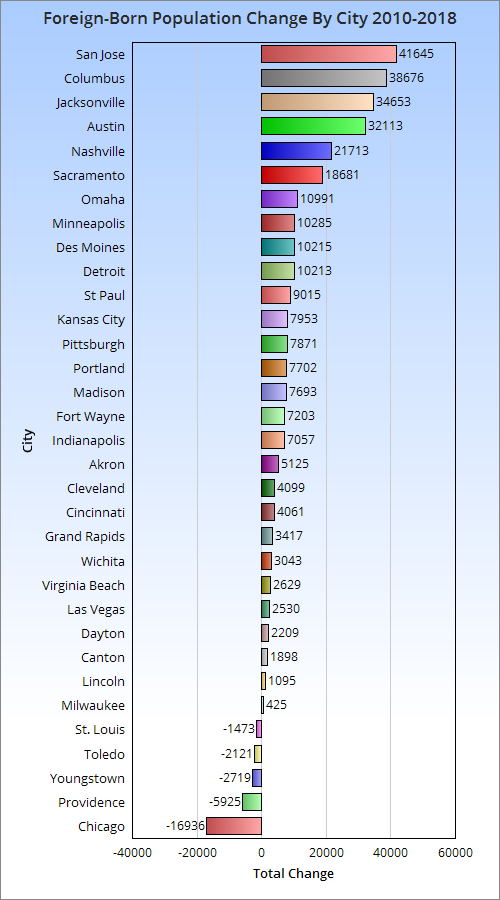
Here’s the 2010-2018 total change.

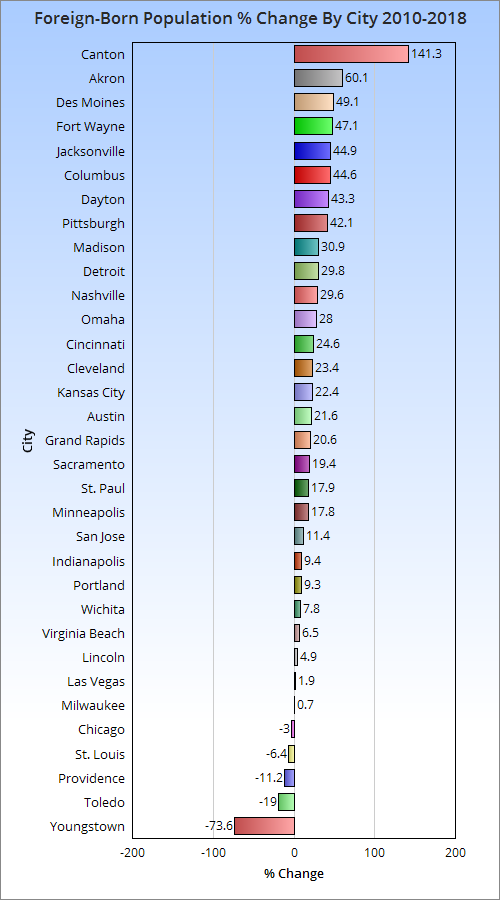
And the 2010-2018 change by %.

Columbus has done very well in both total and % growth of its foreign-born population since 2010.

So now that we know how many foreign-born immigrants are arriving and how fast, let’s take a look at where they are coming from.

Total Foreign-Born Residents From Europe in 2000 and 2018
2000———————————————–2018

1. Chicago: 145,462———————1. Chicago: 91,397
2. San Jose: 21,904———————2. San Jose: 22,043
3. Portland: 17,572———————-3. Jacksonville: 18,808
4. Jacksonville: 10,883————4. Portland: 17,016
5. Las Vegas: 9,070—————-5. Austin: 11,981
6. Cleveland: 8,796—————-6. Las Vegas: 11,472
7. St. Louis: 8,543——————7. Columbus: 8,141
8. Sacramento: 8,204————-8. Nashville: 8,108
9. Milwaukee: 7,841—————9. Virginia Beach: 6,710
10. Austin: 7,474——————10. Sacramento: 6,275
11. Pittsburgh: 7,413————–11. Pittsburgh: 5,047
12. Columbus: 7,017————–12. Minneapolis: 5,031
13. Indianapolis: 6,543———–13. Omaha: 3,845
14. Virginia Beach: 6,333——–14. St. Louis: 4,711
15. Detroit: 5,600—————–15. Indianapolis: 4,199
16. Minneapolis: 5,409———–16. Omaha: 3,845
17. Providence: 5,126————-17. Milwaukee: 3,808
18. Nashville: 4,859—————18. Madison: 3,519
19. Cincinnati: 3,851————–19. Providence: 3,030
20. Grand Rapids: 3,396———20. Lincoln: 2,777
21. Omaha: 3,320—————–21. Cincinnati: 2,738
22. St. Paul: 3,255—————-22. St. Paul: 2,449
23. Des Moines: 3,216———–23. Grand Rapids: 2,336
24. Kansas City: 2,985———-24. Kansas City: 2,320
25. Madison: 2,871—————25. Fort Wayne: 2,235
26. Lincoln: 2,701—————-26. Wichita: 1,851
27. Akron: 2,687—————–27. Detroit: 1,767
28. Fort Wayne: 2076———–28. Akron: 1,580
29. Toledo: 2,020—————-29. Des Moines: 1,042
30. Wichita: 2,004————–30. Toledo: 496
31. Dayton: 901——————31. Canton: 347
32. Youngstown: 870———–32. Dayton: 347
33. Canton: 590—————–33. Youngstown: 337

Columbus had more European immigrants than most in 2000 and 2018, and was one of the relatively few cities that saw an increase by 2018.

Total Foreign-born Population from Asia 2000 and 2018
2000————————————————–2018

1. San Jose: 182,712—————————1. San Jose: 256,504
2. Chicago: 112,932—————————2. Chicago: 144,970
3. Sacramento: 40,253———————3. Austin: 59,711
4. Portland: 26,271—————————4. Sacramento: 56,084
5. Austin: 25,036——————————5. Columbus: 49,185
6. St. Paul: 23,245———————-6. Portland: 42,245
7. Columbus: 22,354——————-7. Jacksonville: 39,543
8. Jacksonville: 17,427—————–8. Las Vegas: 35,959
9. Minneapolis: 17,376—————–9. St. Paul: 34,246
10. Las Vegas: 17,062—————–10. Nashville: 28,142
11. Virginia Beach: 15,176————-11. Indianapolis: 24,992
12. Detroit: 15,114———————-12. Virginia Beach: 21,954
13. Nashville: 12,573——————-13. Milwaukee: 18,192
14. Milwaukee: 12,114——————14. Minneapolis: 17,929
15. Wichita: 10,826——————–15. Detroit: 17,474
16. Madison: 9,736——————–16. Madison: 17,021
17. Indianapolis: 9,190—————-17. Omaha: 14,582
18. Pittsburgh: 7,938—————–18. Wichita: 14,107
19. Providence: 7,871—————–19. Kansas City: 13,753
20. Kansas City: 7,312—————-20. Des Moines: 13,139
21. Lincoln: 6,691———————-21. Pittsburgh: 12,929
22. St. Louis: 6,425——————–22. Lincoln: 11,233
23. Omaha: 6,302 ———————23. Fort Wayne: 10,809
24. Cleveland: 6,213——————-24. Cleveland: 10,351
25. Des Moines: 5,239—————-25. St. Louis: 9,505
26. Cincinnati: 4,326——————26. Akron: 8,391
27. Toledo: 3,847———————-27. Providence: 7,744
28. Grand Rapids: 3,206————–28. Cincinnati: 5,599
29. Akron: 3,099———————–29. Toledo: 3,597
30. Fort Wayne: 2,792—————–30. Grand Rapids: 3,369
31. Dayton: 903————————-31. Dayton: 2,575
32. Youngstown: 338——————32. Canton: 542
33. Canton: 296————————33. Youngstown: 196

Columbus ranks even higher with its foreign-born Asian population.

Total Foreign-born Population from Africa 2000 and 2018
2000—————————————————2018

1. Minneapolis: 12,765——————–1. Columbus: 45,092
2. Chicago: 12,613————————-2. Minneapolis: 26,271
3. Columbus: 9,530———————–3. Chicago: 25,573
4. San Jose: 5,189————————-4. Nashville: 18,423
5. St. Paul: 4,697———————5. Indianapolis: 14,965
6. Nashville: 4,183——————-6. St. Paul: 13,594
7. Detroit:: 3,249———————7. Austin: 9,961
8. Providence: 3,138—————-8. Kansas City: 8,558
9. Indianapolis: 2,650—————9. San Jose: 8,546
10. Portland: 2,430—————–10. Cincinnati: 7,113
11. Austin 2,263———————11. Des Moines: 6,191
12. Kansas City: 2,192————–12. Omaha: 5,474
13. Cincinnati: 1,781—————-13. Grand Rapids: 3,932
14. Jacksonville: 1,719————-14. Portland: 3,899
15. St. Louis: 1,500—————–15. St. Louis: 3,777
16. Omaha: 1,497——————-16. Providence: 3,571
17. Milwaukee: 1,332—————17. Milwaukee: 3,552
18. Cleveland: 1,075—————-18. Jacksonville: 3,426
19. Sacramento: 1,051————-19. Lincoln: 2,942
20. Des Moines: 1,038————-20. Wichita: 2,752
21. Madison: 991——————–21. Madison: 2,599
22. Wichita: 946——————–22. Detroit: 2,081
23. Las Vegas: 916—————–23. Pittsburgh: 1,909
24. Pittsburgh: 905—————-24. Sacramento: 1,784
25. Virginia Beach: 840———–25. Virginia Beach: 1,783
26. Grand Rapids: 718————-26. Fort Wayne: 1,614
27. Toledo: 638——————–27. Dayton: 1,573
28. Lincoln: 637——————–28. Akron: 1,312
29. Dayton: 522——————–29. Las Vegas: 1,206
30. Fort Wayne: 384————–30. Cleveland: 622
31. Akron: 197———————-31. Toledo: 416
32. Canton: 89———————32. Youngstown: 277
33. Youngstown: 50—————33. Canton: 95

Columbus has claimed the number 1 spot in its foreign-born African population, passing previous top city Minneapolis.

And finally, the total foreign-born population from the Americas in 2000 and 2018
2000—————————————————-2018

1. Chicago: 357,235————————–1. Chicago: 277,742
2. San Jose: 117,989————————2. San Jose: 119,455
3. Austin: 73,935———————-3. Austin: 97,933
4. Las Vegas: 63,277——————4. Las Vegas: 83,782
5. Sacramento: 28,927—————5. Jacksonville: 49,339
6. Providence: 27,649—————-6. Sacramento: 42,722
7. Milwaukee: 24,781——————7. Nashville: 39,633
8. Detroit: 21,527———————-8. Indianapolis: 37,287
9. Portland: 20,939——————-9. Providence: 32,650
10. Minneapolis: 19,648————-10. Milwaukee: 31,917
11. Indianapolis: 17,530————–11. Omaha: 26,012
12. Nashville: 17,125——————12. Wichita: 23,429
13. Omaha: 14,467——————–13. Detroit: 23,198
14. Wichita:: 13,988——————14. Columbus: 22,469
15. Grand Rapids: 13,477————15. Portland: 20,407
16. Kansas City: 12,948————–16. Minneapolis: 18,765
17. Jacksonville: 11,881—————17. Kansas City: 18,170
18. St.Paul: 9,804———————18. Virginia Beach: 12,667
19. Columbus: 8,596—————–19. Des Moines: 10,675
20. Des Moines: 6,201—————20. Grand Rapids: 10,395
21. Virginia Beach: 5,754————21. Madison: 9,349
22. Cleveland: 5,192—————–22. St. Paul: 9,070
23. Madison: 5,080——————23. Fort Wayne: 7,831
24. Fort Wayne: 4,930————–24. Lincoln: 6,280
25. Lincoln: 3,106——————–25. Pittsburgh: 5,898
26. St. Louis: 2,961——————-26. Cleveland: 5,810
27. Toledo: 2,942———————27. Cincinnati: 4,901
28. Pittsburgh: 2,463—————-28. Toledo: 4,347
29. Cincinnati: 2,432—————–29. St. Louis: 3,545
30. Dayton: 919———————-30. Dayton: 2,816
31. Akron: 891————————31. Akron: 2,366
32. Canton: 347———————-32. Canton: 2,257
33. Youngstown: 333—————33. Youngstown: 166

Columbus does the worst with this group, but even here it moved up 5 spots in the rankings.

The rest of the foreign-born population is made up of small groups of people from Oceania- or basically island nations.


2018 Columbus Racial Diversity Comparison


racial diversity comparison

Yesterday, the US Census released tons of new demographic data for 2018. The next few posts will detail some of that data and how Columbus compares to Midwestern and national peers in terms of population, racial diversity and other metrics. These peers are based on either large Midwestern cities or metro areas between 1.5-2.5 million.
This post will be a racial diversity comparison, specifically.

Total Non-Hispanic White Population by City by Year
2010———————————–2018

1. Chicago: 853,910————–1. Chicago: 899,980
2. Indianapolis: 482,195———2. Columbus: 486,431
3. Columbus: 470,971———–3. Austin: 470,620
4. Jacksonville, FL: 452,926—-4. Indianapolis: 465,466
5. Portland, OR: 417,876——–5. Portland: 457,042
6. Austin: 384,065—————6. Jacksonville: 455,487
7. Virginia Beach: 282,812——7. Omaha: 307,845
8. Las Vegas: 280,604———-8. Virginia Beach: 275,371
9. Omaha, NE: 277,606———9. Las Vegas: 272,870
10. San Jose, CA: 265,311——10. Kansas City: 269,854
11. Kansas City, MO: 247,473–11. San Jose: 253,571
12. Wichita, KS: 245,146——-12. Minneapolis: 252,327
13. Minneapolis: 242,848——13. Wichita: 242,671
14. Milwaukee: 221,514——–14. Lincoln: 227,215
15. Lincoln, NE: 216,076——-15. Milwaukee: 204,250
16. Pittsburgh: 203,622——–16. Pittsburgh: 195,468
17. Fort Wayne, IN: 179,646—17. Madison: 186,034
18. Madison, WI: 178,307——18. Fort Wayne: 173,088
19. Toledo: 177,341————–19. St. Paul: 159,782
20. Sacramento, CA: 165,610–20. Sacramento: 158,333
21. St. Paul, MN: 159,704——-21. Toledo: 157,967
22. Des Moines, IA: 145,937—22. Cincinnati: 150,693
23. Cincinnati: 143,120———23. Des Moines: 137,268
24. Cleveland: 137,977———24. St. Louis: 133,688
25. St. Louis: 134,146———–25. Cleveland: 131,010
26. Grand Rapids, MI: 104,636–26. Grand Rapids: 115,719
27. Providence, RI: 64,284——27. Detroit: 72,982
28. Detroit: 55,298————–28. Providence: 58,856

Previous peers, such as San Antonio, Charlotte and Orlando were removed as their metros are now larger than the 2.5 million comparison limit.  Jacksonville, Florida entered the comparison with a metro population of just over 1.5 million in 2018.  Smaller Ohio cities like Dayton, Akron, Canton and Youngstown, which are normally compared, did not have this data available.

Total Non-Hispanic White Change 2010-2018
1. Austin: +86,555
2. Chicago: +46,070
3. Portland: +39,166
4. Omaha: +30,239
5. Kansas City: +22,381
6. Detroit: +17,684
7. Columbus: +15,460
8. Lincoln: +11,139
9. Grand Rapids: +11,083
10. Minneapolis: +9,479
11. Madison: +7,727
12. Cincinnati: +7,573
13. Jacksonville: +2,561
14. St. Paul: +28
15. St. Louis: -458
16. Wichita: -2,475
17. Providence: -5,428
18. Fort Wayne: -6,558
19. Cleveland: -6,967
20. Sacramento: -7,277
21. Virginia Beach: -7,441
22. Las Vegas: -7,734
23. Pittsburgh: -8,154
24. Des Moines: -8,669
25. San Jose: -11,740
26. Indianapolis: -16,729
27. Milwaukee: -17,264
28. Toledo: -19,374

Non-Hispanic White % of Total Population by City in 2018
1. Lincoln: 79.1%
2. Madison: 72.1%
3. Portland: 70.0%
4. Omaha: 65.7%
5. Fort Wayne: 65.5%
6. Pittsburgh: 64.9%
7. Des Moines: 63.3%
8. Wichita: 62.3%
9. Virginia Beach: 61.2%
10. Minneapolis: 59.3%
11. Grand Rapids: 57.8%
12. Toledo: 57.5%
13. Kansas City: 54.9%
14. Columbus: 54.3%
15. Indianapolis: 53.9%
16. St. Paul: 51.9%
17. Jacksonville: 50.4%
18. Cincinnati: 49.8%
19. Austin: 48.8%
20. St. Louis: 44.2%
21. Las Vegas: 42.3%
22. Milwaukee: 34.5%
23. Cleveland: 34.1%
24. Chicago: 33.3%
25. Providence: 32.8%
26. Sacramento: 31.1%
27. San Jose: 24.6%
28. Detroit: 10.9%

Total Non-Hispanic Black Population by City by Year
2010————————————2018
1.  Chicago: 895,294————1. Chicago: 784,266
2. Detroit: 587,707————–2. Detroit: 520,161
3. Jacksonville: 249,532——-3. Jacksonville: 274,290
4. Milwaukee: 230,473——–4. Columbus: 259,803
5. Indianapolis: 226,314——-5. Indianapolis: 251,958
6. Columbus: 216,486———6. Milwaukee: 222,619
7. Cleveland: 208,528———7. Cleveland: 178,909
8. St. Louis: 157,382———–8. Kansas City: 137,867
9. Kansas City: 138,461——-9. St. Louis: 137,087
10. Cincinnati: 131,909——-10. Cincinnati: 122,261
11. Virginia Beach: 79,583—11. Virginia Beach: 84,333
12. Toledo: 75,033————12. Minneapolis: 81,930
13. Pittsburgh: 71,539——-13. Austin: 78,354
14. Minneapolis: 63,749—–14. Toledo: 74,630
15. Sacramento: 61,976—–15. Pittsburgh: 68,637
16. Austin: 61,833————16. Las Vegas: 68,488
17. Las Vegas: 60,187——–17. Sacramento: 64,824
18. Omaha: 55,086———–18. Omaha: 56,503
19. Wichita: 42,662———-19. St. Paul: 44,572
20. St. Paul: 41,923———-20. Wichita: 42,874
21. Grand Rapids: 41,848—21. Fort Wayne: 40,640
22. Fort Wayne: 39,016—–22. Portland: 39,882
23. Portland: 37,355——–23. Grand Rapids: 35,264
24. San Jose: 29,831——–24. San Jose: 29,432
25. Des Moines: 19,962—-25. Providence: 26,594
26. Providence: 19,265—–26. Des Moines: 24,018
27. Madison: 17,560——–27. Madison: 20,276
28. Lincoln: 9,023———-28. Lincoln: 12,203

Total Non-Hispanic Black Change 2010-2018
1. Columbus: +43,317
2. Indianapolis: +25,644
3. Jacksonville: +24,758
4. Minneapolis: +18,181
5. Austin: +16,521
6. Las Vegas: +8,301
7. Providence: +7,329
8. Virginia Beach: +4,750
9. Des Moines: +4,056
10. Lincoln: +3,180
11. Sacramento: +2,848
12. Madison: +2,716
13. St. Paul: +2,649
14. Portland: +2,527
15. Fort Wayne: +1,624
16. Omaha: +1,417
17. Wichita: +212
18. San Jose: -399
19. Toledo: -403
20. Kansas City: -594
21. Pittsburgh: -2,902
22. Grand Rapids: -6,584
23. Milwaukee: -7,854
24. Cincinnati: -9,648
25. St. Louis: -20,295
26. Cleveland: -29,619
27. Detroit: -67,546
28. Chicago: -111,028

Non-Hispanic Black % of Total Population by City in 2018
1. Detroit: 77.3%
2. Cleveland: 46.6%
3. St. Louis: 45.3%
4. Cincinnati: 40.4%
5. Milwaukee: 37.7%
6. Jacksonville: 30.4%
7. Indianapolis: 29.2%
8. Columbus: 29.0%
9. Chicago: 29.0%
10. Kansas City: 28.0%
11. Toledo: 27.1%
12. Pittsburgh: 22.8%
13. Minneapolis: 19.3%
14. Virginia Beach: 18.7%
15. Grand Rapids: 17.6%
16. Fort Wayne: 15.4%
17. Providence: 14.8%
18. St. Paul: 14.5%
19. Sacramento: 12.8%
20. Omaha: 12.1%
21. Des Moines: 11.1%
22. Wichita: 11.0%
23. Las Vegas: 10.6%
24. Austin: 8.1%
25. Madison: 7.9%
26. Portland: 6.1%
27. Lincoln: 4.3%
28. San Jose: 2.9%

Total Non-Hispanic Asian Population by City by Year
2010——————————-2018
1. San Jose: 303,227————1. San Jose: 367,280
2. Chicago: 148,280————2. Chicago: 179,841
3. Sacramento: 84,556——–3. Sacramento: 97,192
4. Austin: 46,575—————4. Austin: 73,185
5.  Portland: 43,185————5. St. Paul: 59,395
6. St. Paul: 41,989————–6. Portland: 57,526
7. Las Vegas: 37,406———-7. Columbus: 54,902
8. Columbus: 35,468———-8. Las Vegas: 46,422
9. Jacksonville: 33,663——–9. Jacksonville: 42,639
10. Virginia Beach: 27,303—10. Virginia Beach: 31,875
11. Milwaukee: 22,670——–11. Indianapolis: 31,777
12. Minneapolis: 21,426——12. Minneapolis: 26,768
13.  Wichita: 19,420———-13. Milwaukee: 25,17
14. Indianapolis: 17,137——14. Madison: 23,594
15. Madison: 16,671———-15. Wichita: 17,410
16. Pittsburgh: 12,036——-16. Omaha: 17,185
17. Providence: 11,497——-17. Pittsburgh: 16,724
18. Lincoln: 10,452———–18. Des Moines: 15,057
19. Kansas City: 10,263—–19. Fort Wayne: 13,661
20. Des Moines: 8,867——20. Providence: 12,556
21. St. Louis: 8,717———–21. Lincoln: 12,494
22. Omaha: 8,397———–22. Kansas City: 12,130
23. Fort Wayne: 6,945—–23. St. Louis: 10,662
24. Detroit: 6,549———-24. Detroit: 10,597
25. Cincinnati: 5,938——25. Cleveland: 10,595
26. Cleveland: 5,392——26. Cincinnati: 6,999
27. Grand Rapids: 3,695–27. Grand Rapids: 4,431
28. Toledo: 3,125———-28. Toledo: 2,802

Total Non-Hispanic Asian Change 2010-2018
1. San Jose: +64,053
2. Chicago: +31,561
3. Austin: +26,610
4. Columbus: +19,434
5. St. Paul: +17,406
6. Indianapolis: +14,640
7. Portland: +14,341
8. Sacramento: +12,636
9. Las Vegas: +9,016
10. Jacksonville: +8,976
11. Omaha: +8,788
12. Madison: +6,923
13. Fort Wayne: +6,716
14. Des Moines: +6,190
15. Minneapolis: +5,342
16. Cleveland: +5,203
17. Pittsburgh: +4,688
18. Virginia Beach: +4,572
19. Detroit: +4,048
20. Milwaukee: +2,501
21. Lincoln: +2,042
22. St. Louis: +1,945
23. Kansas City: +1,867
24. Cincinnati: +1,061
25. Providence: +1,059
26. Grand Rapids: +736
27. Toledo: -323
28. Wichita: -2,010

Non-Hispanic Asian % of Total Population by City in 2018
1. San Jose: 35.7%
2. St. Paul: 19.3%
3. Sacramento: 19.1%
4. Madison: 9.1%
5. Portland: 8.8%
6. Austin: 7.6%
7. Las Vegas: 7.2%
8. Virginia Beach: 7.1%
9. Providence: 7.0%
10. Des Moines: 6.9%
11. Chicago: 6.7%
12. Minneapolis: 6.3%
13. Columbus: 6.1%
14. Pittsburgh: 5.6%
15. Fort Wayne: 5.2%
16. Jacksonville: 4.7%
17. Wichita: 4.5%
18. Lincoln: 4.4%
19. Milwaukee: 4.3%
20. Indianapolis: 3.7%
21. Omaha: 3.7%
22. St. Louis: 3.5%
23. Cleveland: 2.8%
24. Kansas City: 2.5%
25. Cincinnati: 2.3%
26. Grand Rapids: 2.2%
27. Detroit: 1.6%
28. Toledo: 1.0%


Total Hispanic Population by City By Year
2010———————————2018
1. Chicago: 763,968————-1. Chicago: 776,661
2. San Jose: 318,389————2. San Jose: 333,819
3. Austin: 288,130—————3. Austin: 314,949
4. Las Vegas: 181,923———–4. Las Vegas: 222,860
5. Sacramento: 124,461———5. Sacramento: 148,343
6. Milwaukee: 104,619———-6. Milwaukee: 119,876
7. Indianapolis: 78,467———-7. Jacksonville: 94,158
8.  Providence: 76,645———-8. Indianapolis: 88,022
9. Jacksonville: 64,081———-9. Providence: 75,177
10. Wichita: 59,823————-10. Wichita: 70,564
11. Portland: 58,986————11. Omaha: 68,747
12. Omaha: 53,661————–12. Portland: 60,760
13. Kansas City: 49,800——–13. Columbus: 53,935
14. Detroit : 45,580————-14. Detroit: 52,718
15. Columbus: 43,276———-15. Kansas City: 52,638
16. Cleveland: 36,067———-16. Cleveland: 47,144
17. Minneapolis: 34,504——-17. Minneapolis: 40,912
18. Grand Rapids: 30,659—–18. Virginia Beach: 37,365
19. Virginia Beach: 29,206—-19. Grand Rapids: 36,469
20. St. Paul: 28,725————20. Des Moines: 31,706
21. Des Moines: 23,832——-21. St. Paul: 26,081
22. Toledo: 21,346————-22. Toledo: 24,625
23. Fort Wayne: 19,576——-23. Fort Wayne: 24,623
24. Lincoln: 16,007————24. Lincoln: 22,339
25. Madison: 14,062———-25. Madison: 18,867
26. St. Louis: 11,207———–26. St. Louis: 12,509
27. Cincinnati: 8,710———-27. Cincinnati: 10,773
28. Pittsburgh: 7,282———28. Pittsburgh: 10,180

Total Hispanic Population Change 2010-2018
1. Las Vegas: +40,937
2. Jacksonville: +30,077
3. Austin: +26,819
4. Sacramento: +23,882
5. San Jose: +15,430
6. Milwaukee: +15,257
7. Omaha: +15,086
8. Chicago: +12,693
9. Cleveland: +11,077
10. Wichita: +10,741
11. Columbus: +10,659
12. Indianapolis: +9,555
13. Virginia Beach: +8,159
14. Des Moines: +7,874
15. Detroit: +7,138
16. Minneapolis: +6,408
17. Lincoln: +6,332
18. Grand Rapids: +5,810
19. Fort Wayne: +5,047
20. Madison: +4,805
21. Toledo: +3,279
22. Pittsburgh: +2,898
23. Kansas City: +2,838
24. Cincinnati: +2,063
25. Portland: +1,774
26. St. Louis: +1,302
27. Providence: -1,468
28. St. Paul: -2,644

Hispanic % of Total Population by City in 2018
1. Providence: 41.9%
2. Las Vegas: 34.6%
3. Austin: 32.7%
4. San Jose: 32.4%
5. Sacramento: 29.2%
6. Chicago: 28.7%
7. Milwaukee: 20.3%
8. Grand Rapids: 18.2%
9. Wichita: 18.1%
10. Omaha: 14.7%
11. Des Moines: 14.6%
12. Cleveland: 12.3%
13. Kansas City: 10.7%
14. Jacksonville: 10.4%
15. Indianapolis: 10.2%
16. Minneapolis: 9.6%
17. Portland: 9.3%
18. Fort Wayne: 9.3%
19. Toledo: 9.0%
20. St. Paul: 8.5%
21. Virginia Beach: 8.3%
22. Detroit: 7.8%
23. Lincoln: 7.8%
24. Madison: 7.3%
25. Columbus: 6.0%
26. St. Louis: 4.1%
27. Cincinnati: 3.6%
28. Pittsburgh: 3.4%

Total Non-Hispanic Other Population by City by Year
2010——————————–2018

1. Chicago: 37,379————–1. Chicago: 65,240
2. San Jose: 32,439————-2. San Jose: 46,017
3. Sacramento: 30,900——–3. Columbus: 40,806
4. Portland: 28,027————-4. Sacramento: 39,825
5. Las Vegas: 24,521———–5. Portland: 37,363
6. Columbus: 23,738———–6. Jacksonville: 37,322
7. Jacksonville: 23,114———-7. Las Vegas: 34,024
8. Minneapolis: 20,753———8. Austin: 27,135
9. Virginia Beach: 20,268——9. Indianapolis: 26,908
10. Indianapolis: 20,086——10. Minneapolis: 23,458
11. Detroit: 16,776————-11. Virginia Beach: 21,245
12. Milwaukee: 16,311——– 12. Kansas City: 19,320
13. Wichita: 16,091————13. Milwaukee: 19,286
14. Omaha: 15,519————14. Omaha: 17,987
15. Austin: 14,915————-15. St. Paul: 17,871
16. Kansas City: 14,668——16. Detroit: 16,223
17. St. Paul: 13,098———–17. Cleveland: 16,123
18.  Pittsburgh: 11,280——-18. Wichita: 15,740
19. Toledo: 10,134————19. Toledo: 14,949
20. Fort Wayne: 8,513——-20. Lincoln: 13,148
21. Cleveland: 8,276———21. Fort Wayne: 12,158
22. St. Louis: 7,704———-22. Cincinnati: 11,889
23. Lincoln: 7,483———–23. Pittsburgh: 10,029
24. Grand Rapids: 7,376—24. Madison: 9,263
25. Cincinnati: 7,230——-25. Des Moines: 8,944
26. Madison: 7,177———26. St. Louis: 8,892
27. Providence: 6,471——27: Grand Rapids: 8,347
28. Des Moines: 5,598—–28. Providence: 6,152

Total Non-Hispanic Other Population Change 2010-2018
1. Chicago: +27,861
2. Columbus; +17,068
3. Jacksonville: +14,208
4. San Jose: +13,578
5. Austin: +12,220
6. Las Vegas: +9,503
7. Portland: +9,336
8. Sacramento: +8,925
9. Cleveland: +7.847
10. Indianapolis: +6,822
11. Lincoln: +5,665
12. Toledo: +4,815
13. St. Paul: +4,773
14. Cincinnati: +4,659
15. Kansas City: +4,652
16. Fort Wayne: +3,645
17. Des Moines: +3,346
18. Milwaukee: +2,975
19. Minneapolis: +2,705
20. Omaha: +2,468
21. Madison: +2,086
22. St. Louis: 1,188
23. Virginia Beach: +977
24. Grand Rapids: +971
25. Providence: -319
26. Wichita: -351
27. Detroit: -553
28. Pittsburgh: -1251

Non-Hispanic Other % of Total Population by City in 2018
1. Sacramento: 7.8%
2. St. Paul: 5.8%
3. Portland: 5.7%
4. Minneapolis: 5.5%
5. Toledo: 5.4%
6. Las Vegas: 5.3%
7. Virginia Beach: 4.7%
8. Fort Wayne: 4.6%
9. Lincoln: 4.6%
10. Columbus: 4.6%
11. San Jose: 4.5%
12. Cleveland: 4.2%
13. Grand Rapids: 4.2%
14. Jacksonville: 4.1%
15. Des Moines: 4.1%
16. Wichita: 4.0%
17. Cincinnati: 3.9%
18. Kansas City: 3.9%
19. Omaha: 3.8%
20. Madison: 3.6%
21. Providence: 3.4%
22. Pittsburgh: 3.3%
23. Milwaukee: 3.3%
24. Indianapolis: 3.1%
25. St. Louis: 2.9%
26. Austin: 2.8%
27. Chicago: 2.4%
28. Detroit: 2.4%

Now that we can see all the numbers, what is the 2018 ranking of most to least racially diverse? To find out, I assigned points by the ranking of % of population, so #1 of a particular ranking would get 1 point, the next 2 points and so on. The cities with the fewest points are the most diverse.
Here are the rankings for both 2010 and 2018.

Most to Least Diverse by Year and Total Points
2010——————————–2018

1. Portland: 50—————–1. Portland: 54
2. Sacramento: 52————2. Sacramento: 54
3. St. Paul: 53—————–3. Minneapolis: 55
4. Minneapolis: 54———–4. St. Paul: 58
5. Virginia Beach: 55——–5. Las Vegas: 59
6. Wichita: 57—————-6. Virginia Beach: 59
7. Las Vegas: 60————-7. Fort Wayne: 62
8. Providence: 61————8. Des Moines: 64
9. Omaha: 66—————-9. Jacksonville: 67
10. Grand Rapids: 69——-10. Columbus: 70
11. Des Moines: 71———-11. San Jose: 71
12. Madison: 72————-12. Cleveland: 72
13. San Jose: 72————-13. Wichita: 72
14. Fort Wayne: 73———14. Grand Rapids: 73
15. Kansas City: 73———15. Providence: 73
16. Milwaukee: 73———-16. Omaha: 74
17. Pittsburgh: 74———-17. Madison: 75
18. Jacksonville: 75——–18. Toledo: 75
19. Chicago: 76————-19. Milwaukee: 76
20. Columbus: 77———-20. Chicago: 77
21. Austin: 80—————21. Austin: 78
22. Indianapolis: 81——–22. Kansas City: 78
23. Toledo: 81————–23. Lincoln: 78
24. Lincoln: 85————-24. Indianapolis: 81
25. St. Louis: 94———–25. Pittsburgh: 82
26. Cleveland: 95———-26. Cincinnati: 91
27. Cincinnati: 97———-27. St. Louis: 96
28. Detroit: 104————28. Detroit: 106

Columbus had one of the fastest improvements of its diversity, moving up 10 spots from 20th to 10th.

To see how Columbus compares to cities in other ways, check out:
Columbus vs. Other Cities
And to see more national population data, visit:
United States Census


2017 Metro Population Estimates


2017 metro population estimates

Today, I am going to examine 2017 metro population estimates from the US Census, not only for Ohio, but also Columbus’ peer group that includes Midwest and national metro areas. Midwest peers (outside Ohio) used would be any metro with a population greater than 500,000. National peers would be metros that either started or ended the period 2010-2017 with a population between 1.5-2.5 Million.

As with counties, I am going to start this look with a comparison of overall population.

Total Metro Area Population Census 2010, July 1, 2016 and July 1, 2017
Census 2010——————————-July 1, 2016————————July 1, 2017

1. Chicago, IL: 9,461,104————-1. Chicago: 9,546,326———–1. Chicago: 9,533,040
2. Detroit, MI: 4,296,250—————2. Detroit: 4,305,869————-2. Detroit: 9,313,002
3. Minneapolis, MN: 3,348,8459—3. Minneapolis: 3,557,276–3. Minneapolis: 3,600,618
4. St. Louis, MO: 2,787,701———4. St. Louis: 2,806,782———4. St. Louis: 2,807,338
5. Pittsburgh, PA: 2,356,285——–5. Charlotte: 2,475,519———5. Charlotte: 2,525,305
6. Portland, OR: 2,226,009———-6. Orlando: 2,453,333———-6. Orlando: 2,509,831
7. Charlotte: 2,217,012———–7. San Antonio: 2,426,211—–7. San Antonio: 2,473,974
8. Sacramento, CA: 2,149,127—–8. Portland: 2,423,102——–8. Portland: 2,453,168
9. San Antonio, TX: 2,142,516—–9. Pittsburgh: 2,341,536——9. Pittsburgh: 2,333,367
10. Orlando, FL: 2,134,411—–10. Sacramento: 2,295,233—10. Sacramento: 2,324,884
11. Cincinnati: 2,114,580———-11. Cincinnati: 2,166,029—–11. Las Vegas: 2,204,079
12. Cleveland: 2,077,240————12. Las Vegas: 2,156,724—-12. Cincinnati: 2,179,082
13. Kansas City, MO: 2,009,342-13. Kansas City: 2,106,382-13. Kansas City: 2,128,912
14. Las Vegas, NV: 1,951,269——–14. Austin: 2,060,558——–14. Austin: 2,115,827
15. Columbus: 1,901,974———-15. Cleveland: 2,060,065——15. Columbus: 2,078,725
16. Indianapolis, IN: 1,887,877——16. Columbus: 2,046,977—16. Cleveland: 2,058,844
17. San Jose, CA: 1,836,911—17. Indianapolis: 2,005,612—17. Indianapolis: 2,028,614
18. Austin, TX: 1,716,289————18. San Jose: 1,990,910—-18. San Jose: 1,998,463
19. Virginia Beach, VA: 1,676,822—19. Nashville: 1,868,855—-19. Nashville: 1,903,045
20. Nashville: 1,670,890—20. Virginia Beach: 1,722,766–20. Virginia Beach: 1,725,246
21. Providence, RI: 1,600,852—-21. Providence: 1,615,878—21. Providence: 1,621,122
22. Milwaukee, WI: 1,555,908—–22. Milwaukee: 1,576,143—22. Milwaukee: 1,576,236
23. Jacksonville, FL: 1,345,596-23. Jacksonville: 1,476,503–23. Jacksonville: 1,504,980
24. Grand Rapids: 988,938–24. Grand Rapids: 1,048,826-24. Grand Rapids: 1,059,113
25. Omaha, NE: 865,350————–25. Omaha: 924,003—-25. Omaha: 933,316
26. Dayton: 799,232——————–26. Dayton: 800,886—–26. Dayton: 803,416
27. Akron: 703,200———————27. Akron: 702,556——–27. Akron: 703,505
28. Wichita, KS: 630,919————-28. Madison: 647,432—28. Madison: 654,230
29. Toledo: 610,001——————29. Wichita: 644,680——29. Des Moines: 645,911
30. Madison, WI: 605,435———–30. Des Moines: 634,740—-30. Wichita: 645,628
31. Des Moines, IA: 569,633——-31. Toledo: 604,591——31. Toledo: 603,668
32. Youngstown: 565,773——32. Youngstown: 544,543—32. Youngstown: 541,926
33. Canton: 404,422——————33. Canton: 401,165—-33. Canton: 399,927

Columbus passed up Cleveland to become Ohio’s 2nd largest metro.

Metro Area Total Growth Census 2010-July 1, 2017 and July 1, 2016-July 1, 2017
Census 2010-July 1, 2017—————————–July 1, 2016-July 1, 2017

1. Austin, TX: +399,507———————————–1. Orlando: +56,498
2. Orlando, FL: +375,432———————————2. Austin: +55,269
3. San Antonio, TX: +331,458—————————3. Charlotte: +49,786
4. Charlotte, NC: +308,313——————————-4. San Antonio: +47,763
5. Las Vegas, NV: +252,810—————————–5. Las Vegas: +47,355
6. Minneapolis, MN: +251,760————————–6. Minneapolis: +43,342
7. Nashville, TN: +232,162——————————-7. Nashville: +34,190
8. Portland, OR: +227,167——————————-8. Columbus: +31,748
9. Columbus: +176,724———————————–9. Portland: +30,066
10. Sacramento, CA: +175,740————————10. Sacramento: +29,651
11. San Jose, CA: +161,523—————————-11. Jacksonville: +28,477
12. Jacksonville, FL: +159,382————————-12. Indianapolis: +23,002
13. Indianapolis, IN: +140,524————————-13. Kansas City: +22,530
14. Kansas City, MO: +119,574————————14. Cincinnati: +13,053
15. Des Moines, IA: +76,278—————————15. Des Moines: +11,171
16. Chicago, IL: +71,499——————————–16. Grand Rapids: +10,287
17. Grand Rapids, MI: +70,173————————17. Omaha: +9,313
18. Omaha, NE: +67,960——————————–18. San Jose: +7,533
19. Cincinnati: +64,396———————————–19. Detroit: +7,133
20. Madison, WI: +48,802——————————-20. Madison: +6,798
21. Virginia Beach, VA: +48,429———————-21. Providence: +5,244
22. Milwaukee, WI: +20,282—————————22. Dayton: +2,530
23. Providence, RI: +19,912————————–23. Virginia Beach: +2,480
24. St. Louis, MO: +19,575—————————24. Akron: +949
25. Detroit, MI: +16,685——————————-25. Wichita: +948
26. Wichita, KS: +14,704——————————26. St. Louis: +556
27. Dayton: +4,165————————————-27. Milwaukee: +93
28. Akron: +302—————————————–28. Toledo: -923
29. Canton: -4,501————————————-29. Cleveland: -1,221
30. Toledo: -6,334————————————-30. Canton: -1,238
31. Cleveland: -18,427——————————-31. Youngstown: -2,617
32. Pittsburgh, PA: -22,924————————-32. Pittsburgh: -8,169
33. Youngstown: -23,873—————————-33. Chicago: -13,286

Now, as done with counties, let’s look at the components of population change for metro areas.

Total Births By Metro Census 2010-July 1, 2017 and July 1, 2016-July 1, 2017
Census 2010-July 1, 2017———————————July 1, 2016-July 1, 2017

1. Chicago: +869,178—————————————-1. Chicago: +115,915
2. Detroit: +364,121———————————————-2. Detroit: +49,940
3. Minneapolis: +331,430————————————–3. Minneapolis: +45,810
4. St. Louis: +246,280——————————————4. San Antonio: +34,318
5. San Antonio: +236,348————————————–5. St. Louis: +33,143
6. Charlotte: +217,525——————————————6. Charlotte: +31,315
7. Portland: +201,872——————————————-7. Orlando: +29,173
8. Orlando: +200,843——————————————-8. Portland: +28,220
9. Kansas City: +200,535————————————–9. Columbus: +27,663
10. Sacramento: +198,466————————————10. Kansas City: +27,565
11. Columbus: +197,185—————————————11. Las Vegas: +27,449
12. Cincinnati: +196,146—————————————12. Austin: +27,400
13. Las Vegas: +194,083————————————–13. Sacramento: +27,148
14. Indianapolis: +193,599————————————14. Cincinnati: +26,855
15. Austin: +188,961——————————————–15. Indianapolis: +26,769
16. San Jose: +176,224—————————————-16. Nashville: +24,690
17. Pittsburgh: +173,472—————————————17. San Jose: +23,826
18. Nashville: +170,824—————————————–18. Pittsburgh: +23,614
19. Cleveland: +168,361—————————————19. Cleveland: +22,873
20. Virginia Beach: +163,787———————————20. Milwaukee: +19,474
21. Milwaukee: +144,429————————————–21. Jacksonville: +18,748
22. Jacksonville: +130,339————————————22. Providence: +16,542
23. Providence: +120,526————————————-23. Grand Rapids: +13,548
24. Grand Rapids: +98,214———————————–24. Omaha: +13,421
25. Omaha: +96,558——————————————-25. Dayton: +9,615
26. Dayton: +69,855——————————————-26. Des Moines: +9,172
27. Wichita: +65,873——————————————27. Wichita: +8,694
28. Des Moines: +63,958————————————28. Madison: +7,400
29. Akron: +54,644——————————————–29. Toledo: +7,345
30. Toledo: +54,309——————————————-30. Akron: +7,342
31. Madison: +53,718—————————————-31. Virginia Beach: +5,935
32. Youngstown: +40,696———————————–32. Youngstown: +5,551
33. Canton: +32,199——————————————33. Canton: +4,434

Total Deaths By Metro Census 2010-July 1, 2017 and July 1, 2016-July 1, 2017
Census 2010-July 1, 2017———————————July 1, 2016-July 1, 2017

1. Chicago: -501,469—————————————1. Chicago: -72,491
2. Detroit: -293,091—————————————–2. Detroit: -41,075
3. Pittsburgh: -197,572————————————3. Pittsburgh: -27,439
4. St. Louis: -186,111————————————–4. St. Louis: -26,755
5. Minneapolis: -161,913———————————5. Minneapolis: -23,527
6. Cleveland: -153,138———————————–6. Cleveland: -21,068
7. Cincinnati: -135,975———————————–7. Cincinnati: -19,515
8. Charlotte: -127,523————————————-8. Charlotte: -19,009
9. Portland: -120,590————————————–9. Orlando: -18,268
10. Sacramento: -120,429——————————10. Sacramento: -18,081
11. Kansas City: -119,748——————————11. Portland: -17,875
12. Orlando: -117,771———————————–12. San Antonio: -17,679
13. San Antonio: -117,289——————————13. Kansas City: -17,106
14. Indianapolis: -113,742——————————14. Las Vegas: -16,867
15. Columbus: -108,704——————————–15. Indianapolis: -16,081
16. Las Vegas: -108,003——————————–16. Columbus: -15,833
17. Providence: -107,920——————————-17. Providence: -15,031
18. Nashville: -99,415———————————–18. Nashville: -14,723
19. Virginia Beach: -97,935—————————-19. Milwaukee: -13,399
20. Milwaukee: -95,601———————————20. Jacksonville: -13,288
21. Jacksonville: -86,920——————————-21. San Jose: -11,360
22. San Jose: -73,507———————————–22. Austin: -10,609
23. Austin: -67,704—————————————23. Dayton: -8,359
24. Dayton: -59,736————————————-24. Grand Rapids: -7,674
25. Grand Rapids: -53,725—————————-25. Akron: -7,138
26. Akron: -50,948—————————————26. Youngstown: -6,821
27. Youngstown: -50,302——————————27. Omaha: -6,667
28. Omaha: -47,763————————————-28. Toledo: -5,968
29. Toledo: -42,313————————————-29. Wichita: -5,686
30. Wichita: -40,647————————————30. Des Moines: -4,631
31. Canton: -31,722————————————31. Canton: -4,366
32. Des Moines: -31,563——————————32. Madison: -4,252
33. Madison: -30,385———————————-33. Virginia Beach: -3,280

Total Net Natural Change (Births vs. Deaths) By Metro Census 2010-July 1, 2017 and July 1, 2016-July 1, 2017
Census 2010-July 1, 2017———————————July 1, 2016-July 1, 2017

1. Chicago: +367,709—————————————1. Chicago: +43,424
2. Minneapolis: +169,517———————————–2. Minneapolis: +22,283
3. Austin: +121,257——————————————3. Austin: +16,791
4. San Antonio: +119,059———————————-4. San Antonio: +16,639
5. San Jose: +102,717————————————–5. San Jose: +12,466
6. Charlotte: +90,002—————————————-6. Charlotte: +12,306
7. Columbus: +88,481————————————–7. Columbus: +11,830
8. Las Vegas: +86,080————————————-8. Orlando: +10,905
9. Orlando: +83,072—————————————-9. Indianapolis: +10,688
10. Portland: +81,282————————————-10. Las Vegas: +10,582
11. Kansas City: +80,787———————————11. Kansas City: +10,459
12. Indianapolis: +79,857——————————–12. Portland: +10,345
13. Sacramento: +78,037——————————–13. Nashville: +9,967
14. Nashville: +71,409————————————14. Sacramento: +9,067
15. Detroit: +71,030—————————————15. Detroit: +8,865
16. Virginia Beach: +65,852—————————–16. Virginia Beach: +7,762
17. Cincinnati: +60,171———————————–17. Cincinnati: +7,340
18. St. Louis: +60,169————————————-18. Omaha: +6,754
19. Milwaukee: +48,828———————————-19. St. Louis: +6,388
20. Omaha: +48,795————————————–20. Grand Rapids: +5,874
21. Grand Rapids: +44,489—————————–21. Jacksonville: +5,460
22. Jacksonville: +43,419——————————-22. Des Moines: +4,541
23. Des Moines: +32,395——————————-23. Madison: +3,148
24. Wichita: +25,226————————————-24. Milwaukee: +6,075
25. Madison: +23,333———————————–25. Wichita: +3,008
26. Cleveland: +15,223——————————–26. Cleveland: +1,805
27. Providence: +12,606——————————27. Providence: +1,511
28. Toledo: +11,996———————————–28. Toledo: +1,377
29. Dayton: +10,119———————————-29. Dayton: +1,256
30. Akron: +3,696————————————–30. Akron: +204
31. Canton: +477—————————————31. Canton: +68
32. Youngstown: -9,606——————————-32. Youngstown: -1,270
33. Pittsburgh: -24,100——————————–33. Pittsburgh: -3,825

Total Domestic Migration By Metro Census 2010-July 1, 2017 and July 1, 2016-July 1, 2017
Census 2010-July 1, 2017———————————July 1, 2016-July 1, 2017

1. Austin: +224,351—————————————–1. Charlotte: +31,102
2. Charlotte: +177,484————————————-2. Austin: +30,120
3. San Antonio: +169,684——————————–3. Las Vegas: +29,414
4. Orlando: +155,498————————————–4. San Antonio: +24,891
5. Nashville: +126,142————————————-5. Orlando: +23,321
6. Las Vegas: +119,742———————————-6. Jacksonville: +18,921
7. Portland: +106,839————————————-7. Nashville: +18,708
8. Jacksonville: +87,040———————————8. Portland: +13,384
9. Sacramento: +49,262———————————9. Sacramento: +12,888
10. Columbus: +42,932———————————10. Columbus: +12,562
11. Des Moines: +32,042——————————-11. Kansas City: +8,531
12. Indianapolis: +30,772——————————-12. Minneapolis: +8,095
13. Kansas City: +16,802——————————-13. Indianapolis: +7,763
14. Madison: +13,224————————————14. Des Moines: +4,812
15. Grand Rapids: +12,355—————————-15. Grand Rapids: +2,217
16. Omaha: +5,265—————————————16. Madison: +1,706
17. Minneapolis: +432———————————–17. Cincinnati: +1,541
18. Canton: -5,797—————————————-18. Omaha: +383
19. Akron: -13,427—————————————-19. Dayton: -346
20. Youngstown: -16,228——————————-20. Akron: -877
21. Dayton: -16,864————————————–21. Canton: -1,469
22. Wichita: -18,452————————————–22. Youngstown: -1,711
23. Cincinnati: -21,259———————————-23. Providence: -2,588
24. Toledo: -23,102————————————–24. Toledo: -3,070
25. Pittsburgh: -24,397———————————25. Wichita: -3,235
26. Providence: -33,335——————————-26. Virginia Beach: -4,706
27. Milwaukee: -50,575——————————–27. Cleveland: -8,008
28. Virginia Beach: -51,916—————————28. Pittsburgh: -8,633
29. Cleveland: -64,353——————————–29. Milwaukee: -9,635
30. St. Louis: -67,560———————————30. St. Louis: -8,828
31. San Jose: -73,026——————————–31. Detroit: -14,863
32. Detroit: -141,006———————————-32. San Jose: -25,729
33. Chicago: -479,482——————————–33. Chicago: -85,177

Total International Migration By Metro Census 2010-July 1, 2017 and July 1, 2016-July 1, 2017
Census 2010-July 1, 2017———————————July 1, 2016-July 1, 2017

1. Chicago: +183,162—————————————1. Chicago: +28,302
2. Orlando: +135,860—————————————2. Orlando: +22,207
3. San Jose: +132,938————————————-3. San Jose: +20,747
4. Detroit: +86,366——————————————4. Detroit: +13,214
5. Minneapolis: +83,552———————————-5. Minneapolis: +13,107
6. Sacramento: +49,560———————————-6. Austin: +8,185
7. Austin: +49,311——————————————7. Sacramento: +7,722
8. Las Vegas: +46,411————————————8. Columbus: +7,350
9. Columbus: +45,744————————————9. Las Vegas: +7,221
10. Providence: +41,325——————————–10. Providence: +6,381
11. San Antonio: +40,953——————————-11. Portland: +6,335
12. Charlotte: +39,380———————————–12. Charlotte: +6,279
13. Portland: +38,542————————————13. San Antonio: +6,173
14. Virginia Beach: +34,619—————————-14. Nashville: +5,510
15. Nashville: +33,169———————————–15. Cleveland: +5,045
16. Cleveland: +31,236———————————-16. Indianapolis: +4,603
17. Indianapolis: +30,329——————————-17. Pittsburgh: +4,359
18. Jacksonville: +28,593——————————-18. Cincinnati: +4,285
19. St. Louis: +27,666————————————19. Jacksonville: +4,043
20. Pittsburgh: +27,300———————————20. St. Louis: +4,032
21. Cincinnati: +26,502———————————21. Milwaukee: +3,689
22. Kansas City: +23,098——————————22. Kansas City: +3,572
23. Milwaukee: +22,616——————————–23. Grand Rapids: +2,233
24. Omaha: +14,383————————————24. Omaha: +2,213
25. Grand Rapids: +13,800—————————25. Madison: +1,949
26. Madison: +12,367———————————-26. Des Moines: +1,807
27. Des Moines: +11,592—————————–27. Dayton: +1,654
28. Dayton: +11,230———————————–28. Akron: +1,647
29. Akron: +10,413————————————-29. Wichita: +1,187
30. Wichita: +8,117————————————-30. Virginia Beach: +1,077
31. Toledo: +4,627————————————-31. Toledo: +769
32. Youngstown: +2,171——————————32. Youngstown: +381
33. Canton: +1,118————————————33. Canton: +174

Total Net Migration By Metro Census 2010-July 1, 2017 and July 1, 2016-July 1, 2017
Census 2010-July 1, 2017———————————July 1, 2016-July 1, 2017

1. Orlando: +291,358————————————–1. Orlando: +45,528
2. Austin: +273,662—————————————-2. Austin: +38,305
3. Charlotte: +216,864————————————3. Charlotte: +37,381
4. San Antonio: +210,637——————————–4. Las Vegas: +36,635
5. Las Vegas: +166,153———————————-5. San Antonio: +31,064
6. Nashville: +159,311————————————6. Nashville: +24,218
7. Portland: +145,381————————————7. Jacksonville: +22,964
8. Jacksonville: +115,633——————————-8. Minneapolis: +21,202
9. Sacramento: +98,822——————————–9. Sacramento: +20,610
10. Columbus: +88,676——————————–10. Columbus: +19,912
11. Minneapolis: +83,984——————————11. Portland: +19,719
12. Indianapolis: +61,101——————————12. Indianapolis: +12,366
13. San Jose: +59,912———————————-13. Kansas City: +12,103
14. Des Moines: +43,634——————————14. Des Moines: +6,619
15. Kansas City: +39,900——————————15. Cincinnati: +5,826
16. Grand Rapids: +26,155—————————16. Grand Rapids: +4,450
17. Madison: +25,591———————————-17. Providence: +3,793
18. Omaha: +19,648————————————18. Madison: +3,655
19. Providence: +7,990———————————19. Omaha: +2,596
20. Cincinnati: +5,243———————————-20. Dayton: +1,308
21. Pittsburgh: +2,903———————————-21. Akron: +770
22. Akron: -3,014—————————————-22. Canton: -1,295
23. Canton: -4,679————————————–23. Youngstown: -1,330
24. Dayton: -5,634————————————–24. Detroit: -1,649
25. Wichita: -10,335————————————25. Wichita: -2,048
26. Youngstown: -14,057—————————–26. Toledo: -2,301
27. Virginia Beach: -17,297————————–27. Cleveland: -2,963
28. Toledo: -18,475————————————28. Virginia Beach: -3,629
29. Milwaukee: -27,959——————————29. Pittsburgh: -4,274
30. Cleveland: -33,117——————————-30. San Jose: -4,982
31. St. Louis: -39,894———————————31. St. Louis: -5,796
32. Detroit: -54,640————————————32. Milwaukee: -5,946
33. Chicago: -296,320——————————-33. Chicago: -56,875


The Midwest vs. South in Regional Domestic Migration in 2016


regional domestic migration in 2016

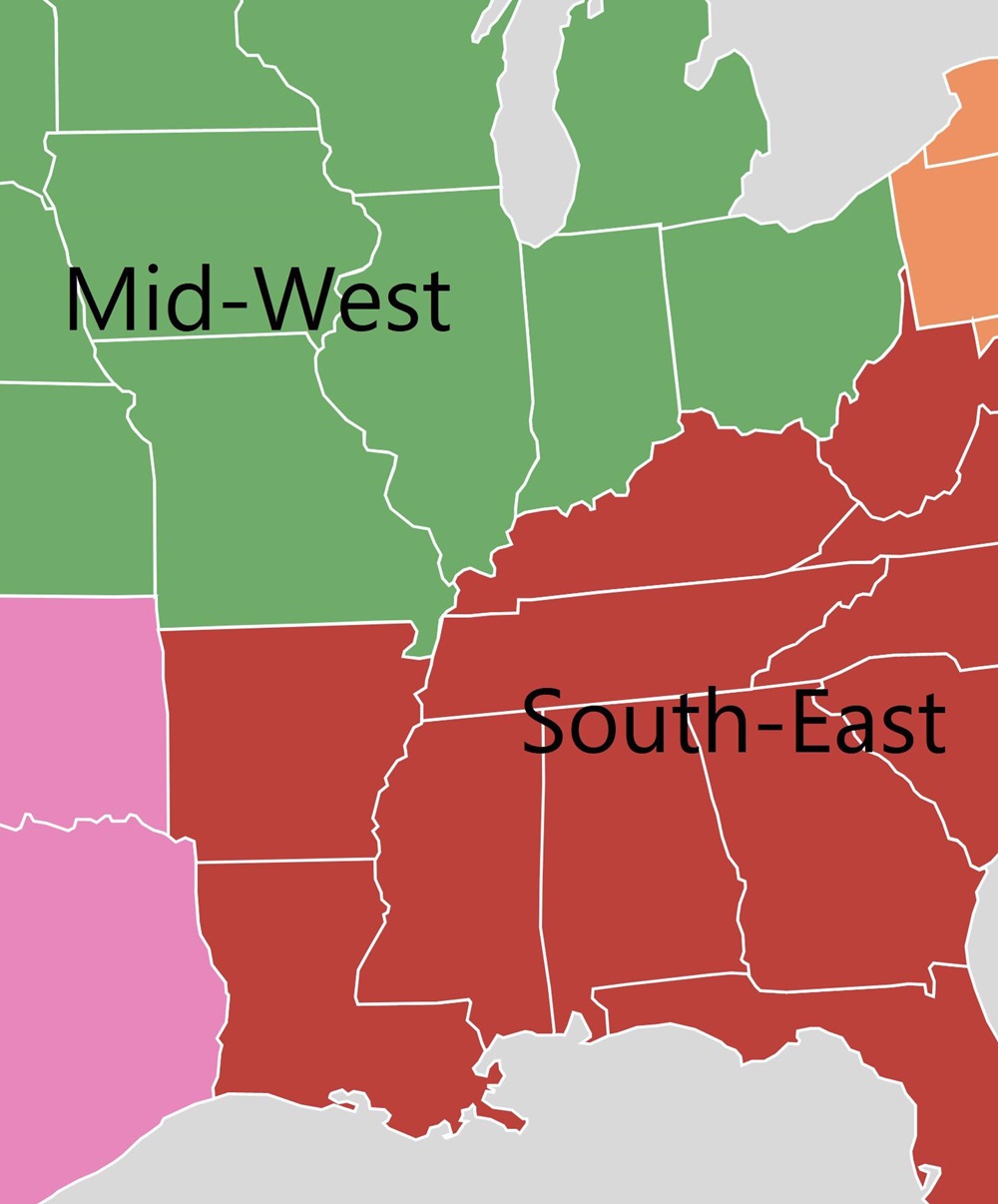
For years, if not decades, we’ve been hearing a familiar tale- that anyone and everyone is moving from the Midwest and Northeast to the South and West. This trend began during and after the collapse of Northern manufacturing, and as higher cost of living began to make the lower-cost South more attractive in particular. However, a lot of the South’s growth over the years- indeed a majority- never had anything to do with region-to-region migration. Instead, it was due largely to natural growth (births vs. deaths) and international migration, particularly from Central America. What received all the attention, though, was the belief that people were packing up and moving to the South from places like Ohio and other struggling Northern states. While that may have been true for a while, that is increasingly looking like it is no longer the case.

The Midwest, especially, has been derided as the region no one wants to live in. Despite its growing population approaching 66 million people, the common refrain was that its colder winters, flailing economies and questionable demographic future meant that it was simply a region being left behind by the booming Southern states.

Recently, the US Census released estimates for 2015-2016 geographic mobility, and they tell a very different story altogether. Regional domestic migration in 2016 may have actually bucked the trends.

First, let’s look at the total domestic migration moving to the Midwest from other regions.
South to Midwest: +309,000
West to Midwest: +72,000
Northeast to Midwest: +61,000
Total to Midwest: +442,000

And then compare that to the total that the Midwest sends to other regions.
Midwest to South: -254,000
Midwest to West: -224,000
Midwest to Northeast: -34,000
Total from Midwest: -512,000

Net difference by region.
Midwest vs. South: +55,000
Midwest vs. West: -152,000
Midwest vs. Northeast: +27,000
Total Net: -70,000

So while the Midwest is seeing an overall net domestic migration loss, it is entirely to the Western states.

This could just be an off year, as almost all recent years showed losses to the South, but then again, maybe not. The South has been in a boom for several decades now, and in that time, the region still lags the other 3 in almost every quality of life metric used. All booms end eventually, and the South’s 2 biggest perceived advantages, low cost of living and business-friendly climate, have been gradually eroding over time. As Census surveys show, people don’t actually move for a change in weather, so it’s the economic factors that are going to make the biggest impacts long-term. The Midwest now has many cities and several states that are doing well economically, including Columbus, and perhaps they are becoming more attractive than they have in many years. Time will tell, but last year, the narrative of an unattractive Midwest vs. South was at least temporarily shelved.