A Look Back- Winter 1995-1996 Review

I have been doing immediate, post-winter reviews since I began this website 13 years ago. While those posts are popular, I get tons of requests and searches for winters of decades past, so I thought it might be a good idea to periodically take a look back at some of them. By far, the winter of 1995-1996 has been at the top of the list from site visitors, so it makes sense to make it the inaugural winter of this series.
Winter 1995-1996 was the most severe of the 1990s, and arguably the most severe winter between 1984-1985 and 2002-2003. The winter featured much above normal snowfall and below normal temperatures that included one arctic outbreak. This winter set multiple records that still stand today, and is regarded as one of the worst winters in Columbus- and Ohio- history.

December-February
These are the statistics for the heart of Winter 1995-1996, as well as departures from average based on the current 1991-2020 normals.
Average High: 36.9 (-2.9)
Average Low: 21.1 (-3.4)
Mean: 29.0 (-3.2)
Coldest High: 6 on February 3rd
Coldest Low: -3 on February 4th
Coldest Mean: 3 on February 3rd and 4th
# of 32 or Below Highs: 41
# of 32 or Below Lows: 73
Warmest High: 71 on February 27th
Warmest Low: 57 on January 4th
Warmest Mean: 64 on February 21st
Precipitation: 7.84″ (+0.70″)
Snowfall: 40.6″ (+18.4″)
Average Daily Snow Depth: 1.8″
Maximum Snow Depth: 12″ on January 8th
Largest Snowstorm: 9.8″ on January 6th-7th
1″+ Snowfall Events: 14
# of Measurable Precipitation Days: 45
# of Measurable Snowfall Days: 35
Highest Average Daily Wind Speed in MPH: 20 on January 27th
Highest Wind Gust in MPH: 51 on February 24th

Entire Cold Season: October-April
Average High: 47.1
Average Low: 29.1
Mean: 38.1
Precipitation: 24.14″
Snowfall: 54.1″
Average Snow Depth: 0.8″
Largest Snowstorm: 9.8″ on January 6th-7th
# of 32 or Below Highs: 46
# of 32 or Below Lows: 127
# of Measurable Precipitation Days: 92
# of Measurable Snowfall Days: 49
Highest Average Daily Wind Speed in MPH: 21.6 on March 25th
Highest Wind Gust in MPH: 58 on April 29th

Temperature

Winter 1995-1996 review average high

Winter 1995-1996 review warmest high by month

Winter 1995-1996 review coldest high by month

High Temperature Records Set
On December 14th, the high reached 65 degrees, tying the record for the date set in 1901.
On January 18th, the high reached 68 degrees, breaking the old record of 67 set in 1929.
On February 3, the high only reached 6 degrees, breaking the old low maximum of 12 set in 1902.
On February 27th, the high reached 71 degrees, tying the old record of 71 set in 1896.

Winter 1995-1996 review average low

Winter 1995-1996 review warmest low by month

Winter 1995-1996 review coldest low by month

Low Temperature Records Set
On November 9th, the low fell to 17 degrees, breaking the old record of 18 set in 1991.

Winter 1995-1996 review average temperature

Winter 1995-1996 review warmest mean by month

Winter 1995-1996 review coldest mean by month

Winter 1995-1996 review 32 or below highs by month

Winter 1995-1996 review 32 or below lows by month

Precipitation

Winter 1995-1996 review precipitation by month

Winter 1995-1996 review greatest precipitation by month

Precipitation Records Set
On January 27th, 1.00″ of precipitation fell, breaking the old record of 0.97″ set in 1913.
On November 11th, 1.03″ of precipitation fell, breaking the old record of 0.84″ set in 1974. This record was later surpassed for the date when 1.14″ fell in 2022.
On December 19th, 0.68″ of precipitation fell, breaking the old record of 0.59″ set in 1982. This record was later surpassed for the date with 08.4″ in 2002 and later with 1.74″ in 2008.
On April 29th, 1.82″ of precipitation fell, breaking the old record of 1.37″ set in 1893. This record was later surpassed for the date when 1.88″ fell in 2021.

Winter 1995-1996 review precipitation days by month

Snowfall

Winter 1995-1996 review total snowfall by month

Winter 1995-1996 review snowfall days by month

Winter 1995-1996 review greatest snowfall by month

Snowfall Records Set
On November 21st, 1.9″ of snow fell, breaking the old record of 1.0″ set in 1911.
On December 19th, 4.3″ of snow fell, breaking the old record of 3.2″ set in 1948.
On January 7th, 8.8″ of snow fell, breaking the old record of 5.5″ set in 1979. This occurred during the Blizzard of 1996
On January 9th, 3.1″ of snow fell, breaking the old record of 2.7″ set in 1943.
On March 7th, 2.3″ of snow fell, tying the old record set in 1911. This record was later surpassed when 5.0″ fell in 2008.
On March 20th, 3.9″ of snow fell, breaking the old record of 3.0″ set in 1967.

Winter 1995-1996 review average snow depth by month

Winter 1995-1996 review greatest snow depth by month

Winter 1995-1996 review 1"+ snow depth days by month

Other

Winter 1995-1996 review average wind speed by month

Winter 1995-1996 review highest wind gust by month

If you are interested in seeing original weather advisories for the entire 1995-1996 winter, the Winter 1995-1996 Weather Advisories provides them.
 

The 2010 President’s Day Snowstorm


The 2010 President’s Day Snowstorm was the third and largest snowstorm to strike Columbus and Ohio during February, 2010. Models began showing the potential for another snow event in the Ohio Valley several days before. Initially, the track was well south, with only counties along the Ohio River being impacted, as this excerpt from the February 12, 2010 Area Forecast Discussion from Wilmington National Weather Service mentions:
MODEL SOLUTIONS CONTINUE TO DIFFER ON SYSTEM COMING IN SUNDAY NIGHT INTO THE BEGINNING OF THE WORK WEEK. THE GEM IS STILL THE FURTHEST SOUTH WITH THE UPCOMING SYSTEM. THE ECMWF HAS TRENDED NORTH WITH THE LATEST RUN AND IS NOW MORE IN LINE WITH THE GFS. THE ECMWF NOW ACTUALLY HAS THE SURFACE LOW SLIGHTLY FURTHER NORTH THAN THE GFS.
WENT WITH A GFS AND ECMWF BLEND. IT WILL BE COLD ENOUGH THAT PRECIPITATION WILL ALL BE IN THE FORM OF SNOW. MONDAY WILL SEE THE GREATEST CHANCE FOR SNOW WITH LOW TRACKING ACROSS KENTUCKY. ACCUMULATING SNOWFALL WILL BE POSSIBLE…ESPECIALLY ALONG AND SOUTH OF THE OHIO RIVER.

As the event grew closer, however, model solutions inched northward. On the afternoon of Saturday, February 13th, Wilmington issued the first Winter Storm Watch for parts of Ohio, but the focus continued to be south of Columbus.
URGENT – WINTER WEATHER MESSAGE
NATIONAL WEATHER SERVICE WILMINGTON OH
222 PM EST SAT FEB 13 2010
…ANOTHER WINTER STORM TO AFFECT THE OHIO VALLEY…
.LOW PRESSURE WILL DEVELOP OVER THE LOWER OHIO VALLEY ON SUNDAY…AND WILL TRACK INTO THE CENTRAL APPALACHIANS BY MONDAY EVENING. AS THE LOW MOVES SOUTH OF THE OHIO RIVER SUNDAY NIGHT AND MONDAY…SNOW WILL OVERSPREAD PARTS OF INDIANA…KENTUCKY AND OHIO. THIS SYSTEM HAS THE POTENTIAL TO PRODUCE SEVERAL INCHES OF SNOW ACROSS PARTS OF THE OHIO VALLEY…ESPECIALLY ACROSS AREAS SOUTH OF THE I-70 CORRIDOR.
FRANKLIN IN-RIPLEY-DEARBORN-OHIO-SWITZERLAND-CARROLL-GALLATIN-BOONE-KENTON-CAMPBELL-OWEN-GRANT-PENDLETON-BRACKEN-ROBERTSON-MASON-LEWIS-FAYETTE OH-PICKAWAY-FAIRFIELD-BUTLER-WARREN-CLINTON-ROSS-HOCKING-HAMILTON-CLERMONT-BROWN-HIGHLAND-ADAMS-PIKE-SCIOTO-
INCLUDING THE CITIES OF…BROOKVILLE…VERSAILLES…LAWRENCEBURG…RISING SUN…VEVAY…CARROLLTON…WARSAW…
BURLINGTON…INDEPENDENCE…ALEXANDRIA…OWENTON…WILLIAMSTOWN…FALMOUTH…BROOKSVILLE…MOUNT OLIVET…MAYSVILLE…VANCEBURG…WASHINGTON COURT HOUSE…CIRCLEVILLE…LANCASTER…HAMILTON…
LEBANON…WILMINGTON…CHILLICOTHE…LOGAN…CINCINNATI…MILFORD…GEORGETOWN…HILLSBORO…WEST UNION…PIKETON…PORTSMOUTH
…WINTER STORM WATCH IN EFFECT FROM SUNDAY EVENING THROUGH LATE MONDAY NIGHT…
THE NATIONAL WEATHER SERVICE IN WILMINGTON HAS ISSUED A WINTER STORM WATCH…WHICH IS IN EFFECT FROM SUNDAY EVENING THROUGH LATE MONDAY NIGHT.
LIGHT SNOW IS EXPECTED TO DEVELOP SUNDAY EVENING…AS A STORM SYSTEM MOVES INTO THE OHIO VALLEY. SNOW WILL INCREASE IN INTENSITY THROUGH EARLY MONDAY…WITH OCCASIONAL SNOW CONTINUING INTO MONDAY EVENING. BY THE TIME SNOW ENDS EARLY TUESDAY…THE POTENTIAL EXISTS FOR TOTAL SNOWFALL ACCUMULATIONS OF 4 TO 6 INCHES…WITH LOCALLY HIGHER AMOUNTS.
THESE FORECAST SNOW AMOUNTS ARE HIGHLY DEPENDENT ON THE EVENTUAL TRACK OF THE UPCOMING STORM SYSTEM. IF THE SYSTEM MOVES FURTHER NORTH OR SOUTH OF THE CURRENT FORECAST TRACK…THEN SNOWFALL AMOUNTS MAY BE LESS.

While Columbus was not included in the initial Watch, its zone forecast did call for accumulating snow by the 13th.
OHZ054>056-140930-
MADISON-FRANKLIN OH-LICKING-
INCLUDING THE CITIES OF…LONDON…COLUMBUS…NEWARK
332 PM EST SAT FEB 13 2010
.TONIGHT…MOSTLY CLOUDY WITH SCATTERED FLURRIES. LOWS 15 TO 20. WEST WINDS 5 TO 10 MPH.
.SUNDAY…PARTLY SUNNY. SCATTERED FLURRIES IN THE MORNING. HIGHS IN THE UPPER 20S. SOUTHWEST WINDS 5 TO 10 MPH.
.SUNDAY NIGHT…MOSTLY CLOUDY. A CHANCE OF SNOW AFTER MIDNIGHT. LOWS 10 TO 15. WEST WINDS 5 TO 10 MPH…BECOMING NORTHWEST AFTER MIDNIGHT. CHANCE OF SNOW 40 PERCENT.
.PRESIDENTS DAY…SNOW. SNOW ACCUMULATION 2 TO 4 INCHES. HIGHS IN THE MID 20S. NORTHEAST WINDS 5 TO 10 MPH…BECOMING NORTHWEST IN THE AFTERNOON. CHANCE OF SNOW 80 PERCENT.
.MONDAY NIGHT…CLOUDY. SNOW LIKELY IN THE EVENING…THEN A CHANCE OF SNOW SHOWERS AFTER MIDNIGHT. ADDITIONAL LIGHT SNOW ACCUMULATION POSSIBLE. LOWS 15 TO 20. WEST WINDS 10 TO 15 MPH WITH GUSTS UP TO 25 MPH. CHANCE OF SNOW 70 PERCENT.
.TUESDAY…CLOUDY WITH A 50 PERCENT CHANCE OF SNOW SHOWERS. HIGHS IN THE MID 20S.
.TUESDAY NIGHT…CLOUDY WITH A 30 PERCENT CHANCE OF SNOW SHOWERS. LOWS AROUND 20.

By the morning of the Valentine’s Day, models had moved far enough north with the low track that the I-70 corridor was in line for much higher totals. At 2:43AM that day, the Winter Storm Watch was expanded into Central Ohio, with predictions of 5″-8″. By late morning, the Watch was upgraded to a Warning, and totals were upped slightly to 6″-9″.
OHZ054>056-150930-
MADISON-FRANKLIN OH-LICKING-
INCLUDING THE CITIES OF…LONDON…COLUMBUS…NEWARK
409 PM EST SUN FEB 14 2010
…WINTER STORM WARNING IN EFFECT FROM 4 AM MONDAY TO 6 AM EST TUESDAY…
.TONIGHT…PARTLY CLOUDY THIS EVENING…THEN MOSTLY CLOUDY WITH A SLIGHT CHANCE OF SNOW AFTER MIDNIGHT. MOSTLY CLOUDY WITH A CHANCE OF SNOW LATE. LOWS 15 TO 20. SOUTHWEST WINDS 5 TO 10 MPH… BECOMING SOUTHEAST AFTER MIDNIGHT. CHANCE OF SNOW 40 PERCENT.
.PRESIDENTS DAY…SNOW. SNOW MAY BE HEAVY AT TIMES IN THE AFTERNOON. SNOW ACCUMULATION OF 4 TO 6 INCHES. HIGHS IN THE UPPER 20S. NORTHEAST WINDS 5 TO 10 MPH…BECOMING NORTH IN THE AFTERNOON. CHANCE OF SNOW 100 PERCENT.
.MONDAY NIGHT…SNOW…MAINLY IN THE EVENING. TOTAL SNOW ACCUMULATION OF 6 TO 9 INCHES. LOWS AROUND 20. WEST WINDS 10 TO 15 MPH WITH GUSTS UP TO 25 MPH. CHANCE OF SNOW 90 PERCENT.
.TUESDAY…CLOUDY. SNOW SHOWERS LIKELY…MAINLY IN THE AFTERNOON. ADDITIONAL LIGHT SNOW ACCUMULATION POSSIBLE. HIGHS IN THE MID 20S. WEST WINDS 15 TO 20 MPH WITH GUSTS UP TO 30 MPH. CHANCE OF SNOW 60 PERCENT.
.TUESDAY NIGHT…CLOUDY WITH A 40 PERCENT CHANCE OF SNOW SHOWERS.LOWS IN THE LOWER 20S. WEST WINDS 10 TO 15 MPH WITH GUSTS UP TO 25 MPH.

Snow began in the area by 8:30AM on the 15th and was heavy through mid-afternoon. The bulk of the snow moved out of the area by Midnight, with only occasional wraparound snow showers continuing into the 16th.

The storm generally exceeded forecast snow totals across the region. Columbus received a record 9.7″ for the 15th, with a total storm total of 10.4″, making it one of the very rare storms to produce double-digit snowfall totals for the city. Since 1950, Columbus has had just 6 such events- the Great Thanksgiving Blizzard of 1950, April 3-4, 1987, February 14-17, 2003, March, 2008, President’s Day 2010 and February 4-5, 2014. Double-digit snowfalls have historically occurred roughly once every 12 years. It has been 9 years since the last one, but there have been decades between some of them.

Snowfall totals across Franklin County were 7″-11″, with the highest totals in the southwest. Most of the I-70 corridor south had at least 6″. Snow depths in Columbus reached record highs, with the airport having a post-storm depth of 14″, the highest February depth since at least 1939.

This was the peak event for the month, but not the end of February, 2010’s historically snowy run. A 4th, but far smaller snow event would occur towards the end of the month, bringing a general 3″-5″ across most areas. This would contribute to making the month the all-time snowiest on record for many areas. Columbus’ 30.1″ of snow for the month was the highest on record, and is the 2nd snowiest of any month to ever occur, falling just behind January, 1978’s 34.4″. Cincinnati, Dayton and other cities would also record either their top snowiest or 2nd snowiest February as well. Additionally, Winter 2009-2010 went into the record books at the 5th snowiest of all time. A truly memorable run!

If you are interested in seeing stats from other winters, records of all types can be found on the Winter Season Records page.


The Great Thanksgiving Blizzard of 1950


The Great Thanksgiving Blizzard of 1950

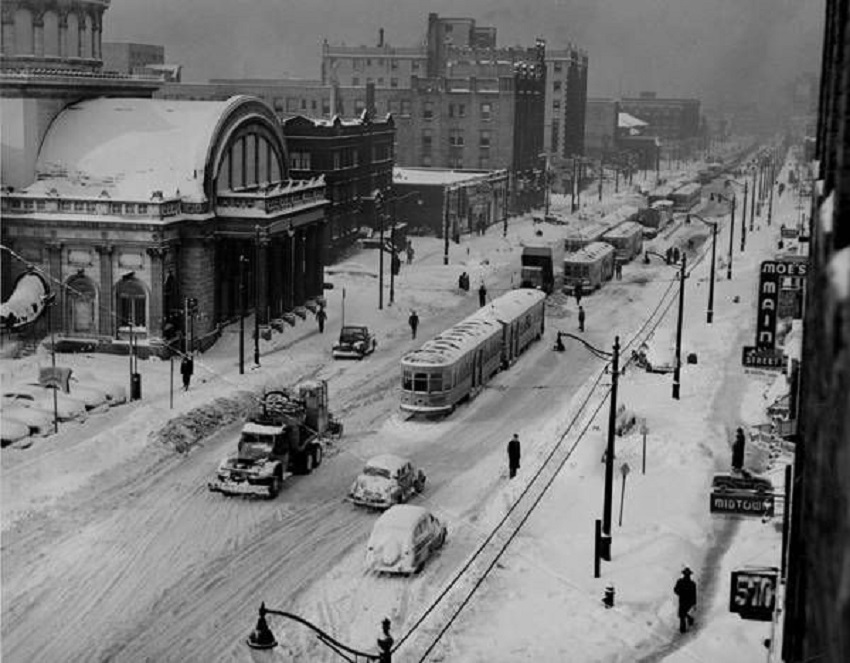
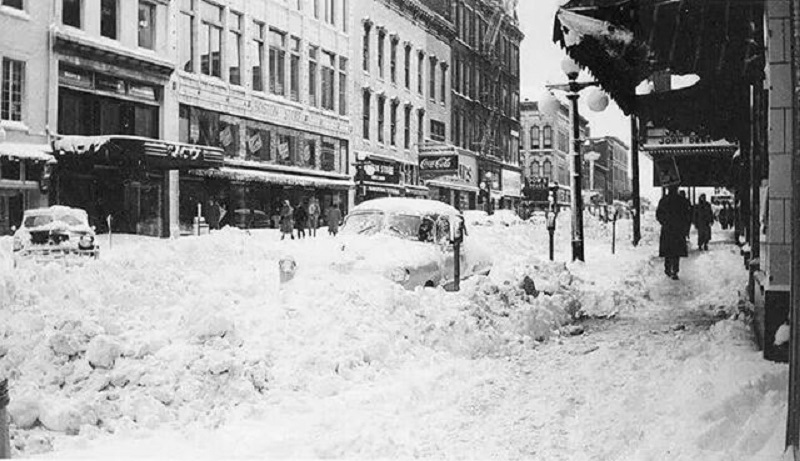
Springfield, Ohio after the storm.

Exactly 67 years ago today, the Great Thanksgiving Blizzard of 1950 began. It was the biggest snowstorm for Columbus, and indeed most of Ohio, during the 40-year period of 1920-1960. That period, especially from the mid-1920s through the mid-1950s, had the lowest rates of cold and snowy winters of any comparable period. The average seasonal snowfall during that period was just 19.1″, a full 9″ below the average the 1980s-2010s have had to date. Still, the period was not without its memorable winters, including 1935-36, 1939-40 and 1947-48. None of those winters, however, had a snow event nearly as big as November 1950.

October 1950 had generally been very warm, ranking historically as the 19th warmest October in Columbus. Highs reached 65 or higher on 21 days of the month. This warmth lasted through early November, and the 80 degrees recorded on November 1st, 1950 remains tied for the warmest November temperature ever recorded. After that, the month seesawed up and down until a strong cold front and rainstorm on the 19th-20th dropped temperatures 25-30 degrees across the state, from the upper 50s-low 60s on the 20th to the low-mid 30s on the 21st. This front would be one of the catalysts for one of Ohio’s greatest winter weather events in its history.

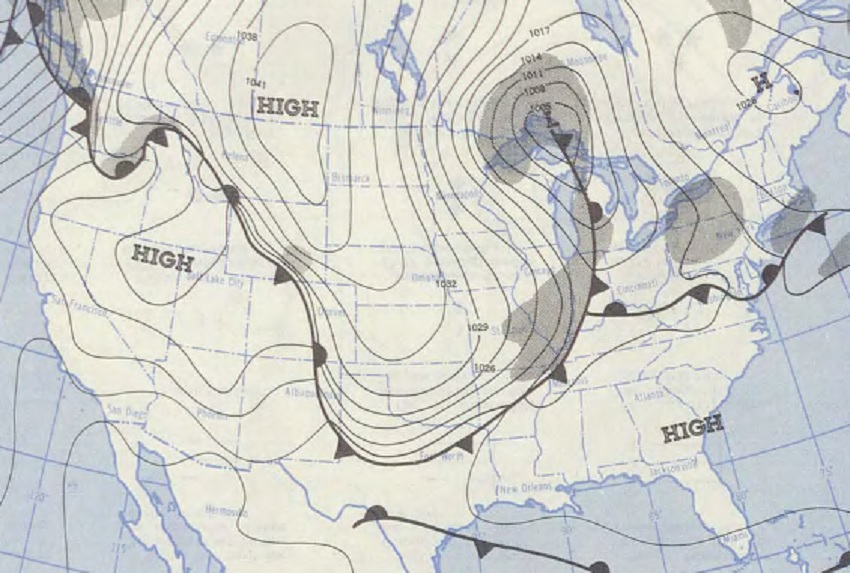
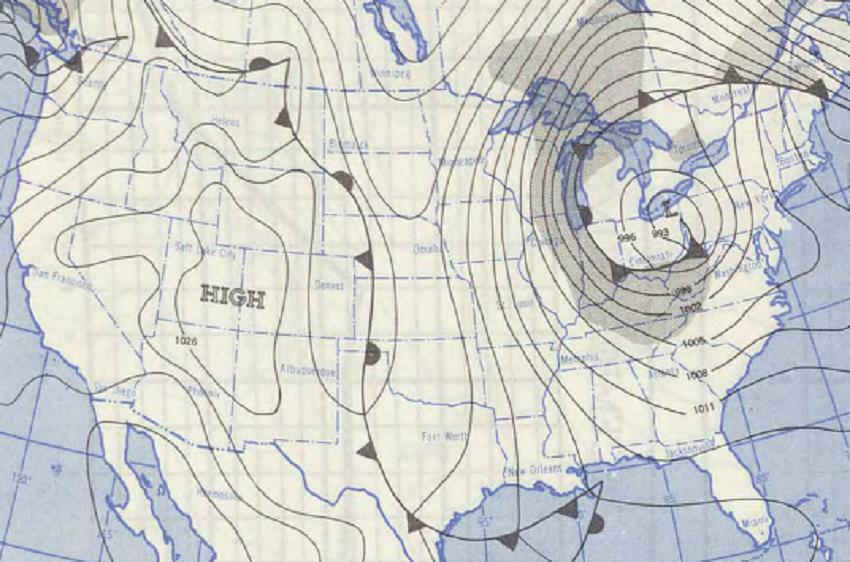
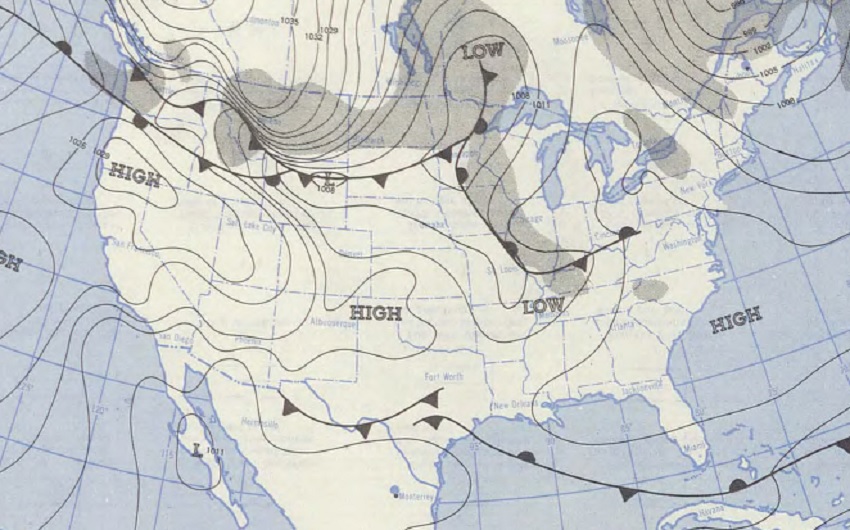
Snow began in Columbus and other parts of Ohio on Thanksgiving, Thursday, November 23rd as a low moved through the Great Lakes and weakened. Behind that system, another cold high pressure was diving south out of Canada.

Thursday, November 23rd 1950 National Map

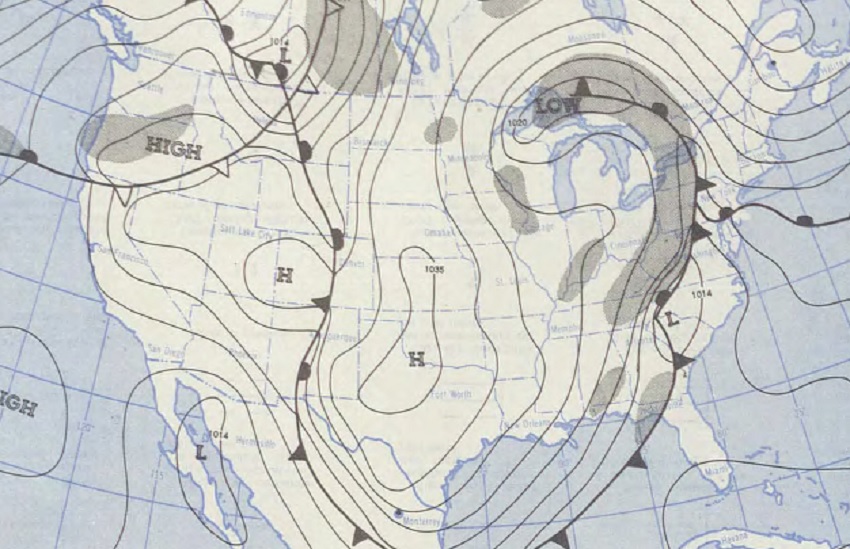
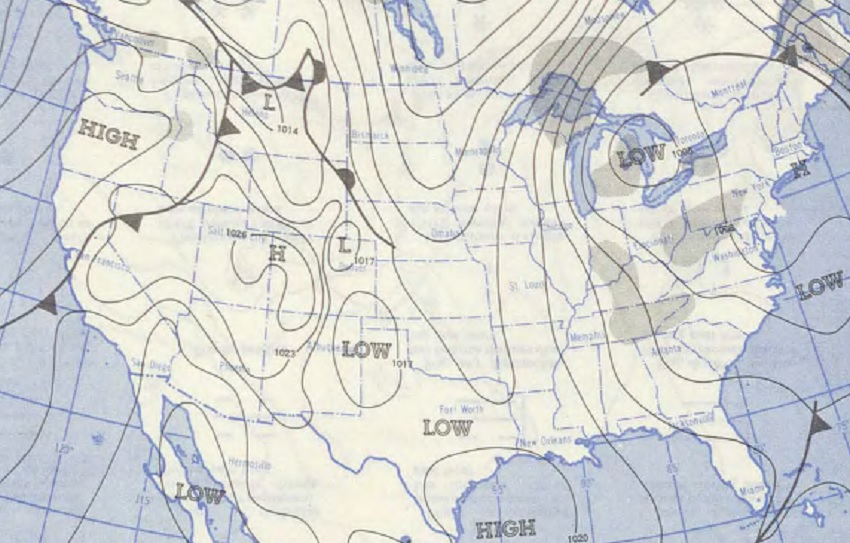
On Friday the 24th, a low formed on the stalled cold front that had moved through Ohio a few days earlier. Initially forming in southeastern North Carolina, this low would’ve normally gone out to see or moved up the East Coast as a Nor’easter. Instead, the strong, cold high pressure was moving into the Ohio Valley at the same time, and the little low exploded and as it began to move north. The strong push of cold was very evident in Ohio, as temperatures plunged from the upper-30s to upper 40s on Thanksgiving afternoon to single digits and low teens by early Friday morning.

Friday, November 24th, 1950 National Map

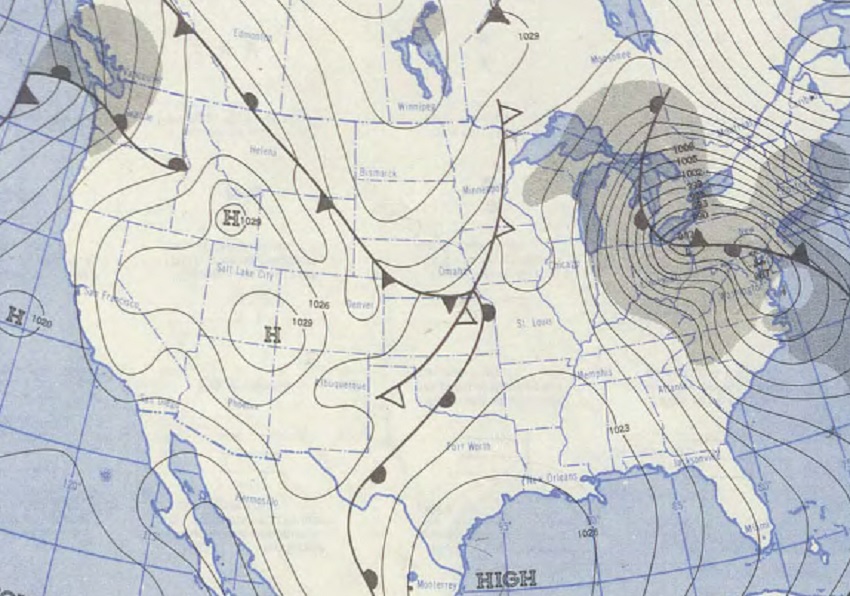
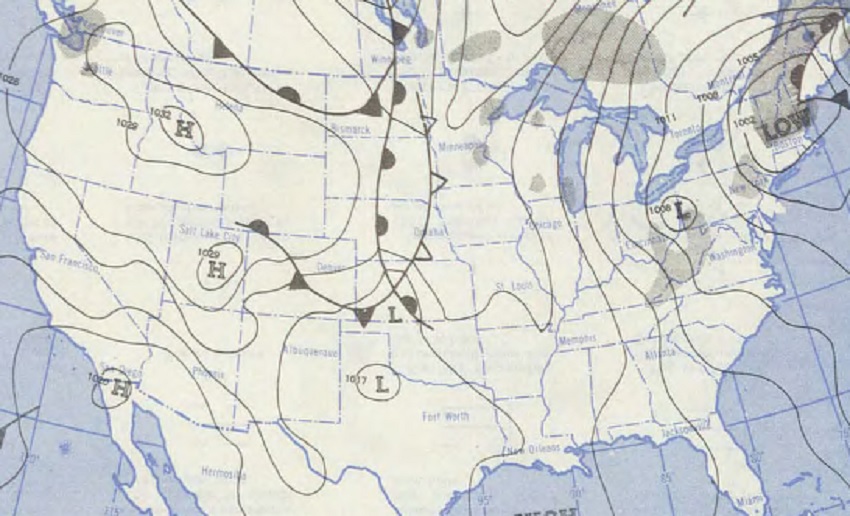
The low moved into southern Pennsylvania by the morning of the 25th, and then began to do something few other storms ever do- it began to retrograde toward the west and Ohio, continuing to strengthen as it went. The unusual west movement was caused by a blocking high pressure system parked over Maine.

Saturday, November 25th, 1950 National Map

Light snow that had been ongoing in Ohio on the 24th quickly intensified from east to west across the state as the low moved westward from Central Pennsylvania to Northern Ohio by the end of the day on the 25th. With it arrived winds of 40-60 miles per hour, causing blinding white-outs and drifting.
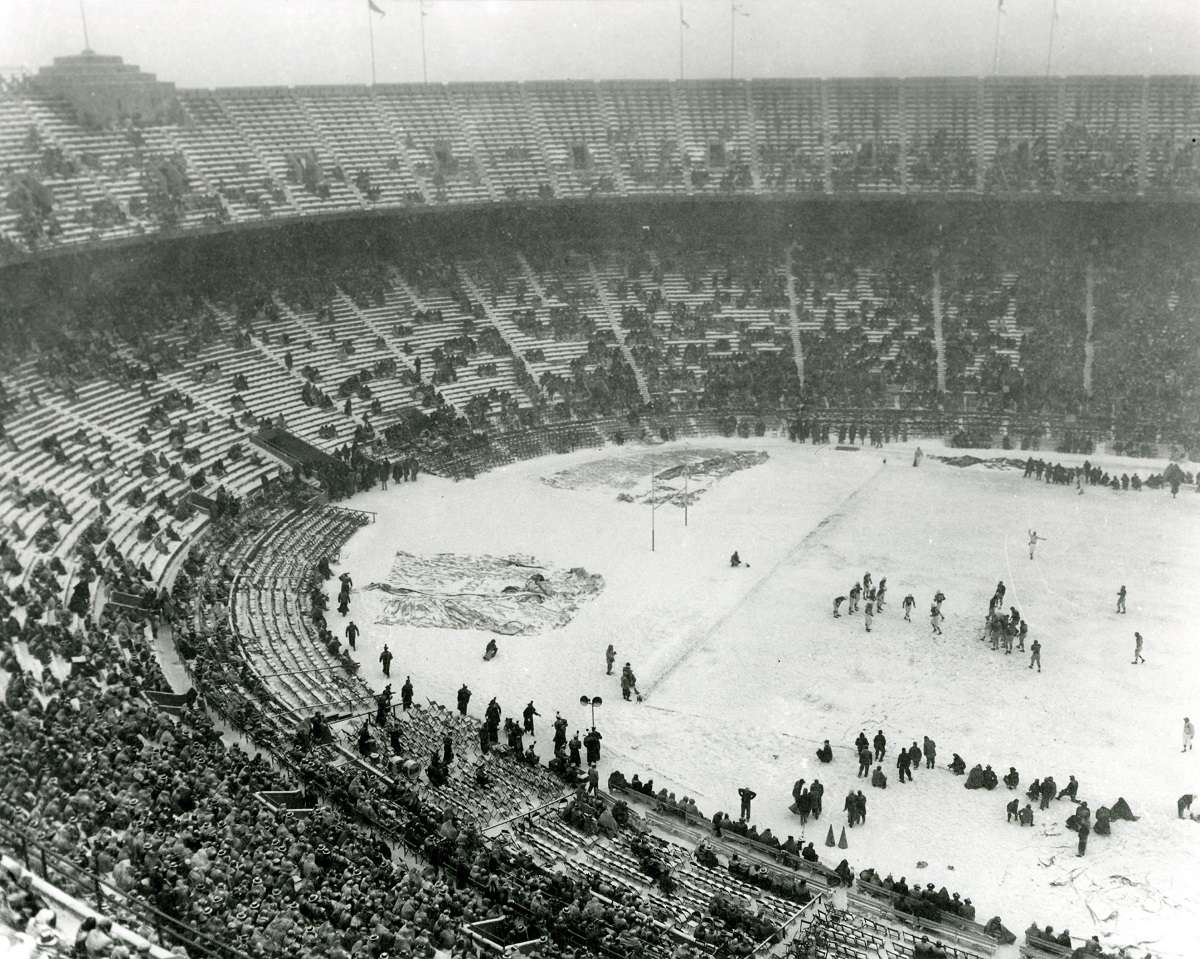
Saturday the 25th was the height of the storm as the low pressure bottomed out at 978mb, a pressure normally associated with hurricanes. This day was, coincidentally, the famed Ohio State-Michigan rivalry football game, now famously known as the “Snow Bowl” for its terrible weather conditions.

With temperatures on Saturday morning in the single digits, wind chills well below zero and with heavy snow, there was debate about cancelling the game altogether, which was the Big Ten Championship. Ironically, despite the fact that Ohio State would’ve gone on to the Rose Bowl had the game been cancelled (Michigan did not want to reschedule), it was Ohio State’s athletic director who ultimately refused to cancel the game, much to the rest of the staff’s disappointment. Perhaps after the fact, considering Ohio State lost 9-3, that decision was regretted, especially in front of the more than 50,000 die-hard fans that managed to show up for the game.

Columbus would receive 7.5″ at the airport, with eastern suburbs getting up to 10″, just on that Saturday alone.

Due to the blocking high pressure, the storm didn’t budge for days, and it continued through the 26th and 27th before slowly dying out. The last accumulating snowflakes from this system fell on the 29th, 6 days after the snow began.

Sunday, November 26th, 1950 National Map

Monday, November 27th, 1950 National Map

Tuesday, November 28th, 1950 National Map

Wednesday, November 29th, 1950 National Map

All in all, the storm was a record-breaker. Snow totals reached 10″ or more across most of the state except the far northwest and far southwest. In Central Ohio, snow had piled up between 10″-20″, with Columbus officially reporting 15.2″ for the duration of the event. This was the second-heaviest snowstorm in Columbus on record to that time, falling just shy of the 15.3″ that occurred February 17-18, 1910. Both of these storms would be surpassed by the February 14-17, 2003 snowstorm of 15.5″, which itself was surpassed by March 7-8th, 2008’s 20.5″.

Other totals in the state included up to 22″ in Cleveland, 27″ in Marietta, and reports of 44″ in Steubenville in far eastern Ohio. Totals of 25″-30″ were common throughout the eastern 1/3rd of the state. These totals are some of the highest the state has ever seen, coming close to those seen in the eastern Ohio snowstorm of April 1901.

In addition to the snow, record cold temperatures in Columbus of 5 degrees on the 25th (along with a record low maximum of 20) made this one of the greatest early winter events of all time.

Cleveland after the storm.

For more November weather records, go here: November Weather

The February 5-6, 2010 Snowstorm


The winter of 2009-2010 will go down as one of the best ever (if you like winter, that is). The biggest reason for that is February 2010 and its cascade of significant winter storms that placed the month as one of the snowiest of all time. The February 5-6, 2010 snowstorm event was one of the capping events of the month and winter as a whole.

The first event started in the morning on February 5th. Forecasts in the days leading up to this event were mixed. Models were showing a lot of precipitation, but also a strong push of upper-level warm air into Ohio. How far north this warm layer reached was the point of contention. In most years, the WTOD, or the “Warm Tongue of Death” as some Ohio weather enthusiasts like to refer to it, is a constant threat each and every winter. When a storm is moving north or northeast south of the state, they tend to pull warm air north, and the Appalachian Mountains act like a funnel directing this warm air straight into Ohio. During winter events, it presents itself as a layer of warm air above the surface, often turning snow to ice, sleet or just plain rain, even if the surface itself is relatively cold. It’s a constant source of frustration for winter weather lovers. It was this phenomenon that was predicted to strike again and the dividing line, as it so often is, was predicted to be along I-70/I-71. North of there, mostly or all snow was predicted, while south was more mix, ice and rain. The I-70 corridor, including Columbus, was to be the northern extent of this mixing, limiting snowfall accumulations. Still, even with the mix predicted, a solid 4″-6″ was predicted, which is a decent event by itself and typically the largest snow event of any given winter.

Precipitation began as snow across southern counties by dawn and spread north, reaching the Columbus area between 9AM and 9:30AM. It started out as flurries, but the flakes were already fairly large. Within 15 minutes, the flurries had turned to very heavy, wet snow. Flakes were as large as quarters at times and stayed large, accumulating quickly despite the above freezing temperatures. Visibility quickly dropped to a half mile or less at times, and traffic quickly snarled with accidents as plows could not keep up with the pace of the inch-per-hour snowfall rates. Between 4PM and 5PM, there was a respite as snowfall lightened and there was a mix of sleet and ice pellets, but all snow resumed once heavier precipitation moved in, concluding the only and very short period of mixing I-70 had. Snow continued through the night of the 5th and into the 6th, finally ending before noon.

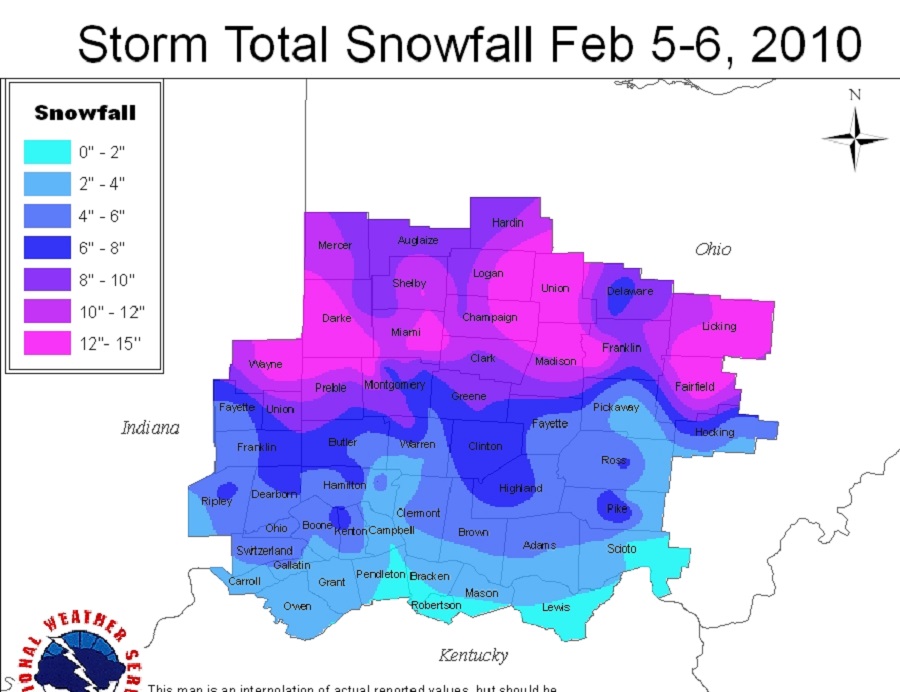
Snowfall totals were impressive, especially along and north of I-70, where little mixing took place, but also in pockets to the southeast of Columbus, like Lancaster. For Columbus, the 9.9″ that fell was good enough to be a top 15 largest snowstorm for the city. It would not, however, be the largest snowfall of the month.

Some snow totals across Ohio from February 5-6, 2010
Greenville: 14.8″
Lancaster: 13.0″
Akron: 12.1″
Bellefontaine: 12.0″
Urbana: 12.0″
Westerville: 11.4″
Dayton: 11.1″
Springfield: 11.0″
Columbus: 9.9″
Youngstown: 8.4″
Delaware: 8.0″
Cleveland: 5.9″
Cincinnati: 4.5″
Circleville: 3.0″
Toledo: 3.0″

The February 5-6, 2010 snowstorm Columbus, Ohio

Snow totals for the NWS Wilmington area.

This event was the only the beginning of what would be a trio of consecutive snowstorms that would strike the area over the course of 11 days, including the February 9-10, 2010 Snowstorm, which occurred just a few days later.

The Wilmington National Weather Service, meanwhile, is a great source if you want to know the current weather in the area.