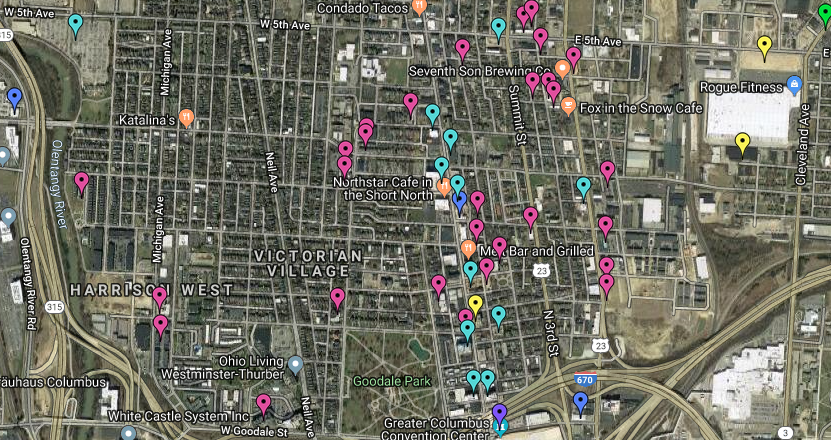
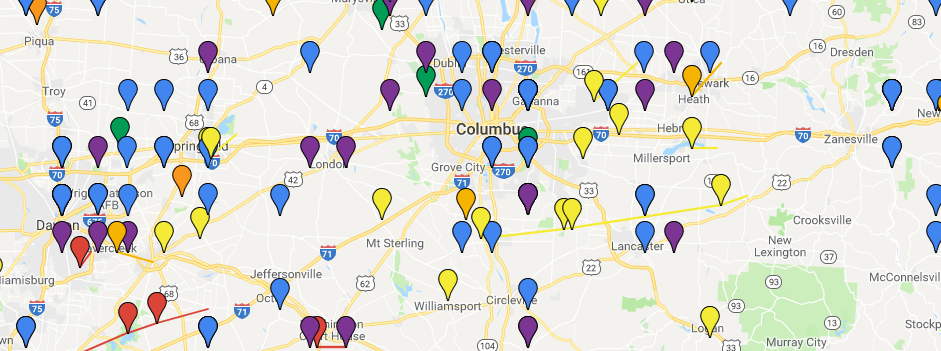
Columbus Development Maps 2010-2013 Development 2014-2019 Development 2020-2025 Development All these pages are basically just map versions of the development pages. However, the maps are organized by year and include before and after photos of the development sites.
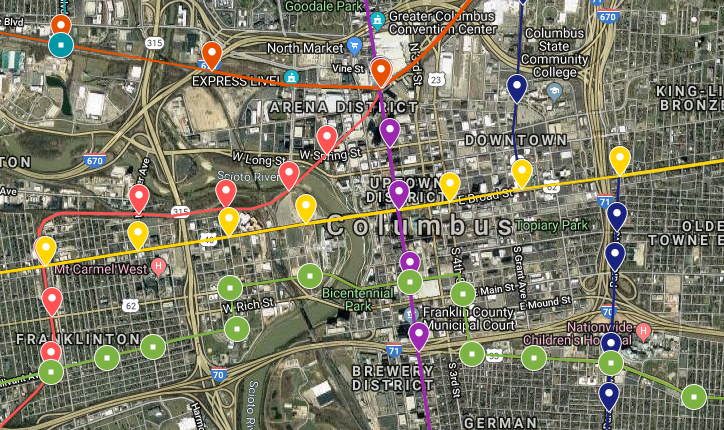
Columbus Fantasy Transit Map 2019 Transit Map The transit map for the Columbus Metro Area is just one example of many existing fantasy maps for Central Ohio. This one includes routes for light rail, BRT (Bus Rapid Transit) and interurban rail to neighboring counties.
The Redevelopment of Westland Mall Mall Site Westland Mall and the larger surrounding area is in desperate need of a revamp. Recently, a proposal to make the site into a “Weston” development in the potential style of Easton has emerged. I made this map several years ago as a basic blueprint for how the entire area could be rebuilt into a much more urban, walkable, vibrant corridor.
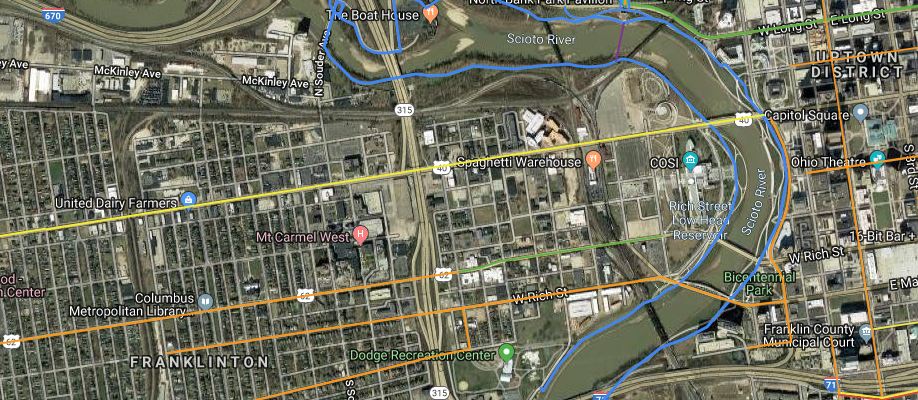
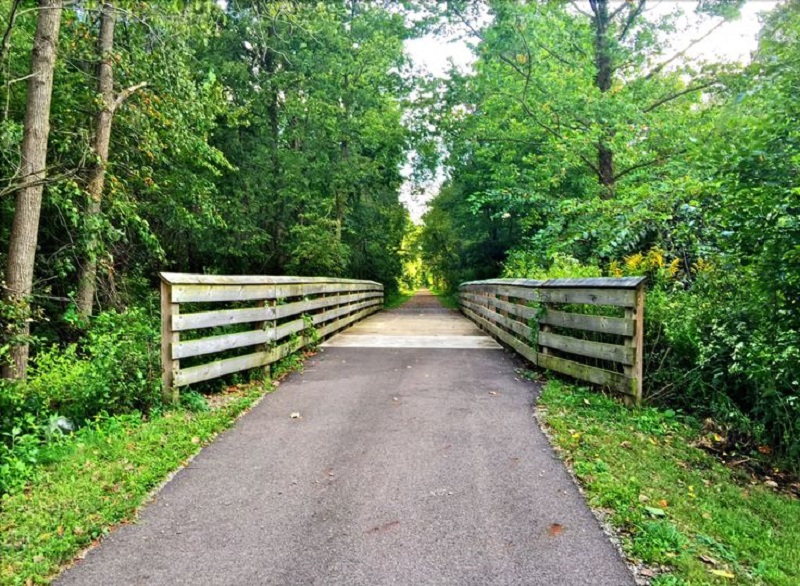
Columbus Area Bike Lanes, Multi-use Paths and Sidewalk Infrastructure Bike Infrastructure This map attempts to include all the existing bike and multi-use infrastructure in the area, along with general pedestrian infrastructure. The map will is not fully updated yet through 2019.
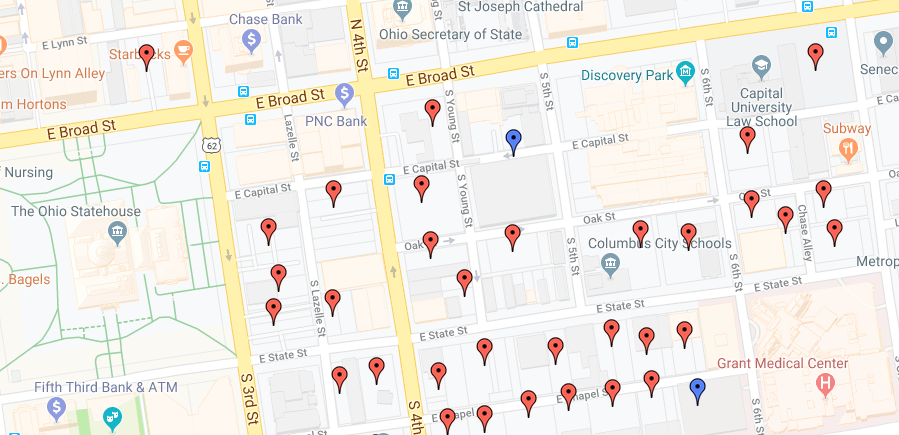
Downtown Columbus Parking Infrastructure Parking Lots and Garages This map, last updated in 2015, documents all existing parking garages and surfaces lots throughout Downtown.
So first up to repost from the data loss will be one of the easiest. As mentioned the first time, I wanted to create a map that included the 10-county metro area highlighting every bit of existing, planned and under construction infrastructure involving biking and pedestrian activities. There are some existing maps that show this, but they are not regularly updated and they lack significant detail in what type of infrastructure exists.
The map is still very much a work in progress. I have neither finished the existing infrastructure level or the planned infrastructure level. I update it a bit more almost every day, so keep checking back!
“Walkability” is the new buzzword when it comes to urban neighborhoods and what new generations want. Based on the WalkScore criteria, and with scores from 0-100 (100 being the most walkable), here are Columbus’ most walkable neighborhoods.
Top 25 Most Walkable Neighborhoods and Total Score 1. Downtown: 86 2. Dennison Place (Short North): 85 3. Italian Village (Short North): 85 4. Weinland Park (Just northeast of Short North): 85 5. Indiana Forest (Northeast Campus Area): 84 6. Necko (South Campus): 81 7. Victorian Village (Short North): 81 8. Old North Columbus: 80 9. Glen Echo (North Columbus): 80 10. North Campus: 80 11. German Village: 79 12. Tri-Village (5th Avenue West): 79 13. Brewery District: 78 14. OSU: 77 15. Iuka Ravine (North Columbus): 76 16. Clintonville: 75 17: King-Lincoln (Near East Side): 74 18. Schumacher Place (Near South Side): 73 19. Busch (Northwest Columbus): 72 20. Indianola Terrace (North Columbus): 71 21. Merion Village: 69 22. Governours Square (Bethel and Henderson): 68 23: Harrison West (Hilltop): 67 24. Old Beechwold (North Columbus): 67 25. Olde Towne East: 67
Together, the top 25 neighborhoods contain a little over 100,000 people.
Overall Columbus Neighborhood Walkability Score Breakdown 90-100 (Walker’s Paradise-daily errands do not require a car): 0 70-89 (Very Walkable- most errands can be done on foot): 20 50-69 (Somewhat Walkable- some errands cand be done on foot): 72 0-49 (Car Dependent- most or all errands require a car): 120 Average Columbus Score: 47
So less than half of Columbus’ neighborhoods are walkable, and only a small amount are very walkable, where most tasks do not require a car. The overall score shows that Columbus is still largely a car-dependent city.
Walkability, however, is just part of the picture. There are also scores for biking and mass transit access, both of which are also measured on the 0-100 scale.
Top 25 Bikeable Neighborhoods 1. North Campus: 89 2. Harrison West: 88 3. Northmoor (North Columbus): 80 4. Old North Columbus: 80 5. Clintonville: 77 6. OSU: 75 7. Brewery District: 74 8. Dennison Place: 74 9. Glen Echo: 74 10. Victorian Village: 74 11. Indiana Forest: 72 12. Iuka Ravine: 72 13. Necko: 71 14. Italian Village: 70 15. Merion Village: 68 16. Tri-Village: 68 17. Weinland Park: 67 18. Downtown: 66 19. Indianola Terrace (North Columbus): 66 20. North Hilltop: 66 21. Whetstone: 66 22. German Village: 64 23. Mount Vernon (Near East Side): 64 24. Riverview (North Columbus): 63 25. Schumacher Place: 63
The majority of Columbus’ most bikeable neighborhoods are also the most walkable.
Similar to its walkability, the majority of Columbus’ neighborhoods are not particularly bikeable. This has a lot to do with the further out and newer suburban areas of the city being built almost exclusively for cars. Only in the last 10 years has the city become more interested in promoting bike use. The city is adding several hundred miles of bike lanes and bike infrastructure, and it recently launched its own bike-share system.
Finally, we have the transit scores, which are based on access to mass transit options.
Top 25 Most Transit-Friendly Neighborhoods 1. Downtown: 64 2. Brewery District: 57 3. Italian Village: 57 4. German Village: 55 5. Victorian Village: 55 6. Dennison Place: 54 7. Weinland Park: 54 8. Necko: 52 9. Olde Towne East: 52 10. Schumacher Place: 52 11. Indiana Forest: 50 12. Harrison West: 49 13. King-Lincoln: 49 14. North Campus: 49 15. OSU: 49 16. Franklin Park (Near East Side): 49 17. Beechwood: 47 18. Iuka Ravine: 47 19. Milo-Grogan: 47 20. South of Main (Near East Side): 47 21. Livingston Park North (Near South Side): 46 22. Mount Vernon: 46 23. Old North Columbus: 46 24. Woodland Park (Near East Side): 46 25. Franklinton: 45
Clearly, based on these numbers, the city’s transit system needs a ton of improvement. COTA, or the city’s bus system, is really the only form of mass transit available, and beyond a few areas near Downtown, seems to struggle to provide access. The city is currently studying BRT (Bus Rapid Transit) with a first line proposed from Downtown and up along Cleveland Avenue to the North Side, with future lines coming after that. This will help, but there is still much to be done. Some type of rail system should also be part of near future development, as the city remains one of the largest in the US without any type of passenger rail.
So what is the overall picture of the city? First, that too much of the city is built for car use only. The boom in urban development has been significant, but the vast majority of it is occurring in areas that have the highest scores. Correlation or coincidence? Densification of neighborhoods further from the core is entirely possible, and these areas can and should be built with walkability and transit in mind. The city is taking steps for improvement, but it is, at least in my opinion, one of the weakest points of Columbus.