There’s been some discussion over the last few years about how driving habits are changing nationally. I’ve seen at least a few reports suggesting that overall driving is actually on the decline and has been for some time. This even while the population of the US continues to rise. A http://uspirg.org/sites/pirg/files/reports/US_Transp_trans_scrn.pdf”>new report has come out detailing the changing habits of cities, including the changing Columbus transit scene.
Percent Change in Per-Capita Vehicle Miles Traveled from 2006-2011 Columbus: -5.7% Dayton: -0.2% Akron: +1.2% Cleveland: +5.1% Youngstown: +5.4% Cincinnati: N/A Toledo: N/A
Columbus saw the largest drop in vehicle miles traveled, indicating that people there are driving less. Northeast Ohio all saw increases, which goes against the national trend. Toledo and Cincinnati did not have comparable numbers.
Percent Change in Per-Capita Passenger Miles Traveled on Mass Transit 2005-2010 Columbus: +1.6% Dayton: -0.6% Akron: -2.8% Youngstown: -8.3% Toledo: -28.8% Cleveland: -34.2% Cincinnati: -34.8%
Columbus was the only city to see an increase in its mass transit miles. Cleveland, Cincinnati saw drops of more than 1/3rd.
Change in the Proportion of Workers who Commuted by Car, 2000-2011 Dayton: -1.5% Columbus: -1.2% Toledo: -1.0% Youngstown: -1.0% Akron: -0.8% Cleveland: -0.4% Cincinnati: -0.2%
All 7 saw declines.
Change in the Proportion of Workers who Biked to Work, 2000-2011 Columbus: +0.3% Akron: +0.1% Cleveland: +0.1% Dayton: +0.1% Toledo: +0.1% Cincinnati: +0% Youngstown: +0%
Columbus saw the largest increase of all 7, although the actual changes are all small. No city measured in the US saw a change of more than +1.7%. The majority of cities were less than 0.3%.
Change in the Proportion of Workers Who Worked From Home, 2000-2011 Columbus: +1.4% Cincinnati: +0.9% Dayton: +0.8% Cleveland: +0.6% Toledo: +0.6% Youngstown: +0.6% Akron: +0.5%
Columbus again leads, though all cities saw increases.
Total Per-Capita Vehicle Miles Traveled in 2006 Cleveland: 8,285 Youngstown: 8,806 Akron: 9,379 Columbus: 9,956 Dayton: 10,084 Cincinnati: N/A Toledo: N/A
Total Per-Capita Vehicle Miles Traveled in 2011 Cleveland: 8,705 Youngstown: 9,284 Columbus: 9,385 Akron: 9,490 Dayton: 10,068 Cincinnati: N/A Toledo: N/A
Total Per-Capita Mass-Transit Miles Traveled in 2005 Cleveland: 172.0 Cincinnati: 110.0 Dayton: 64.7 Columbus: 52.6 Toledo: 51.6 Akron: 42.9 Youngstown: 17.3
Total Per-Capita Mass-Transit Miles Traveled in 2010 Cleveland: 113.0 Cincinnati: 71.8 Dayton: 64.1 Columbus: 53.4 Akron: 41.7 Toledo: 36.7 Youngstown: 15.9
% of Workers who Traveled by Car, 2011 Cleveland: 89.2% Columbus: 89.8% Cincinnati: 90.6% Dayton: 91.4% Akron: 92.5% Toledo: 93.1% Youngstown: 94.4%
National Rank (of 100 cities) in the % Change for those who Biked to Work, 2000-2011 Columbus: 15th Dayton: 37th Cleveland: 38th Akron: 39th Toledo: 49th Cincinnati: 74th Youngstown: 81st
% Change of Households with No Vehicle, 2006-2011 Akron: +2.2% Dayton: +1.0% Cleveland: +0.9% Columbus: +0.9% Cincinnati: -0.3% Toledo: -0.4% Youngstown: N/A
So what does all this data tell us? Well, for the most part, all Ohio cities are seeing car use decline in some way or another. Columbus performs strongly in car use declines and increases in at-home workers and increases in bike commuting. Mass-transit was where it performed the weakest, where it’s middle of the pack. Yet even there, it saw increases in its use.
Home values are, in part, tied to how well a neighborhood is performing. In the case of urban neighborhoods, how home values change over time may be a good indication of how that neighborhood is revitalizing. I looked at median home values by census tract for the years 2000 and 2010. Here is the map of how values changed during that period. What the different colors indicate are different levels of performance, obviously. Yellow and oranges indicate decline, which few areas experienced. Light green, which makes up quite a bit of the suburban areas in and outside 270, indicates mostly stability or slow growth (but below average) in home values. Dark green is average to a bit above average growth. Blues and purple are high growth areas.
What the map shows it that the strongest growth in median home values occurred in the urban core neighborhoods, especially along the High Street corridor. Pockets of strong growth also occurred around Easton and sporadically in some suburban areas. What this says, particularly for the urban core, is that quite a few neighborhoods are on the rise. Grandview, Upper Arlington, the Short North, Campus, Clintonville, German and Merion Villages, the western half of Weinland Park, Downtown, and the Near East Side around Franklin Park were some of the best performing areas. This would seem to indicate that strong gentrification is taking place.
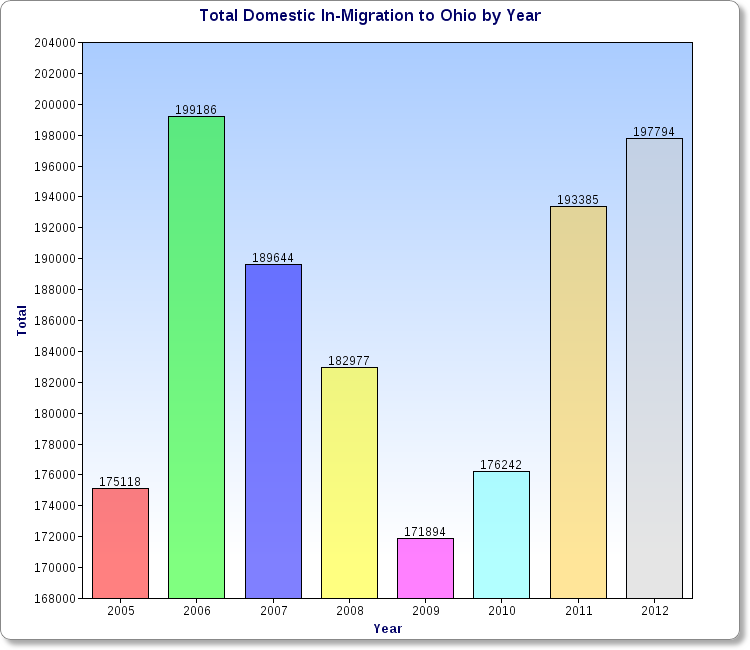
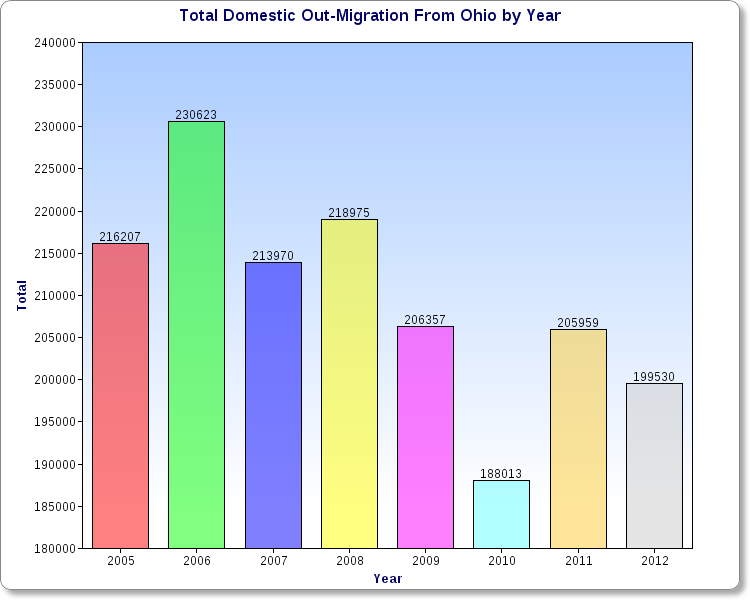
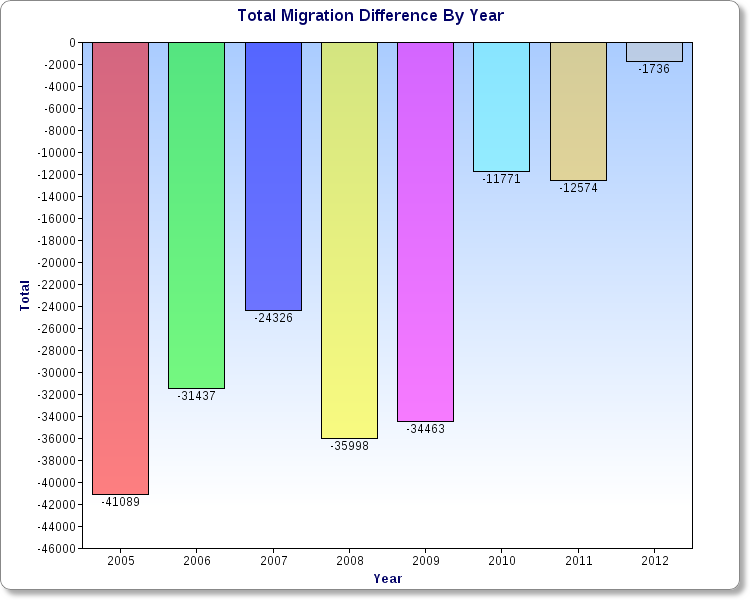
Ohio has been growing fairly slowly for several decades now. In fact, if it was not for Columbus’ population growth and international migration, the state would’ve been losing population in recent years. But is the picture really that bad? Are things changing? I decided to find out. The first chart above shows the total population that moved to Ohio from all other 49 states plus Puerto Rico and DC by year. The drop during the recession is pretty obvious, as mobility greatly decreased during that time. 2012 had the 2nd highest total of the period, only slightly behind 2006. What the out-migration chart shows is that the total is gradually going down, meaning fewer people, on average, are leaving Ohio each year. So what is the overall difference of in vs. out migration to Ohio? As the chart shows, the trend has been improving over time, and 2012 barely registered a loss at all. Will the state begin seeing positive domestic in-migration in the very near future? Based on this chart, the answer seems to be yes. A lot can still happen, but it does appear that Ohio is finally shaking off its long-term population issues.
The latest numbers for the Columbus housing market from Columbus Realtors.
LSD=Local school district CSD=City school district
Top 15 Most Expensive Locations by Median Sales Price in October 2013 1. New Albany: $445,900 2. Upper Arlington CSD: $358,000 3. Downtown: $330,000 4. Powell: $305,000 5. Dublin: $302,125 6. Jefferson LSD: $292,500 7. Olentangy LSD: $288,500 8. Granville CSD: $272,000 9. New Albany Plain LSD: $262,500 10. Worthington: $249,900 11. Buckeye Valley LSD: $246,250 12. Big Walnut LSD: $238,500 13. Beechwold/Clintonville: $230,000 14. Bexley: $225,875 15. German Village: $217,500
Top 15 Least Expensive Locations by Median Sales Price in October 2013 1. Whitehall: $42,500 2. Lancaster CSD: $75,250 3. Hamilton LSD: $83,450 4. Columbus CSD: $84,200 5. Newark CSD: $87,450 6. Groveport Madison LSD: $90,150 7. London CSD: $94,500 8. South-Western CSD: $95,000 9. Columbus: $104,500 10. Circleville CSD: $110,250 11. Blacklick: $134,251 12. Obetz: $134,950 13. Canal Winchester CSD: $135,000 14. Grove City: $135,000 15. Reynoldsburg CSD: $136,200
Overall Metro Median Sales Price in October 2013: $149,302 Median Sales Price Change October 2012-October 2013: -$3,183
Top 15 Locations with the Highest Median Sales Price % Growth Between October 2012-October 2013 1. Hamilton LSD: +85.4% 2. Jefferson LSD: +69.8% 3. Downtown: +63.8% 4. Reynoldsburg CSD: +54.4% 5. Obetz: +51.8% 6. Jonathan Alder LSD: +50.4% 7. Sunbury: +36.5% 8. Beechwold/Clintonville: +28.6% 9. Westerville CSD: +20.2% 10. Minerva Park: +19.4% 11. Marysville CSD: +19.4% 12. Lithopolis: +19.0% 13. Northridge LSD: +17.4% 14. Circleville CSD: +16.7% 15. Granville CSD: +15.6%
Top 15 Locations with the Lowest Median Sales Price % Growth Between October 2012-October 2013 1. German Village: -16.3% 2. Lancaster CSD: -16.3% 4. Buckeye Valley LSD: -14.9% 5. New Albany Plain LSD: -14.6% 6. Canal Winchester CSD: -14.6% 7. Grandview Heights: -14.2% 8. Hilliard: -12.8% 9. South-Western CSD: -11.4% 10. London CSD: -11.3% 11. Dublin CSD: -10.8% 12. Dublin: -10.3% 13. Whitehall: -7.6% 14. Gahanna Jefferson CSD: -5.6% 15. Johnstown Monroe LSD: -3.7%
Overall Metro Median Price % Change October 2012-October 2013: -2.1%
Top 10 Locations with the Most New Listings in October 2013 1. Columbus: 1,107 2. Columbus CSD: 691 3. Westerville CSD: 177 4. South-Western CSD: 169 5. Hilliard CSD: 158 6. Olentangy LSD: 157 7. Dublin CSD: 123 8. Groveport Madison LSD: 91 9. Worthington CSD: 79 10. Dublin: 73
Top 10 Locations with the Fewest New Listings in October 2013 1. Valleyview: 0 2. Lithopolis: 0 3. Minerva Park: 2 4. Jefferson LSD: 5 5. Obetz: 5 6. Sunbury: 5 7. Northridge LSD: 9 8. Jonathan Alder LSD: 9 9. German Village: 9 10. Grandview Heights: 10
Overall Metro New Listings in October 2013: 2,693 New Listings % Change October 2012-October 2013: +5.9%
Top 10 Fastest-Selling Locations by # of Days Homes Remain on the Market Before Sale in October 2013 1. Johnstown Monroe LSD: 30 2. Powell: 31 3. Buckeye Valley LSD: 32 4. Grandview Heights: 39 5. Minerva Park: 42 6. Beechwold/Clintonville: 45 7. Northridge LSD: 45 8. Olentangy LSD: 46 9. Westerville: 46 10. Jonathan Alder LSD: 47
Top 10 Slowest-Selling Locations by # of Days Homes Remain on the Market Before Sale in March 2013 1. Circleville CSD: 118 2. London CSD: 107 3. Lancaster CSD: 106 4. Obetz: 105 5. Hamilton LSD: 96 6. New Albany CSD: 91 7. Granville CSD: 84 8. Jefferson LSD: 82 9. Big Walnut LSD: 81 10. Hilliard: 78 11. Reynoldsburg: CSD: 78
Overall Metro Average # of Days on Market Before Sale: 74.7
Top 10 Locations with the Best Change in # of Days on the Market Before Sale October 2012-October 2013 1. Lithopolis: +522.2% 2. Minerva Park: -77.25 3. Johnstown Monroe LSD: -74.6% 4. Buckeye Valley LSD: -71.7% 5. Jonathan Alder LSD: -69.1% 6. Grandview Heights: -64.2% 7. Powell: -62.7% 8. German Village: -61.2% 9. Northridge LSD: -54.5% 10. Pickerington LSD: -47.0%
Top 10 Locations with the Worst Change in the # of Days on the Market Before Sale October 2012-October 2013 1. Hamilton LSD: +190.9% 2. Obetz: +150.0% 3. Lancaster CSD: +86.0% 4. Sunbury: +50.0% 5. Circleville CSD: +45.7% 6. London CSD: +27.4% 7. New Albany: +14.6% 8. Worthington: +13.7% 9. Granville CSD: +9.1% 10. New Albany CSD: +8.3%
Overall Metro # of Days on Market Before Sale % Change October 2012-October 2013: -24.9%
I’ve compared Columbus to peer cities nationally in terms of density and population, but I’ve never compared Columbus to the Midwest as a whole historically for those categories. For the following historic Midwest population and density ranking, I used the top 15 largest Midwest cities as of 2012 as determined by the US Census.
Red indicates a fallen ranking while blue indicates a rise. Black is no change.
Historic Population Rankings 1840 1. Cincinnati: 46,338 2. St. Louis: 16,469 3. Detroit: 9,102 4. Cleveland: 6,071 5. Columbus: 6,048 6. Chicago: 4,470 7. Indianapolis: 2,695 8. Milwaukee: 1,700 9. Toledo: 1,222 10. Kansas City: Not incorporated. 11. Lincoln: Not incorporated. 12. Minneapolis: Not incorporated. 13. Omaha: Not incorporated. 14. St. Paul: Not incorporated. 15. Wichita: Not incorporated.
1850 1. Cincinnati: 115,435 2. St. Louis: 77,860 3. Chicago: 29,963 4. Detroit: 21,019 5. Milwaukee: 20,061 6. Columbus: 17,882 7. Cleveland: 17,034 8. Indianapolis: 8,091 9. Toledo: 3,829 10. St. Paul: 1,112 11. Kansas City: Not incorporated. 12. Lincoln: Not incorporated. 13. Minneapolis: Not incorporated. 14. Omaha: Not incorporated. 15. Wichita: Not incorporated.
Columbus seems poised to take the #2 spot from Indianapolis around or just after 2020. Also, 11 of 15 would’ve seen growth 2010-2020. Cleveland, Toledo, St. Louis and Detroit would be the only cities that still lost.