Politics and Ohio’s Economic Performance

Politics and Ohio's economic performance

For this post, I want to focus on politics and Ohio’s economic performance in relation to the party in power. There’s been much said over whether the economy does better under Republicans or Democrats at the national level, and I wanted to see if national politics played any role in the economic performance of Columbus and Ohio overall. Now, to put it simply, I really just looked at Bureau of Labor Statistics to see how the economy performed under different administrations. It’s not necessarily going to be a very deep analysis beyond that. In recent surveys, many user responses chose political content as something I should contribute to the site more often. While I do not want to make the site overtly political, I think there can be a balance by using a data-driven approach. This is what I used in past posts relating to politics, from Covid numbers to voting totals.

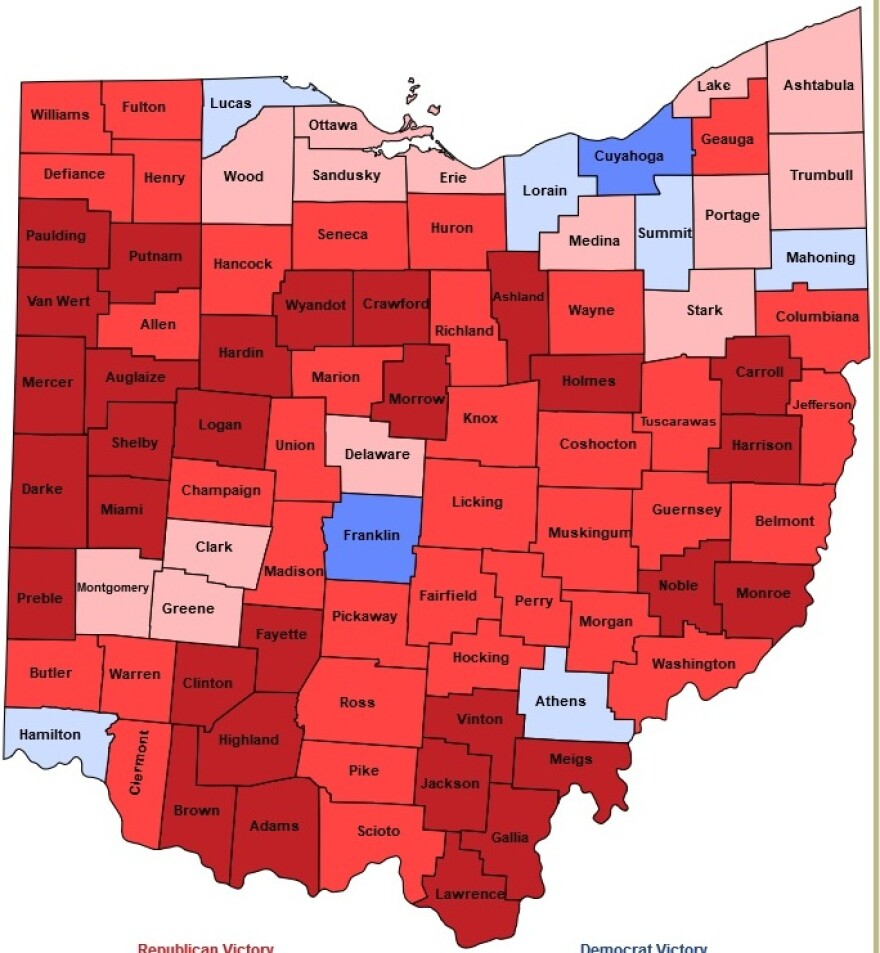
In any case, we have to determine what administrations we’re going to look at. First, the criteria is that they have to be completed adminisrations, as we will look at entire 4-year periods. The data for the BLS for Ohio goes back to 1976, but only to 1990 for Columbus itself. Therefore, for the state we will use Carter, Reagan, Bush, Clinton, Bush II, Obama and Trump for the state numbers, and Clinton, Bush II, Obama and Trump for city numbers. Will the state numbers follow the same patterns as the city, or not?

For this post, it’s all about Ohio.

Let’s look at the overall stats of each president. These will be Labor Force (people within the job market), Employment (people in the labor force with jobs), Unemployment (people in the labor force without jobs), and Unemployment Rate (percent of the labor force without jobs).

State of Ohio

Labor Force Data

President

Figure at Term Beginning

Figure at Term End

Net Change

% Change

Jimmy Carter (D)

1/1977-1/1981

4,781,086

5,085,673

+304,587

+6.37

Ronald Reagan (R)

1st Term

1/1981-1/1985

5,085,673

5,088,875

+3,202

+0.06

Ronald Reagan (R)

2nd Term

1/1985-1/1989

5,088,875

5,316,349

+227,474

+4.47

George H.W. Bush (R)

1/1989-1/1993

5,316,349

5,478,918

+162,569

+3.06

Bill Clinton (D)

1st Term

1/1993-1/1997

5,478,918

5,684,684

+205,766

+3.76

Bill Clinton (D)

2nd Term

1/1997-1/2001

5,684,684

5,802,000

+117,316

+2.06

George W. Bush (R)

1st Term

1/2001-1/2005

5,802,000

5,851,991

+49,991

+0.86

George W. Bush (R)

2nd Term

1/2005-1/2009

5,851,991

5,960,636

+108,645

+1.86

Barack Obama (D)

1st Term

1/2009-1/2013

5,960,636

5,705,642

-254,994

-4.28

Barack Obama (D)

2nd Term

1/2013-1/2017

5,705,642

5,791,153

+85,511

+1.50

Donald Trump (R)

1st Term

1/2017-1/2021

5,791,153

5,720,805

-70,348

-1.21

Joe Biden (D)

1/2021-1/2025

5,720,805

5,922,243

+201,438

+3.52


Total Labor Force Change by Entire Presidency
1. Bill Clinton: +323,082
2. Jimmy Carter: +304,587
3. Ronald Reagan: +232,676
4. Joe Biden: +201,438
5. George H.W. Bush: +162,569
6. George W. Bush: +158,636
7. Donald Trump: -70,348
8. Barack Obama: -169,483
Total by Party
Democratic: +659,624
Republican: +483,533

Next up, Employment.

State of Ohio

Employment Data

President

Figure at Term Beginning

Figure at Term End

Net Change

% Change

Jimmy Carter (D)

1/1977-1/1981

4,423,538

4,629,708

+206,170

+4.66

Ronald Reagan (R)

1st Term

1/1981-1/1985

4,629,708

4,633,809

4,101

+0.09

Ronald Reagan (R)

2nd Term

1/1985-1/1989

4,633,809

5,032,921

+399,112

+8.61

George H.W. Bush (R)

1/1989-1/1993

5,032,921

5,092,311

+59,390

+1.18

Bill Clinton (D)

1st Term

1/1993-1/1997

5,092,311

5,396,922

+304,611

+5.98

Bill Clinton (D)

2nd Term

1/1997-1/2001

5,396,922

5,577,863

+180,941

+3.35

George W. Bush (R)

1st Term

1/2001-1/2005

5,577,863

5,484,332

-93,531

-1.68

George W. Bush (R)

2nd Term

1/2005-1/2009

5,484,332

5,437,168

-47,164

-0.86

Barack Obama (D)

1st Term

1/2009-1/2013

5,437,168

5,279,345

-157,823

-2.90

Barack Obama (D)

2nd Term

1/2013-1/2017

5,279,345

5,489,730

+210,385

+3.99

Donald Trump (R)

1st Term

1/2017-1/2021

5,489,730

5,370,247

-119,483

-2.18

Joe Biden (D)

1/2021-1/2025

5,370,247

5,651,168

+280,921

+5.23


Total Employment Change by Entire Presidency
1. Bill Clinton: +485,552
2. Ronald Reagan: +403,213
3. Joe Biden: +280,921
4. Jimmy Carter: +206,170
5. George H.W. Bush: +59,390
6. Barack Obama: +52,562
7. Donald Trump: -119,483
8. George W. Bush: -140,695
Total by Party
Democratic: +1,025,205
Republican: +202,425

Now Unemployment.

State of Ohio

Unemployment Data

President

Figure at Term Beginning

Figure at Term End

Net Change

% Change

Jimmy Carter (D)

1/1977-1/1981

357,548

455,965

+98,417

+27.53

Ronald Reagan (R)

1st Term

1/1981-1/1985

455,965

455,066

-899

-0.2

Ronald Reagan (R)

2nd Term

1/1985-1/1989

455,066

283,428

-171,638

-37.72

George H.W. Bush (R)

1/1989-1/1993

283,428

386,607

+103,179

+36.40

Bill Clinton (D)

1st Term

1/1993-1/1997

386,607

287,762

-98,845

-25.57

Bill Clinton (D)

2nd Term

1/1997-1/2001

287,762

224,137

-63,625

-22.11

George W. Bush (R)

1st Term

1/2001-1/2005

224,137

367,659

+143,522

+64.03

George W. Bush (R)

2nd Term

1/2005-1/2009

367,659

523,468

+155,809

+42.38

Barack Obama (D)

1st Term

1/2009-1/2013

523,468

426,297

-97,171

-18.56

Barack Obama (D)

2nd Term

1/2013-1/2017

426,297

301,423

-124,874

-29.29

Donald Trump (R)

1st Term

1/2017-1/2021

301,423

350,558

+49,135

+16.30

Joe Biden (D)

1/2021-1/2025

350,558

271,075

-79,483

-22.67


Total Unemployment Change by Entire Presidency
1. Barack Obama: -222,045
2. Ronald Reagan: -172,537
3. Bill Clinton: -162,470
4. Joe Biden: -79,483
5. Donald Trump: +49,135
6. Jimmy Carter: +98,417
7. George H.W. Bush: +103,179
8. George W. Bush: +299,331
Total by Party
Democratic: -365,581
Republican: +279,108

And finally, the Unemployment Rate

State of Ohio

Unemployment Rate Data

President

Figure at Term Beginning

Figure at Term End

Net Change

Jimmy Carter (D)

1/1977-1/1981

7.5

9.0

+1.5

Ronald Reagan (R)

1st Term

1/1981-1/1985

9.0

8.9

-0.1

Ronald Reagan (R)

2nd Term

1/1985-1/1989

8.9

5.3

-3.6

George H.W. Bush (R)

1/1989-1/1993

5.3

7.1

+1.8

Bill Clinton (D)

1st Term

1/1993-1/1997

7.1

5.1

-2.0

Bill Clinton (D)

2nd Term

1/1997-1/2001

5.1

3.9

-1.2

George W. Bush (R)

1st Term

1/2001-1/2005

3.9

6.3

+2.4

George W. Bush (R)

2nd Term

1/2005-1/2009

6.3

8.8

+2.5

Barack Obama (D)

1st Term

1/2009-1/2013

8.8

7.5

-1.3

Barack Obama (D)

2nd Term

1/2013-1/2017

7.5

5.2

-2.3

Donald Trump (R)

1st Term

1/2017-1/2021

5.2

6.1

+0.9

Joe Biden (D)

1/2021-1/2025

6.1

4.6

-1.5


Total Unemployment Rate Change by Entire Presidency
1. Ronald Reagan: -3.7
2. Barack Obama: -3.6
3. Bill Clinton: -3.2
4. Joe Biden: -1.5
5. Donald Trump: +0.9
6. Jimmy Carter: +1.5
7. George H.W. Bush: +1.8
8. George W. Bush: +4.9
Total by Party
Democratic: -6.8
Republican: +3.9

Presidents Ranked by Ohio Performance Overall Per Average Rank Position
1. Bill Clinton/Ronald Reagan: 2.0
2. Joe Biden: 3.75
3. Barack Obama: 4.25
4. Jimmy Carter: 4.5
5. Donald Trump: 6.0
6. George H.W. Bush: 7.0
7. George W. Bush: 7.5

It seems pretty clear based on this that Ohio does significantly better when Democrats are in the Oval Office. They produced 5x the number of jobs and moved the unemployment rate down by an average of -1.7 points, while Republicans moved it up by an average of almost 1 point. Every single metric measured by the BLS did better under Democrats. Only Reagan really stood out for Republicans while even Carter- regularly derided as a terrible president- did better than all 3 other Republicans on the list. In regards to the two most recent presidents from both parties, Biden clearly had much more favorable numbers than Trump did in his first term.

Now, does this trend translate to the more local level? In an upcoming post, I will examine how the Columbus Metro performed
Columbus Area Housing Permits


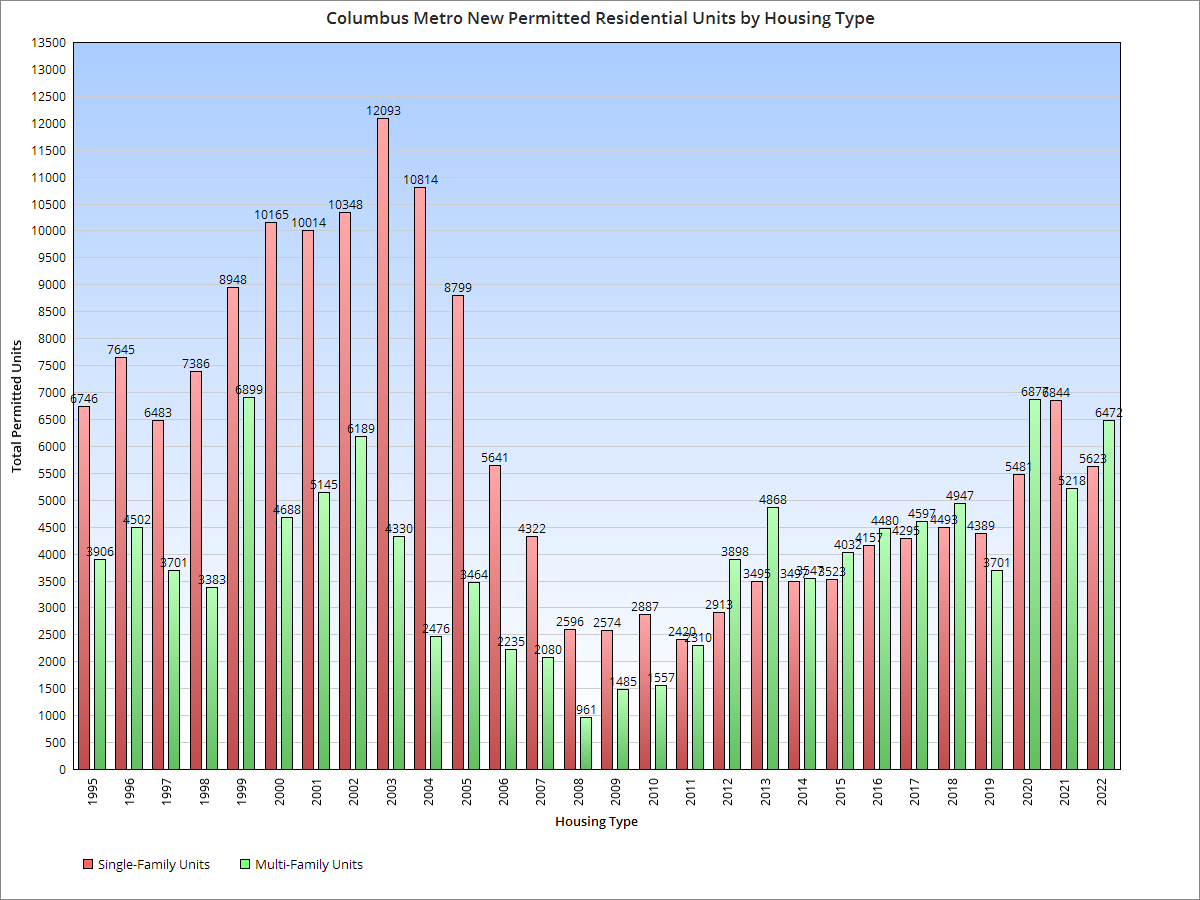
I talked about housing permits before- almost a decade ago now- and thought it would be a good time to update and expand the information. The following graphs detail Columbus area housing permits as they pertain to new residential units being permitted for construction.

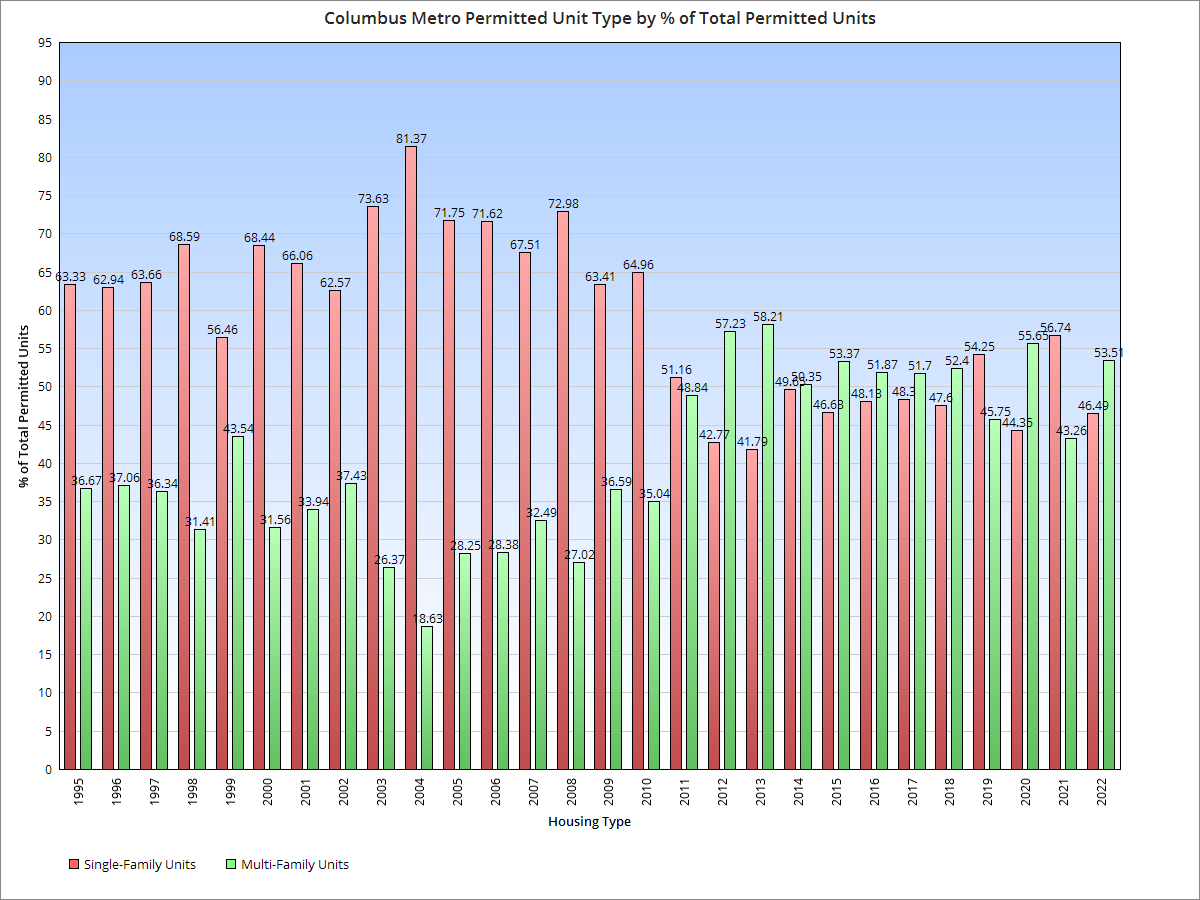
Up first, the below graph shows all permitted units by type for the entire metro area since 1995.
Columbus area housing permits metro area total permits
What most stands out about the graph is how single-family construction dominated until the late 2000s. When the Great Recession hit, it completely changed that dynamic. Since then, multi-family units have mostly been on top in most years, perhaps because more money could be made with them with less financial risk.

Here is the permitted housing type as a % of total permitted units.
Columbus area housing permits % of total units
Between 1995-2010 the average breakdown was 67.46% Single-Family and 32.54% Multi-Family. Since 2010, the breakdown has been 48.16% Single-Family and 51.84% Multi-Family, representing a full 38.6-point margin change towards Multi-Family.

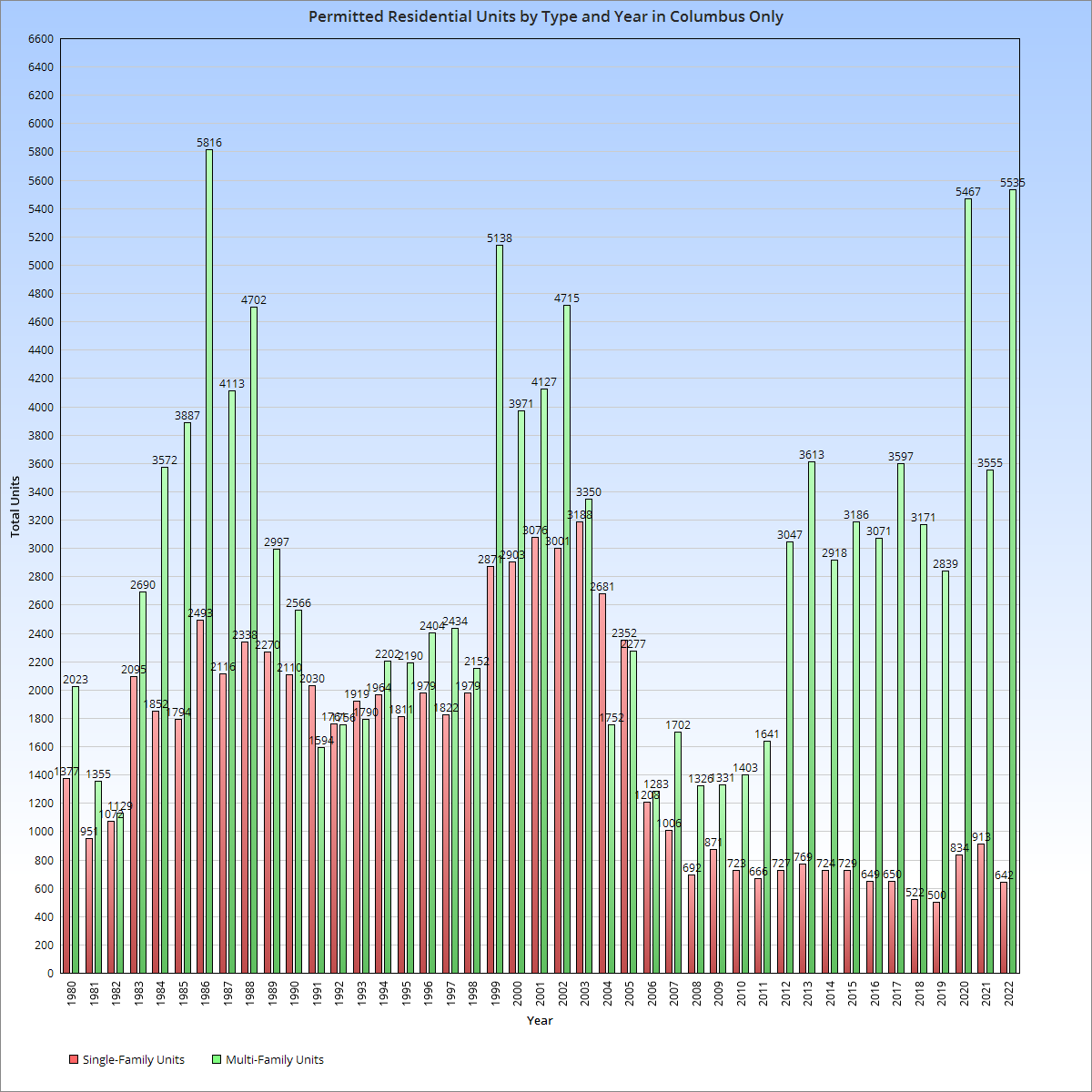
But what about what is actually getting permitted within just the city of Columbus, rather than the entire metro? City-exclusive data is available going back to 1980.
Columbus area housing permits Columbus city permits
The city experienced the same shift as the overall metro, but much more drastically.

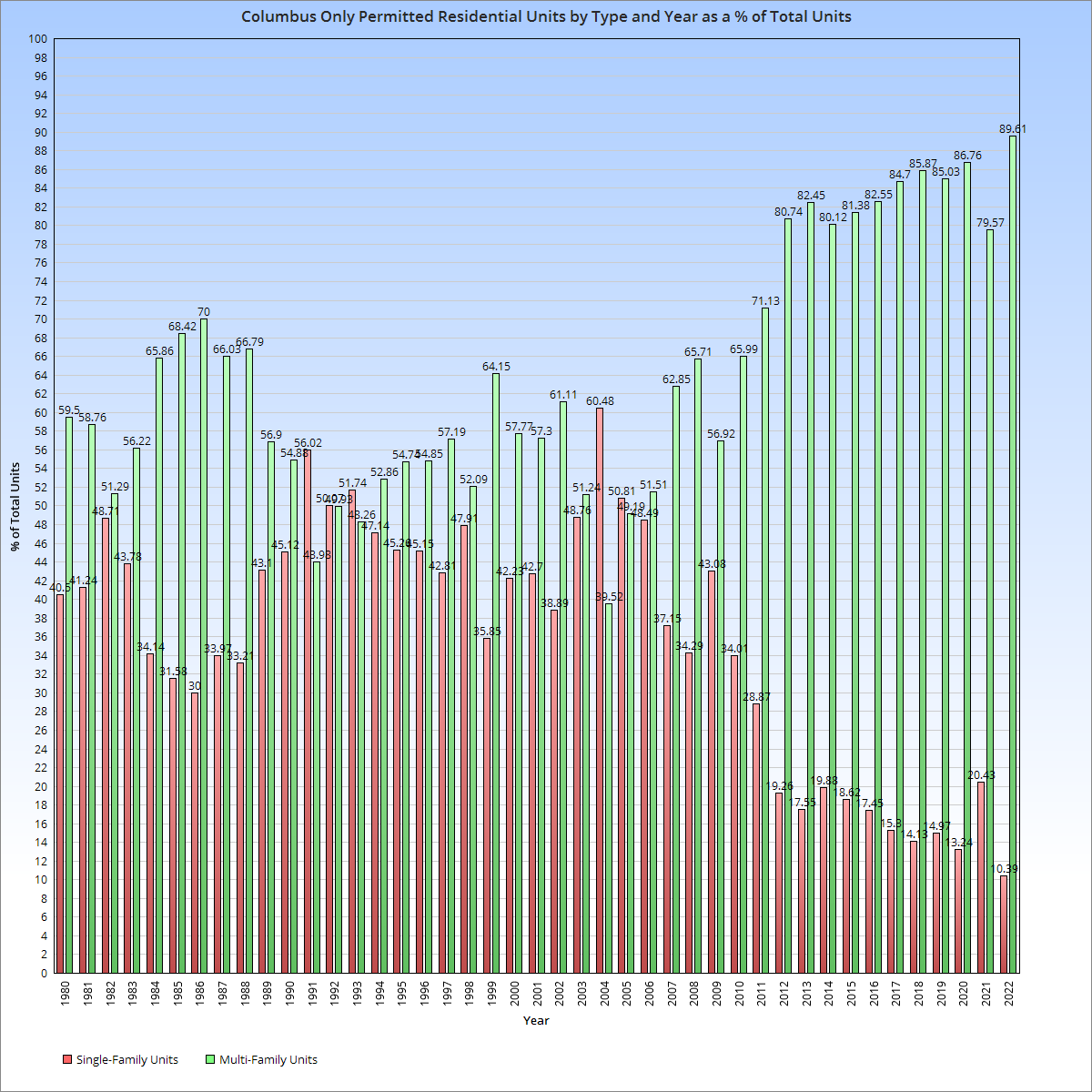
The % of total units by type for the city shows that single-family housing has been steadily becoming a smaller part of new construction permits since around 2003.
Columbus area housing permits Columbus % of total units

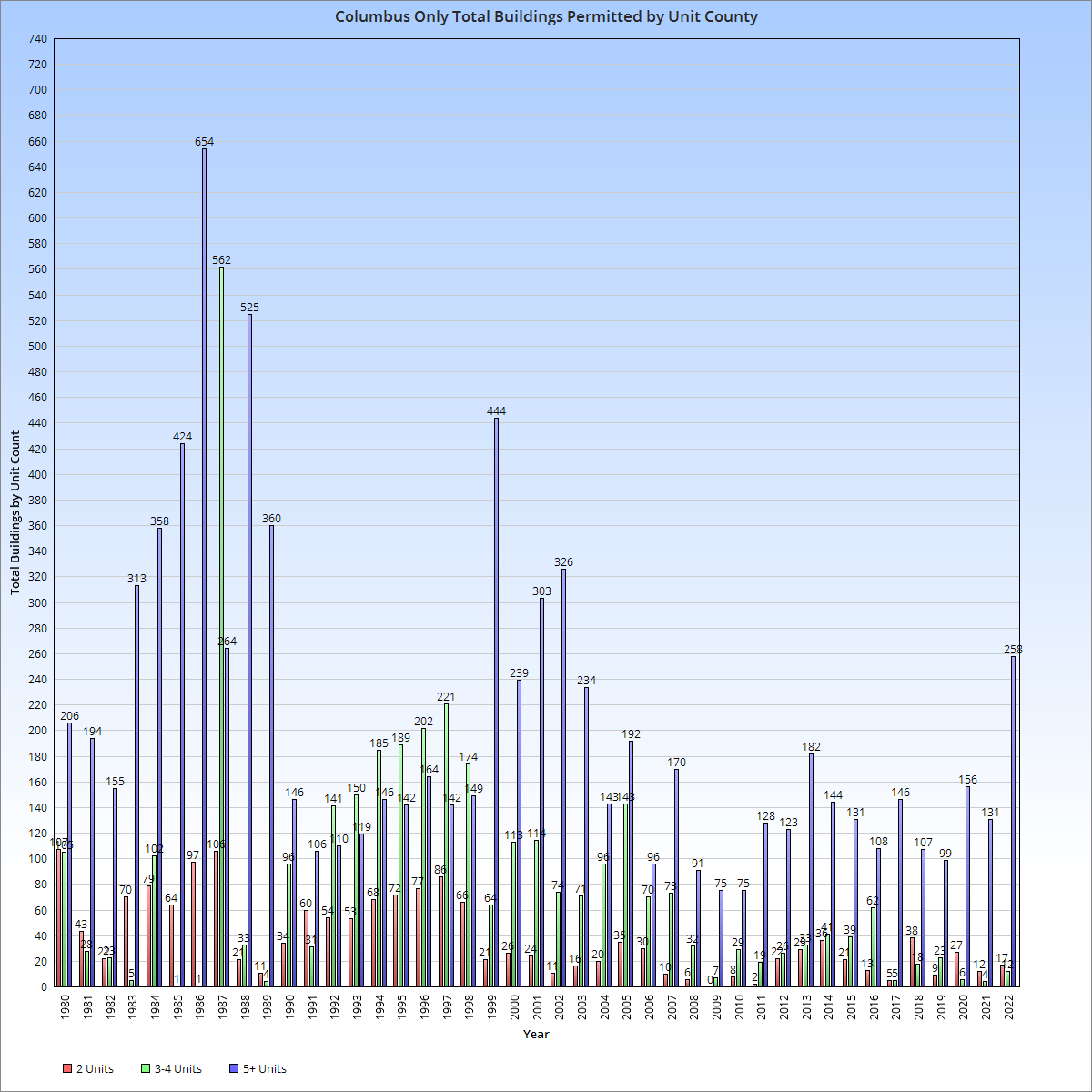
Finally, let’s break down multi-family permits by total number of buildings per unit count for the city only.
Columbus area housing permits Columbus multi-family buildings
Except for during the 1990s, 5+-unit buildings have been dominant, but it seems that fewer overall buildings are being built despite total units being high, suggesting that project size has increased over the years.

Cool Link- Issue 1 Results in Franklin County

Issue 1 Results

Issue 1 was a contentious, controversial proposal to make it harder for Ohioans to make changes to the state constitution. After a short campaign season, it would go on to defeat by just over 14 points- 57.01% to 42.99%. I provided a state county map with the results on the new Special Issues page. But what were the Issue 1 results in Franklin County and its precincts, specifically?

Today’s Cool Link provides the answer with a precinct map of the county. The map shows the results of Issue 1 for every single precinct, ward or city in Franklin County.

Based on the map, here were the overall margins for all the places in the county. Negative numbers are No wins, and positive numbers are Yes wins.
1. Bexley: -74.35
2. Grandview Heights: -71.19
3. Riverlea: -70.04
4. Marble Cliff: -69.02
5. Urbancrest: -64.16
6. Minerva Park: -63.1
7. Worthington: -61.94
8. Columbus: -61.8
9. Clinton Township: -58.32
10. Upper Arlington: -51.55
11. Sharon Township: -50.76
12. Mifflin Township: -46.54
13. Perry Township: -45.32
14. Whitehall: -43.97
15. Gahanna: -42.54
16. New Albany: -42.43
17. Hilliard: -41.09
18. Blendon Township: -39.79
19. Truro Township: -37.93
20. Reynoldsburg: -36.32
21. Jefferson Township: -36.29
22. Westerville: -36.0
23. Dublin: -35.71
24. Norwich Township: -27.9
25. Valleyview: -26.32
26. Canal Winchester: -18.14
27. Madison Township: -17.75
28. Groveport: -16.1
29. Obetz: -14.03
30. Grove City: -13.66
31. Prairie Township: -11.44
32. Plain Township: -9.12
33. Washington Township: -7.5
34. Franklin Township: -6.7
35. Brown Township: -2.58
36. Pleasant Township: +9.2
37. Jackson Township: +13.71
38. Hamilton Township: +15.04
As we can see, almost no part of the county voted Yes except for a few rural townships on the far south side. Not a single suburb voted yes, including in more conservative suburbs like Grove City and Canal Winchester. This suggests there was a lot of bipartisan opposition within the county.


Cool Link Zoning Change Focus Map

Zoning Change Focus Map

Columbus city officials have been working on updating zoning codes for more than a year. In many cases, the codes haven’t been updated since the 1960s or earlier, when priorities were significantly different than they are now. Developers wanting to build more density in neighborhoods and even along high-traffic corridors are often forced to go through lengthy and expensive variance requests. This raises costs for projects- and ultimately rents- and prevents the necessary density to address the long-standing housing shortage. The zoning change code map link below shows the initial areas that could see updates.

The focus areas of the update- at least in the first phase, are detailed on the following map:
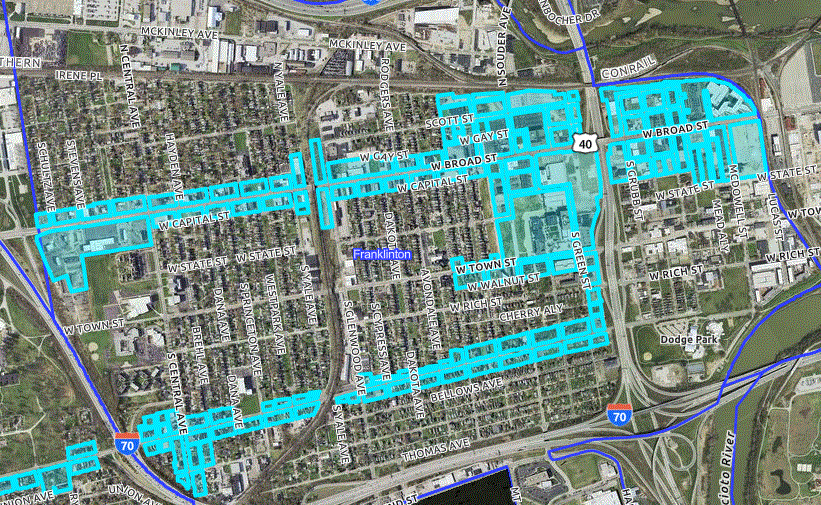
Zoning Code Change Focus Areas

The first phase largely looks at the city’s main corridors. Later phases will look at updates in all neighborhoods. Although no specific changes have been confirmed as of yet, it’s possible that the city may do away with single-family exclusionary zoning. What this means is that, outside of historic areas, neighborhoods won’t be limited to single-family housing restrictions. Higher density projects, including doubles and multi-family projects, would be allowed in places where they are not essentially off-limits. Other changes may include reducing or eliminating parking minimums and significantly raising height restrictions.


Redeveloping Westland Mall


Years ago- originally in 2013 and later reposted in 2016- I made a rather crude map of how I thought the Westland Mall site should be redeveloped.. It seems that the mall may finally be torn down soon after a long period of deterioration, so I figured it was time to revisit this map once more, but this time update it in detail and give a much clearer sense of how redeveloping Westland Mall would drastically change the entire West Side.

One of the problems with the original map was that it really didn’t take into account the massive size of the entire site and how many decent-sized buildings could truly fit within it. While on the old map I used single, general boxes to convey multiple buildings, this time I actually laid out nearly 50 of them. These mixed-use buildings are all a minimum of 4 stories and contain residential, office, hotel and retail/restaurant space.
Each of these buildings could hold 100 or more residential units, so there could easily be several thousand new residents in this neighborhood.
3 parking garages of various sizes are also included, with enough combined space for thousands of parking spaces. The garages would mostly be covered by new walk-up condo or apartment units. A new park avenue street grid connects these garages and all other buildings, with a central roundabout plaza flanked by retail and restaurant locations. Between the streets, a series of pedestrian-only alleyways provide convenient places for outdoor patio seating for any restaurants and retail locations.
One of the biggest changes on the new map is that the park space has become significantly larger, almost doubling in size to more than 18 acres. This would be a significant new park for the West Side, something this part of the city doesn’t have much of. The closest park is also fairly new- Wilson Road Park- which opened in 2017, but its out-of-the-way location makes it somewhat underused. The new Westland park would be lined with retail and restaurant space overlooking it, and a new outdoor market would sit on the northern end- perhaps another extension of North Market similar to what Bridge Park received?
There are also new connections to the park and overall development. Multi-use path connections could be built on the eastern end along the old Shopper’s Lane, a western connection that travels under or over I-270 to the large residential area south of Lincoln Village, and a southern path would connect directly to the Camp Chase Trail. The old Lincoln Park West apartment complex would also have adjacent access.
A rapid-transit station could go on West Broad Street in front of the entire complex as part of the LinkUS plan.
Finally, another big difference between this and the old map is that I tried to be a bit less Sim City about it, meaning that I largely stuck with the existing Westland site and didn’t go beyond it. However, the light yellow areas are all potential future redevelopment locations. These areas are mostly low-density retail strip centers or big box stores with large parking lots. Over time, these areas could be redeveloped to create an enormous, 160-acre redevelopment of the Westland area.
For comparison, Dublin’s Bridge Park is only about 40 acres and Jeffrey Park in Italian Village is about 42 acres, with both developments being good examples of what could be done on the Westland site. In fact, Easton is the only comparable area. The potential is incredible and would finally give West Siders the destination and transformative development they’ve been asking for.

To date, there have been no solid plans released about the future of the Westland site by its owners. However, given that they’ve already sold off a small part of the site on Broad Street for a gas station, the chances that they have any significant, urban vision for it seem to be very slim. In reality, I would expect a suburban-style apartment development with fast-food outlets and another strip retail center, adding to the car-dominated stroad hellscape that already exists on West Broad Street now. The only way to avoid that outcome is for residents to demand better.