June 2013 Jobs Data


June 2013 jobs data Columbus, Ohio

These latest June 2013 jobs data numbers are from the Bureau of Labor Statistics

Columbus City
Unemployment Rate: 6.4%
Unemployment Rate Change since June 2012: -0.1
Unemployment Rate Change since January 2013: -0.4
Civilian Labor Force: 438,100
Civilian Labor Force Change since June 2012: +5,000
Civilian Labor Force Change since January 2013: +11,700
Employment: 409,900
Employment Change since June 2012: +5,100
Employment Change since January 2013: +12,600
Unemployment: 28,200
Unemployment Change since June 2012: -100
Unemployment Change since January 2013: -900

Franklin County
Unemployment Rate: 6.4%
Unemployment Rate Change since June 2012: -0.1
Unemployment Rate Change since January 2013: -0.4
Civilian Labor Force: 640,600
Civilian Labor Force Change since June 2012: +7,400
Civilian Labor Force Change since January 2013: +16,900
Employment: 599,600
Employment Change since June 2012: +7,500
Employment Change since January 2013: +18,600
Unemployment: 41,100
Unemployment Change since June 2012: +0
Unemployment Change since January 2013: -1,500

Columbus Metro Area
Unemployment Rate: 6.4%
Unemployment Rate Change since June 2012: +0
Unemployment Rate Change since January 2013: -0.6
Civilian Labor Force: 992,617
Civilian Labor Force Change since June 2012: +12,256
Civilian Labor Force Change since January 2013: +24,712
Employment: 929,158
Employment Change since June 2012: +11,636
Employment Change since January 2013: +28,702
Unemployment: 63,459
Unemployment Change since June 2012: +620
Unemployment Change since January 2013: -3,990

Ohio Overall
Unemployment Rate: 7.2%
Unemployment Rate Change since June 2012: -0.1
Unemployment Rate Change since January 2013 : +0.2
Civilian Labor Force: 5,756,192
Civilian Labor Force Change since June 2012: +9,844
Civilian Labor Force Change since January 2013: +15,900
Employment: 5,343,335
Employment Change since June 2012: +15,079
Employment Change since January 2013: +2,483
Unemployment: 412,857
Unemployment Change since June 2012: -5,235
Unemployment Change since January 2013: +13,417

Metro Non-Farm Jobs
Total: 972,400
Change from June 2012: +15,200
Change from January 2013: +28,800

By Industry
Mining/Logging/Construction Total: 31,900
Change from June 2012: +1,000
Change from January 2013: +5,000

Manufacturing Total: 67,800
Change from June 2012: +1,400
Change from January 2013: +2,800

Trade/Transportation/Utilities Total: 181,600
Change from June 2012: -700
Change from January 2013: -1,600

Information Total: 16,400
Change from June 2012: -400
Change from January 2013: -100

Financial Activities Total: 71,800
Change from June 2012: +0
Change from January 2013: +100

Professional and Business Services Total: 161,900
Change from June 2012: +3,400
Change from January 2013: +6,300

Education and Health Services Total: 142,800
Change from June 2012: +6,600
Change from January 2013: +3,300

Leisure and Hospitality Total: 102,100
Change from June 2012: +4,700
Change from January 2013: +13,600

Other Services Total: 36,600
Change from June 2012: -500
Change from January 2013: +400

Government Total: 159,500
Change from June 2012: -300
Change from January 2013: -1,000

Overall, June was a pretty good month for Columbus and the state. Unemployment rose, but mostly because the labor force had strong growth, which is a sign of more people entering a recovering job market. Most industries saw job growth both year-over-year and year-to-date.


May 2013 Jobs Data


May 2013 jobs data

The latest May 2013 jobs data is now out from the Bureau of Labor Statistics.

Columbus City
Unemployment Rate: 6.0%
Unemployment Rate Change since May 2012: +0
Unemployment Rate Change since January 2013: -0.8
Civilian Labor Force: 431,500
Civilian Labor Force Change since May 2012: +3,600
Civilian Labor Force Change since January 2013: +5,100
Employment: 405,500
Employment Change since May 2012: +3,400
Employment Change since January 2013: +8,200
Unemployment: 26,000
Unemployment Change since May 2012: +100
Unemployment Change since January 2013: -3,100

Franklin County
Unemployment Rate: 6.0%
Unemployment Rate Change since May 2012: +0
Unemployment Rate Change since January 2013: -0.8
Civilian Labor Force: 631,000
Civilian Labor Force Change since May 2012: +5,300
Civilian Labor Force Change since January 2013: +7,300
Employment: 593,100
Employment Change since May 2012: +5,100
Employment Change since January 2013: +12,100
Unemployment: 37,900
Unemployment Change since May 2012: +200
Unemployment Change since January 2013: -4,700

Columbus Metro Area
Unemployment Rate: 6.0%
Unemployment Rate Change since May 2012: +0.1
Unemployment Rate Change since January 2013: -1.0
Civilian Labor Force: 977,400
Civilian Labor Force Change since May 2012: +8,600
Civilian Labor Force Change since January 2013: +9,500
Employment: 919,100
Employment Change since May 2012: +7,800
Employment Change since January 2013: +18,600
Unemployment: 58,300
Unemployment Change since May 2012: +800
Unemployment Change since January 2013: -9,100

Ohio Overall
Unemployment Rate: 7.0%
Unemployment Rate Change since May 2012: -0.3
Unemployment Rate Change since January 2013 : +0
Civilian Labor Force: 5,750,000
Civilian Labor Force Change since May 2012: -5,000
Civilian Labor Force Change since January 2013: +10,000
Employment: 5,345,000
Employment Change since May 2012: +9,000
Employment Change since January 2013: +4,000
Unemployment: 405,000
Unemployment Change since May 2012: -15,000
Unemployment Change since January 2013: +6,000

Metro Non-Farm Jobs
Total: 966,900
Change from May 2012: +12,200
Change from January 2013: +23,300

By Industry
Mining/Logging/Construction Total: 30,600
Change from May 2012: +500
Change from January 2013: +3,700

Manufacturing Total: 66,600
Change from May 2012: +600
Change from January 2013: +1,600

Trade/Transportation/Utilities Total: 180,700
Change from May 2012: -1,200
Change from January 2013: -2,500

Information Total: 16,400
Change from May 2012: -200
Change from January 2013: -100

Financial Activities Total: 71,300
Change from May 2012: -200
Change from January 2013: -400

Professional and Business Services Total: 161,000
Change from May 2012: +1,100
Change from January 2013: +5,400

Education and Health Services Total: 142,600
Change from May 2012: +4,500
Change from January 2013: +3,100

Leisure and Hospitality Total: 99,700
Change from May 2012: +4,900
Change from January 2013: +11,200

Other Services Total: 35,800
Change from May 2012: -600
Change from January 2013: -400

Government Total: 162,200
Change from May 2012: -200
Change from January 2013: +1,700


Cool Link Columbus Job Density


The Brookings Institute recently released a study on job density, or basically where jobs are most heavily concentrated within metro areas.

Here is how Columbus job density compared to other Ohio metros.

Total Jobs Located within 3 Miles of the Central Business District (Downtown) in 2010, Most to Least
1. Columbus: 157,193
2. Cincinnati: 151,956
3. Cleveland: 127,846
4. Dayton: 75,481
5. Akron: 66,247
6. Toledo: 59,552
7. Youngstown: 54,368

% of Total Metro Jobs Located within 3 Miles of the Central Business District (Downtown) in 2010, Highest to Lowest
1. Youngstown: 27.3%
2. Akron: 24.9%
3. Dayton: 24.5%
4. Toledo: 23.8%
5. Columbus: 21.2%
6. Cincinnati: 17.7%
7. Cleveland: 15.4%

So Columbus has the highest total number of jobs within 3 miles of the CBD, but is in the bottom half for % of total metro jobs in that area.

Jobs Change from 2000-2010 for all Jobs Located within 3 Miles of the CBD, Best to Worst
1. Toledo: -15,412
2. Akron: -16,700
3. Youngstown: -17,307
4. Columbus: -30,338
5. Cincinnati: -31,717
6. Dayton: -32,420
7. Cleveland: -54,134

% Jobs Change from 2000-2010 for all Jobs Located within 3 Miles of the CBD, Best to Worst
1. Cincinnati: -1.9%
2. Cleveland: -2.1%
3. Akron: -2.5%
4. Columbus: -2.5%
5. Toledo: -2.5%
6. Youngstown: -2.9%
7. Dayton: -3.9%

At first glance, this may seem like horrible news, and while it’s not necessarily good, almost all metros lost jobs in this area, even high growth cities like Charlotte, Atlanta, Dallas, etc. This has a lot to do with the suburbanization of the nation over the last several decades, including during most of the 2000s. Jobs left the central core to spread out into the suburban areas people were moving to.

Total Jobs Located Between 3 and 10 Miles from the CBD in 2010, Highest to Lowest
1. Columbus: 321,508
2. Cleveland: 317,128
3. Cincinnati: 252,789
4. Dayton: 164,453
5. Toledo: 137,339
6. Akron: 117,986
7. Youngstown: 89,711

% of Total Metro Jobs Located Between 3 and 10 Miles from the CBD in 2010, Highest to Lowest
1. Toledo: 54.8%
2. Dayton: 53.4%
3. Youngstown: 45.1%
4. Akron: 44.3%
5. Columbus: 43.4%
6. Cleveland: 38.1%
7. Cincinnati: 29.5%

% Jobs Change 2000-2010 for all Jobs Located Between 3 and 10 Miles from the CBD, Best to Worst
1. Dayton: +1.5%
2. Youngstown: +1.1%
3. Akron: +0.7%
4. Toledo: -0.1%
5. Cincinnati: -1.4%
6. Cleveland: -1.4%
7. Columbus: -2.4%

The positive % changes even while the area lost jobs has to do with how many the share of total metro jobs. While the area may have lost jobs, its share of the entire metro grew as other areas shrank faster.

Finally, the far suburbs…

Total Jobs Located between 10 and 35 Miles from the CBD in 2010, Highest to Lowest
1. Cincinnati: 452,895
2. Cleveland: 386,727
3. Columbus: 262,003
4. Akron: 82,260
5. Dayton: 67,838
6. Youngstown: 54,709
7. Toledo: 53,736

% of Total Metro Jobs Located Between 10 and 35 Miles from the CBD in 2010, Highest to Lowest
1. Cincinnati: 52.8%
2. Cleveland: 46.5%
3. Columbus: 35.4%
4. Akron: 30.9%
5. Youngstown: 27.5%
6. Dayton: 22.0%
7. Toledo: 21.4%

% Jobs Change 2000-2010 for all Jobs Located Between 10 and 35 Miles from the CBD, Best to Worst
1. Columbus: +5.0%
2. Cleveland: +3.5%
3. Cincinnati: +3.3%
4. Dayton: +2.5%
5. Toledo: +2.5%
6. Akron: +1.7%
7. Youngstown: +1.7%

So what do all these numbers show? Well, the larger the metro, the more spread out it seems to be as far as where jobs are located. Smaller metros like Akron and Dayton are more compact. Columbus is the most compact of the 3-Cs and has the most total jobs, by far, within 10 miles of its core of any metro, but not by %. None of the metros saw real jobs growth within 10 miles of their cores, which is to be expected. However, in recent years, urban development has exploded, and companies seem to be shifting jobs closer to the center. It remains to be seen if these are long term trends or just a blip.


2012 Jobs Data


2012 jobs data

Columbus City
Civilian Labor Force January 2012: 422,500
Civilian Labor Force December 2012: 426,600
Yearly Change: +4,100
Employment January 2012: 392,700
Employment December 2012: 403,800
Yearly Change: +11,100
Unemployment January 2012: 29,800
Unemployment December 2012: 22,700
Yearly Change: -7,100
Unemployment Rate January 2012: 7.1%
Unemployment Rate December 2012: 5.3%
Yearly Change: -1.8%

Franklin County
Civilian Labor Force January 2012: 617,700
Civilian Labor Force December 2012: 623,900
Yearly Change: +6,200
Employment January 2012: 574,400
Employment December 2012: 590,600
Yearly Change: +16,200
Unemployment January 2012: 43,300
Unemployment December 2012: 33,300
Yearly Change: -10,000
Unemployment Rate January 2012: 7.0%
Unemployment Rate December 2012: 5.3%
Yearly Change: -1.7%

City and County numbers are rounded.

Columbus Metro Area
Civilian Labor Force January 2012: 949,737
Civilian Labor Force December 2012: 958,689
Yearly Change: +8,952
Employment January 2012: 880,680
Employment December 2012: 906,886
Yearly Change: +26,206
Unemployment January 2012: 69,057
Unemployment December 2012: 51,803
Yearly Change: -17,254
Unemployment Rate January 2012: 7.3%
Unemployment Rate December 2012: 5.4%
Yearly Change: -1.9%

Metro Area Continued
Non-Farm Jobs January 2012: 927,300
Non-Farm Jobs December 2012: 962,300
Yearly Change: +35,000

Metro Yearly Jobs Changes by Industry
Mining/Logging/Construction: +2,400
Manufacturing: +1,300
Trade/Transportation/Utilities: +10,700
Information: -100
Financial Activities: +1,800
Professional and Business Services: +4,400
Education and Health Services: +5,700
Leisure and Hospitality: +6,100
Other Services: +700
Government: +2,000

Ohio Overall
Civilian Labor Force January 2012: 5,780,410
Civilian Labor Force December 2012: 5,728,748
Yearly Change: -51,662
Employment January 2012: 5,339,657
Employment December 2012: 5,344,151
Yearly Change: +4,494
Employment January 2012: 440,753
Employment December 2012: 384,597
Yearly Change: -56,156
Unemployment Rate January 2012: 7.6%
Unemployment Rate December 2012: 6.7%
Yearly Change: -0.9%

Local employment data back to 1990 is at Columbus MSA Economy


Columbus GDP 2001-2011


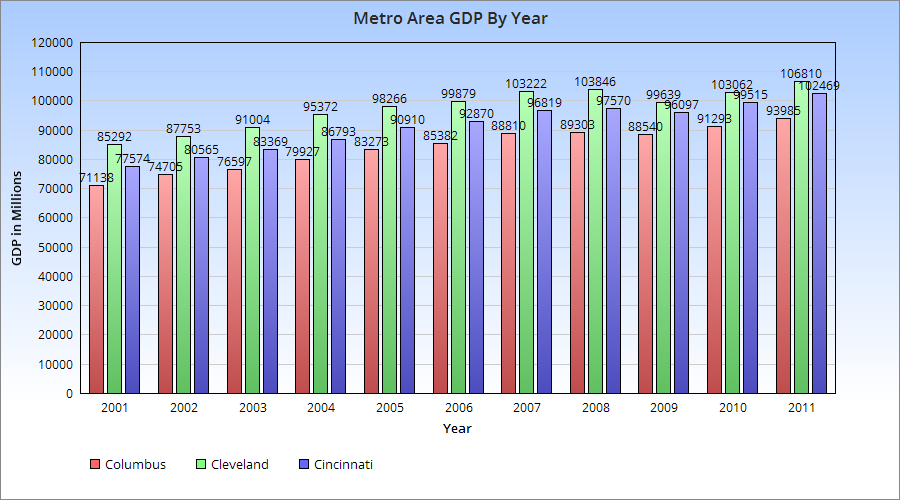
Recently the US Bureau of Economic Analysis released GDP numbers for metro areas for 2011. Below is a chart for Ohio’s 3-Cs of GDP from 2001 to 2011.
Columbus GDP 2001-2011 Columbus, Ohio

All the metros saw GDP growth during this period, and all saw dips during the recession before growing again the past few years.

Total Growth (in Millions) 2001-2011
Cincinnati: $24,795
Columbus: $22,850
Cleveland: $21,518

GDP % Growth 2001-2011
Columbus: 32.1%
Cincinnati: 31.9%
Cleveland: 25.2%

So this shows that the Columbus metro has had the fastest growth the past 10 years in its GDP, albeit only a bit faster than Cincinnati.

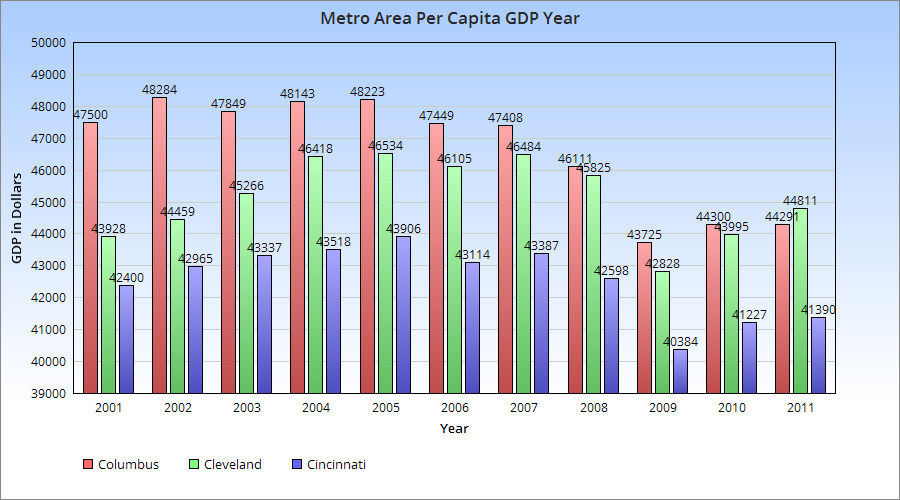
The graph above shows the metro GDP per capita. Columbus was clearly ahead the first half of the last decade, but has fallen since. There are two reasons for this: Continuously growing population and the recession. A growing population and stagnant GDP during the recession meant that the GDP was diluted between more people. Neither of the other two faced the strong population growth during the recession. I expect the trends will reverse again over the next few years, however.